CHAPTER 1 — The Quiet of Wealth
The Granados estate in Valle de Bravo didn’t feel like a home anymore.
It felt like a museum where nobody was allowed to breathe.
Marble floors so polished they reflected the chandeliers like still water. Glass walls that looked out over pine-covered hills and a lake that glittered like money. A long driveway lined with cypress trees, each one trimmed with the kind of precision that screamed control.
Leonardo Granados had built an empire on control.
Telecommunications. Infrastructure. Contracts that decided whether whole regions would have signal or silence. A man who could end arguments with a look and end careers with a phone call.
But inside his own house, he had finally met something he couldn’t negotiate with.
A disease that did not care about power.
The doctors had said the words gently, like softening them would change their meaning.
Aggressive leukemia.
Not a “maybe.” Not a “let’s see.”
The best specialists in Mexico City. A team flown in from Houston. Equipment imported so new it still smelled like plastic and promise.
Same verdict. Same timeline.
Two weeks.
That’s what they told him his daughters had left.
Diana. Abigail. Adriana.
Triplets.
Seven years old.
Once, the three of them had treated the mansion like their personal playground—running down hallways in socks, inventing games that turned expensive furniture into pirate ships, shouting their father’s name as if he was a superhero who could fix anything.
Now they were quiet.
Too quiet.
They lay in three beds placed side-by-side in the estate’s private medical wing—an entire hallway sealed off as if sickness could be contained by architecture. Machines hummed softly. The air smelled like antiseptic and fear. A curtain stayed drawn because Leonardo couldn’t stand sunlight touching their pale faces; it made them look more fragile, more temporary.
The staff walked on tiptoe.
The cook stopped making their favorite foods because—what’s the point?
The nurses rotated in and out, each one leaving with the same haunted expression. Even seasoned professionals who had seen real suffering couldn’t take the heaviness of a mansion full of money that couldn’t buy time.
And Leonardo?
Leonardo started doing the unthinkable.
He stopped going in.
At first he told himself it was “discipline.” He said he needed to be sharp, to make decisions, to coordinate specialists, to be the anchor.
But the truth was uglier.
He couldn’t stand the sound of the monitors. The sight of their tiny wrists taped to IV lines. The way their hair was gone, leaving their heads looking too small—like they’d been shrunk by grief.
He loved them so much it felt like drowning.
So he avoided the room that proved he couldn’t save them.
He stayed in his office with its glass desk and its wall of screens. He hid behind spreadsheets, phone calls, negotiations, and the illusion that if he kept moving, he wouldn’t have to feel.
And then Brenda Anzures arrived.
Not in a luxury car. Not with credentials that impressed a billionaire.
She came up from the town in a bus, carrying a small suitcase and a backpack that looked like it had been repaired more than once. She had no entourage, no polished résumé.
Just a calm face and eyes that didn’t blink when people tried to intimidate her.
The head of staff, Mrs. Carter, met her at the entry hall with the tired sympathy of someone who had watched too many hopeful hires quit.
“Honey,” Mrs. Carter said gently, “trained nurses don’t last two days here. The pain is… in the walls.”
Brenda adjusted the strap of her backpack.
“I’m not here to cure their bodies,” she said quietly. “I’m here to remind them they’re alive.”
Mrs. Carter stared, unsure if that was bravery or madness.
From the second-floor landing, Leonardo saw her pass through the foyer. He didn’t pay much attention. He had stopped expecting anything new from people.
Another employee. Another person who would see the medical wing and break.
Later that day, Brenda crossed paths with him in the corridor.
He didn’t even slow down.
“The medical wing is off-limits,” he snapped. “My daughters need silence.”
Brenda stopped.
And then—something nobody in that house ever dared to do—
She looked him straight in the eyes.
“Mr. Granados,” she said evenly, “children who are dying don’t need silence. They need someone who believes they’re still worth saving.”
Leonardo’s steps faltered.
His jaw tightened.
The nerve.
The arrogance.
“What did you just say?” he demanded, voice sharp enough to cut glass.
Brenda didn’t flinch.
“You’re treating them like ghosts,” she said. “Like they’re already gone. And you’re calling it ‘protecting them.’ But it’s not protection. It’s surrender.”
For a moment, Leonardo felt rage—hot, humiliating rage—because some woman from the bus had spoken a truth he’d been avoiding.
He should’ve fired her on the spot.
But he didn’t.
Maybe it was exhaustion. Maybe it was the strange steadiness in her voice. Maybe some exhausted part of him wanted someone else to carry hope because he couldn’t.
He walked past her, forcing his voice to stay cold.
“Do what you want,” he muttered. “Just don’t get in my way.”
Brenda watched him leave.
And whispered, almost to herself, “Then don’t stand in your daughters’ way either.”
CHAPTER 2 — The First Rebellion
Brenda entered the triplets’ room like a person stepping into a storm.
The air was heavy, stale with the kind of quiet that doesn’t feel peaceful—only final.
The curtains were drawn. The light was dim. The machines were the loudest voices in the room.
Three small beds.
Three small faces.
Diana’s eyes were half-open, unfocused. Abigail’s hands twitched slightly, like she was reaching for something in her dreams. Adriana—smallest, frailest—looked like she was sleeping too deeply.
A nurse hovered nearby, ready to stop anyone from “disturbing” them.
Brenda didn’t argue.
She didn’t demand.
She simply took off the latex gloves the nurse offered her.
And the nurse blinked as if she’d seen something illegal.
Brenda approached Diana first, moving slowly so the child wouldn’t startle. She placed her warm palm against Diana’s cheek.
Not medical. Not clinical.
Human.
Diana’s eyelids fluttered, and her gaze found Brenda’s.
“Who… are you?” Diana whispered.
Brenda smiled softly.
“Someone who’s staying,” she said.
The next morning, Leonardo woke up to a sound he thought had been erased from his house forever.
A laugh.
It wasn’t loud.
It wasn’t strong.
But it was real.
Leonardo sat up so fast he nearly knocked over the water on his bedside table. He threw on his robe and walked down the hall like a man chasing a ghost.
The closer he got to the medical wing, the more certain he became that he’d imagined it.
And then he reached the doorway and froze.
The curtains were open.
Sunlight poured into the room, bright and shameless, lighting up the sterile space like it was allowed to be alive again.
Brenda stood near the beds holding a hairbrush like it was a microphone, singing a popular song—terribly off-key, completely fearless.
Diana was smiling.
Abigail was clapping—weak, but clapping.
And Adriana… Adriana was watching, eyes more awake than they had been in days.
Leonardo’s voice came out rough.
“What are you doing?”
Brenda didn’t stop singing. She just grinned.
“Breakfast with music,” she said. “The girls requested joy.”
“They need rest,” Leonardo snapped automatically. “Rest is critical.”
Brenda set the brush down gently.
“They’ve been resting for months,” she replied. “Maybe it’s time they start living.”
Leonardo had no immediate comeback.
Because the room—his room, his rules, his million-dollar equipment—had finally lost its grip on the only thing that mattered.
The girls weren’t better.
But they were here.
And he couldn’t deny what he’d heard:
laughter.
CHAPTER 3 — The Birthday She Refused to Cancel
By day three, the mansion had changed in ways Leonardo couldn’t explain.
Not medically.
Emotionally.
Brenda put wildflowers in vases. She let sunlight into places Leonardo had kept dark. She talked to the girls like the future existed. She asked them questions about their favorite colors, their favorite stories, what kind of cake they’d want if they could choose anything.
Leonardo tried to stay angry.
But anger required energy, and grief had taken his.
One morning, he found Brenda in the kitchen scribbling in a battered notebook.
He leaned in without thinking and saw the list:
Balloons. Streamers. Confetti. Ingredients for a rainbow cake.
He stiffened.
“You’re really going to do this?” he asked, trying to sound like the billionaire again.
Brenda looked up. Calm. Unapologetic.
“Yes,” she said. “They turn seven in ten days. We’re celebrating.”
Leonardo’s throat tightened.
“The doctors said—”
“I know what the doctors said.”
“They might not make it,” he said, his voice turning raw despite him.
Brenda held his gaze.
“And if they do?” she asked.
That question hit him harder than any diagnosis.
Because it forced him to admit something he hadn’t wanted to say out loud:
He’d already planned for their absence.
He’d already started preparing to live in a world without them.
In his head, he had already buried them.
Brenda’s voice softened, but her words stayed sharp.
“There’s a difference between dying quietly,” she said, “and living until the last second.”
Leonardo wanted to argue.
But the truth was: he was terrified.
And fear had been running his house like a fourth invisible child—demanding silence, demanding darkness, demanding surrender.
That afternoon, Leonardo looked out from his office window and saw Brenda wheel the girls into the garden.
They were wrapped in blankets, fragile but upright.
Brenda knelt beside Adriana and pointed out a butterfly dancing near the roses.
Diana and Abigail watched, faces lit by the sun like it was a secret they’d almost forgotten.
Leonardo pressed his hand to the glass.
When was the last time he’d looked at them without thinking about blood counts?
Brenda lifted her head, as if she could feel his stare, and met his eyes through the distance.
She didn’t wave.
She didn’t smile.
She just held the look, as if asking:
Are you going to stay in that office and watch your life happen through a window?
Leonardo’s stomach dropped.
Because suddenly he realized something that scared him more than death:
Brenda wasn’t only fighting for his daughters.
She was fighting for him.
CHAPTER 4 — The Locked Dining Room
On the ninth day, Leonardo woke up to a silence so heavy it made his heart stutter.
He ran to the medical wing, certain something had happened.
The beds were empty.
Panic hit him like a punch.
Then Mrs. Carter intercepted him in the hall, breathless.
“They’re in the dining room, sir,” she said. “With Miss Brenda.”
Leonardo’s blood went cold.
The dining room had been locked for years—ever since Catherine died.
His wife.
The only person who could soften him without breaking him.
After she was gone, Leonardo couldn’t step into that room without hearing echoes of Sunday mornings—pancakes, laughter, the clatter of dishes, the normal life he’d lost.
So he locked it.
He made grief a room and put a key in his pocket.
When he pushed the doors open now, he stopped like he’d walked into a memory.
The long mahogany table was covered in crayons, glitter, paper cutouts, and half-finished invitations.
The triplets sat around the table—tired, pale, but focused.
Brenda was in the center like the sun of a small universe, guiding them with gentle hands.
Diana held up a crooked rainbow drawing.
“Look, Daddy,” she said. “It’s for our party.”
Leonardo’s chest tightened so hard he couldn’t breathe.
Brenda noticed his face.
“We needed space,” she said simply.
Leonardo should’ve been furious.
Instead, he felt something crack inside him—something old and stubborn that had kept him frozen.
Then Diana did something that made the room tilt.
She stood.
Not dramatically. Not like a miracle in a movie.
Just… slowly. Carefully.
One shaky step.
Then another.
She reached him and took his hand.
“Help me,” she whispered.
Leonardo dropped into a chair, throat burning, and for the next hour the most powerful man in Mexico drew clumsy flowers with his daughters.
He listened to them talk about cake colors and silly outfits.
And he realized how much life he’d missed while hiding behind fear.
After Brenda helped the girls back to bed, Leonardo stayed alone in the dining room staring at the drawings.
Brenda returned to pick up crayons.
Leonardo spoke without looking up.
“My wife used to sit here,” he said quietly. “Sunday mornings. Pancakes. The girls drew while we waited.”
His voice broke.
“After she died, I shut the door. And I think… I forgot how to be their father.”
Brenda didn’t pity him.
She didn’t preach.
She just said, softly, “It’s not too late.”
“They’re dying,” Leonardo whispered. His eyes were wet now, and he didn’t try to stop it. “The doctors—”
“The doctors are trained to measure the body,” Brenda cut in, firmer now. “But your daughters are fighting with everything they have. And what they need most is you beside them.”
Leonardo covered his face and cried for the first time in twenty years.
Brenda didn’t give him empty comfort.
She put a hand over his—steady, warm—and stayed.
CHAPTER 5 — The Party That Shouldn’t Exist
The morning of the girls’ seventh birthday arrived wrapped in mist.
Valle de Bravo looked like a dream you couldn’t quite wake from—fog rolling over the hills, the lake hidden behind gray curtains of air.
Leonardo walked downstairs with a heart full of dread.
Ten days ago, the doctors gave him two weeks.
Today was day ten.
Time was slipping.
He reached the dining room door and stopped.
It was… bright.
Balloons floated near the ceiling. Streamers draped the walls. The cold elegance of the mansion was replaced by color—cheap, cheerful, glorious color.
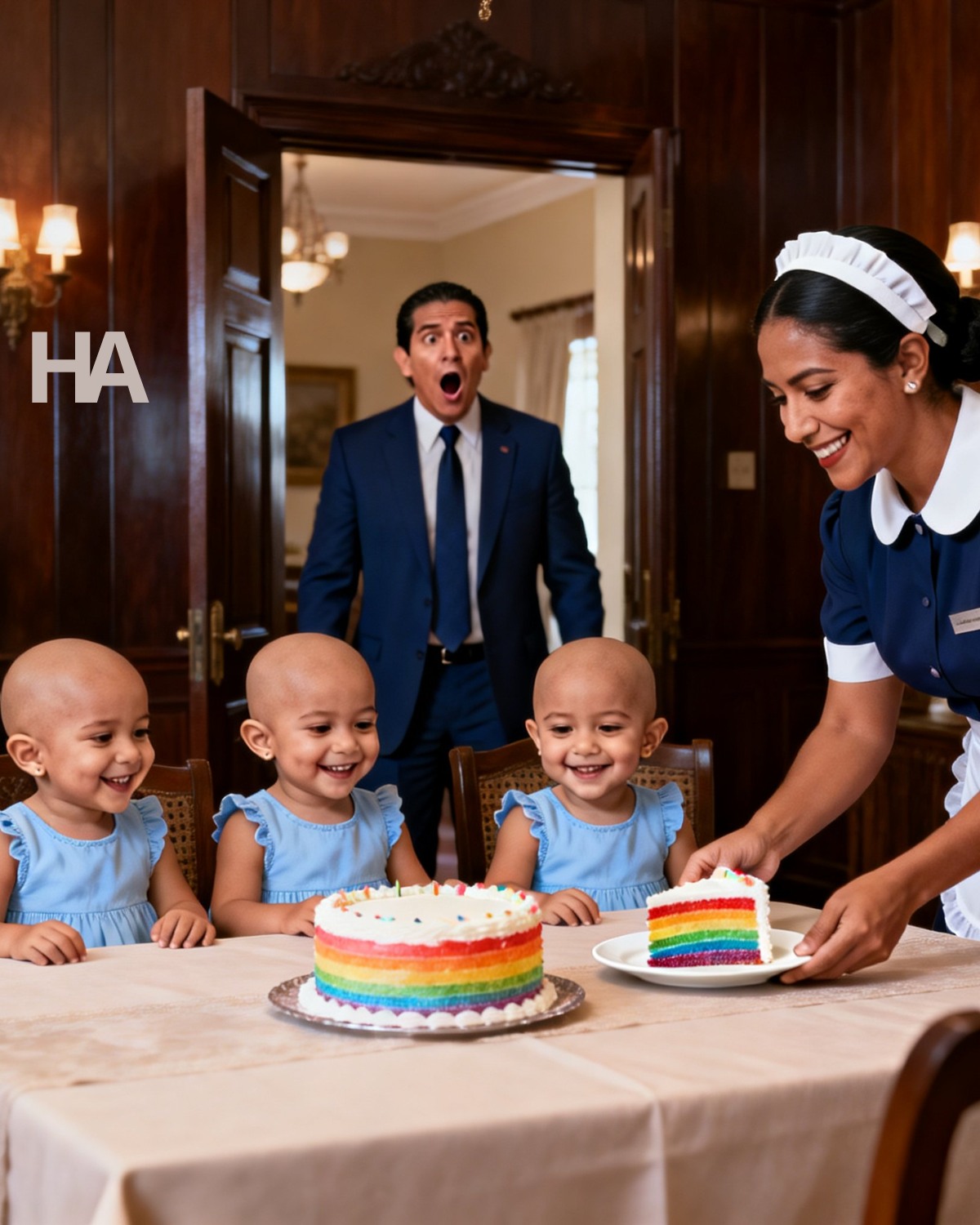
A rainbow cake sat in the center of the table like a dare.
Brenda turned toward him, flour on her cheek, a simple dress, hair tied back.
“It’s their birthday,” she said. “That’s all that matters.”
Then the girls arrived.
Diana in blue. Abigail in yellow. Adriana in pink.
They were thin. Fragile. But their eyes… their eyes were lit like candles.
Mrs. Carter carried the cake forward with seven small flames.
Brenda leaned close and whispered, “Make a wish.”
Diana looked at her sisters, then up at her father.
“Daddy,” she asked, voice tiny, “will you help us blow them out?”
Leonardo knelt down. His hands trembled.
The four of them blew together.
The candles went out.
And Leonardo’s control—his iron—collapsed.
“I’m sorry,” he choked. “I was so scared of losing you that I forgot to love you while you were still here.”
Diana wrapped her arms around his neck.
“It’s okay, Daddy,” she whispered.
Adriana pressed her cheek against him.
“We’re still here,” she murmured.
Brenda stood in the corner, tears sliding down her face, because she understood something Leonardo was only beginning to learn:
Sometimes the first miracle isn’t the body getting better.
Sometimes the first miracle is a father coming back.
CHAPTER 6 — The Night the House Went Dark
Two nights after the birthday, a violent storm hit.
Wind slammed into the glass walls like fists. Trees bowed and groaned. The sky flashed bright, then swallowed itself again.
The power went out.
The generator kicked in—but the mansion still felt isolated, like a ship cut loose in black water.
Leonardo moved through the hall toward the medical wing, heart hammering.
He found Brenda in a chair between the girls’ beds, a small battery lamp glowing beside her. She wasn’t panicking.
She was just there.
“The storm’s getting worse,” Leonardo whispered.
Brenda nodded once.
Then Adriana stirred—restless, uncomfortable, frightened.
Leonardo’s fear spiked.
Brenda moved immediately, calm but urgent, checking her, soothing her, calling Leonardo closer.
The mansion felt like it was holding its breath.
Diana and Abigail woke, frightened by the storm and by their sister’s sudden distress.
Leonardo’s hands shook as he tried to call for help—no signal. No landline. The road to town would be dangerous in this weather.
His mind spiraled into panic.
And then Brenda did something that changed the whole night:
She took Leonardo’s face in both hands and forced him to focus.
“Listen to me,” she said. “You’re here. Stay here. Be her father. Don’t disappear.”
Leonardo swallowed hard.
He nodded.
He stayed.
The storm raged outside.
Inside, Brenda and Leonardo held the room together with nothing but steadiness and love.
Minutes later, Adriana’s breathing eased.
Not because of magic.
Not because of money.
But because she wasn’t alone, and her fear had somewhere safe to land.
Leonardo sat back, shaking with relief.
In the faint light, Brenda’s face looked older for a second—like she carried something heavy beneath her calm.
Leonardo stared at her, voice low.
“Who are you really?” he asked.
Brenda looked down at her hands.
“A mother,” she said softly. “Just… a mother.”
CHAPTER 7 — Naomi’s Name
The next morning, the storm cleared like it had never been.
Sunlight returned, bright and clean.
The girls slept, exhausted but calm.
Leonardo found Brenda in the kitchen, staring out the window like she was miles away.
He couldn’t stop thinking about the way she’d steadied him. The way she’d spoken with the authority of someone who had survived the kind of pain that rewires you.
Last night, in the tension and panic, he’d heard her whisper a name when she thought nobody was listening.
A name that didn’t belong to his daughters.
“Brenda,” he said gently. “You said ‘Naomi.’ Who is Naomi?”
Brenda’s shoulders tightened.
For a long moment, she didn’t answer.
Then she turned, and the calm on her face finally cracked.
“My daughter,” she whispered.
Leonardo’s chest tightened.
Brenda’s voice trembled, but she forced the words out like they were a confession she’d carried too long.
“She was six,” Brenda said. “Leukemia.”
Leonardo’s breath caught.
Brenda looked down, blinking hard.
“I did everything,” she continued. “Hospitals. Treatments. Prayers. I held her the way you held Adriana. I begged. I tried to trade places with her in my mind a thousand times.”
She swallowed, jaw clenched.
“But she didn’t come back.”
The kitchen was silent except for the distant sound of the staff moving quietly around them.
Brenda pressed her palm to her chest as if she could hold herself together.
“After Naomi,” she said, voice low, “I made a promise. I told God—if I couldn’t save my daughter, then let me help someone else’s child feel loved while they fight. Let me be the person I needed when I was alone in that hospital room.”
Leonardo stared at her like he was seeing her for the first time.
Not a maid.
Not an employee.
A mother who had walked through fire and came out carrying a torch.
He reached for her hand carefully, like it was something sacred.
“You didn’t just help them,” Leonardo said hoarsely. “You saved us. You saved me.”
Brenda wiped her face and gave a small, tired smile.
“I didn’t come here to watch another child vanish in silence,” she said. “Not if I could help it.”
CHAPTER 8 — The Ending: What the Mansion Became
Time passed.
Not quickly. Not easily.
There were hard days. Scares. Setbacks. Moments where Leonardo’s fear tried to reclaim him.
But something had shifted in the house.
The girls weren’t treated like shadows anymore.
They were treated like girls.
And Leonardo stopped hiding.
He learned how to sit by their beds without needing to fix anything. How to read stories with a voice that cracked. How to laugh when they teased him. How to be present even when presence was painful.
And slowly—shockingly—there were signs nobody expected.
The doctors came, checked, rechecked, then checked again.
Numbers changed. Trends shifted.
Not a fairy-tale overnight miracle.
But enough to make the specialists stare at their screens like they were looking at the wrong patient.
One doctor finally said it out loud, disbelief trembling under her professionalism:
“I can’t explain why they’re stabilizing. But whatever is happening here… don’t stop.”
Leonardo didn’t argue.
He didn’t care what label anyone used.
He only cared that his daughters were laughing again.
Months later, Diana’s hair began to return in soft wisps. Abigail regained strength. Adriana—once the most fragile—started surprising everyone with a stubbornness that looked a lot like her father’s, only warmer.
And the mansion?
The mansion stopped being a mausoleum.
Windows stayed open.
Music returned.
The dining room stayed unlocked.
Five years later, spring arrived in Valle de Bravo with jacaranda blossoms so bright they looked unreal.
The Granados triplets—now twelve—ran through the garden with long hair and loud voices, chasing each other and arguing about who was faster.
There were no machines.
No wheelchairs.
Just life.
In the kitchen, Brenda was frosting another rainbow cake, laughing as Leonardo—now wearing an apron like it was a medal—tried to “help” and got flour on his shirt.
“You’ll never learn,” Brenda teased.
Leonardo grinned.
“I’m learning the only thing that matters,” he said.
The girls burst in, breathless and smiling.
“Come!” Diana demanded. “It’s ready!”
They pulled Brenda and Leonardo outside to a corner of the garden where a young jacaranda tree stood—planted the year before.
A small wooden plaque hung from one of its branches.
FOR NAOMI, WHO TAUGHT US THAT LOVE DOESN’T DIE—IT MULTIPLIES.
Brenda’s eyes filled.
Leonardo put an arm around her shoulders. The girls hugged her from all sides like she belonged there—because she did.
Under the jacaranda’s purple blooms, the family stood together—not built by blood alone, but by the decision to not surrender to fear.
That night, under the stars, they celebrated Brenda’s birthday.
Leonardo raised a glass.
“To the woman who arrived with nothing,” he said, voice thick, “and gave me everything back—my daughters, my faith, and my heart.”
Brenda closed her eyes, made a wish, and blew out the candles.
And somewhere beyond what anyone could measure—beyond wealth, beyond medicine, beyond logic—she felt it.
A quiet warmth.
Like a little girl named Naomi smiling.
Because her mother’s love didn’t end when she lost her.
It became the light that saved three sisters… and a father who had forgotten how to live.
THE END