When Maria Thompson stepped into the nursery of the Harrington estate in Upper Brookline, the first thing that struck her wasn’t the wealth.
It was the sound.
A thin, broken cry—ragged, exhausted, as if the baby had been begging for help for so long his body was giving up.
The room looked like a luxury catalog spread: ivory walls, a designer chandelier, a handcrafted European crib that probably cost more than Maria earned in several months as a pediatric nurse at Boston Children’s Hospital. But in the center of it all, Oliver Harrington, four months old, lay trembling with fatigue.
His eyes—large, dark, far too alert—stared at nothing. He wasn’t really crying anymore. Just releasing shallow, painful whimpers that made something inside Maria tighten.
“Sensitive skin again,” Maria muttered bitterly.
After twenty-five years in pediatric care, she’d learned a cruel truth: poor children suffered from lack of resources, while rich children often suffered from appearances.
Oliver was dressed in a pristine white designer onesie—organic, imported, aggressively branded. His mother, Vanessa Harrington, had shown it off that morning like jewelry.
“It’s perfect for when Ethan gets home,” she’d said, admiring her reflection, nails immaculate, smile camera-ready.
Maria had gently suggested plain cotton. Seamless. Soft.
Vanessa had waved it away. “This is the best money can buy.”
Now the baby had been screaming for three straight hours.
When Maria finally lifted him, something felt wrong. It wasn’t fever. Not gas. Not vaccine soreness.
Every movement seemed to hurt him.
“Easy, sweetheart,” Maria whispered, laying him on the changing table. “Just for a second.”
Vanessa was on a call—rarely distracted, but today fully absorbed. For the first time, Maria had the baby completely to herself.
She unfastened the onesie.
The moment the fabric lifted from Oliver’s skin, his entire body relaxed.
Not gradually. Instantly.
He released a deep, shuddering breath and went still. His eyes locked onto Maria with an expression that wasn’t gratitude—babies don’t do that—but something she understood all the same.
It stopped hurting.
Maria swallowed hard.
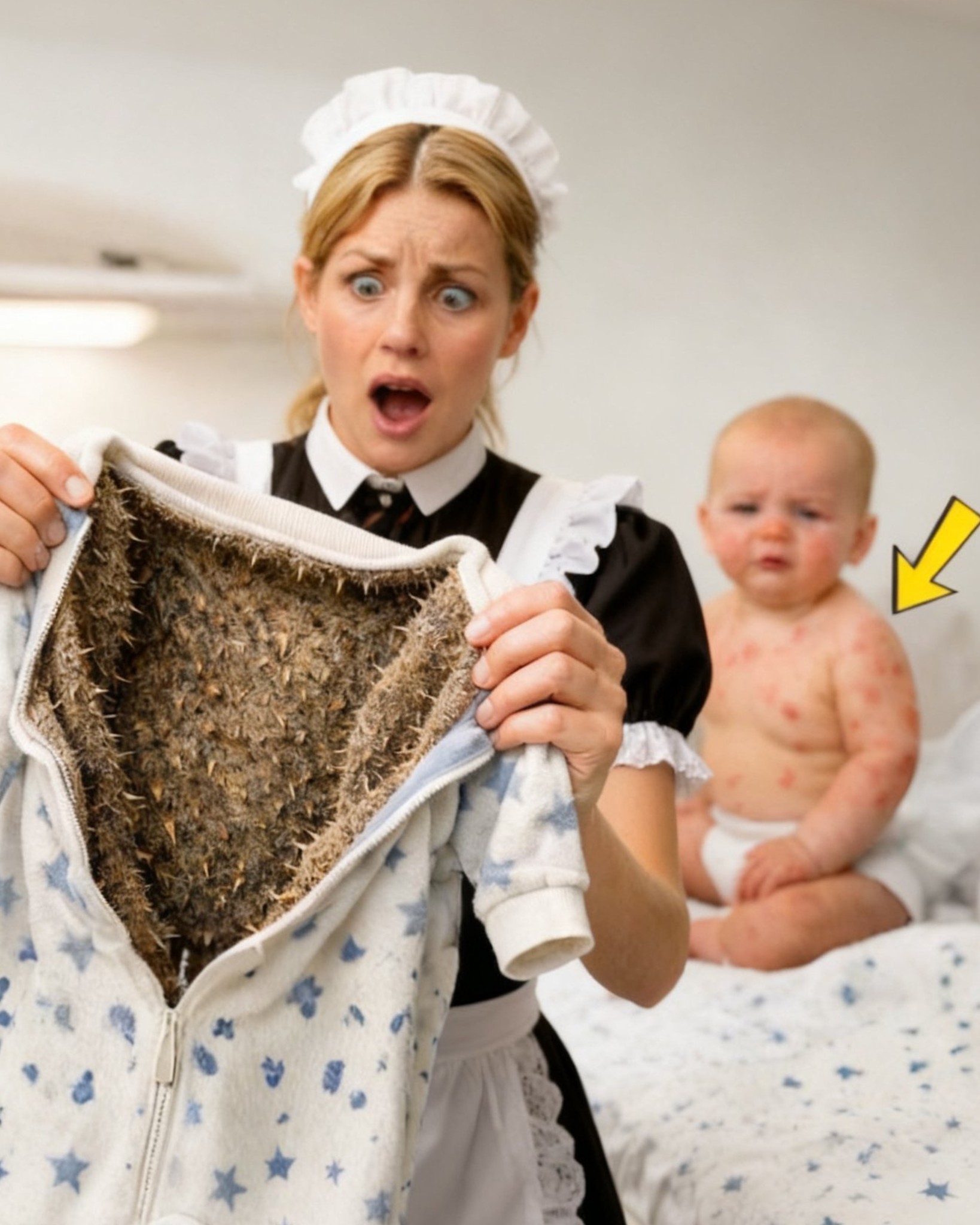
Oliver’s skin was covered in tiny red marks—across his chest, his back, his thighs. Some faint. Some angry and scraped. The pattern was too precise.
Her hands began to shake as she turned the onesie inside out.
And then she saw it.
Tiny spikes—dozens of them—stitched carefully into the inner seams. Not random. Not accidental. In other sections, the soft fabric had been replaced with something coarse.
Maria brushed it lightly with her fingertip.
Sandpaper.
Fine-grit. Glued and sewn into strategic places: chest, back, thighs—where the baby moved most.
Her stomach turned.
She had seen neglect. She had seen bruises explained away. But this?
This was engineered.
She held the garment up to the light. The thread didn’t match. The stitching was uneven. Hand-done. Calm. Intentional.
Vanessa’s voice cut through the room.
“Why is he undressed? Ethan will be here in thirty minutes. I want him looking cute.”
Maria turned slowly, holding the onesie inside out like evidence.
“Because I found this, Mrs. Harrington.”
Vanessa frowned, then forced a laugh. “That’s from an upscale boutique. It’s hypoallergenic.”
“It has spikes sewn inside,” Maria said. “And sandpaper.”
Vanessa didn’t touch it. Her eyes flicked—calculating.
“It must be a defect. I’ll sue.”
“It’s hand-stitched.”
Silence settled, heavy and dangerous.
Then Vanessa lifted her chin. “Are you accusing me of hurting my child?”
“I’m telling you this hurts him,” Maria replied evenly. “And someone did it on purpose.”
Vanessa’s mouth tightened. “You’re fired.”
Maria didn’t move.
“I’m calling Child Protective Services and the police.”
That broke her.
Not performative tears—real fear.
“What do you want?” Vanessa whispered. “I’ll pay you. Anything.”
Maria pulled out her phone. Old. Cracked screen.
“I want Oliver safe.”
She dialed.
“Detective Laura Chen, Crimes Against Children.”
“This is Maria Thompson, pediatric nurse. I’m in Upper Brookline. Four-month-old infant with patterned injuries caused by modified clothing—spikes and abrasive material sewn inside. I have photos and the garment. The mother attempted to bribe me.”
A pause.
“Send the address. We’re on the way.”
Vanessa collapsed into a chair.
“You’re ruining my life,” she hissed. “Ethan will leave me.”
And then—without meaning to—she said what confirmed everything.
“He only holds him when he cries. Five minutes, then back to work. I needed him to stay. If the baby screamed with him, Ethan felt guilty. He tried harder.”
Maria felt cold.
“You used your baby to control your husband.”
“It was to make him a better father!”
“No,” Maria said quietly. “It was to manipulate him.”
Sirens arrived like punctuation.
Detective Chen entered with officers and a social worker. Gloves. Cameras. No excuses.
They examined the garment. The marks. Oliver, now calm in a diaper and blanket.
“He’s going to the hospital,” the social worker said.
“I’ll go with him,” Maria said immediately.
At the hospital, doctors treated Oliver’s skin. The injuries weren’t deep—but repeated. The most serious damage was psychological.
“If pain is associated with being held,” a child psychologist explained, “attachment can be affected long-term.”
Near midnight, Ethan Harrington arrived—tie loose, face undone.
“Is it true?” he asked. “Did she do this?”
Maria didn’t soften it. “Yes. Only when you were home.”
Ethan broke down.
“I thought he hated me,” he whispered.
Maria guided him to the crib. “Hold him. Without the onesie.”
Ethan lifted Oliver carefully.
The baby stirred… then smiled.
A small, unsure smile.
Ethan shattered.
“He doesn’t hate me.”
“He never did,” Maria said. “He hated the pain.”
The case moved fast. Evidence didn’t lie.
Months later, Ethan sold the mansion. Moved to a smaller home. Rebuilt slowly. Therapy. Presence. Patience.
Maria became a steady figure in Oliver’s life—not famous, not photographed—but real.
At Oliver’s first birthday, barefoot in the grass, he toddled toward her with open arms.
“Ma…ree,” he babbled.
Maria held him, feeling the trust in his small body.
Some happy endings aren’t perfect.
They’re earned.
A baby who learns to feel safe again.
A father who learns to stay.
And one ordinary woman who chose to turn a piece of clothing inside out—and changed a life forever.