The lobby looked like a place where pain wasn’t allowed.
Marble floors so polished they reflected the ceiling lights like a second sky. A string quartet drifting through hidden speakers. The faint scent of citrus and expensive hand soap. Everyone moved softly—heels clicking like whispers, voices kept low, eyes trained forward.
That’s why the girl didn’t belong.
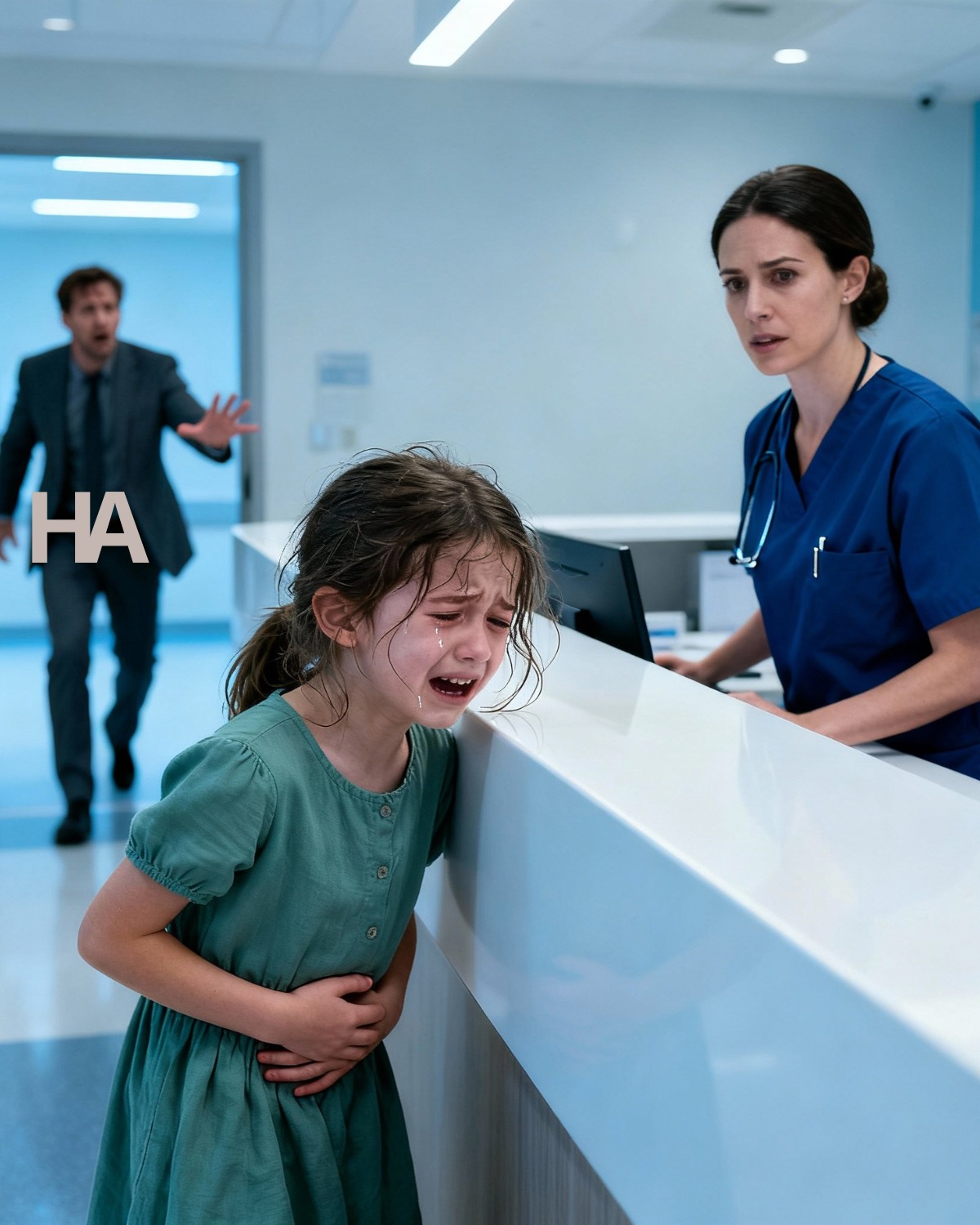
She was eight years old, barefoot, and shaking so hard it looked like the air itself was hurting her. Her hair was tangled, her cheeks streaked with dried tears, and her small hands—dark with street dust—left faint smudges on the immaculate front desk as she leaned forward to stay upright.
Her stomach clenched again, sharp enough to steal her breath. She folded over, hugging herself like she could keep whatever was happening inside from spilling out.
She lifted her head anyway.
Because kids don’t walk into places like this unless they believe one thing:
A hospital is supposed to help.
Her voice came out thin.
“Please… I need a doctor.”
Behind the counter, the receptionist barely blinked.
Her name tag read Cynthia—the kind of bright, friendly name the hospital liked. The kind of name that sounded warm even when the person wearing it wasn’t.
She stared at the child’s hands on the marble like the girl had dragged mud onto a white wedding dress.
“Sweetie,” Cynthia said, loud enough for nearby visitors to hear, “this is a private facility.”
The girl swallowed. “It hurts. A lot.”
Cynthia’s smile didn’t move. Only her eyes hardened.
“We don’t serve beggars here,” she said, letting the words land like a slap. “Go somewhere else.”
The girl’s mouth opened, then closed. Her eyes filled so fast it was like she’d been holding back tears for days and her body finally gave up.
“I don’t have anywhere else,” she whispered.
Cynthia reached for the phone under the counter—not with urgency, but with annoyance. Like she was calling maintenance about a spill.
Two security guards near the entrance straightened and started walking over.
The lobby stayed quiet.
Not because people didn’t hear.
Because people did.
A man in a suit glanced up, then immediately looked back down at his watch. A woman with a designer purse turned her body slightly, placing herself between the scene and her child. Someone coughed—like that might cover the shame of doing nothing.
The girl clung to the edge of the counter as the guards approached, her fingertips scraping the marble.
“Please,” she said again, and this time her voice cracked. “Just… please.”
One guard—young, stiff, trained to follow orders—reached for her arm.
The older guard hesitated.
His badge read Jonas. His face looked tired in the way only people who’ve seen too much can look tired. His gaze flicked to the girl’s trembling knees, then away, like he couldn’t afford to feel anything at work.
“Come on,” the younger guard said. “Let’s go.”
The girl tried to step back—but her body betrayed her.
She swayed.
Her knees folded.
And just like that, the tiny figure dropped toward the floor, too weak to catch herself.
The lobby went even quieter than before—because there’s something about a child collapsing in a place full of adults that forces the truth to the surface:
Everyone saw.
Cynthia frowned, irritated—not scared, not concerned.
“Get her out,” she snapped. “Before paying patients see this.”
That’s when the man on the cream-colored leather sofa finally moved.
He’d been there the whole time—mid-fifties, plain clothes, worn shoes. He looked like someone’s uncle waiting for a ride. No security around him. No entourage. Nothing that screamed importance.
But when he stood, something in the air shifted.
He didn’t rush.
He didn’t yell.
He simply crossed the lobby with the kind of steady, unstoppable purpose that makes people step aside without understanding why.
He stopped beside the collapsed girl and looked down.
The child’s breathing was shallow, her forehead damp, her face pale with exhaustion. She was so small on that huge marble floor it felt wrong, like someone had dropped a sparrow into a museum.
The man’s jaw tightened.
Then he spoke.
Not loud.
Not dramatic.
Just… final.
“Give her to me.”
Jonas blinked. The younger guard looked confused.
“Sir, hospital policy—”
The man didn’t even look up.
“Give her to me,” he repeated.
Jonas obeyed first, almost instinctively, like his body recognized authority even before his mind caught up.
The man lifted the child carefully—like she was fragile glass, like she mattered.
And as he carried her toward the emergency hallway, Cynthia rushed out from behind the desk, furious.
“Hey! You can’t do that!” she snapped. “You need admission. You need paperwork!”
The man didn’t slow down.
“This child is unconscious,” he said, eyes forward. “She doesn’t need a form. She needs a doctor. Now.”
Cynthia scurried after him, heels clicking like angry punctuation.
“And who’s going to pay?” she demanded. “We require a deposit. Insurance. Identification—this isn’t a charity!”
The man stopped just long enough to turn his head.
His expression wasn’t rage.
It was something colder.
Something disappointed.
“I’ll pay,” he said. “All of it.”
Cynthia laughed, quick and sharp.
“In what world?” she scoffed, looking him up and down. “Do you even know what the ICU costs?”
The man’s eyes flicked to the child in his arms, then back to Cynthia.
“In what world?” he repeated softly. “The one where a hospital chooses money over a child’s life.”
A nurse appeared in the hallway, drawn by the noise. Behind her, an admin staffer peeked out.
“Sir,” the nurse said, trying to sound calm, “we do have procedures—”
The man lifted the girl slightly, letting everyone see her face.
“She’s not a procedure,” he said. “She’s a patient.”
The hallway hesitated.
And then—like someone hit a hidden switch—another figure arrived.
A man in an immaculate suit, confident posture, cold eyes.
Dr. Valadares. The hospital’s administrative director. The one people whispered about. The one obsessed with “image.”
“What’s going on?” he asked, already irritated.
Cynthia launched into her version like she’d practiced it.
“This man just barged in. He’s causing a scene. He brought in a homeless kid—we can’t—”
Valadares held up a hand and fixed his gaze on the man carrying the girl.
“Sir,” he said smoothly, “either provide proof of payment immediately… or we’ll call security and the police. We’ll transfer the child to a public hospital, where she belongs.”
Where she belongs.
The words weren’t shouted.
That made them worse.
The man stared at Valadares for a long beat.
Then, with the girl still resting against his chest, he reached into his pocket and pulled out a simple smartphone with a slightly scratched screen.
Cynthia smirked, convinced he was about to call someone to rescue him from embarrassment.
But he didn’t dial 911.
He didn’t call a lawyer.
He looked at the admin staffer hovering behind Valadares—an accountant-type with glasses and a tablet.
“Mr. Guimarães,” the man said, voice even, “give me the hospital’s main account information.”
Guimarães froze. “Sir—”
Valadares frowned. “That’s not necessary.”
The man didn’t blink.
“It is,” he said.
Something in his tone made Guimarães recite the numbers anyway, hands trembling slightly as he did.
The man typed fast. Too fast for someone who didn’t belong.
He tapped once.
Then again.
Then he held up the phone slightly.
“Check the account,” he said.
Guimarães looked down at his tablet.
His eyes widened so quickly it was almost comical—if the moment hadn’t been so deadly serious.
He swallowed hard.
“Dr. Valadares…” he whispered.
Valadares snatched the tablet, annoyed.
Then he saw it.
A fresh deposit. Instant transfer.
A number so big it didn’t look real.
Two million dollars.
Cynthia’s face drained of color like someone pulled the plug.
The hallway went silent in a new way—not the “ignore the poor” silence.
The “we just met the wrong person” silence.
Valadares’ mouth opened slightly.
“Who are you?” he managed.
The man’s gaze didn’t soften.
“It doesn’t matter,” he said, and turned toward the ER doors. “Save her. Now.”
And suddenly the hospital moved like it remembered what a hospital was.
A gurney appeared. Nurses rushed. A doctor called orders. Doors swung open.
The girl disappeared into the emergency wing.
And the marble hallway—so proud of its perfection—was left with something it couldn’t polish away:
shame.
THE MAN ON THE SOFA WASN’T A VISITOR
Valadares found his voice again, though it sounded smaller now.
“Sir… I apologize for the misunderstanding—”
The man finally turned back.
And for the first time, he said his name out loud like a verdict.
“Artur Monteiro.”
Cynthia’s knees almost buckled.
Guimarães went stiff.
Valadares blinked twice, as if trying to force reality to reload.
Artur Monteiro wasn’t just wealthy.
He was a ghost story in business circles—the kind of man who bought hospitals and never attended the ribbon-cuttings. The kind of owner staff rarely saw and leadership rarely questioned.
Valadares’ voice cracked.
“Mr. Monteiro… I—”
Artur cut him off with a quiet stare.
“How many people,” he asked, “have you sent away because they didn’t look profitable?”
Valadares tried to recover.
“Our policies are designed for sustainability. You know healthcare economics, sir—”
Artur stepped closer, close enough that Valadares could smell the plain soap on him.
“I know what it costs,” Artur said. “I also know what it costs when you don’t pay.”
Valadares swallowed.
Cynthia stood frozen, lips pressed tight, eyes darting like she wanted to disappear into the wall.
Artur’s voice lowered.
“I came here tonight,” he said, “to see the hospital the way real people see it. From the entrance. From the front desk. From the place where mercy is either offered or denied.”
His gaze flicked to Cynthia.
“And the first thing I witnessed was my hospital telling an eight-year-old child, ‘We don’t serve beggars.’”
Cynthia tried to speak. “Sir, I was just following—”
Artur raised a hand.
“No,” he said. “You were choosing.”
Cynthia’s eyes filled with panic. “I—”
Artur turned away before she could finish.
“Board meeting,” he said into his phone as he walked. “Emergency. One hour. Full review. All leadership present.”
Valadares’ face tightened.
Artur’s tone didn’t change.
“And prepare termination documents for Dr. Valadares.”
The words hit like a dropped chandelier.
Valadares opened his mouth, but no sound came out.
Artur didn’t look back.
Because what mattered wasn’t humiliation.
What mattered was behind the ER doors.
WHY ARTUR COULDN’T WALK PAST A CHILD IN PAIN
Artur sat in the waiting area outside pediatric ICU later, hands clasped, elbows on knees.
The place smelled like antiseptic and quiet fear.
He’d been here before.
Not in this hospital.
In another one.
Years ago.
His daughter’s name had been Lúcia.
She’d had a laugh that could fill a room, the kind that makes adults stop pretending they aren’t tired. She loved stickers, loved lemonade, loved sitting on his lap while he pretended not to be busy.
And Artur had been the type of father who solved problems with resources.
Money. Influence. The best specialists.
He believed that if you threw enough power at something, it would bend.
Then Lúcia got sick.
And the world didn’t care who he was.
He remembered the moment he realized his money was just paper.
He remembered promising her it would be okay.
He remembered it not being okay.
After she died, Artur didn’t collapse publicly. He didn’t go on talk shows. He didn’t become a motivational quote.
He did what men like him do when grief is too big:
He built.
He bought hospitals the way some people build monuments.
Not because he wanted profit.
Because he wanted control over the one environment where he’d been powerless.
But control was a lie, too.
Because tonight proved something he hadn’t wanted to face:
You can own a hospital and still lose its soul.
A social worker named Helena arrived quietly at his side, holding a folder.
“We stabilized her,” Helena said gently. “She’ll need surgery soon. She’s… been through a lot.”
Artur’s throat tightened. “Who is she?”
Helena hesitated, as if the answer was heavy.
“Her name is Lia,” she said. “Lia Soares.”
Artur repeated it silently.
Helena continued, voice careful.
“She has no ID on her. No guardian. We’re working on her background. Jonas—the older security guard—said he’s seen her around the neighborhood sometimes.”
Artur looked up sharply.
“You’ve seen her before?” he asked as Jonas stepped closer.
Jonas didn’t meet his eyes at first. “Not in here,” he admitted. “Outside. Once by the dumpsters. Once near the bus stop.”
Artur’s jaw clenched. “And she came to a hospital… alone?”
Jonas swallowed. “Yes, sir.”
Artur stared at the hallway. “How many times,” he asked quietly, “did she try to get help before she walked into mine?”
No one answered.
Because the answer was probably worse than silence.
THE SURGERY, THE WAIT, AND THE TRUTH THAT FOLLOWED
The surgery lasted hours.
Artur paced like a man trying to outrun memory.
Valadares tried to approach twice. Artur ignored him.
Cynthia didn’t come back into the hall. Word spread fast when a powerful name appeared. Fear travels faster than compassion.
Helena sat with Artur at one point and opened the folder.
“We found something,” she said. “It’s not much… but it’s something.”
She slid a small plastic bag across to him.
Inside was a thin bracelet—frayed, childish—with a faded letter bead.
L.
Artur’s fingers froze on the edge of the bag.
Helena watched his face.
“It was in her pocket,” Helena said. “We thought maybe it’s… sentimental.”
Artur’s chest tightened.
He’d seen that bracelet before.
Not that exact one, maybe—but the idea of it.
Lúcia used to make bracelets like that at her school’s volunteer club. She’d sit at the kitchen table, tongue sticking out slightly as she threaded beads, telling him she wanted to give them to kids who “didn’t have enough.”
Artur’s eyes burned.
Helena softened. “Mr. Monteiro?”
Artur exhaled shakily. “My daughter… her name was Lúcia.”
Helena’s expression changed—gentler, sadder.
Artur stared at the bracelet again and felt something crack open inside him.
Because it wasn’t just that Lia reminded him of his daughter.
It was that Lia felt like a message he’d ignored for too long:
Your money didn’t fail you. Your system did.
A doctor finally emerged—mask lowered, eyes exhausted but steady.
“She made it,” the doctor said. “She’s stable.”
Artur’s legs almost gave out.
He pressed a hand to the wall, not caring who saw.
“Can I see her?” he asked.
“Briefly,” the doctor said. “One minute.”
Artur walked into the ICU like it was a sacred room.
Lia lay surrounded by machines, tiny under blankets, face calmer now. Still pale. Still small. But alive.
Artur didn’t touch her at first. He just looked.
Then he whispered—so softly it barely existed:
“You’re safe.”
He didn’t know if she could hear him.
But he needed to say it anyway.
Because somewhere in his chest, he was talking to someone else too.
THE CONSEQUENCES WERE QUIET—AND THAT MADE THEM PERMANENT
The next morning, the board meeting happened behind closed doors.
It wasn’t dramatic.
It was worse.
It was paperwork.
Emails.
Signatures.
A formal audit of “admissions practices.”
A review of how often “appearance” had influenced “policy.”
Helena brought Artur what she’d discovered.
It wasn’t just Cynthia.
Valadares had built an entire culture where the lobby acted like a velvet rope at a nightclub.
Public hospitals were treated like dumpsters for inconvenient humanity.
And the staff had learned to comply because fear was cheaper than integrity.
Artur didn’t scream.
He didn’t throw things.
He did what real power does when it finally decides to be moral:
He changed the structure.
Valadares was removed immediately.
Cynthia was dismissed—not as a scapegoat, but as a consequence.
New training rolled out: trauma-informed intake and non-discriminatory triage. The hospital began tracking a new metric that wasn’t “profit per patient.”
It was time-to-care.
And Artur created something no one expected:
The Lúcia Monteiro Fund—covering all pediatric emergency care, no questions, no deposits, no delays.
A plaque went up in the lobby:
IF A CHILD NEEDS HELP, WE HELP. PERIOD.
People took pictures.
Some called it good PR.
Artur didn’t care what they called it.
Because he knew what it really was:
An apology he’d owed the world since he lost his daughter.
WHEN LIA WOKE UP, SHE DIDN’T ASK FOR FOOD FIRST
Lia opened her eyes two days later.
Slowly. Confused. Like she wasn’t sure she was allowed to come back.
Helena was there. A nurse. And Artur—sitting quietly in a chair, plain clothes again, hands folded like a man trying not to scare a wild animal.
Lia blinked at him.
Her voice came out as a whisper.
“Did… they throw me out?”
Artur felt his throat tighten.
“No,” he said gently. “No one’s throwing you out.”
Lia stared at him like she didn’t trust kindness yet.
“You’re the man,” she said slowly. “The one who carried me.”
Artur nodded. “That was me.”
Lia’s eyes filled with tears she tried to hide.
“Thank you,” she whispered, and the way she said it—like gratitude hurt—made something in Artur’s chest ache.
Helena asked her quiet questions.
Where had she been staying? Did she know her full name? Any family?
Lia’s answers came in fragments.
Parents gone. Shelter. Ran away. Streets.
Then Lia looked at Artur again and asked the question that mattered most to her:
“Are you going to send me back?”
Artur didn’t answer quickly.
Because he could have said something safe.
Something professional.
Something like, “We’ll figure it out.”
But he didn’t want to do safe anymore.
He wanted to do right.
So he leaned forward, keeping his voice calm.
“If you want…” he said, “you can stay with me.”
Lia’s eyes widened.
“With you?” she repeated, stunned. “But… why?”
Artur swallowed.
Because telling a child “I’m lonely” felt too heavy.
But the truth didn’t need fancy words.
“Because you shouldn’t have to be alone,” he said. “Not anymore.”
Lia stared at him like she was waiting for the joke.
Then her mouth trembled.
And she whispered, “Okay.”
Just one word.
But it landed like a door opening.
EPILOGUE — THE SAME LOBBY, ONE YEAR LATER
One year later, the lobby looked similar.
Marble. Music. Clean air.
But the energy was different.
There was a small kids’ corner near the entrance with books and stuffed animals. There was a low reception window for children. There were posters on the wall about dignity and access and what to do if you’re in crisis.
And behind the desk, there was a new receptionist—older, softer-eyed, trained to stand up to bad policy.
A little girl walked in holding a man’s hand.
She wore sneakers now.
Her hair was neatly braided.
And she looked straight ahead—not with fear, but with the quiet confidence of someone who knows she belongs in the world.
Lia stopped in front of the plaque and traced the engraved name with her finger.
LÚCIA MONTEIRO FUND
She looked up at Artur.
“That was her name,” Lia said softly.
Artur nodded, eyes shining. “Yes.”
Lia squeezed his hand.
Then she turned toward the desk, lifted her chin, and said something that made the new receptionist smile:
“Hi. We’re here to donate some toys.”
Artur blinked. “We are?”
Lia nodded solemnly, like it was obvious.
“Because this place is where you saved me,” she said. “So other kids should feel safe too.”
Artur’s chest tightened.
He looked around the lobby—the people moving, the staff working, the doors that now opened instead of blocking.
And for the first time in years, he didn’t feel like a ghost inside his own empire.
He felt like a father who finally found a way to keep a promise.
Lia tugged his sleeve.
“Come on,” she said. “We’ve got work to do.”
Artur smiled—small, real.
“Yeah,” he said. “We do.”
And together, they walked deeper into the hospital—not as owner and rescued child…
…but as proof that the world can change the moment one person decides to stand up.
THE END.