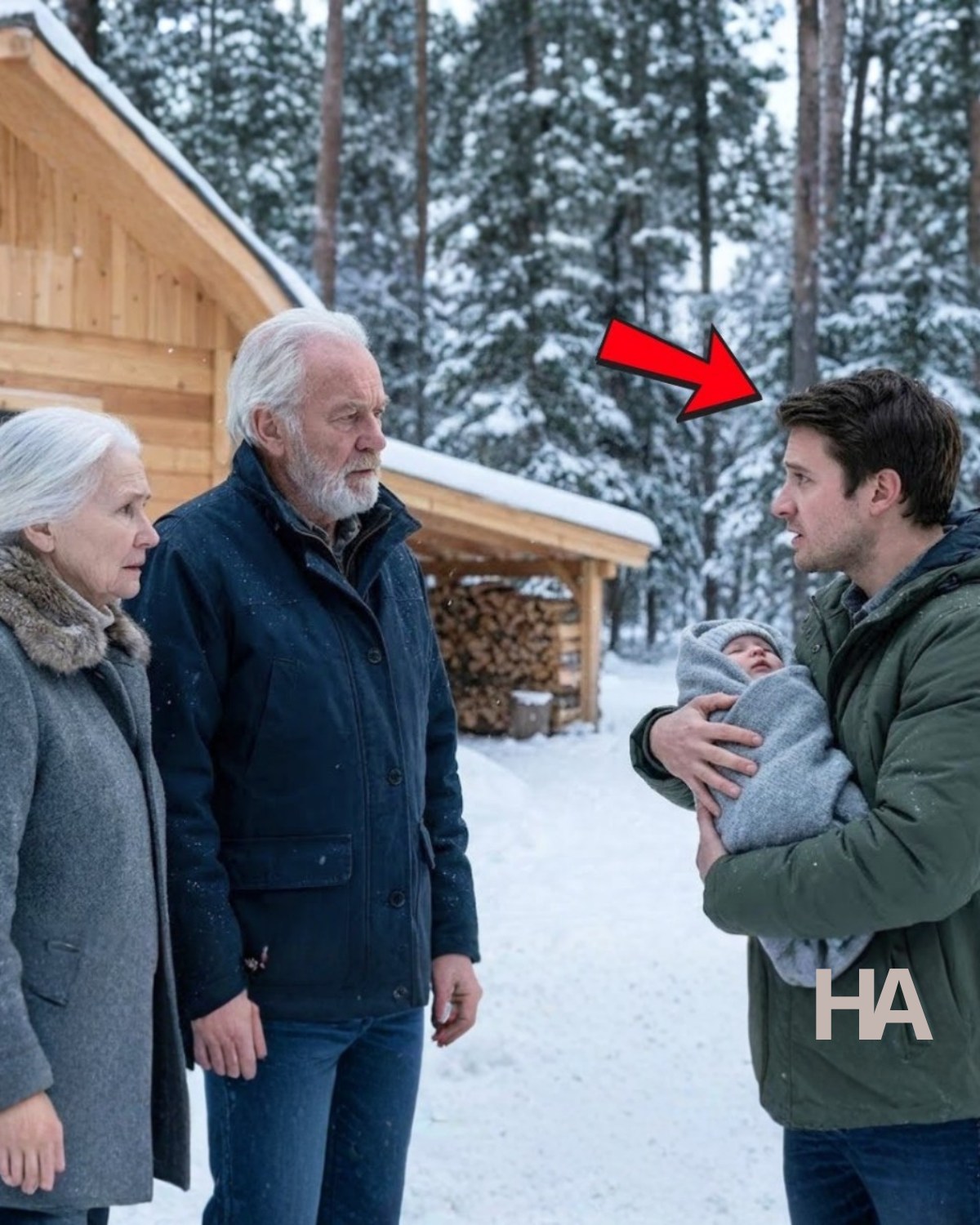
You’re hiking back to your cabin on Christmas Eve with a six-month-old baby sleeping against your chest, and the snow is falling so quietly it feels like the world is holding its breath. The wind bites through your jacket anyway, slipping under the seams like it knows exactly where you’re tired. You tell yourself you just have to make it home, warm up a bottle, and survive one more night the way you’ve been surviving every night. The path is white, the trees are black silhouettes, and the whole mountain feels like it’s watching you. You’re thinking about diapers and formula and the one bill you keep pretending you didn’t see. Then you round the last bend and your porch light hits something that doesn’t belong. Two figures sit on the bench you built with your own hands. And for one terrifying second, you’re not sure if you’re looking at people… or bodies.
They’re old—seventies at least—and the snow is collecting on their shoulders like they’ve been waiting a long time. The man’s lips are tinted blue, the woman’s hands are clenched tight against her coat as if she’s trying to hold her bones together. Their clothes are wrong for this weather, too light, too neat, like they stepped out of a city and into a nightmare by accident. When you move, their heads snap up, and they try to stand with a dignity that makes your stomach twist. Your instincts scream questions—Who are you? Why here? Where’s your car?—but the baby shifts in your carrier and lets out a small whimper. That sound slices through everything. You drop your grocery bags into the snow and rush forward like you don’t have a choice. “Inside,” you say, your voice sharper than you mean, because panic always comes out sounding like anger.
You get the door open, shove them into warmth, and the cabin greets you with the smell of wood and last night’s ash. You kick the door shut with your boot and crank the stove like your life depends on it—because maybe theirs does. The woman staggers, then steadies herself with her palm against your kitchen table, her eyes glassy and far away. The man sits down hard on a chair and breathes like he’s been borrowing oxygen from the future. Your baby starts to cry louder now, hungry and offended at the cold interruption, and you bounce gently as you grab blankets with one hand. You wrap them tight, you push a mug of sweet punch into their fingers, and you watch their skin slowly come back from the edge. “Thank you,” the man croaks, and the words sound scraped raw. The woman keeps staring at your baby like she’s seeing something holy.
He introduces himself as Roberto, and she says her name is Marta, but you don’t feel like that answers anything. It’s the way Roberto looks at you that makes your neck prickle, like he’s memorizing your face rather than just appreciating your help. Marta, on the other hand, stares at your daughter with a softness that almost hurts to witness. When your baby wriggles and cries, Marta lifts trembling hands in a silent question. You hesitate because you’ve learned the hard way that trust is expensive, and you’ve been broke for a long time. But Marta’s eyes hold the kind of careful love that doesn’t beg for permission—it just exists. You nod once and pass your daughter over. Marta takes her with a practiced gentleness, like she’s done it a thousand times and missed it every day she didn’t. She hums a tune under her breath, old and steady, and your baby quiets almost instantly. That calm hits you in the chest like a surprise punch.
They tell you their car died up the road, that they walked until they saw your porch light through the snow. It’s plausible, except your gut keeps circling the same thought: most people don’t end up on this mountain by accident. Roberto’s hands are clean and smooth, not the hands of a man who fixes things when they break. His shoes are expensive—wet and ruined now, but expensive all the same—and that detail sticks in your mind like a splinter. Marta’s scarf is thin, but it’s silk, the kind you see in department store glass cases. Still, the fear in their faces looks real, and the cold doesn’t care about your theories. You tell them there’s a guest room, that you’ll take the couch, and you say it like it’s a fact carved into stone. Roberto tries to protest, but you cut him off with one look. “Nobody freezes on my porch,” you say, and you mean it so deeply you surprise yourself.
Dinner is simple—beans, tortillas, a little cheese, the punch that’s too sweet because you overdid the sugar without thinking. Outside, the wind throws snow against the windows like handfuls of gravel, and the cabin feels smaller in a good way for the first time in months. You eat slowly, watching your baby’s tiny fingers curl around Marta’s pinky as if she’s claiming her. You try not to think about what it does to you to see your daughter soothed by someone else. Since Alma died, you’ve lived like a man walking a tightrope, afraid to lean on anything because everything breaks. But Marta’s humming fills the room like warmth you forgot existed. Roberto watches you across the table and doesn’t talk much. His eyes keep flicking to the curve of your jaw, the bridge of your nose, the shape of your hands. It feels less like curiosity and more like recognition, and that unsettles you more than the storm.
When everyone finally sleeps, you lie on the couch staring at the ceiling and listening to the cabin settle. Your daughter breathes softly in the cradle you built, and for a moment the quiet doesn’t feel like loneliness. Then you hear it: Roberto’s footsteps, slow, careful, stopping near the fireplace. You keep your eyes closed, because sometimes you can learn more by pretending you’re asleep. He doesn’t touch anything, doesn’t steal, doesn’t rummage through your life the way strangers usually do in your nightmares. He just stands there, watching, and you can almost feel the weight of his gaze. After a long minute, you hear a quiet sound—like a muffled sob swallowed too fast. The floor creaks again as he returns to the guest room. Your eyes snap open in the dark, wide awake now, and your heart won’t slow down.
Over the next few days, the mountain keeps them trapped the way a storm traps everything it wants to keep. The road stays blocked, their “car” stays unreachable, and Roberto and Marta become a strange part of your routine. Marta insists on helping with the baby, changing diapers with a calm confidence that makes you feel both grateful and ashamed. Roberto offers to chop wood, and you watch him struggle with the axe like a man who’s never had to fight his own heat. He doesn’t complain, though—he just keeps trying, sweating into the cold, like he needs to earn something. At night, Marta tells your daughter stories in a whisper, and you catch words like “brave” and “miracle” and “home.” She keeps saying Alma’s name with careful reverence, and every time she does, your chest tightens. You want to ask how she knows, but part of you is afraid of the answer. Roberto barely mentions the storm anymore; he’s here for something else, and you can feel it in the air.
On the fourth night, you finally corner him when Marta takes the baby to bed. The fire pops and throws sparks, and Roberto’s face flickers between shadows and orange light. You stand with your arms crossed, because you don’t know what else to do with your hands. “Stop looking at me like that,” you say, blunt, exhausted, done playing polite. Roberto blinks, like you slapped him without touching him. “Like what?” he asks, but his voice isn’t convincing. “Like you’re trying to remember me,” you say. “Like you already know me.” The words hang in the cabin like smoke. Roberto’s shoulders sag, and for the first time he looks as old as he is.
He doesn’t deny it. He just stares into the fire as if the flames are easier to face than you are. “You’re right,” he says finally, and the two words sound like surrender. His hands tremble, not from cold this time, but from something inside him breaking loose. “I didn’t come here by accident,” he admits, and your stomach drops even though you already knew. You feel the urge to grab your baby, to lock the door, to throw this man back into the snow. But Roberto doesn’t move closer; he stays seated like he knows he doesn’t have the right. “I came because I couldn’t live another year without seeing you,” he says. You swallow hard, tasting fear. “Why?” you ask, because it’s the only word you can force out. And when he answers, your entire life tilts.
Thirty years ago, Roberto says, he was the golden boy of a wealthy family—money, influence, expectations tighter than chains. He fell in love with a woman named Lucía Vega, a woman from a small town with dirt under her nails and fire in her laugh. He tells you her name like it’s a prayer he’s been afraid to speak. “She was brave,” he says, voice cracking. “And I was not.” His family gave him a choice: Lucía or the life he’d been promised, and he chose the one that came with comfort. He left without turning back, without checking for consequences, without asking the question that would have saved everything. “I didn’t know she was pregnant,” he says, and the cabin seems to shrink around you. Your chest is tight, your ears ringing, your mind racing ahead of him like it’s trying to protect you from the next sentence. Roberto’s eyes fill with tears. “She died giving birth,” he says softly. “And her baby… was sent to a home in Saltillo.” He looks up at you, and his voice breaks completely. “You,” he whispers. “That baby was you.”
You stare at him so hard it feels like your eyes might crack. Your body goes cold even though the fire is blazing, and you suddenly understand what real shock feels like—like your bones forgot how to hold you. You’ve imagined your father a thousand different ways: violent, careless, evil, nonexistent. You never imagined him sitting in your cabin, crying by your fireplace, looking like a man who’s spent decades punishing himself. The anger hits first, hot and sharp, because anger is easier than grief. “So you just… left?” you ask, and your voice comes out low and dangerous. Roberto nods, ashamed. “I was a coward,” he says. “I chose my name over my son.” You want to yell, you want to throw something, you want to make him feel even one percent of what you’ve carried your whole life. But then you hear your baby shift in the other room, and the sound stitches your rage to the floor.
You pace, because standing still feels impossible. Your mind drags you backward through memories you didn’t know were connected: the nun’s flat voice, the way you stopped asking questions because it made people uncomfortable, the years of learning to be your own rescue. Roberto keeps talking, but you barely hear him over the roar in your head. He says he hired investigators, chased paperwork, followed threads that kept snapping, and still he kept going. He says he found your name and your age and your location like a man finding the last door in a burning building. Marta, he explains, is his wife—not the love of his life, but the woman who stayed when his guilt started poisoning everything. “She knows what I did,” Roberto says, “and she still came.” That part makes you glance toward the hallway, where Marta’s soft humming is fading as she settles your daughter. You realize the biggest twist isn’t that Roberto is your father. It’s that Marta—this gentle woman holding your baby—chose to step into the mess anyway.
When you finally stop pacing, you feel like you’ve run ten miles. “I need time,” you say, because your heart is too full to hold anything else. You don’t say “get out,” but you don’t say “stay,” either, and the space between those words feels like a cliff. Roberto nods as if you’ve granted him a mercy he doesn’t deserve. “I’m not asking for forgiveness,” he says quickly, desperate. “I’m not asking for anything.” His eyes shine with something raw. “I just needed you to know the truth,” he says. You swallow, forcing air into your lungs. “And now what?” you ask. Roberto’s mouth trembles. “Now I live with what I did,” he says. “The way you had to.”
When the road finally clears, they leave with a quietness that hurts. Roberto doesn’t try to hug you, doesn’t try to buy you, doesn’t try to force a happy ending. He just leaves a business card with an elegant number on it and a handwritten letter sealed in an envelope. Marta kisses your baby’s forehead like she’s saying goodbye to someone she’s loved a long time, and your daughter smiles at her like she doesn’t understand distance yet. You stand on the porch watching them disappear down the snowy path, and you feel hollowed out by the knowledge you asked for all your life. Inside, the cabin is warm, but your bones are cold. That night you read Roberto’s letter once, then again, then again until the paper softens at the folds. He doesn’t make excuses. He doesn’t ask you to understand. He just tells the story as honestly as he can and ends with one sentence that knocks the air out of you: “You became a good man without me, and that is both my shame and my miracle.”
For days you don’t call. You go back to the grind: feedings, diapers, work in your small woodworking shop, the constant math of survival. But the letter sits on your table like it has weight, like it’s alive. You catch yourself staring at your reflection sometimes, trying to see Roberto in your face. You hate that you can. You hate that the resemblance makes everything more complicated, because it means he’s not just a ghost anymore—he’s biology, history, blood. You imagine what it would’ve been like if he’d stayed, and your mind refuses to build the fantasy because it’s too painful. Then you look at your daughter and think about choice—how every day you choose her even when you’re exhausted. The question comes uninvited, sharp as glass: Could you ever leave her? Your body answers before your brain does: Never. And that’s when you realize your anger isn’t just anger. It’s grief for the child you were, the one who didn’t get chosen.
A month later, you dial the number with your thumb hovering like it’s afraid. Roberto answers on the second ring, as if he’s been holding the phone this whole time. “Mateo,” he says, and your name sounds strange in his mouth, like he’s tasting it for the first time. You don’t say hello. You don’t soften your voice. “I don’t forgive you,” you say, because you need him to hear the truth without sugar. There’s a long pause, and you hear his breath catch. “I understand,” he whispers. You stare out your window at the trees. “But… if you want to see Sofía,” you add, voice rough, “you can. And maybe we can try to… figure out what this is.” On the other end of the line, Roberto breaks. He sobs like a man who’s been waiting thirty years for permission to live.
From that point, weekends change shape. Roberto and Marta start driving up whenever the weather allows, and they come without arrogance, without demands, without the entitlement you expected from a wealthy man. Roberto shows up in worn jeans instead of suits, willing to get splinters under his nails like it’s a penance he needs. He asks you to teach him how to sand a plank correctly, and you watch him listen like a student, not a boss. Marta brings food in containers and folds tiny baby clothes with the care of someone folding prayers. She never tries to replace Alma; she speaks her name with respect and lets your grief sit in the room without arguing with it. Sofía takes to them quickly, especially Marta, who somehow always knows the right song. And you—stubborn, guarded you—start sleeping an extra hour on Saturdays because someone else can hold your world for a moment. That small mercy feels bigger than any apology.
It isn’t smooth. Nothing this broken ever is. Roberto’s adult daughters come once, stiff and suspicious, looking at you like you’re a problem that might cost them something. You see the calculation in their eyes, and it makes your jaw tighten. You stand your ground in your own kitchen with your daughter on your hip. “I don’t want your money,” you tell them flatly. “I don’t want an inheritance. I don’t even know what I want. I’m here because I’m trying to understand where I came from.” The bluntness disarms them, if only slightly. One of them looks at your baby and softens for a second before snapping her face back into place. You realize they’ve been raised in a world where love and leverage get tangled together. And you swear quietly that your daughter will never have to untangle that kind of knot.
Time passes the way it always does—slow in the moment, fast in memory. Your baby becomes a toddler with fearless steps and loud opinions. Your cabin fills with small messes and sudden laughter, the kind that makes you stop mid-task just to listen. Roberto becomes steadier with tools and softer with himself, like he’s learning to live without punishing every breath. Marta becomes something you didn’t know you needed: a steady grandmother-energy presence who never judges you for being tired. Some nights you catch yourself almost calling Roberto “Dad,” and the word sticks behind your teeth, not ready yet. You still have days when the old abandonment burns like acid, when you want to slam the door and protect your peace. But then you remember the night you found them freezing on your porch and how you opened the door without thinking. And you wonder if that instinct—your instinct—was the real miracle.
Two years after that Christmas Eve, the next twist hits like a hammer. Roberto gets sick, and it isn’t the kind of sick that goes away. The doctors say “cancer” in voices trained to sound calm, and suddenly every room feels colder. Marta wants to take him back to the city, to the big house, to private nurses and expensive machines. Roberto refuses. He looks at you with a quiet determination that scares you. “I want to be here,” he says. “Where I finally found my son.” The words land heavy, because you realize he’s not just choosing a place—he’s choosing you. And you’re not sure you’re strong enough to hold that. But then you think about Sofía watching you. You think about what it means to show your child what family can be, even when it’s messy. So you nod. “Okay,” you say. “We’ll do it here.”
Care is a strange kind of love. It’s not romantic. It’s not dramatic. It’s wiping sweat and warming soup and helping a grown man stand when pride wants him to fall. You learn Roberto’s rhythms: good mornings, bad afternoons, nights when pain makes him silent. You read to him sometimes when his eyes can’t focus, and you hate how natural it feels to sit by his bed. Marta sleeps lightly, always listening, always ready. Sofía wanders in with a toy and calls him “Abuelo” like it’s the simplest truth in the world. Roberto cries the first time she says it and then laughs through the tears, embarrassed and grateful at once. You watch the scene and feel something inside you crack open. The child in you is angry that it took this long. The father in you is grateful it happened at all.
Roberto dies in the spring, when the snow finally loosens its grip and the mountain starts to breathe again. The morning is quiet, bright, almost cruel in its normalcy. Marta sits on one side of the bed holding his hand, and you sit on the other side feeling like your heart is a locked door someone is slowly picking open. Sofía is asleep in the next room, unaware that endings can happen in ordinary moments. Roberto looks at you, his gaze weak but clear, as if he’s trying to memorize you one last time. “Knowing you,” he whispers, “was the best thing that ever happened to me.” His voice shakes. “I’m sorry,” he says, “for not having the courage sooner.” You feel tears burn behind your eyes, and you hate yourself for still wanting to be strong. Then something in you gives. You lean closer and let the truth out without armor. “I forgive you,” you say—slow, steady, real. Roberto smiles like a man finally allowed to rest. And then he’s gone.
Grief hits different when it’s layered. You grieve the man who just died, the father you never had, and the years you can never get back—all at once. You expect Marta to leave afterward, to return to the big house full of echoes and expensive emptiness. But she doesn’t. She looks around your cabin, at your daughter’s toys, at the scuffed floor, at the warmth you built with your hands. “That house isn’t home,” she tells you quietly. “It’s just a museum of what we were told to value.” She sits at your table and folds laundry like she belongs there, like she chose this life. Roberto’s daughters protest, talk about reputation and property and appearances, but Marta finally finds her spine in a way that shocks even them. “I’m staying where love is,” she says. And for once, nobody can buy her silence.
The months that follow are not magically easy. Money questions arise, legal papers appear, old family dynamics snarl and bite. You set boundaries like a carpenter sets level lines—firm, clear, necessary. You make it known you won’t be treated like a secret, and you won’t be treated like a mistake. You don’t chase their fortune because you learned long ago that money doesn’t fix loneliness. But you also don’t let them erase you again. Marta becomes a bridge, insisting that truth is the price of access to your life. Slowly, the tension dulls from sharp hate to manageable discomfort. And in that space, something fragile grows: a new kind of family, stitched together from regret and choice.
Years later, you sit on the same bench where you first found Roberto and Marta buried in snow. Sofía is bigger now, running around with wild confidence, her laugh bouncing off the trees like birdsong. She calls Marta “Grandma” and doesn’t know what a miracle that is, because for her, love has always shown up. You watch her and think about Alma—how you still say her name out loud, how you still tell Sofía stories about her mother’s laugh, her stubbornness, her light. Marta listens without jealousy, without discomfort, the way only a woman who has lost and grown can listen. Sometimes you catch yourself smiling at the sky, like maybe Alma is watching too. You don’t pretend everything was fair. You don’t romanticize the pain. You just acknowledge the truth: you survived. And then you built something.
And when you look back at the moment it all started—the storm, the porch, the two strangers trembling under snow—you realize the twist wasn’t that Roberto was your father. The twist was you. You opened the door before you knew what you were letting in. You chose kindness without bargaining for a reward. You gave warmth without demanding a story first. That one instinct changed everything: it dragged truth into the light and turned a frozen night into the first chapter of a life you never thought you’d have. People talk about miracles like they’re loud, shining events that happen to other people. But you know better now. Sometimes a miracle is quiet. Sometimes it’s two strangers on a bench and a baby’s soft cry inside your coat. Sometimes it’s the courage to open a door. And sometimes… it’s the life that walks through it.