You drive fifteen minutes past your office like everything is normal, then turn down a side street you never use. You park behind a thick hedge, cut the engine, and sit there with your hands locked on the steering wheel. Your heart pounds hard enough to feel it in your throat, like it’s trying to warn you before your brain catches up. You tell yourself you’re being paranoid, that you’re letting stress invent monsters in daylight. But the image of Mrs. Greene’s worried face keeps replaying in your mind, stubborn as a bruise. You get out, shut the door quietly, and walk back home as if silence can keep the truth from noticing you. Each step feels louder than it should, and your stomach twists tighter with every crunch of gravel. By the time you slip inside, your fear has turned into a decision you can’t undo.
You lock the door behind you, then lock it again even though it’s already latched. The house smells like laundry detergent and the vanilla candle you light when you want things to feel safe. You move through the hallway like you’re trespassing in your own life, careful not to disturb anything. Lily’s room is at the end, the door cracked open the way she always leaves it. You push it wider, and the sight hits you with a strange punch of normalcy. Her bed is made with hospital corners, her backpack isn’t there, and her desk looks like a catalog photo. It’s the kind of neat that’s meant to prove innocence, and that realization makes your skin prickle. You swallow hard and tell yourself you’re not here to accuse her, you’re here to understand her. Still, your hands shake as you step closer, because the truth usually hides in places you don’t want to look.
Your name is Olivia Carter, and you’ve always believed you were the kind of mother who notices things. After your divorce two years ago, it’s just been you and Lily in a small house in a quiet Massachusetts suburb. You’ve built your days like careful stacks: work, dinner, homework check, quick talk on the couch, lights out. Lily has always been responsible, smart, polite, the kind of kid teachers praise in emails you save to reread on hard days. She doesn’t slam doors or skip chores or talk back like the movies say teenagers do. When she gets quiet, you chalk it up to hormones and middle school drama, because that’s the easiest explanation to hold. You’ve seen her yawn at dinner and push food around her plate, but you told yourself she was just tired. You wanted normal so badly that you treated every warning sign like background noise.
It starts the morning before, on a Thursday that feels ordinary until it doesn’t. You’re leaving for work with your bag on your shoulder when Mrs. Greene waves from her porch across the street. She’s older, the kind of neighbor who knows the schedules of the neighborhood like she’s reading a calendar no one else can see. Her smile is gentle, but her eyes are uneasy, and that’s what stops you mid-step. “Olivia,” she says softly, like she’s afraid of startling you, “is Lily missing school again?” The word again lands like a crack in glass, because you didn’t know there was a first time. You force a laugh that doesn’t sound like you and shake your head too fast. Mrs. Greene frowns and tilts her chin toward your house, as if the evidence lives right behind you.
You tell her she must be mistaken, that Lily goes every day, that you drop her off yourself most mornings. Mrs. Greene doesn’t argue, but she doesn’t back down either, and that’s what makes your chest tighten. “I see her come home during the day,” she insists, “sometimes with other kids.” Your brain rejects it at first, the way your body rejects a splinter by swelling around it. You smile again, too bright, and say maybe she saw someone else with the same hair. Mrs. Greene’s expression doesn’t change, and you feel the ground tilt under your confidence. You walk to your car with your face composed and your hands cold. The moment the door shuts, the composure collapses into a buzzing panic you can’t turn off. On the drive to work, every red light feels like a question you can’t answer.
That night at dinner, Lily looks almost normal, and that almost is what scares you. She eats slowly, polite and quiet, answering your questions with soft little “fine” and “good.” You bring up Mrs. Greene as gently as you can, like you’re testing a bruise. For half a second, Lily stiffens, and it’s so quick you could convince yourself you imagined it. Then she laughs and waves her fork like the whole thing is ridiculous. “She probably saw someone else,” Lily says, eyes too steady, voice too casual. “I’m at school, Mom, I promise.” You nod and pretend you accept it, because you want to accept it. But something in her tone trembles underneath the words, and your mother instincts start screaming into the quiet.
You lie awake that night with the house dark around you, staring at the ceiling as if it might confess. You replay Lily’s face when you mentioned the neighbor, the way her shoulders rose like armor for a heartbeat. You remember the way she’s been sleeping more, the way she’s been skipping snacks she used to beg for. You remember how she flinched when the phone rang last week, then forced a smile like it was a joke. You wonder if she’s sick, if she’s scared, if she’s doing something dangerous or if something dangerous is being done to her. Every possibility feels like a hallway full of locked doors, and you hate that you don’t know which one to open. Sometime after 2 a.m., you sit up and accept the truth you’ve been avoiding. If Lily won’t tell you, you have to witness it.
The next morning, you play your role like an actress who doesn’t trust the script. You kiss Lily’s head and tell her to have a great day at school, keeping your voice light. Lily smiles, says “You too, Mom,” and walks out with her backpack like a kid who has nothing to hide. You leave a few minutes later, start the car, and drive away where she can see you. Then you circle back, heart hammering, and park behind the hedge like you’re stalking your own child. The shame of that thought nearly makes you turn around, but fear keeps your hands steady. You let the neighborhood settle into its morning rhythm, then slip back inside as quietly as you can. Your house feels different when you enter it like a secret.
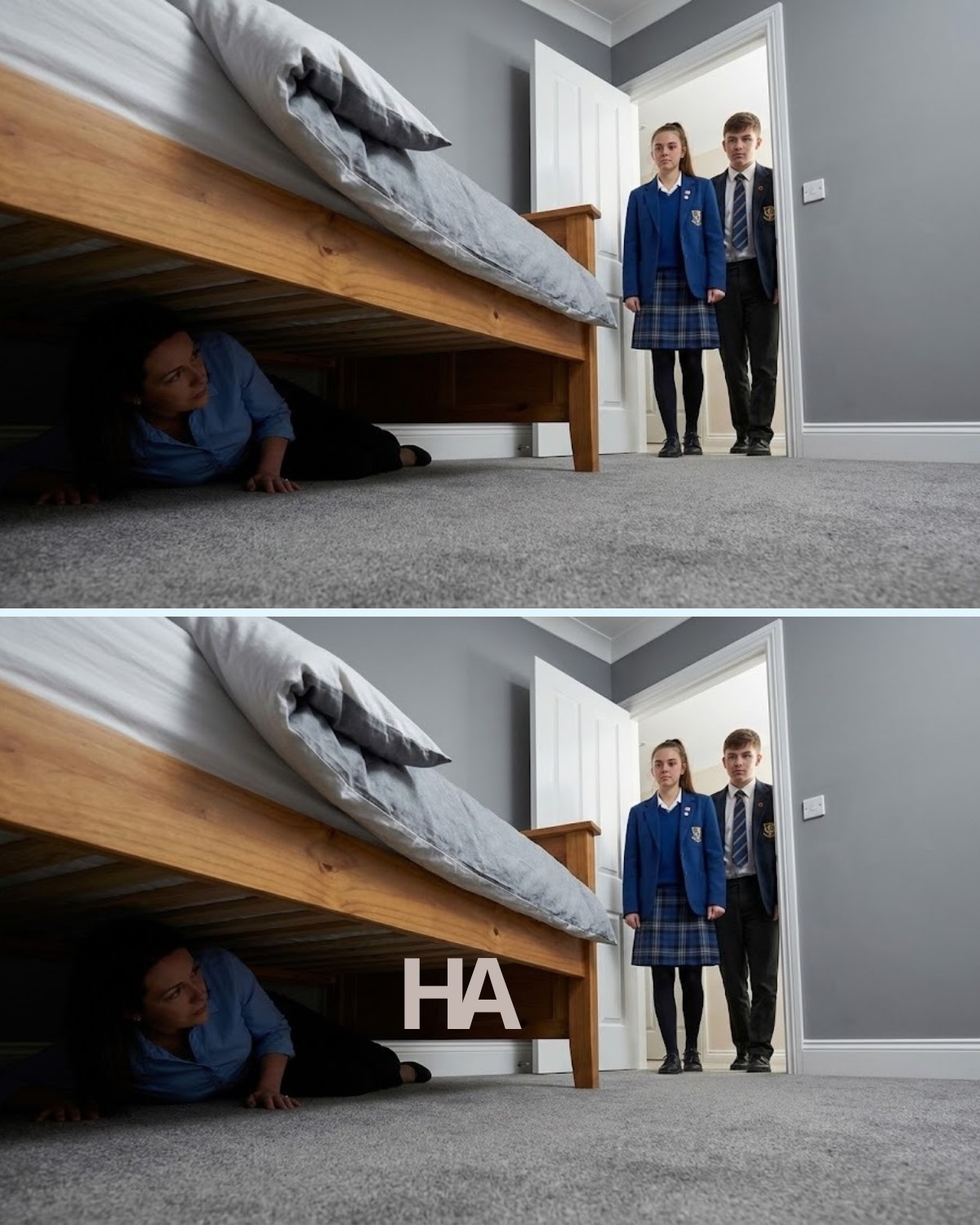
You go straight to Lily’s room and close the door behind you. The air is still, faintly scented with her shampoo and the clean linen spray she likes. You look at the bed and think about how absurd this is, how a mother shouldn’t have to hide in her own home. Then you drop to your knees, lift the bed skirt, and slide underneath like you’re crawling into a confession. Dust sticks to your sleeves, and the space is tighter than you expected, pressing your shoulders in. Your phone is on silent, face-down, because you can’t risk a vibration giving you away. Your breathing sounds too loud, so you press your cheek to the carpet and try to become invisible. Time stretches cruelly when you’re waiting for something you’re afraid to find.
At 9:00 a.m., nothing happens, and your knees ache from being folded too long. At 9:20, still nothing, and doubt starts to creep in like a fog. You wonder if Mrs. Greene was wrong, if Lily told the truth, if you’re about to become the kind of mother who invents problems. Your legs go numb, and you shift slightly, wincing at the tiny squeak of the bed frame. You freeze again, listening, but the house stays quiet. Part of you wants to crawl out and laugh at yourself, to go to work and pretend this never happened. Then, at 9:37, you hear it—the clean, unmistakable click of the front door opening. Your entire body locks up like a switch has been flipped.
Footsteps, light and quick, move through the hallway downstairs. Not one pair, but several, overlapping and urgent, like kids trying not to sound like kids. A whisper floats upward, sharp and commanding. “Shh—quiet,” someone says, and you recognize Lily’s voice immediately. The sound punches you with simultaneous relief and dread, because you know she’s home, and you know she’s not alone. Another voice answers, small and shaky, and it doesn’t sound like trouble. It sounds like fear. You press your hand over your mouth so your breath won’t give you away. The footsteps move toward the living room, and you feel the house shift around them like it’s holding a secret meeting. Under the bed, you realize you are about to learn something you can’t unlearn.
Lily’s voice rises again, softer now, trying to sound calm. “Sit in the living room,” she says, “I’ll get water.” A weak “thank you” follows, and the gratitude in it makes your throat burn. You hear the cabinet open, a glass clink, the faucet run, ordinary sounds that suddenly feel terrifying. Then you hear a child sniffle, the kind of silent crying that happens when someone is trying to disappear. “My dad yelled at me again this morning,” a boy whispers, and your stomach drops. A girl murmurs, “They shoved me yesterday—almost down the stairs.” Another voice cracks, “They dumped my lunch again, and everyone laughed.” Your fingers curl into the carpet like you’re trying to hold the floor together. These aren’t kids skipping school for fun. These are kids fleeing something adults should have stopped.
Lily speaks again, and there’s exhaustion in her tone you’ve never heard before. “You’re safe here,” she says, and your heart twists because she sounds older than thirteen. “Mom works until five, and Mrs. Greene goes out around noon,” she adds, like she’s planned this down to the minute. “No one will bother us.” You feel tears collect fast, hot and helpless, because your daughter has been strategizing safety in your absence. One of the kids asks quietly, “Lily… shouldn’t you tell your mom?” Silence drops like a heavy blanket, and you can feel it even from under the bed. Then Lily whispers, “I can’t.” The next words crack something open inside you.
“Three years ago,” Lily says, voice trembling, “when they bullied me in elementary school… Mom fought for me.” You squeeze your eyes shut, remembering the meetings, the emails, the sleepless nights where you cried in the bathroom so she wouldn’t hear. Lily continues, “She went to the school again and again, and it hurt her so much.” A shaky breath, then, “I don’t want to hurt her like that again.” Your chest tightens until it feels hard to breathe, because your daughter thinks protecting you means suffering alone. She whispers, “I just want Mom to be happy.” Another kid says, “If it wasn’t for you, Lily, I’d have nowhere to go,” and Lily answers, “We survive together.” Under the bed, you realize your child has been building a shelter out of her own silence.
A boy’s voice turns bitter, edged with a kind of disappointment only children should never have to learn. “The teachers don’t care,” he mutters. “They see it, and they pretend they don’t.” Lily’s reply is quieter but sharper, like a blade. “That’s because the principal told them not to ‘cause trouble,’” she says, and you feel anger flare in your blood. “He told me I was lying,” she adds. “He said my mom used to ‘make scenes’ and I shouldn’t turn out like her.” Your hands shake, not with fear now, but fury. The school didn’t just fail Lily; it targeted you, using your past advocacy as a weapon to silence your child. Lily’s voice breaks, and she says, “We just have to survive one day at a time.” Something inside you snaps into clarity.
You can’t hide under the bed anymore, not when you’ve heard the truth breathing downstairs. You slide out slowly, careful and stiff, your legs numb like they belong to someone else. You wipe your face with your sleeve and stand, swallowing the sob rising in your throat. The house creaks as you move toward the stairs, and each step feels like walking toward a fire. Halfway down, a stair groans, and the living room falls silent. “Did you hear that?” a child whispers, and your heart breaks at how ready they are to be caught. Lily says, “Probably outside,” but her voice isn’t confident. You reach the last step, turn the corner, and the scene hits you with brutal simplicity. Four kids are huddled together like they’re trying to take up less space, and Lily stands in front of them like a shield. Then Lily’s eyes meet yours, and her face drains of color.
“M—Mom?” Lily whispers, and the word comes out like it’s made of glass. She takes a step toward you and then stops, torn between running and protecting the others. “It’s not what you think,” she says fast, voice cracking, because she thinks you’re about to punish her. You don’t move for a second because you’re trying not to scare the children who look like trapped animals. Then you step forward and let the tears fall, not dramatic, just honest. “I heard everything,” you say, and your voice shakes anyway. Lily’s knees buckle, and she collapses into your arms like she’s been holding her breath for months. “I’m sorry,” she sobs, “I didn’t want you to worry.” You hold her tighter and whisper, “You never have to hide pain from me.”
The kids on the couch stare at you with wide, terrified eyes, waiting for the yelling that usually comes from adults. Their shoulders are rigid, and their hands clutch their sleeves like they’re bracing for impact. You turn your body slightly so Lily still feels protected, then soften your tone like you’re approaching frightened animals. “You’re safe here,” you tell them, and you keep your hands visible so they know you’re not a threat. “Sit down, breathe,” you add, and your voice becomes steady through sheer will. They don’t trust you yet, because trust is expensive when you’ve been failed repeatedly. But slowly, one by one, they sink into the couch cushions like their bodies are finally allowed to stop running. Lily wipes her face, ashamed, and you tilt her chin up gently. “You did the brave thing,” you whisper, “but you don’t have to do it alone.”
You ask their names, and it takes them a moment to answer, like names are a risk. “Mia,” one girl says, voice thin. “David,” the boy murmurs, eyes down. “Harper,” the smallest one whispers, gripping a plastic water bottle with both hands. The fourth kid barely speaks at all, just nodding when you look his way. You sit across from them, not towering, not looming, and you let your face show what you feel: heartbreak and anger, but not at them. You ask what happened, and at first they talk in fragments, because full stories feel too big. Then the words begin to spill—shoves in hallways, laughter when someone trips, slurs whispered in locker rooms. They describe teachers glancing over and looking away, like pain is contagious. Each sentence lands in you like a weight you didn’t know you could carry.
You ask about the principal, and Lily’s jaw tightens the way yours does when you’re holding back something sharp. “He said it wasn’t bullying,” Lily says, voice flat. “He said we were being dramatic.” Mia adds, “He told my mom I ‘misunderstood.’” David says, “He said if we complained again, we’d get detention for ‘disrupting the learning environment.’” Harper’s eyes fill with tears as she whispers, “He told me to be stronger.” Your hands clench around the edge of the coffee table, knuckles whitening. You realize the school isn’t just ignoring bullying; it’s protecting itself with intimidation. Lily looks down and says, “He said you used to cause trouble,” like that sentence is supposed to shame her into silence. You feel a cold, clear rage settle into your bones, the kind that doesn’t scream, it acts.
Then Lily does something you don’t expect—she walks to her backpack and pulls out her laptop with hands that are still shaking. She opens a folder and turns the screen toward you, and your breath catches. Screenshots fill the display, one after another, like an endless hallway of cruelty. Messages that say “K*ll yourself,” “Nobody wants you here,” “Freak,” “Loser,” stacked like bricks meant to crush. Photos of bruises on elbows, red marks on wrists, torn straps on backpacks. Short video clips of kids slamming lockers, laughing, shoving someone out of frame while adults stand nearby and do nothing. Your stomach flips as you see timestamps, dates, patterns—proof that this is systematic. Lily’s voice is small when she says, “I’ve been collecting it.” You stare at your daughter and realize she’s been doing investigative work just to survive school.
You ask how she got some of the emails, because you recognize the tone of staff responses—careful, defensive, vague. Lily hesitates, then whispers, “Ms. Chloe Reynolds.” The name means nothing to you at first, but the way Lily says it is different, softer. “She’s the young teacher,” Lily adds. “She tried to help us.” Lily points to an email chain where Ms. Reynolds reports incidents and the principal replies with pressure: do not escalate, do not document, do not alarm parents. Your throat tightens as you read between the lines. Ms. Reynolds didn’t just notice; she fought, and someone higher tried to silence her. Lily says, “He warned her,” and her eyes flicker with guilt like she thinks she caused an adult trouble. You shake your head and tell her, “She did the right thing.” Then you copy everything onto a USB drive with hands that won’t stop trembling.
You stand up and tell the kids something they clearly aren’t used to hearing from adults. “I believe you,” you say, and you watch their shoulders loosen a fraction. “And I’m not going to let them bury this.” Lily stares at you like she’s afraid you’ll shatter, because she’s been trying to protect you from exactly this moment. You take her hands and squeeze, grounding her in your certainty. “I’m not fighting alone,” you tell her, “and neither are you.” Then you ask for parents’ phone numbers, and a ripple of panic crosses the kids’ faces. David whispers, “They’ll be mad,” and Mia adds, “They’ll make us go back.” You shake your head and keep your voice calm. “They’re going to be mad,” you correct, “but not at you.”
When you start calling, the first parent answers with a guarded “Hello?” like they’ve been trained to expect bad news. You introduce yourself and choose your words carefully, because you’re holding someone’s world in your mouth. “Your child is safe,” you say first, and you hear a sob on the other end that makes your chest ache. “They’re here with me,” you add, “and we need to talk about what’s happening at school.” One by one, parents arrive, faces pale, eyes frantic, hands shaking as they step into your living room. Some come in angry because fear often wears anger’s mask. Some come in guilty, because not knowing feels like failure even when it isn’t. Lily sits on the stairs, watching, looking like she’s about to faint from the weight of being seen. You hand out water, offer seats, and then you show them the evidence. The room fills with gasps, curses, crying, and a silence so heavy it feels like grief settling.
A father’s voice breaks when he sees the messages on the screen, and he covers his mouth like he’s trying to swallow the sound. A mother grips her daughter’s shoulders and keeps repeating, “Why didn’t you tell me?” until her daughter finally whispers, “Because they said no one would believe me.” Another parent reads an email where the principal dismisses a report and turns red with rage. You watch adults realize they’ve been lied to, and you feel your own anger sharpen into purpose. Someone says, “We should go to the school right now,” ready to storm the building. You lift a hand and stop them, because you’ve learned that private fights get buried. “No,” you say, voice steady, “we do this the right way.” The parents look at you, waiting, and you say the word that changes everything. “Public.”
That night, you don’t sleep, but it’s a different kind of sleeplessness than before. You and the parents form a plan like a small army built out of love and fury. You contact a local reporter you once met through a community fundraiser, someone who cares more about facts than school board friendships. You write down every incident, every date, every name the kids can remember, making sure it’s organized and undeniable. You call an education attorney who explains the difference between outrage and action, and how to make action stick. You draft a letter to the school board that includes evidence, legal language, and a deadline for response. You reach out to Ms. Reynolds, expecting her to refuse out of fear, but she answers with a tired voice that sounds like she’s been carrying guilt for months. “I’ve been trying,” she admits, and you believe her. When she says she has more emails, your stomach turns, because it means the cover-up is bigger than you feared. Still, you feel a strange relief, because the truth is finally joining forces with you.
Within a week, the story explodes like a controlled burn that becomes a wildfire. The local news runs the headline, and suddenly other parents come forward with their own screenshots and scars. Reporters camp outside the school, cameras aimed at the front doors like the building itself is on trial. The principal releases a statement about “isolated incidents,” but your evidence makes the word isolated look ridiculous. The district tries to calm the public with meetings and promises, but the parents have already learned not to accept vague comfort. Ms. Reynolds provides the missing emails, trembling as she hands them over, and you see the relief in her eyes when she realizes she’s not alone anymore. Social media fills with stories, some anonymous, some furious, all echoing the same pattern of silence and dismissal. The school board launches a formal investigation because they can’t hide from cameras. You watch the pressure build and feel something rare: hope backed by momentum.
The principal gets called into a closed-door session, and for once, his power doesn’t protect him. Parents pack the board meeting, standing shoulder to shoulder, refusing to be politely silenced. You speak when it’s your turn, and your voice shakes at first, then steadies as you look at the faces of people who tried to erase your kids. You don’t scream; you present facts like blades laid on a table. You name the intimidation, the discouragement, the deliberate lack of documentation, and you watch board members exchange uneasy glances. One of them tries to interrupt, but another raises a hand and lets you continue, because the crowd is too loud to dismiss now. You end by saying, “You don’t get good statistics by hiding pain.” The room goes still, and in that stillness you feel a shift, like the system is finally being forced to listen. Outside, Lily waits for you with her arms wrapped around herself, and when you come out, she searches your face like she’s checking if you’re okay. You smile at her, and she looks startled, like she forgot you could be strong and gentle at the same time.
The investigation finds what you already knew, but hearing it officially still makes your stomach turn. The principal is terminated, not with applause, but with the quiet finality of consequence. Two staff members are suspended pending review, and suddenly teachers start “remembering” incidents they previously “didn’t see.” Policies get rewritten, committees are formed, and the district announces a new anti-bullying task force with outside oversight. Some people call it progress; you call it too late, but necessary. Ms. Reynolds is publicly recognized for advocating for students, and you watch her cry on the news, overwhelmed by finally being believed. The kids’ bullies get disciplined, and the school implements safety plans that include monitored hallways and real reporting procedures. None of it erases what happened, but it changes what can happen next. Lily’s shoulders drop for the first time in months, as if her body is finally allowed to stop bracing for impact. You realize your daughter wasn’t skipping school because she didn’t care. She was creating a sanctuary because adults failed to.
Six months later, the house feels different, and not because you painted the walls or bought new furniture. Lily laughs again—real laughter that bubbles up without checking for danger first. She eats more at dinner, asks for seconds sometimes, and the sight of that nearly makes you cry the first time. She joins a student support group and helps new kids navigate the halls like someone who refuses to let anyone else feel alone. The parents you met in your living room become a kind of extended family, and your weekly dinners feel like a quilt stitched from shared survival. Mia brings cupcakes one week, David brings board games the next, and Harper starts talking louder, like she’s learning her voice has weight. You watch the kids heal in uneven steps, forward and back, but moving. Some nights Lily still wakes from nightmares, and you sit with her until her breathing calms. You don’t fix it with speeches; you fix it with presence. Because presence is what the system refused them, and what you refuse to withhold.
One evening, Lily sits beside you on the couch while the TV plays quietly in the background. She stares at the phoenix sticker on her laptop, then turns to you with eyes that look older but softer now. “Mom,” she whispers, “I thought strength was hiding pain.” You feel your heart squeeze, because you recognize the lie she learned too young. Lily swallows and continues, “But strength is sharing it… so someone can help carry it.” You pull her into your arms and rest your cheek on her hair, breathing in the familiar scent that reminds you she’s still your kid. “Yes,” you say, voice thick, “and we’re stronger together.” Lily smiles, small and genuine, and leans her head on your shoulder like she’s letting herself be thirteen again. In that moment, you understand the real win wasn’t the headlines or the firings. The real win is that your child doesn’t have to survive alone anymore. And this time, neither do you.