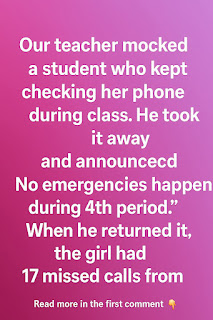
It was a typical school day, the kind filled with the low hum of disinterest and the glow of secret phone screens. Our teacher, a man known for his sharp wit, had finally had enough of a girl in the third row. Her attention was clearly elsewhere, her eyes darting to her phone in her lap. He called her out, his voice laced with sarcasm as he strode over. He plucked the phone from her desk, holding it aloft like a trophy. “No emergencies happen during fourth period,” he announced to the class, and a ripple of obedient laughter followed. He placed the phone on his desk, a clear symbol of his authority, and the lesson continued. The girl sank lower in her seat, saying nothing, her face a mask.
When the bell for the end of the period finally rang, he returned the phone to her with a final, dismissive comment. We all watched as she powered it on. The change in the room was immediate and profound. The chatter died mid-sentence. Her face, previously flushed with embarrassment, drained of all color as she stared at the lit screen. Seventeen missed calls. All from the same unknown number. The triumphant smirk faded from our teacher’s face as he watched her. With a stillness that was terrifying, she simply raised her hand and asked to leave. The permission was granted, but the confidence had left his gesture. The door clicked shut behind her, and a heavy, unfamiliar silence filled the space she left behind.
We didn’t need to hear the conversation in the hall to understand the gravity had shifted. The vice principal’s appearance at the door, the hushed words, the way our teacher’s shoulders seemed to collapse inward—it all painted a clear picture of a terrible mistake. He returned to the room a different man, his voice flat, instructing us to work quietly. The girl did not come back. In the hallways and lunchroom, the story began to assemble itself in hushed tones. The calls were from a hospital. A family member was in crisis. Those glances at her phone hadn’t been boredom; they had been a lifeline to a private, unfolding tragedy.
The next morning, before any lesson began, our teacher stood before us. He offered no justification, no attempt to save face. He offered a simple, direct apology for his assumption and his public shaming. He spoke about compassion being a necessary companion to rules, about the unseen burdens people carry. For many of us, it was a seismic moment—the first time we witnessed an adult in a position of power demonstrate such raw accountability. The lesson on the syllabus was forgotten, but the lesson in that room was permanently etched into our understanding of the world.
That day taught us more about humanity than any textbook chapter ever could. It revealed that behind every face is a story we cannot see, a battle we might not understand. It taught us that patience is a form of grace, and that a moment of kindness, or the withholding of a judgmental comment, can be a profound gift. Years later, I still carry the weight of that quiet classroom. It is my personal compass, a reminder to always choose curiosity over assumption, because you never truly know what someone else’s screen is showing them.