The château near Versailles glittered, a snow globe of wealth shaken for a wedding day. Outside its golden light, a boy named Ilyès hesitated. He was ten, sharp with hunger, a child of the Paris streets raised by an old man’s weary kindness. His treasure was a frayed red bracelet and the memory of a guardian’s voice: “If you find your mother, forgive her.”
Drawn by the scent of food, he slipped inside. A sympathetic cook pressed a warm plate into his hands. He ate in the shadows, a silent spectator to a ballet of silk and crystal. Then, a fanfare. The bride descended. She was beauty incarnate, but Ilyès saw none of it. His world dissolved until only one thing remained in focus: on her slender wrist, a red braided bracelet, worn thin with time.
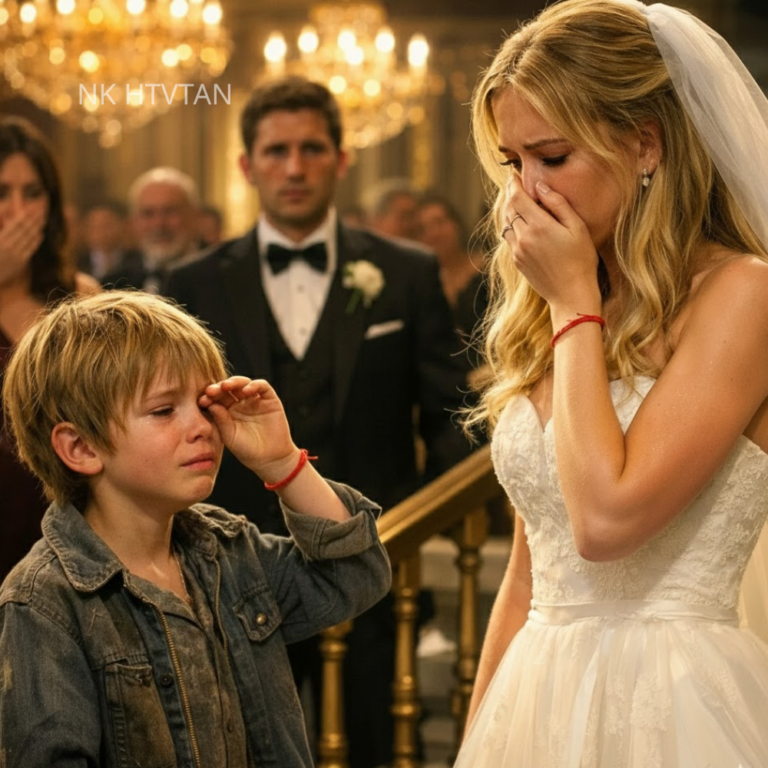
A current, older than memory, pulled him forward. He stood before the radiant vision, his voice a fragile thread in the hushed room. “Ma’am… that bracelet… are you my mother?”
Time fractured. The music played to an audience that no longer heard it. The bride stared, her composure crumbling like ancient plaster. She sank to the floor, her white gown pooling around her, a stark contrast to the dusty boy. “What is your name?” she breathed.
“Ilyès.”
The name, spoken aloud in that room, was a key turning in a long-locked door. Her confession was not for the crowd, but for him—a story of a girl, too young and too alone, who made a choice that haunted every day of her life since. She had kept the bracelet as a sacred tether to the son she believed she’d lost forever.
Then, a new figure entered the scene: the groom. He absorbed the shock in the room, the weeping woman, the child who was his wife’s living history. The guests braced for scandal, for retreat. Instead, he knelt. He met Ilyès not as a problem, but as a person. His question was simple, kind: “Would you like to stay and eat with us?”
The boy shook his head, his wish more fundamental than food. “I only want my mother.”
The groom’s smile was the truest thing in the room that day. He opened his arms, encircling both the woman he loved and the child who was part of her soul. “Then, from today on, you will have a mother—and also a father.”
In that embrace, the wedding’s purpose was rewritten. The splendor became irrelevant. What mattered was the mending of a broken thread, now woven into a stronger, more beautiful pattern. The applause that erupted was wet with tears, a salute not to perfection, but to grace. And Ilyès, holding two new hands, knew he was no longer a boy from under the bridge, but a son who had finally found his way home.