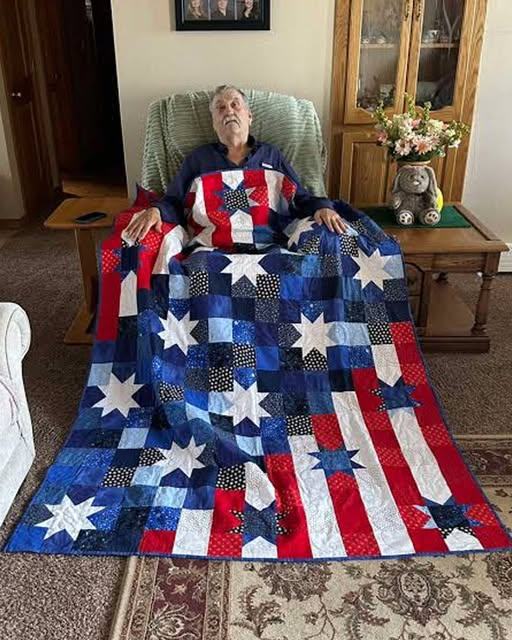
There is a photograph that tells a story deeper than words. It shows a frail man, wrapped in the soft folds of a red, white, and blue quilt, his hands gently tracing the fabric. To a casual observer, it is a tender scene. But to those who know, it is a monument to a long-delayed homecoming. This is the image of a Vietnam veteran, in the final stages of his life, finally receiving the thanks he had waited for since 1973. For fifty-two years, his service was met not with gratitude, but with a nation’s anger and rejection, a burden he carried in silence.
He was a young man when he left for Vietnam, completing three tours of duty. He returned not to parades, but to protests; not to handshakes, but to hostility. The experience taught him to hide his past. He stored his medals, swallowed his stories, and built a quiet life, all while holding a private belief that his sacrifice was something to be ashamed of, not honored. This unspoken shame became a companion for over half a century, a silent weight that even his loving family could not fully lift.
As he entered hospice care for stage-four cancer, his daughter faced a heartbreaking dilemma. She was losing him, and she realized she didn’t know how to honor a man who had spent a lifetime believing he was not worthy of honor. Desperate, she turned to an online community, posting a simple question: did anyone make quilts for veterans in hospice? The response was immediate. A stranger, a quilter, sent a message saying she would start that very night.
The quilter worked tirelessly for three weeks. Her father, also a veteran, had died feeling forgotten, and she was determined to prevent another family from knowing that pain. She crafted a Quilt of Valor, a national program that gives tangible thanks to service members. Each stitch was an act of apology, each star a piece of validation. She mailed it with a note that read, “Let your dad know the country was wrong. His service mattered. He matters.”
When the quilt was unfolded and placed over him, a lifetime of stoicism dissolved. He touched the stars and stripes with reverence, and then he wept for twenty minutes. It was not a cry of pain, but of release. He kept whispering, “Someone made this for me?” In that moment, the young soldier who never got a welcome home finally received one. The quilt was more than fabric; it was a correction of history, a moral salve applied to a wound that time alone could not heal.
This single act of kindness ignited a mission. The veteran’s son, witnessing the transformation, began using the same app to connect other dying veterans with volunteer quilters. They are now racing against time to ensure no one else leaves this world feeling forgotten. The original quilt will outlive the veteran, becoming a family heirloom that whispers, “He mattered.” It stands as a powerful reminder that gratitude is never too late, and that sometimes, healing can arrive wrapped in stars.