The email from Human Resources arrived at exactly 10:14 AM. It was a sterile, corporate death sentence, wrapped in phrases like “organizational restructuring” and “streamlining operational efficiencies.” In a matter of seconds, my position as a senior data analyst was erased. A cold dread coiled in my gut, not just from the loss of income, but from the terrifying vulnerability it created.
I was twenty-eight, living in a modest apartment in the heart of the city, and entirely self-sufficient. Or so I thought.
By 3:00 PM, the heavy, frantic pounding on my front door shattered the silence of my living room. I expected a delivery, perhaps a neighbor. I did not expect to open the door to find my building manager, Mr. Alvarez, standing there with a face pale and slick with sweat. He held a manila envelope so tightly his knuckles were white.
But it wasn’t Mr. Alvarez who made the breath catch in my throat. It was the trio standing right behind him in the hallway.
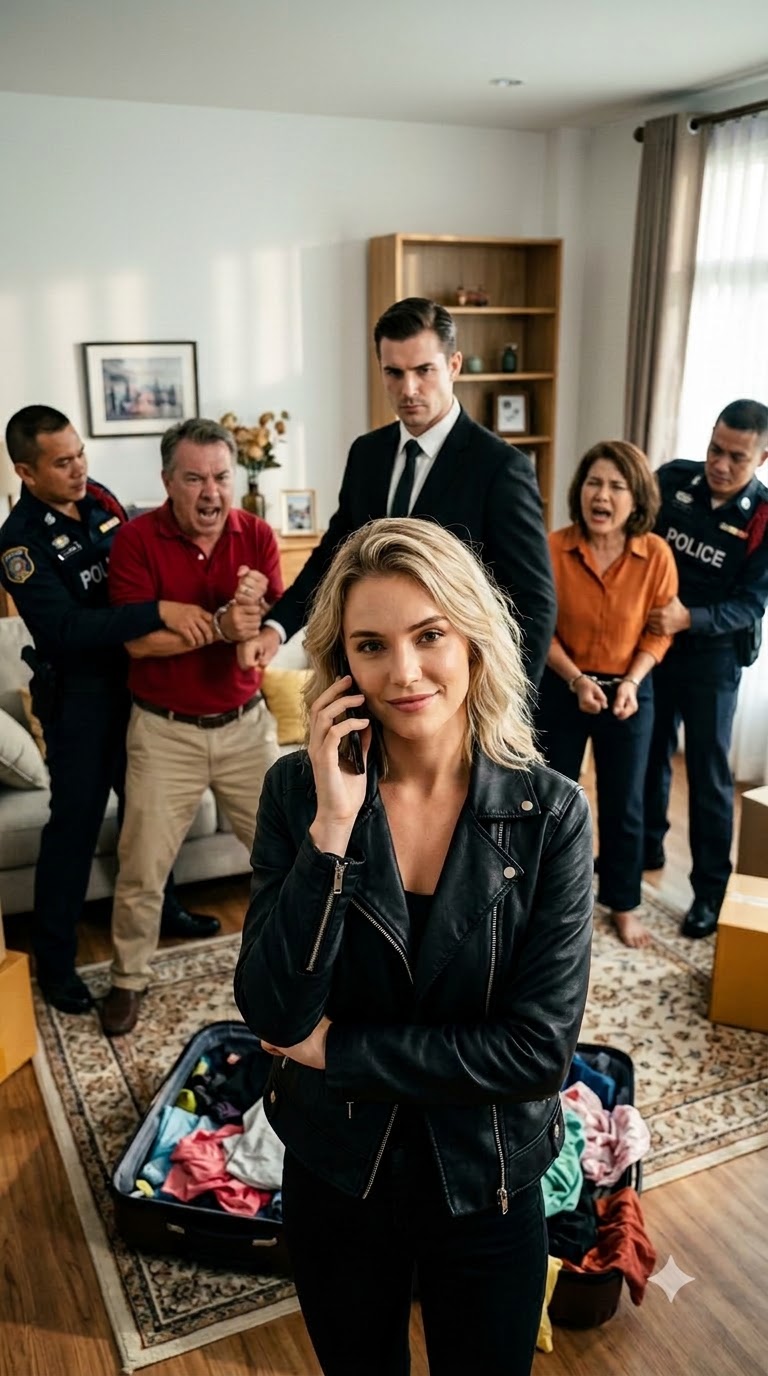
My mother, Diane, wore her signature cashmere sweater, holding her smartphone up, the red recording light blinking ominously. Beside her stood my father, Robert, his arms crossed, a smirk playing on his lips. And leaning against the wall was my younger brother, Tyler, vaping and looking utterly bored, yet undeniably amused.
“What is going on?” I asked, my voice barely a whisper.
“We’re documenting a pivotal moment in your life, Claire,” my mother chirped, her voice dripping with artificial sweetness. “The moment you learn about real-world consequences.”
Mr. Alvarez couldn’t meet my eyes. He stepped forward, his shoulders slumped. “Miss Claire, I… I am so sorry. Your parents, they paid me. A thousand dollars in cash. They said if I didn’t enforce an immediate, emergency eviction and lock you out by sunset, they’d ensure I lose my job when they take over the building’s management.”
When they take over the building. The words echoed in my mind, a sickening puzzle piece snapping into place.
“You’re evicting me?” I stared at my parents. “I just lost my job five hours ago. How do you even know?”
“Word travels,” Dad said dismissively. “You’ve been entirely too arrogant, Claire. Hoarding your grandfather’s resources. Thinking you’re better than this family. It’s time you hit rock bottom. A few nights on the street will teach you the humility you so desperately lack.”
Tyler chuckled, exhaling a cloud of vapor. “Smile for the camera, sis. Going to make a great TikTok. ‘Rich girl learns how to use a cardboard box.’”
I stepped back, trying to close the door, but Dad wedged his expensive leather loafer in the jamb. He nodded at Mr. Alvarez. “Do it. Get her trash out of here.”
Mr. Alvarez looked like he wanted the floor to swallow him whole. With trembling hands, he reached past me to the small entryway table. My grandfather, Arthur Whitmore, had left me only one personal item outside of his financial estate: a vintage, gold-plated pocket watch. It sat on a velvet display cushion.
Before I could stop him, Mr. Alvarez, driven by the panic of losing his livelihood, grabbed the cushion and tossed it out into the hallway. The watch hit the hardwood floor with a sickening crack, the glass face shattering into a dozen jagged pieces.
Time seemed to freeze. The ticking I had listened to for comfort since Grandpa died suddenly ceased.
Mom brought the camera closer, capturing my horrified expression. “Don’t cry, Claire. This is for your own good. We’re doing this because we love you.”
I looked at the broken glass. I looked at the red light on my mother’s phone. And then, the cold dread in my stomach evaporated, replaced by a glacial, unyielding fury.
They weren’t doing this to teach me a lesson. The cruelty was too specific. The timing was too perfect.
“Give me one hour to pack,” I said, my voice eerily calm.
Dad smirked. “One hour. Then the locks are changed.”
They retreated to the end of the hall to wait, laughing amongst themselves. I closed the door, locked the deadbolt, and walked past my empty suitcases. I didn’t pack clothes. I picked up my phone and dialed the one person who could confirm my sudden, terrifying suspicion.
If they want a show, I thought, staring at the broken watch, I’m going to give them a masterpiece.
The phone rang twice before she answered. “Claire? It’s unusual for you to call during business hours.”
“Elise,” I said, my voice steady. “I need you to look at Section 4, Paragraph B of the trust agreement. The guardianship contingency. Right now.”
I heard the rustle of papers, followed by a sharp intake of breath from my attorney. “Claire… how did you know? Someone filed a motion in probate court this morning to declare you legally incompetent and unhoused.”
Elise Chen did not panic; she strategized. As the primary legal counsel for the Whitmore Family Trust, she was a woman whose blood ran with the icy precision of case law. Within thirty minutes of my call, I was sitting in the back of a black car heading toward her downtown office, having slipped out the building’s fire escape with only my laptop, the broken pocket watch, and a single duffel bag.
Let my parents film an empty apartment. Let them think they had won.
Elise’s office smelled of expensive leather and old paper. She had a thick, red-tabbed file waiting on her mahogany desk when I arrived.
“They moved fast,” Elise said, bypassing any pleasantries. She slid a copy of a legal filing across the desk. “Your father’s attorney—a rather sleazy practitioner named Marcus Vance—filed an emergency petition for a transfer of trusteeship. The grounds? The current trustee—you—has suffered a sudden job loss, is facing immediate homelessness, and is exhibiting signs of severe mental distress.”
I scoffed, reading the document. “They engineered the homelessness. They bribed my building manager to throw me out on the street today.”
Elise’s eyes narrowed. “The trust your grandfather set up is ironclad, Claire. He made you the controlling trustee because he knew your parents lacked financial discipline. But there is that one Achilles’ heel. Section 4, Paragraph B. If the trustee becomes bankrupt, incarcerated, legally unhoused, or mentally incapacitated, control of the trust’s assets automatically reverts to the legal next-of-kin. Your parents.”
“They didn’t want to teach me a lesson,” I muttered, tracing the gold rim of my grandfather’s broken watch. “They wanted the keys to the kingdom.”
“And they almost got them,” Elise said. “But there is something else. Something worse.”
She opened the second half of the red folder. For the past month, I had authorized Elise to conduct a quiet, routine audit of the trust’s auxiliary disbursements. My parents received a comfortable monthly allowance, but over the last two years, I had been approving massive, emergency medical withdrawals for my mother.
“Diane claimed she was diagnosed with early-stage pancreatic cancer,” I said, the words tasting like ash. “The treatments, the out-of-network specialists, the private rehabilitation retreats… I approved every single invoice. I didn’t want to be the reason she suffered.”
Elise turned a monitor toward me. On the screen were banking trails. Complex, winding paths of digital currency that Elise’s forensic accountant had painstakingly mapped out.
“There is no cancer, Claire,” Elise said softly.
The room spun. I grabbed the edge of the desk. “What?”
“We subpoenaed the medical facilities listed on the invoices. The clinics are shell companies. The doctor signatures are forged. Diane has not seen an oncologist in a decade. The ‘treatments’ were a complete fabrication.”
A sickening wave of betrayal washed over me. I had cried for her. I had spent nights staring at the ceiling, praying for her recovery, willingly depleting the trust’s safety net to save my mother’s life. It was all a lie.
“Where did the money go?” I asked, my voice barely recognizable to my own ears.
Elise clicked a button, bringing up a property deed. “It was laundered through three different LLCs and finally deposited here.”
I stared at the photograph on the screen. It was a sprawling, ultra-modern mansion located in Oakridge Estates, the most exclusive zip code in the state. Floor-to-ceiling windows, an infinity pool, a pristine driveway.
“Your brother Tyler’s ‘startup’ didn’t fail, Claire,” Elise explained. “It never existed. The trust money—nearly two million dollars of fake medical bills—was used to purchase this estate outright. It is registered under a trust controlled by Tyler and your parents. They’ve been living a double life on your grandfather’s dime, and now, they want the rest of the pie.”
I closed my eyes. The audacity of it was suffocating. They had filmed my orchestrated misery, mocked my unemployment, and shattered my grandfather’s watch, all while lounging in a mansion bought with stolen grief.
When I opened my eyes, the sadness was gone. It had burned away, leaving only a sharp, tactical clarity.
“Elise,” I said. “Can we prove the fraud? Unquestionably?”
“With this paper trail? Yes. It constitutes felony wire fraud and grand larceny.”
“Good.” I stood up, grabbing my laptop. “I want you to draft a very specific contract. And I need you to hire private security. We are going to let them think their little plan worked. For exactly forty-eight hours.”
As I turned to leave the office, my phone vibrated in my pocket. It was a text from Tyler, accompanied by a photo of my empty apartment living room.
Looks like the little bird flew the coop. Enjoy the park bench, loser. Don’t forget, Mom and Dad are celebrating at Le Petit Château tomorrow night. Too bad you can’t afford the breadsticks.
I smiled, typing a reply he wouldn’t receive until it was far too late.
Oh, I wouldn’t miss it for the world.
I spent the next two days living out of a mid-range hotel, letting the silence do my heavy lifting. I ignored the fourteen missed calls from my mother. I ignored the mocking voicemails from my father pretending to be a homeless shelter intake worker.
I was busy orchestrating a symphony of ruin.
Elise and I worked around the clock. We didn’t just gather the financial documents; we gathered the people. I made a visit to Mr. Alvarez. The man was a nervous wreck, terrified of losing his job, terrified of my parents. I sat at his cramped kitchen table and offered him a choice: become an accessory to a multi-million-dollar fraud scheme, or become a protected whistleblower.
It took thirty minutes of tears and apologies, but he finally handed over the security footage of my parents bribing him in the hallway, and, more importantly, an audio recording he had secretly taken on his phone when my father first threatened him into the scheme.
Next came the family. My aunts, uncles, and cousins—the same relatives who had spent the last three years whispering that I was a greedy, heartless tyrant hoarding Grandpa Arthur’s wealth. I didn’t tell them the whole truth. I simply told them I had a major announcement regarding the distribution of the Whitmore Family Trust, and that I would be making it at my parents’ dinner party. Greed is a fantastic motivator; every single one of them RSVP’d.
Friday night arrived, draped in a crisp, unforgiving chill.
Le Petit Château was an absurdly pretentious French restaurant downtown, the kind of place where the chandeliers looked like frozen waterfalls and the waiters spoke in hushed, reverent tones. It was exactly the kind of place my parents loved to display their imagined superiority.
I parked two blocks away. Elise sat in the passenger seat of her sedan, reviewing the final draft of the contract.
“You realize,” Elise said, adjusting her glasses, “once we walk through those doors, there is no going back. This will detonate your family structure permanently.”
I looked at the shattered face of Grandpa’s pocket watch, resting in my cupped hands. “They detonated the family the day they faked cancer to buy a swimming pool.”
I stepped out of the car. The night air was biting, but I felt nothing.
Through the massive glass windows of the restaurant’s private dining atrium, I could see them. The long mahogany table was set for twenty. My parents sat at the head, glowing with triumph, raising glasses of champagne. Tyler was next to them, laughing loudly at something my uncle had said. The entire extended family was there, dressed to the nines, waiting for the “good news.”
They thought they were celebrating a legal victory. They thought my father’s sleazy lawyer had successfully filed the paperwork making them the masters of the trust. They thought I was shivering on a street corner.
I pushed through the heavy brass doors of the restaurant. The maître d’ tried to stop me, eyeing my simple black trench coat and jeans, a stark contrast to the evening gowns and tuxedos inside.
“Excuse me, miss, this is a private event,” he said.
“I know,” I replied, stepping past him. “I’m the guest of honor.”
Behind me, the heavy tread of heavy boots echoed on the marble floor. Elise flanked my right. To my left, two uniformed police officers—friends of Elise who occasionally worked private security—fell into step. And trailing behind them, looking like he was walking to the gallows, was Mr. Alvarez.
I reached the entrance of the private atrium just as my father tapped his crystal glass with a silver spoon.
“Family,” Dad announced, his voice booming over the quiet chatter. “We are gathered tonight to celebrate a new era. An era where the Whitmore legacy is finally guided by responsible hands, free from the selfish grip of—”
I pushed the grand oak doors open with a resounding crash that rattled the chandeliers.
“Free from the grip of whom, Dad?” I asked, stepping into the light.
The champagne glass slipped from my mother’s hand, shattering on the floor. It sounded exactly like a breaking watch.
Silence descends in different ways. Sometimes it’s peaceful. This silence was a vacuum, sucking the oxygen out of the luxurious room. Twenty pairs of eyes snapped toward me, wide with shock, confusion, and in my parents’ case, naked terror.
Tyler choked on his wine, coughing violently into his napkin.
“Claire?” Aunt Susan whispered, looking from my jeans to the police officers standing stoically behind me. “What is the meaning of this? Your father said you were in a residential psychiatric facility.”
I let out a harsh, humorless laugh. “Is that the story? How creative. No, Aunt Susan. My parents paid my landlord one thousand dollars to illegally evict me on the day I lost my job, hoping to render me legally homeless so they could trigger a contingency clause and steal Grandpa’s trust.”
Murmurs erupted around the table.
Dad recovered first. He slammed his hand on the mahogany table, his face flushing crimson. “How dare you barge in here and spew these lies! You are unwell, Claire. Officers, please escort my daughter out. She is having a mental breakdown.”
“I’m perfectly sane,” I said, walking slowly toward the head of the table. I gestured for Elise to step forward. “But I am very, very thorough. Elise?”
Elise didn’t flinch. She dropped a massive stack of bound documents right into the center of the table, knocking over a centerpiece of white roses.
“This,” Elise announced, her voice carrying the cold authority of a judge, “is a comprehensive forensic audit of the Whitmore Family Trust spanning the last twenty-four months. Conducted under the authority of the controlling trustee, Claire Whitmore.”
Mom’s face lost all color. The heavy makeup couldn’t hide the sudden, skeletal hollows of her cheeks. “An audit?” she whispered.
“Yes, Mom,” I said, leaning over the table to look her dead in the eyes. “An audit of your miraculous, invisible pancreatic cancer.”
A collective gasp echoed through the room. My relatives exchanged horrified glances.
“For two years,” I addressed the room, my voice rising, vibrating with years of repressed anger, “I authorized emergency medical withdrawals to save my mother’s life. Over 1.8 million dollars. I cried for you. I lost sleep for you.” I pointed a trembling finger at Tyler. “And you used that money to buy a six-bedroom mansion in Oakridge Estates while I was clipping coupons to make sure the trust remained stable.”
“That’s a lie!” Tyler shouted, standing up so fast his chair crashed backward. “She’s making it up! It’s her fault my business needed a loan!”
“A loan?” I snapped. “Show me the promissory note, Tyler. Show me the business license.”
I snapped my fingers. Mr. Alvarez, shaking like a leaf, stepped forward and placed a small Bluetooth speaker on the table. He pressed play on his phone.
The audio was slightly muffled, but unmistakable.
Dad’s voice: “Listen to me, you little immigrant rat. You take this thousand, you throw her stuff in the hall, and you change the locks today. If you don’t, when the judge gives me this building tomorrow, you and your family are on the street.”
Mom’s voice, laughing in the background: “Make sure she doesn’t have time to pack her coat. It’s supposed to freeze tonight. She needs to learn her place.”
The recording clicked off. The silence that followed was apocalyptic.
Aunt Susan covered her mouth, tears welling in her eyes as she looked at my mother with pure disgust. “Diane… you faked cancer? To steal from our father’s legacy?”
Mom burst into dramatic, theatrical tears, reaching out toward me. “Claire, honey, please! It wasn’t like that! We just wanted Tyler to have a fair start. You had everything! The power, the money—”
“I had a job, and I had the burden of keeping this family from bankrupting itself!” I roared, slamming my hands on the table. “You didn’t want a fair start. You wanted to destroy me because my independence made you feel small.”
Dad puffed out his chest, trying to salvage the unsalvageable. “You can’t do anything with this. The paperwork is filed. You’re homeless. The trust is mine.”
Elise pulled a single, crisp sheet of paper from her briefcase. “Actually, Robert, your attorney, Mr. Vance, withdrew his petition twenty minutes ago. Upon receiving a preview of this audit, he realized he had been an accessory to perjury and fraud. He abandoned you.”
Dad froze. The arrogant façade cracked, crumbling into a portrait of a desperate, cornered old man.
I turned to the two police officers. “Gentlemen, you have the evidence packets Elise prepared regarding the wire fraud and forged medical documents?”
The taller officer nodded, stepping forward and unhooking handcuffs from his belt. “We do, ma’am. Robert and Diane Whitmore, we need you to step away from the table.”
Mom let out a piercing, guttural scream as the officer reached for her wrist. “Claire! You can’t send your own mother to prison! Please!”
I looked down at her, feeling absolutely nothing.
“I can,” I said softly. “But I have a better idea.”
I held up a hand, stopping the officers before they could cuff my parents. The officers paused, looking at Elise, who nodded once. This was the theatrical climax we had carefully rehearsed.
“You wanted to teach me a lesson about the real world,” I said, my voice echoing in the dead silence of the ruined dinner party. I pulled a thick legal document from Elise’s folder and slid it across the table toward my father. A sleek Montblanc pen rested on top of it.
“What is this?” Dad rasped, staring at the paper as if it were a coiled snake.
“This is your salvation, and your ruin,” I replied. “It is a legally binding, irrevocable surrender of all claims, current and future, to the Whitmore Family Trust. It includes a confession of financial fraud and medical forgery.”
Mom sobbed into her napkin, her mascara running in thick black rivers down her face. “If we sign it… what happens?”
“If you sign it,” Elise interjected, her tone clinical, “Claire will decline to press federal fraud charges. You will not go to federal prison.”
Tyler let out a breathless laugh of relief. “Okay. Okay, fine. We sign it. We give up the trust. Big deal.”
I turned my gaze to my brother, stripping away any lingering affection I ever held for him. “You didn’t let me finish, Tyler. The document also stipulates immediate restitution. The Oakridge Estates mansion? As of Monday morning, it is being seized by the trust to recoup the stolen medical funds. You have forty-eight hours to vacate the premises.”
Tyler’s jaw dropped. “You can’t take my house! I live there! My cars are there!”
“The cars were bought with the same fraudulent funds,” Elise noted, tapping her pen against her clipboard. “They will be liquidated at auction.”
“You’re leaving us with nothing?” Dad asked, his voice shaking with a terrifying mix of rage and impotence.
“I’m leaving you with exactly what you tried to leave me with,” I said, leaning in close. “A suitcase and the clothes on your back. The trust will no longer issue your monthly stipends. You will have to get jobs. Real jobs, where you clock in and answer to someone else. If you refuse to sign, the officers will arrest you right now, and I will personally see to it that the prosecution uses every page of this audit to ensure maximum sentencing.”
I tapped the Montblanc pen. “You have sixty seconds to decide. Tick tock.”
The silence was agonizing. The relatives who had once called me cruel now watched in silent, grim approval. They saw the cancer lie. They saw the eviction video. There was no sympathy left for the wolves.
Dad looked at the police officers, then at the audit, and finally at me. He saw no hesitation in my eyes. With a shaking, defeated hand, he picked up the pen and signed. He pushed it toward my mother, who signed it blindly through her tears.
“Get out,” I said, pulling the document back.
Tyler didn’t move, staring at me in shock. “Claire… where are we supposed to go?”
I picked up Grandpa’s broken pocket watch from my pocket and placed it gently on the table, right next to the spilled champagne.
“I hear sleeping outdoors builds character,” I said. “It should teach you a lesson.”
They left in silence. The grand exit they had envisioned for themselves at my expense had morphed into a walk of shame, watched by every member of the family they had tried to manipulate.
Two months have passed since the dinner at Le Petit Château.
The Oakridge mansion was sold, the proceeds returned to the trust, restoring its balance and securing the financial future of the relatives who actually needed and deserved support. I used a small portion to repair the gold pocket watch. The glass is new, but the ticking heart inside is exactly as Grandpa left it.
My parents moved into a tiny, cramped one-bedroom apartment on the outskirts of the city. Dad is working as a floor manager at a hardware store, and Mom took a job as a receptionist at a dental clinic. Tyler, stripped of his fake startup and luxury cars, is currently sleeping on a friend’s couch, working night shifts at a warehouse.
I never moved back into Mr. Alvarez’s building. I bought a small, beautiful townhouse with my own savings—money I had built up because I was, as they complained, “too independent.”
I also found a new job. It pays better, the title is higher, and the team respects me. But the real victory isn’t the job, or the house, or even the money.
The real victory is the profound, unshakeable silence from people who once thought they could break me for sport. They believed that removing my safety net would make me compliant. They failed to realize that the net wasn’t catching me; it was the only thing holding me back from fighting back.
I learned the hardest lesson a daughter can learn: sometimes, the people who are supposed to protect you are the ones you need the most protection from. But I survived it. I documented it. I conquered it.
If you want more stories like this, or if you’d like to share your thoughts about what you would have done in my situation, I’d love to hear from you. Your perspective helps these stories reach more people, so don’t be shy about commenting or sharing.