Chapter 1: The Invisible Pedigree
Karl always possessed a quiet confidence that I mistook for simplicity. For the four years we dated, I felt I had memorized every contour of his soul. He was the man who preferred domestic evenings over loud bars, who could fix a leaky faucet with a focused scowl, and who held my hand as if I were the most fragile and precious thing he had ever encountered. But there was a wall in his mind, a fortified border that I was never permitted to cross: the subject of his family.
In the early days of our relationship, I assumed the silence was born of tragedy. I imagined lost parents or a fractured childhood that was too painful to revisit. But as our life together deepened, the absence of his kin became more conspicuous. There were no holiday phone calls, no childhood photos on the mantel, no “crazy uncle” stories shared over wine.
“They’re complicated, Megan,” he would say whenever I pressed for a name or a location. His voice would take on a clipped, metallic edge that warned me to back away.
“Complicated how, Karl? Everyone has family drama. My sister didn’t speak to my mom for three years over a bridesmaid dress. We can handle it.”
He would give a short, humorless laugh—a sound that didn’t reach his eyes. “Rich people complicated. It’s a different dialect of misery, babe. Trust me, we’re better off in our little bubble.”
That was the end of the conversation. Every time.
I grew to accept it, though I couldn’t help but notice the small things that slipped through the cracks of his secrecy. He had a refined palate for things we couldn’t afford—a knowledge of vintage wines and the specific cut of a suit that seemed incongruous with his modest salary as a graphic designer. He spoke three languages fluently but claimed he’d “just picked them up” from apps.
One evening, about six months before the wedding, we were sitting at our tiny, chipped kitchen table eating spaghetti. The radiator was clanking, and the overhead light flickered with the rhythm of a dying star. Karl set his fork down and looked around our cramped apartment, his eyes lingering on the water stain on the ceiling.
“You ever think about how different life could be with more money?” he asked suddenly.
“Sure,” I said, trying to keep it light. “In this economy, even a fifty-dollar raise would be amazing. I could finally buy that ergonomic chair for my desk.”
He shook his head, his expression intense. “No, I mean real money. The kind that buys freedom. The kind where you never have to check your balance before you walk into a store. Traveling whenever you want. Starting a business without worrying it’ll ruin you. Being… untouchable.”
I smiled, reached across the table, and squeezed his hand. “You sound like you’re pitching a scam, Karl. We’re doing okay. We have enough for the bills, and we have each other. As long as I have you, I’m happy.”
His face softened, the tension in his jaw bleeding away. “You’re right. As long as we’re together and don’t have to answer to anyone else, everything will be okay. That’s the dream, isn’t it? Independence.”
I should have asked more questions. I should have asked why he felt he had someone to “answer to.” But I chose patience. I thought that by being a safe harbor, I would eventually earn the right to see the map of his past. I believed that love was a slow-thawing process. I didn’t realize that some ice is meant to hide a shipwreck.
Chapter 2: The Vow and the Void
Our wedding day was a triumph of DIY aesthetics and genuine joy. We had rented a historic reception hall that smelled of floor wax and old wood, filling it with wildflowers and fairy lights. I felt like a queen in my lace dress, and Karl—my God, Karl looked like a man who had finally stepped out of a long shadow. He had discarded his suit jacket early in the night, rolling up his sleeves as he spun me around the dance floor to a slow jazz standard.
“I’ve never seen you this happy,” I whispered into his ear.
“Because I’ve never been this free,” he replied.
The music transitioned into a more upbeat tempo. Laughter echoed off the high ceilings. My parents were dancing, his cousin Daniel—the only family member who bothered to show up—was nursing a drink at the bar, and for a moment, the world was perfect.
Then, the rhythm of my life shattered.
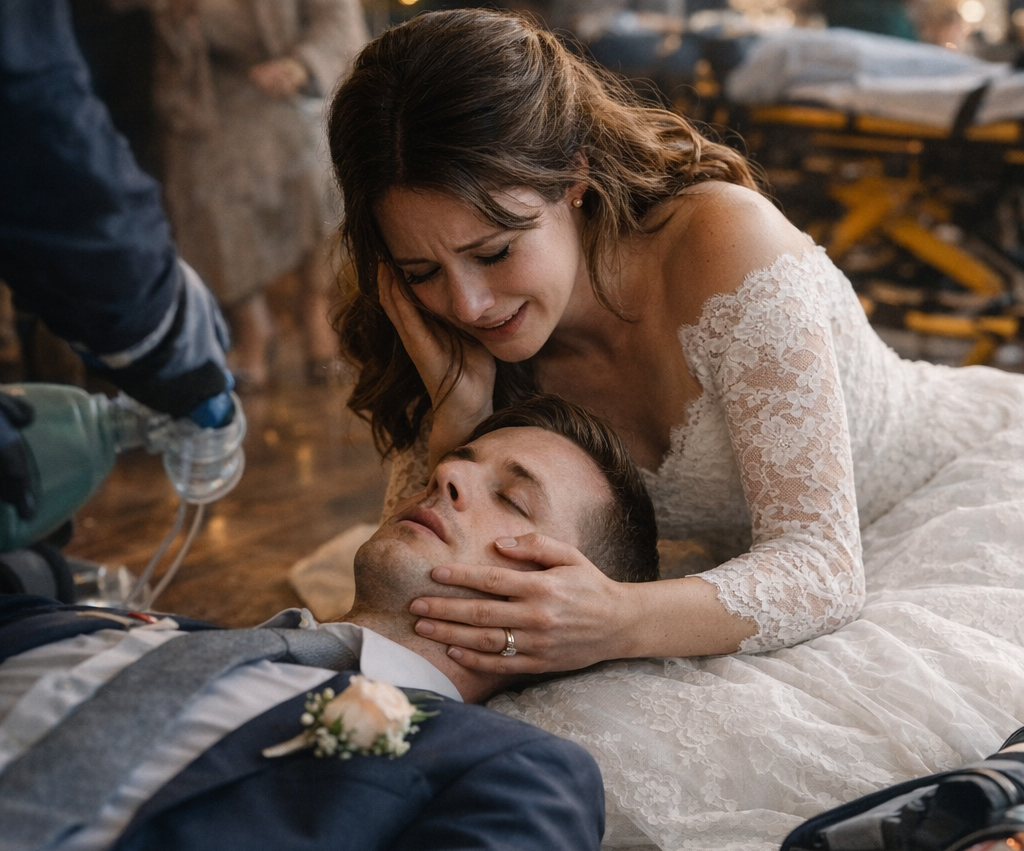
Karl’s hand flew to his chest, his fingers bunching the fabric of his white shirt. His eyes, which had been full of light moments before, suddenly rolled back, revealing only the whites. His body jerked violently, a strange, mechanical spasm as if he were trying to catch himself on an invisible ledge.
And then—he collapsed.
The sound of him hitting the parquet floor was a dull, sickening thud that seemed to vibrate through my own bones. For one heartbeat, the room went silent. The band faltered, the guests froze mid-stride, and the air seemed to vanish from the hall.
Then, the world exploded into chaos.
A woman screamed. Someone shouted for the music to be cut. “Call an ambulance! Someone call 911!”
I was already on my knees, the heavy satin of my wedding dress pooling around me like a white shroud. I grabbed his face, his skin already feeling unnervingly cool. “Karl? Karl, look at me! Breathe, please, just breathe!”
His body was limp, his jaw slack. The paramedics arrived with a speed that felt both miraculous and terrifying. They swarmed over him, a blur of blue uniforms and black equipment. I heard the frantic, clipped language of emergency medicine.
“V-fib! Charge to 200!” “Clear!” “Again!” “No response.”
I stood there, my hands pressed against my mouth, watching the man I had married minutes ago be treated like a malfunctioning machine. Finally, one of the paramedics looked up at me, his eyes full of a practiced, heavy sympathy.
“It appears to be a massive cardiac arrest, ma’am. We’re taking him to Mercy General, but it doesn’t look good.”
They loaded him onto a stretcher and raced toward the exit. I stood frozen in the center of the dance floor, the fairy lights still twinkling mockingly above me. Tears were streaming down my face, hot and salty, as I stared at the double doors long after they had swung shut. Someone—maybe my mother—wrapped a coat around my shoulders, but I felt nothing. I was a hollowed-out shell, standing in the wreckage of a dream.
The hospital was a blur of fluorescent lights and the smell of stale coffee. A doctor eventually emerged, his face a mask of professional regret.
“I’m so sorry, Mrs. White. We did everything we could, but the damage was too extensive. Your husband passed away shortly after arrival.”
The words didn’t make sense. Karl was thirty-two. He ran five miles every morning. He didn’t have a heart condition. He was supposed to be my “forever.” Now, he was a body in a cold room, and I was a widow before I had even signed the marriage certificate.
Chapter 3: The Lonely Grave
The following four days were a masterclass in survival through dissociation. I arranged everything. There was no one else to do it. My parents were supportive, but they were as blindsided as I was.
I sat in the funeral director’s office, choosing a mahogany casket and a plot in a quiet corner of the cemetery. I felt like I was planning someone else’s life, or perhaps a movie I didn’t want to see. When I checked Karl’s phone for family contacts, there was only one: Daniel (Cousin).
I called him. He picked up on the first ring, his voice guarded. When I told him Karl was dead, there was a long, heavy silence. He didn’t cry. He didn’t gasp. He just said, “I’ll be there.”
The funeral was a small, somber affair. The weather was a perfect, insulting blue. I stood by the grave, my black veil fluttering in the breeze, feeling the weight of every clod of earth that hit the lid of the casket. Karl’s parents didn’t show up. There were no flowers from a “Mr. and Mrs. Sterling” or whoever they were.
Daniel stood off to the side, his hands shoved deep into his coat pockets. He looked uncomfortable, his eyes darting toward the cemetery gates as if he were expecting a raid. When the service ended, I walked over to him, my grief beginning to curdle into a sharp, bitter anger.
“You’re Karl’s cousin, right?” I asked, my voice raw.
He nodded slowly. “Daniel. I’m sorry for your loss, Megan.”
“I thought his parents would come,” I said, gesturing to the empty chairs. “I thought even ‘complicated’ people showed up for their son’s funeral.”
Daniel rubbed the back of his neck, refusing to meet my eyes. “Yeah… they’re complicated, like I said. Wealthy people, Megan. They don’t forgive mistakes easily. Especially the one Karl made.”
“What mistake?” I demanded, my voice rising. “What could he have possibly done that justifies skipping his burial?”
Daniel’s phone buzzed in his pocket. He pulled it out, glanced at the screen, and looked visibly relieved. “I’m sorry. I have to go. Business.”
“Daniel, wait! What mistake was he talking about?”
But he was already moving, his pace quickening until he was almost at a trot. He climbed into a black sedan and sped away, leaving me standing alone among the headstones.
That was the first crack in the reality I had built.
The second crack came that night. I returned to our apartment, but it wasn’t a home anymore; it was a museum of a dead man. His toothbrush was still in the holder. His half-finished book was on the nightstand. Every corner of the room screamed his name.
I lay down on the bed, but every time I closed my eyes, I saw him hitting the dance floor. The sound of his skull on the wood. The “clear!” of the defibrillator. The cycle was endless, a carousel of trauma that wouldn’t stop spinning.
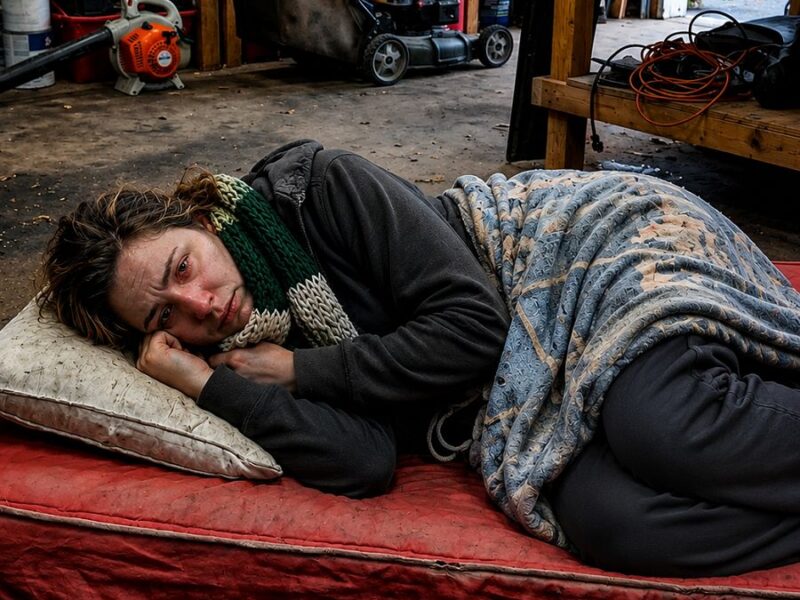
Before the sun could rise, I knew I couldn’t stay. I packed a backpack with the essentials—some clothes, my laptop, my passport, and the small amount of cash we had in the “emergency jar.” I didn’t have a plan. I just needed distance. I needed to be somewhere where the air didn’t taste like his cologne.
I walked to the bus station, my footsteps echoing in the pre-dawn silence. I bought a ticket for the first bus headed north, to a city I’d never visited. As the bus pulled out of the station, I leaned my head against the cold glass of the window, watching the city lights blur into a gray, morning haze. For the first time in a week, the pressure in my chest eased. I could breathe.
Chapter 4: The Scent of a Ghost
The bus was nearly empty for the first two hours. I watched the landscape shift from urban sprawl to industrial zones, and finally to the stark, skeletal beauty of the winter countryside. I felt like a ghost myself, drifting away from a life that had ended before it truly began.
At the third stop, a small group of passengers climbed aboard. I kept my eyes fixed on the window, trying to maintain my bubble of anonymity. Someone sat in the seat directly beside me, despite there being plenty of empty rows. I felt a flash of irritation, but before I could move my bag, a scent hit me.
It was a sharp, clean fragrance—sandalwood and a hint of citrus.
It was Karl’s cologne. Specifically, the expensive one he saved for special occasions. The one he had been wearing on our wedding day.
My heart began to race, a frantic drumming against my ribs. I turned my head, slowly, terrified of what I would see.
It was Karl.
He was pale, his eyes underlined with deep shadows of exhaustion, but he was undeniably, physically there. He was wearing a dark hoodie and a baseball cap, trying to slouch into the seat.
I opened my mouth to scream, a primal sound building in my throat, but he leaned in close, his hand hovering near my arm.
“Don’t scream, Megan. Please. You need to know the whole truth.”
My voice came out as a thin, shattered whisper. “You died. I was there. I felt your pulse stop. I… I buried you, Karl. I watched the dirt go over the casket.”
“I had to,” he said, his voice low and urgent. “I did it for us. It was the only way.”
“What the heck are you talking about?” I hissed, my shock turning into a white-hot wave of fury. “I spent four days in a graveyard! I haven’t slept! I thought my life was over!”
A couple across the aisle glanced over, curious at the intensity of our whispered argument. Karl pulled his cap lower and leaned even closer.
“Please, just listen. I told you my parents were complicated. They’re more than that—they’re controlling. Obsessive. They cut me off years ago because I refused to be their puppet in the family investment firm. They told me I was nothing without their name.”
I stared at him, my mind struggling to bridge the gap between the man I buried and the man sitting in front of me. “And? What does that have to do with faking a heart attack?”
“When they found out I was getting married—really married, to someone they didn’t choose—they reached out. They offered me a chance to ‘fix my mistake.’ They said if I came back to the fold, if I brought my new wife into the family business and accepted their terms, they would restore my inheritance. Millions, Megan. More money than you or I could spend in three lifetimes.”
I blinked, the absurdity of it washing over me. “So you decided to fake your death instead of just saying no? Or—God, Karl—instead of just taking the money?”
“I agreed to their terms,” he whispered. “I told them I’d come back. They transferred a ‘good faith’ payment into an account I managed to hide from them. A few days before the wedding. It was five million dollars.”
My jaw dropped. “Five million?”
“I moved it immediately,” Karl said, a spark of triumph in his tired eyes. “I laundered it through three different crypto-wallets Daniel set up. My parents think the money is still in the trust, but it’s gone. It’s ours.”
“And the heart attack?”
“I never intended to go back to them. But they’re powerful, Megan. If I just ran with the money, they’d find me. They’d find us. But they won’t look for a dead man. This way, we get the money, and we get our freedom. No strings. No parents. Just us.”
Chapter 5: The Price of a Secret
I stared at him, and for the first time, I felt like I was looking at a complete stranger. This wasn’t the man who fixed my faucet or held me when I cried. This was a strategist. A thief. A man who had calculated my trauma as an acceptable business expense.
“You let me plan your funeral,” I said, each word feeling like a stone in my mouth.
He flinched. “I know that was hard. Believe me, being in that casket… hearing you cry… it was the hardest thing I’ve ever done.”
“Hard?” My voice rose, cracking with emotion. “I watched them carry you out while I was still in my wedding dress! I spent my wedding night in a hospital waiting room! I stood by a hole in the ground and wondered how I was going to live another day!”
A man two rows up turned around, frowning. Karl grabbed my wrist, his grip firm. “Lower your voice. I said I’m sorry. I knew you’d understand once I explained the stakes. I did this for us! For our future! You can see that, can’t you? We never have to work again. We can go to the Maldives, or Paris, or anywhere. We’re free.”
“No,” I said, shaking my head. “You didn’t do this for us. You did it for the money, Karl. You didn’t want to be ‘free’ with me in our tiny apartment. You wanted the five million, and you didn’t care what it cost me to get it.”
“That’s not fair!” he snapped, his irritation bubbling to the surface. “You have no idea what kind of opportunity this is. I didn’t want to burden you with the decision, babe. If I’d told you, you would have been an accomplice. This way, you’re innocent.”
“Burden me? No—you didn’t want me to say no. You knew I would never agree to this insanity, so you just… removed my choice.”
I reached into my handbag, my fingers trembling as I found my phone. I didn’t take it out. I just felt for the side button and the screen, tapping the voice memo icon by memory. I left the bag open on my lap, the microphone pointed upward toward his face.
“How did you do it?” I asked, my voice dropping to a low, inquisitive tone. “The whole thing. The paramedics… the doctor at the hospital… how do you fake a death in front of a hundred people?”
Karl sighed, thinking he’d finally won me over with the “logic” of his plan. “Daniel helped. He’s been my inside man for years. He found a team of paramedics—actually, they’re struggling actors and a disgraced EMT. They thought they were being hired for a secret film project, a ‘guerrilla theater’ thing. They didn’t even know it was a real wedding. And the doctor… Daniel knew a guy at the morgue who owed him a massive gambling debt. He signed the certificate and made sure the ‘body’ was processed privately.”
By now, the bus was humming with a different kind of energy. The people around us weren’t just glancing; they were openly listening. The silence of the bus made our whispers carry like a stage play.
An elderly woman in the seat across from us leaned forward, her silver hair shimmering in the morning sun. “Excuse me,” she said, her voice sharp and clear. “I don’t mean to interfere, but did I just hear you correctly? Did you pretend to die at your own wedding to steal money from your parents?”
Karl’s face darkened. He turned toward her, his eyes cold. “This is a private conversation, lady. Mind your own business.”
“It stopped being private when you started confessing to a felony on public transportation,” she snapped back.
A younger guy behind us, wearing headphones around his neck, leaned over the seat. “Okay, wait. His parents sound like total psychos, though. If they’re that controlling, maybe he had to go to extremes?”
The elderly woman shot him a look of pure steel. “And so does he! He let this poor girl bury him! That’s not ‘extreme,’ that’s psychological torture!”
A man near the back of the bus chimed in. “I don’t know, lady. He’s trying to get away from a rich, oppressive family. In this economy? I’d fake my death for five million, too.”
The bus felt charged, the air thick with the conflicting morals of a dozen strangers. It was a jury of peers, and the verdict was split.
Chapter 6: The Breaking Point
Karl looked at me, his eyes desperate and increasingly angry. He ignored the voices around us, focusing entirely on me. “Ignore them, Megan. They don’t know us. They don’t know what we’ve been through. It’s done. The money is moved, the ‘body’ is buried, and the trail is cold. We can still have a good life. We can get off at the next stop, head to the airport, and be in another country by midnight.”
For one fleeting, treacherous second, I pictured it. I saw the sun-drenched beaches, the luxury hotels, the end of every financial worry I’d ever had. I saw a version of Karl that was happy and relaxed, no longer haunted by his parents.
Then, the image shifted. I saw myself standing in the rain at the cemetery, my hand resting on a mahogany lid, feeling the world collapse into a black hole. I remembered the physical pain in my chest, the way my heart felt like it was being squeezed by a cold hand.
I looked at him—really looked at him—and I saw the truth. The man who could do that to the person he supposedly loved didn’t have a heart to save.
“You really think we can just walk away from this?” I asked.
“Yes! That’s the beauty of it,” he urged. “We disappear. We start over.”
“No, Karl. You disappeared. I stayed behind to deal with the funeral, the bills, and the grief. You didn’t ‘start over’—you just left me in the wreckage.”
The bus began to slow down as it approached the next stop. A sign for a local transit hub flashed past the window. I saw the blue and white lights of a police station across the street from the station.
I picked up my backpack and stood.
Karl stood too, a look of relief washing over his face. “You made the right decision. We’ll get off here, find a taxi to the airport, and then—”
“No, Karl,” I said, my voice finally finding its strength. “Unless you plan to accompany me to that police station across the street, I’m not going anywhere with you.”
His face twisted, the mask of the loving husband finally falling away to reveal a desperate, cornered animal. “You wouldn’t… how could you? After everything I’ve done for you! I secured our future!”
I looked at him for a long moment. I looked at the man I had loved for four years, the man I had promised to honor until death. “You did this for yourself, Karl. You just expected me to be a supporting character in your heist. But I’m not an actress, and this isn’t a movie. I recorded everything you just said, and I’m taking it to the police.”
The elderly woman across the aisle began to applaud, a slow, rhythmic sound that was joined by a few others.
The bus doors hissed open with a cloud of cold air. I moved past him, my shoulder brushing his, and headed down the aisle.
“Megan, please!” Karl pleaded, following me to the door. “Don’t do this! If you go to the cops, they’ll take the money back. We’ll have nothing! Don’t destroy our chance to be happy!”
I stepped off the bus and onto the pavement. The cold air felt like a benediction. I stood there for a second, my legs shaking, my wedding ring suddenly feeling like a lead weight on my finger.
I didn’t look back. I strode across the street, dodging a taxi, and walked through the glass doors of the police station. I went straight to the sergeant’s desk.
“Can I help you, miss?” the officer asked, looking at my tear-stained face and my disheveled backpack.
I pulled my phone out of my bag and stopped the recording. “My name is Megan White. I’d like to report a fraud. And… I’d like to report a resurrection.”
Standing there, listening to the playback of Karl’s voice—the cold, calculating tone of a man who thought love was a commodity—I understood the final truth. Karl had died on our wedding day after all. Not his body, and not his physical heart. But the man I thought I knew—the man I had given my life to—was gone.
I was a widow, not of a person, but of an illusion. And as I began to tell the story to the officer, I realized that for the first time in my life, I was truly, completely free.