
“Dad, please come home quickly. I can’t take it anymore. My back hurts so much,” Caroline whispered in a broken voice, so small and desperate that Steven’s blood ran cold.
In the boardroom on the thirty-eighth floor, surrounded by executives, screens and million-dollar figures, Steven Marquez stopped listening to the presentation because he could only hear the trembling of pain.

“Caroline, darling, tell me exactly what’s going on,” he asked, standing up without realizing it, as all the men sitting at the table turned their heads toward him.
On the other end of the line there was a muffled sob, followed by a short breath, as if the girl were trying to speak without anyone hearing her.
—It’s Matthew… I’ve been carrying him all day because Jimena says it’s my responsibility to keep him from crying… but he’s very heavy… and I can’t anymore, Dad.
Those last words were not a simple childish lament, but the exact sound of a string stretched taut for too long, about to break forever.
Steven looked at his watch.
Six fifteen in the afternoon.
I had left home at eight in the morning.
Ten hours.
Ten hours in which her nine-year-old daughter had been carrying a one-and-a-half-year-old baby while trying to clean, obey, and not make noise.
He felt disbelief at first, then such brutal rage that it rose from his chest to his throat like liquid fire.
“Where is Jimena?” he asked in a low voice, because when real anger enters a dangerous man, his voice doesn’t rise; it becomes colder.
—She’s in her room watching TV —Caroline replied tearfully—. She told me not to bother her because she has migraines.
Steven gripped the phone so tightly that his knuckles turned white.
He remembered all the times Jimena had said she was tired, sensitive, stressed, exhausted by the baby, and how he, out of guilt, haste or naiveté, had accepted it.
“Have you eaten anything today?” he asked, already feeling that the answer was going to devastate him even more.
—Only the breakfast you made me… Jimena said she couldn’t eat until she finished the dishes, the cooking, and taking care of Matthew without putting him down.
There was a short silence.
Too short for the world.
Too long for a father who had just discovered that the luxury of his house hid something dirtier than any windowless basement.
“Caroline, listen to me carefully,” Steven said, walking toward the boardroom door as the executives exchanged puzzled glances. “Hang on for another fifteen minutes. I’m coming.”
—But you said you had meetings until eight today…
—The meetings can wait. You can’t.
He hung up without adding anything else because he knew that if he continued speaking, his voice would reveal the magnitude of the terror that was already tearing him apart inside.
He turned towards the table.
The Vice President of Finance was still standing next to the screen, holding the laser pointer and holding an open slide about an international acquisition.
Steven didn’t even look at the projection.
—Gentlemen, the meeting is over. I have a family emergency. Please reschedule everything.
Nobody protested.
Nobody dared.
They knew Steven Márquez as a disciplined, precise, and almost impossible-to-disrupt man, so seeing him leave like that indicated to them that something serious was happening.
While waiting for the elevator, he called Jimena three times.
Three.
All three calls went straight to voicemail.
She wasn’t asleep.
He was not unconscious.
I was ignoring it.
And that detail, so small and so deliberate, caused something in Steven to change forever.
For years he had been considered a man difficult to deceive.
He had built companies, negotiated with sharks, fired corrupt executives, and anticipated crises before they exploded in the markets.
However, in his own home he had not seen what was happening right in front of his eyes.
Or worse.
Yes, I had seen it in parts, but I had chosen to believe the more convenient version because I worked too much, arrived late, and needed to think that at least the home was in order.
That made her nauseous.
The elevator descended with unbearable slowness.
Every second felt like a betrayal.
He went out to the parking lot, threw the briefcase onto the back seat of his BMW and drove off before the door had completely closed.
Chicago roared outside with its rush-hour traffic, with honking horns, red lights, and endless lines of cars that seemed to mock its urgency.
Steven drove like someone chasing the last minute of a life that was already slipping through his fingers.
During the journey, as I jumped from lane to lane and clenched my jaw until it hurt, memories came to me that at first seemed loose, but began to form a monstrous figure.
Caroline said weeks ago that she was very tired lately.
Caroline asking if she could go to the office with him more often.
Caroline falling asleep on her plate one ordinary night.
Caroline stopped drawing at the breakfast table to simply stare out the window with that strange seriousness that should never have existed in a child.
And Jimena.
Jimena always has sweet and perfect explanations.
“She’s in a sensitive stage.”
“She’s acting strangely because of her jealousy over the baby.”
“He needs discipline.”
“She exaggerates a lot when she wants to get attention.”
Steven had wanted to believe her because the alternative was unbearable.
The alternative was to accept that she had brought a predator into her home and sat him at the table in front of her daughter.
And now that alternative was no longer just a suspicion.
It was a child’s voice, broken by the telephone.
It was ten hours of pain.
It was a baby strapped to a girl’s back.
He arrived at the suburban mansion with his heart pounding in his ribs as if it wanted to get out of the car before him.
The house looked strangely dark.
Not dark for rest.
Dark with abandonment.
Only a few lights on the ground floor broke the pristine facade of the place, a facade that suddenly seemed obscene to him.
He opened the front door.
The first thing he heard was Matthew’s high-pitched cry.
Secondly, the sound of plates clattering against each other.
The third thing was Jimena’s silence.
That silence of the person who knows perfectly well what is happening and yet does not intend to move.
Steven walked quickly towards the kitchen.
And the scene tore him apart inside in a way that no lost contract, no corporate betrayal, and no financial death ever had.
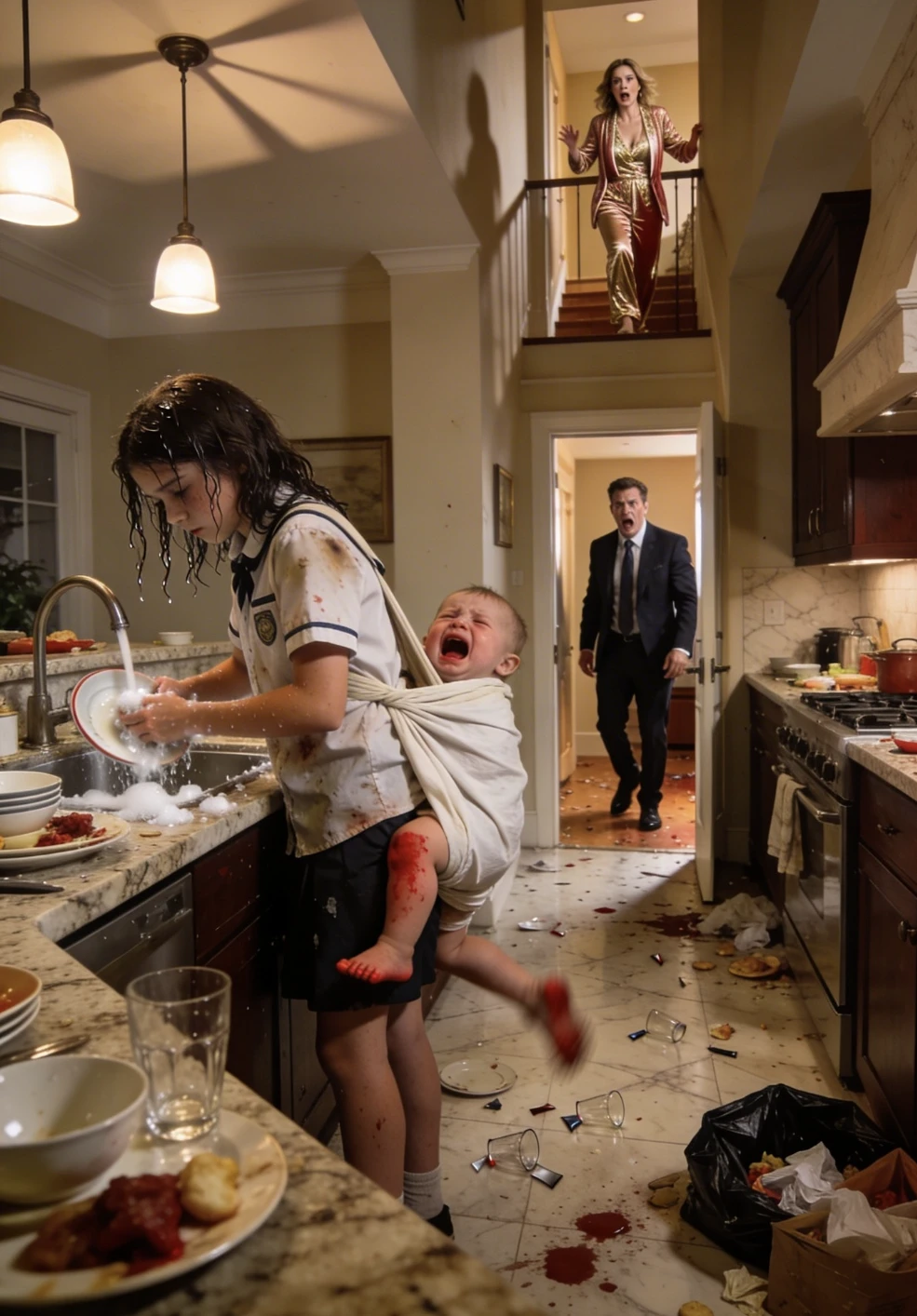
The kitchen was an absolute disaster.
Dirty dishes piled up to the edge of the sink.
Dried food scraps stuck to the marble.
Overflowing garbage.
Broken glasses in a corner.
Spilled milk forming a yellow crust on the ground.
And in the middle of it all, her daughter.
Caroline.
Nine years old.
With Matthew strapped to his back with a sheet knotted around his chest, like an improvised load, like a small mule forced to keep walking even though it can no longer support its own weight.
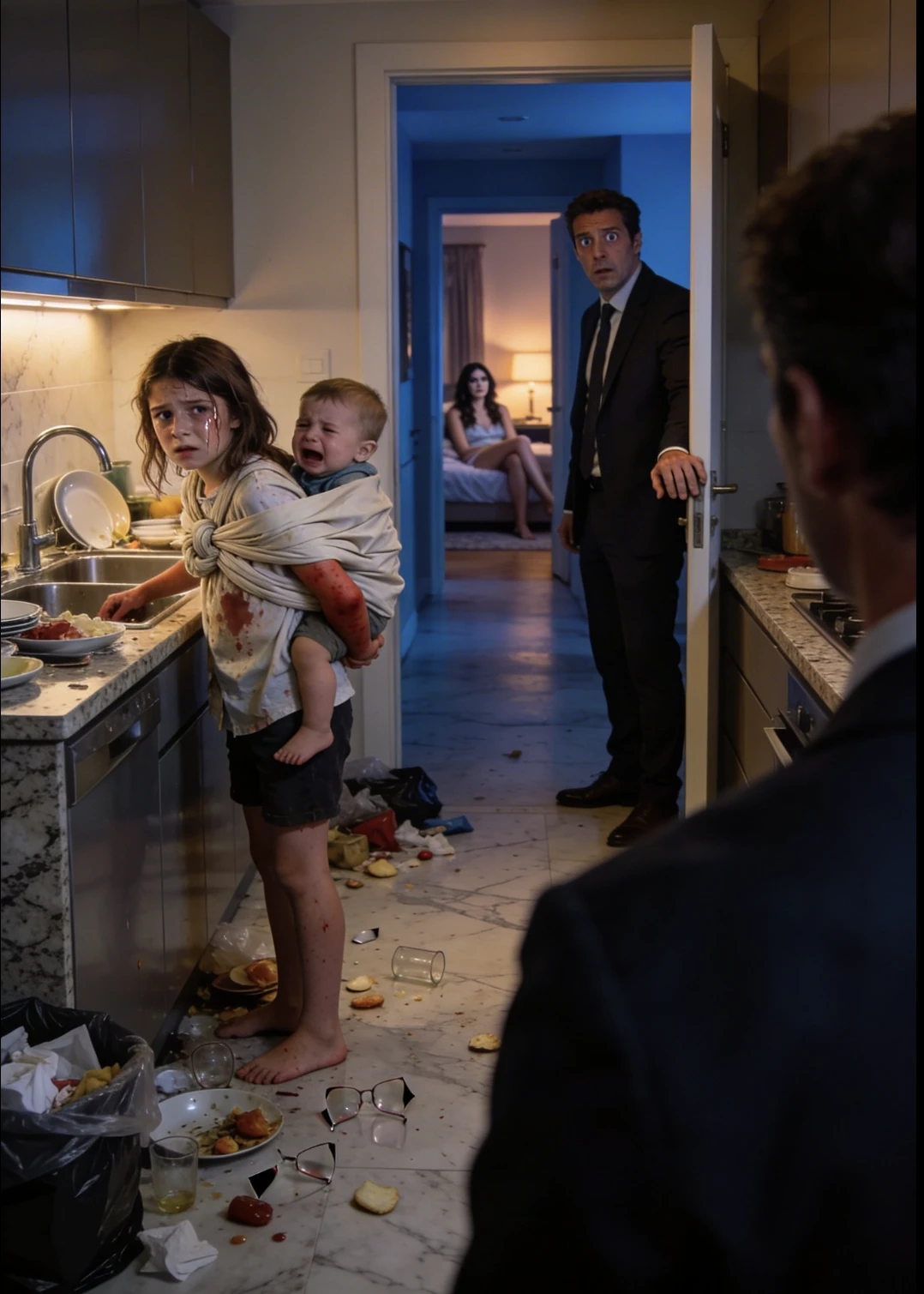
The baby cried incessantly, kicking her waist.
Caroline’s hands trembled as she washed a plate that was too big for her tired arms.
His hair was stuck to his forehead with sweat.
The blouse was stained with drool, food, and detergent.
Slumped shoulders.
The back is defeated.
And there was something in her eyes that Steven didn’t see at first because it hurt him too much to see it: resignation.
Not just tiredness.
Not just pain.
Resignation.
The expression of a girl who has learned that crying doesn’t save her, so she continues to obey even though her body is already asking for help.
—Caroline — Steven whispered.
She turned her head with difficulty.
When she saw him, she didn’t run to hug him.
She didn’t burst into tears immediately.
First he showed relief.
Then fear.
And only then did he allow the dam to break.
-Dad…
That “dad” destroyed him.
He ran towards her, untied the sheet with clumsy hands, and lifted Matthew into his arms.
The baby was also sweaty, irritated, and had a red face from crying so much.
She placed him in the high chair, quickly checked that he didn’t have a fever, and returned to Caroline, who could barely stand upright for a few seconds before bending forward in pain.
Steven caught her before she fell.
When he touched her back over her shirt, she let out an involuntary moan that sounded too grown-up for her age.
“My God,” he murmured.
He carefully lifted the edge of her blouse and saw red marks, deep abrasions, and purple areas on both sides of her shoulder blades and at her waist.
These were not accidental injuries.
It was a time of undue weight.
Hours of effort.
Hours of operation.
At that moment, fury ceased to be a feeling and became a decision.
“Where is Jimena?” he asked, even though he already knew the answer.
Caroline nodded towards the hallway.
—In his room.
Steven looked up at the ceiling as if trying to hold back something worse than a scream.
I didn’t want to scream.
I wanted to see.
To understand.
Remember every detail.
Because he knew, with icy clarity, that from that second on everything was going to change and he would have to do it with precision, not just with anger.
He picked Caroline up in his arms like when she was four years old and would fall asleep in the car after birthdays.
She rested her head on his shoulder with a small moan, of relief and exhaustion.
He took her to the living room sofa, covered her with a blanket, gave her water, and called the family doctor.
Then he took a picture of her back.
Another one from the kitchen.
Another one of the sheets used as a harness.
Another one from the sink.
Another one of the food scraps.
Another one of the oven clock showing six twenty-nine.
And only then did he go up.
Each step seemed hammered with the same thought.
My daughter.
My daughter.
My daughter.
He opened the master bedroom door without knocking.
Jimena was half-lying in bed with a face mask on, the television was on, and a glass of water with lemon slices was on the bedside table.
She didn’t seem sick.
She looked comfortable.
She was so comfortable that when she saw Steven enter, she frowned in annoyance instead of surprise.
“What are you doing here so early?” he asked.
He looked at her for two seconds that must have seemed endless to her.
—How long have you been forcing Caroline to carry Matthew?
Jimena took barely an instant to adopt the offended expression she always used as a shield.
-Sorry?
—Don’t repeat my question as if you didn’t understand it.
She sat up straighter.
—I only asked him to help a little. I’m his stepmother, not a slave owner. You’re exaggerating.
Steven took two steps towards the bed.
—Her back is bruised. She hasn’t eaten all day. I found her washing dishes with a baby strapped to her body. I want the truth.
Jimena crossed her arms.
“She always dramatizes when she wants your attention. You know how she is. Ever since Matthew was born, she’s been impossible.”
Steven felt disgust mixing with rage until it became something new, colder, and more dangerous.
He didn’t scream.
He didn’t insult her.
He simply observed her like a man who has finally stopped loving the person in front of him.
And she noticed.
He noticed it immediately.
Because for the first time in a long time, I was no longer arguing with a guilty, tired, and easily manipulated husband.
I was standing in front of a father.
And a father who wakes up late is often more devastating than one who never found out.
“Come downstairs now,” Steven said. “You’re going to explain everything in front of a doctor, in front of my lawyer, and, if necessary, in front of the police.”
Jimena blinked.
Then he let out a short, incredulous laugh.
—You can’t be serious.
—I’ve never been more serious.
—Steven, please. I have a migraine. I’ve been feeling awful all day. Caroline offered to help with her brother because I could barely get up.
He took it a step further.
—It stopped being a credible explanation when you ignored my calls and when my daughter told me that you punished her by not letting her eat until she finished tasks that were not her responsibility.
Jimena opened her mouth.
She closed it.
He tried another strategy.
—Well, maybe I went too far, but I’m here alone all day with the baby and you’re never around. I’m exhausted too. Where were you when I needed help?
The low blow was there.
The attempt to turn his brutality into a marital claim.
The classic shifting of blame from the person who was discovered.
Steven nodded slowly.
—I understand. So your response to exhaustion was to turn a nine-year-old girl into a nanny, maid, and physical support person for ten hours.
Jimena changed her tone again, this time towards offended crying.
—That’s not how it was. You always idealize her. Caroline knows how to manipulate you. I just wanted to teach her responsibility.
He interrupted her.
—Don’t you ever utter the word responsibility again while my daughter is trembling below from the pain you caused her.
The silence exploded in the room.
Jimena finally got out of bed.
She seemed more irritated than embarrassed.
That’s what finally sealed the deal.
There was no guilt.
There was no horror.
There wasn’t even the slightest human reflex to see the damage and stop.
Just annoyed at having been discovered.
“You know what?” she said, taking a step toward him. “I’m tired of that girl controlling you emotionally. Everything revolves around Caroline. Always Caroline. Never my effort, never my exhaustion, never what I need.”
Steven thought about his daughter’s back.
In a broken voice on the phone.
The baby was tied up with a sheet.
And he understood that the conversation was no longer about saving anything.
It was to document the end.
He took out his phone, activated the recording, and left it on the dresser without hiding it.
—Repeat that —he said.
Jimena remained still.
He realized too late that the terrain had changed.
It was no longer a domestic dispute.
It was a file.
“Are you recording me?” he asked.
-Yeah.
—That’s sickening.
—Not as much as tying a baby to a girl’s back and calling it teaching.
She barely paled.
Then he turned towards the door as if he wanted to flee before saying something worse.
But the urge to justify himself was stronger.
It always has more power in people convinced of their own superiority.
“I just cried and cried,” she finally said, faster, almost defensively. “Matthew wouldn’t calm down. Caroline is good to him. I needed to rest. What did you want me to do?”
Steven did not respond immediately.
Because the real answer was so obvious that it was scary to have to say it.
—To be the adult.
Jimena let out a dry laugh.
—Sure. It’s easy to say that when you only show up to judge. I’m the one who takes care of everything in this house.
—No.
The word came out sharply.
Definitive.
—From this second onwards, you are not responsible for anything.
He went downstairs without waiting for her reaction.
He called his assistant and instructed her to contact the pediatrician, the pediatric orthopedist, his family lawyer, and a private investigator he had previously used in a corporate case.
Then she called the police not to make a scene, but to file a preventive report and ask for immediate guidance regarding possible child abuse within the home.
While she waited, she prepared food for Caroline with her own hands.
Soft toast.
Warm soup.
Sliced banana.
The girl ate slowly, with difficulty, as if her body had forgotten that it was allowed to be cared for.
Steven sat across from her and felt that every careful move his daughter made was a direct accusation against everything he had failed to see.
“Has he made you do this before?” she asked gently.
Caroline looked down at her plate.
Sometimes children don’t answer because they don’t want to.
Sometimes they don’t answer because they are still trying to figure out what truth is certain.
“Not always with Matthew,” she finally whispered. “Sometimes he just tells me to clean a lot. Or he says that if I don’t finish everything before you get here, he’s going to tell you I was naughty.”
Steven felt a hammer fall inside his chest.
—Since when?
—For a long time.
—And why didn’t you tell me anything?
Caroline shrank back a little.
—Because you were always working. And she said that if I bothered you, you’d be sad with me. And I didn’t want to cause you any more trouble.
That was the exact moment Steven grasped the full magnitude of the disaster.
It wasn’t just physical exploitation.
It was systematic emotional manipulation.
Isolation.
Blame.
Trained silence.
Everything happening under his roof, financed with his money, and protected by his absence.
He felt like vomiting.
He didn’t.
He forced himself to keep breathing.
The doctor arrived first.
He checked on Caroline in the living room, with Steven present and a nurse taking notes.
The preliminary conclusions were clear and devastating: acute muscle overload, spasms, severe chafing, possible mild lumbar injury, dehydration and signs consistent with prolonged physical exertion inappropriate for his age.
She then checked on Matthew and found irritability, excessive tiredness, and signs of having cried for too long without adequate containment.
Jimena came down at that moment, already dressed, half-made up, and with the calculated expression of someone preparing a social defense, not a repentance.
He wanted to intervene during the evaluation.
Steven stopped her with a single glance.
—You don’t talk to my daughter.
She raised her chin.
—They are also my family.
—No.
That word again.
Once again, the invisible door slammed.
-Not anymore.
When the officers arrived, Steven showed them the photos, explained the call, handed over the newly made recording, and asked that everything be put in writing.
Jimena tried to present it as an exaggeration caused by stress, but her story began to crack as soon as one of the agents asked why a baby had ended up strapped to a girl’s back.
There was no good response.
There is no good answer for that.
There are only clumsier versions of horror.
Caroline was transferred to the children’s hospital for further evaluation.
Steven went with her into the private ambulance that her GP had requested, because he wanted speed, privacy, and detailed clinical evidence.
During the journey, the girl fell asleep with her hand wrapped around two of her fingers.
I slept poorly.
With microspasms.
Even asleep she seemed to continue carrying an invisible weight.
Steven looked at her and knew he would never fully forgive himself.
Not because I loved again.
Not because she got married.
But rather for having confused stability with comfort, and comfort with security.
At the hospital, tests confirmed serious muscle contractions, muscle inflammation, and a risk of further injury had the effort continued for a few more hours.
The doctor spoke cautiously, but Steven only heard the essential part.
It could have been worse.
Much worse.
He didn’t go home that night.
He spent hours sitting by Caroline’s bed, answering calls from lawyers, canceling secondary cards in Jimena’s name, requesting changes to the house’s access codes, and authorizing the review of internal cameras.
Yeah.
There were cameras.
Not in the bedrooms.
But yes in hallways, kitchen, dining room, main entrance and patio.
Jimena had insisted years ago on installing them for “security”.
She never imagined that they would end up being the rope with which she would hang herself.
At two in the morning, the investigator and the lawyer were in a private room at the hospital reviewing the material.
The images from that Thursday were enough to make the silence weigh like concrete.
At eight o’clock in the morning, Caroline was seen entering the kitchen already dressed for the day.
At eight seventeen, Jimena handed Matthew over.
At eight twenty, he would give her a sheet.
At eight twenty-five, it was clearly visible how he tied it to the girl’s back.
At nine o’clock, Caroline was trying to wash dishes with the baby crying.
At eleven forty-three, she would sit down for a moment in a chair, but Jimena would come in, speak to her from close by, and the girl would get up again.
At ten past one, Caroline knocked on the master bedroom door with one hand while holding Matthew with the other.
There was no response.
At three past seven, I was sweeping with the baby on top of me.
At five forty, I was trying to clean the floor on my knees and almost fell.
At six twenty-seven, Steven entered the frame.
Nobody in the room said anything for several seconds.
Then the lawyer spoke.
—With this, the custody of your minor son and Jimena’s exclusion from the home are priorities. There’s no room for compromise.
Steven nodded.
She no longer wanted to soften anything.
Too much time had been spent softening the unbearable to be able to continue calling what was happening home.
The following morning, while Caroline remained hospitalized under observation, Steven returned to the mansion accompanied by his lawyer, two agents, and a court officer to execute a temporary order.
Jimena greeted them at the door wearing dark glasses and with perfectly staged indignation.
—This is ridiculous. They’re treating me like a criminal.
The officer handed him the document.
—Mrs. Márquez, you are temporarily excluded from the home due to an active investigation of child abuse and negligent conduct towards minors under your supervision.
Jimena remained motionless.
The image was almost theatrical.
The elegant wife, the marble, the immaculate garden, the legal paper trembling between carefully tended fingers.
But Steven no longer saw his wife.
He saw the obscene contrast between the beauty of the scenery and the vileness of the acts that had been allowed within it.
“You can’t do this to me,” Jimena said, looking at him over the top of the document. “I’m your wife.”
He held her gaze without blinking.
“You were my wife. The person who did this to Caroline will never sleep under the same roof as my children again.”
—I am also Matthew’s mother.
—And that’s why the court will decide very soon under what conditions you can see him.
Jimena tried to cry.
He tried to soften the blow.
He tried to seduce her with the old voice of vulnerable weariness that had so often disarmed him.
—Steven, I made a mistake. I was exhausted. I didn’t think. I didn’t really mean to hurt him.
He responded with terrifying calm.
—That’s the problem. You didn’t even think.
They gave him thirty minutes to collect essential personal items.
As he went up the stairs with a suitcase, Steven looked at the hallway where Caroline had so often walked in silence and felt disgusted by the whole house.
Not from the design.
Not luxury.
From self-deception.
She made a promise right then and there: she would never again allow a pristine wall to convince her that everything was fine inside.
The news soon leaked.
Not immediately, because Steven had power, lawyers, and a fierce obsession with protecting his children.
But wealthy families filter misfortunes like others filter water, and in less than a week rumors were already circulating in clubs, foundations and private dinners.
That Steven’s young wife had been expelled.
That there was police.
That the eldest daughter was hospitalized.
That the real story was worse than what was whispered about.
Jimena, of course, tried to get ahead.
She called two influential friends.
He spoke of a misunderstanding.
From a jealous girl.
From a controlling husband who always made her feel watched.
But the images existed.
The medical reports existed.
The recording existed.
And when the rich world smells concrete evidence, its compassion becomes selective with admirable speed.
Caroline left the hospital three days later with prescribed physical therapy, partial rest, pain management, and urgent psychological follow-up.
The child psychologist was clear from the first session.
The deepest damage wasn’t just in the muscles.
It was in the way the girl had taken on inappropriate responsibilities, in the fear of disappointing, in the guilt of asking for help, and in the ingrained idea that her pain had to wait.
Steven listened to that sitting in a small doctor’s chair, with his hands clasped between his knees, feeling smaller than ever.
The specialist was not cruel to him.
And that’s precisely why it hurt more.
—Your daughter didn’t stop talking for no reason. She stopped talking because she learned that being “easy” for adults was safer than being honest.
That phrase haunted him for weeks.
At home, everything changed visibly and brutally.
Steven fired two domestic workers who, although not directly involved, admitted to noticing strange dynamics and not reporting anything because they “didn’t want trouble with the lady.”
He temporarily closed several areas of the mansion.
He moved his bedroom to the room next to Caroline’s.
He installed a bed for Matthew in the same wing.
He reduced meetings.
He cancelled trips.
And for the first time in decades, he began to arrive late to everything business-related in order to arrive early to what was truly urgent.
The board of directors murmured.
The partners did the calculations.
The financial media noted his occasional absence in certain negotiations.
But Steven was no longer willing to sacrifice what was essential in order to continue appearing as an invulnerable man.
One night, while he was adjusting an orthopedic pillow for Caroline, she looked at him with a mixture of shame and sadness that no child should ever know.
—Dad, are you mad at me?
He froze.
—With me? Why would I be angry with you?
Caroline played with the edge of the sheet.
—Because I didn’t tell you sooner. And because I made Matthew cry a lot. And because of me, everything’s bad at home now.
Steven felt something inside him break in a silent and definitive way.
He sat on the bed.
He looked her in the eyes.
Not like someone who offers quick comfort.
Like someone who knows that part of the future depends on this answer.
“Look at me closely, Caroline. None of this is your fault. None of it. What happened is the fault of the adults who failed to protect you. Starting with me.”
She shook her head gently.
—But you work very hard for us…
—And because I worked so much, I stopped seeing things I should have seen. That was also my fault. Not yours.
Caroline remained silent.
Then he asked something even worse.
—So you believe me?
Steven closed his eyes for a second.
The fact that a little girl has to ask that question should be enough to shame an entire century.
“Yes,” she replied, her voice breaking. “I believe you completely. And I will always believe you.”
She began to cry silently.
Him too.
They didn’t make a spectacle of that crying.
They didn’t need it.
Sometimes two people cry in a room not because a tragedy has just occurred, but because they have finally stopped pretending that it hasn’t happened for a long time.
Jimena fought.
Of course he fought.
He asked to see Matthew.
He denied any ill intent.
She hired an aggressive lawyer.
She cited postpartum exhaustion, stress, lack of support, discrimination for being a young stepmother, and even manipulation by Caroline.
But the facts were more compelling than their versions.
The prosecution considered opening a more serious case.
Child welfare services produced a damning report.
And the judge, after reviewing the images and medical reports, imposed immediate restrictions on any unsupervised contact with the minors.
Steven was offered a private settlement to avoid public scandal, as often happens when wealthy families try to contain fires without leaving a trace.
He rejected it.
Not because I wanted media revenge.
But because he finally understood that respectable silence had been part of the problem from the beginning.
Too many things were hidden in beautiful houses.
Too many girls learned to suffer in hushed tones so as not to ruin the image of well-dressed adults.
Too many powerful men were celebrated for moving millions while failing miserably to see the truth sitting at their own table.
Steven also began to change outside the home.
He requested internal audits of labor policies in his companies.
She discovered something uncomfortable and revealing: there were exhausted mothers, absent fathers due to economic necessity, exploited assistants, and employees who hid serious family situations for fear of losing their jobs.
He understood that his personal blindness was not just personal.
It was structural.
It was the privilege of a man so well served by the system that he had never stopped to think how many people were keeping his comfort on the brink of collapse.
That enraged him even more.
And he transformed it.
He created a real, non-advertising fund for immediate support to employees with children in family crises.
It extended licenses.
He financed childhood therapy.
It established internal reporting channels with external oversight.
And when his image consultants suggested he not mix private matters with corporate structure, he responded with something that left everyone speechless.
—My personal experience taught me how much damage a comfortable adult can do by choosing not to look. I will not reward that blindness again.
The networks found out months later, when an inevitable leak brought part of the story to investigative journalists.
The news broke.
“Chicago billionaire discovers alleged abuse of his daughter inside his own mansion.”
“Nine-year-old girl forced to carry her little brother for ten hours.”
“The phone call that broke up a millionaire marriage.”
The outrage was massive.
There was debate.
There was fury.
There were women recounting experiences with cruel stepmothers, abusive stepfathers, absent fathers, and families who prefer prestige to truth.
There were also those who tried to downplay it.
“It probably wasn’t that bad.”
“Girls used to help around the house.”
“Today they call everything abuse.”
And that reaction ended up making the story even more viral, because it revealed how many people still confuse help with servitude and discipline with cruelty.
Steven did not give long interviews.
He didn’t turn Caroline’s pain into a media circus.
He only issued a brief, precise, and devastating statement.
She confirmed that her daughter had been subjected to inappropriate tasks and burdens, that child protection services were taking action, and that no family prestige would ever justify the suffering of a minor.
He added a line that ignited comments for weeks.
“The most dangerous houses are not always the poorest or the darkest; sometimes they have perfect gardens, private security, and adults who are too used to no one questioning them.”
That phrase was shared everywhere.
Because it touched on an uncomfortable truth.
Money does not erase violence.
He only buys her better curtains.
Months later, the court case left Jimena out of the home, under strict supervision for any process related to Matthew, and with a civil record impossible to cover up in certain circles.
His social image was shattered.
Some friends only half-heartedly defended her.
Others disappeared.
Those who knew her best avoided looking at her too much, perhaps because deep down they always suspected that beneath her charm lay a sickly hardness.
Steven got divorced without a romantic spectacle, without theatrical declarations, and without trying to recover anything emotional.
The only thing that mattered to him was protecting his children.
He sold part of his stake in a secondary line of business to completely reorganize his schedule.
He bought fewer companies and more time.
He discovered, with a mixture of embarrassment and amazement, that Matthew calmed down much faster when he held him and sang awkwardly to him than when any caregiver tried to distract him.
He discovered that Caroline drew better when she was no longer on high alert.
He discovered that breakfast could be an act of reparation if one put the phone away and really looked.
In short, he discovered that he had spent years financing a house without actually living in it.
One autumn afternoon, several months later, Caroline was sitting in the garden with a blanket over her legs and a sketchbook.
She was still going to physiotherapy once a week.
He still had difficult days.
She still sometimes woke up at night, startled, with the feeling that someone was putting weight on her back again.
The recovery was not linear.
It never is.
Steven sat down next to her with two cups of hot chocolate, one for her and a ridiculously large one for him, because he wanted to make her smile.
He did it.
Small.
But real.
“What are you drawing?” he asked.
Caroline showed him the sheet.
It was a bridge.
A long bridge between two mountains.
On one side there was a large, dark house.
In the other, a smaller house with illuminated windows.
And in the middle, two figures crossing hand in hand.
Steven swallowed.
—It’s beautiful.
Caroline drank some chocolate.
—The psychologist says that sometimes drawings help to say things that I don’t yet know how to express.
He nodded.
He didn’t say anything right away.
I had learned that not every wound needs immediate interpretation.
Sometimes it’s enough to stay by their side while the other person finds their own language.
“And what does this bridge mean?” he finally asked.
Caroline looked at the drawing as if it were a secret tired of hiding.
—That you did come.
Steven felt like the whole world was reduced to that one sentence.
No to their buildings.
No to their accounts.
No to his last name.
To that phrase.
That you did come.
That was all.
Not that you were perfect.
Not that you never failed.
Not that you were always on time.
But when you finally understood, you came.
And for a wounded child, sometimes that difference decides the rest of their life.
Steven left the cup on the grass.
He carefully took his daughter’s hand.
“Yes,” he said. “And if you ever call me again saying you’re in pain, I’ll always come. Even if I have a hundred meetings. Even if the building is falling down. Even if the whole world tells me to wait.”
Caroline rested her head on her arm.
The afternoon sun fell upon them with a quiet warmth that did not seem grand, but was nonetheless real.
Steven then understood something that would have seemed unbearable to him months before: he had built an empire, and yet the real work was just beginning.
It wasn’t about making more money.
It wasn’t about gaining more power.
It was about learning to be the kind of father for whom no business matter ever sounds more urgent than his daughter’s broken voice.
The story continued to circulate for a long time.
It was discussed on television.
It was analyzed in columns.
She became an example of domestic violence hidden behind privilege.
It sparked waves of uncomfortable conversations about parenting, emotional absence, burdens placed on older girls, and how easily certain environments call exploitation “help.”
Many tried to turn Steven into a hero.
He rejected that idea every time he could.
Because he knew the part that didn’t look good in headlines: he arrived late.
He arrived when the pain had already lasted for hours.
It arrived after signs that he chose not to read.
She arrived after having left someone else in complete control of the home because the job was simpler than watching closely.
That didn’t cancel everything out.
But it didn’t completely absolve him either.
And accepting that truth was, perhaps, the bravest thing he ever did.
Not saving his daughter at the last moment.
Rather, it means publicly accepting that a successful man can also be blind, negligent by omission, and part of the system that allows these silent tragedies.
Over time, Caroline’s drawing of the bridge ended up framed in Steven’s office.
Not in the original mansion, because that house was sold.
Yeah.
Sold.
He didn’t even want to keep the walls.
She did not want to aesthetically rehabilitate the place where her daughter had learned to be silent in order to survive.
They moved to another house, smaller, brighter, and less pretentious.
A house where kitchens became kitchens again.
No scenarios of subjugation.
Where bedrooms were rest.
No handling shelters.
Where no one ever again confused authority with cruelty.
And where Matthew, already growing up, learned a lesson that Steven made sure to repeat to him whenever he could.
Love does not unload its weariness on the little ones.
Love does not punish crying with abandonment.
Love does not use the weakness of others as a stepping stone to feel important.
Years later, when Caroline first spoke about it all at a youth forum on child welfare, she said something that made half the room cry.
“I used to think being strong meant enduring. Now I know that sometimes being strong is dialing a number and saying, ‘Dad, come here’.”
The entire room stood up.
Because that truth was too big to be left unattended.
And because, although the story began in a Chicago mansion, it actually belonged to thousands of homes where children still believe they must carry more than their body and soul can bear.
That’s why this story shocked so many people.
Because it doesn’t just talk about a cruel stepmother.
It speaks of all the adults who don’t look.
Of all the parents who believe that providing is enough.
Of all the girls who act as mothers, servants, nannies and silent shields while the adults call it collaboration.
It talks about the price of being late.
And also of the brutal and beautiful possibility of change when one finally opens their eyes.
That afternoon, when the phone rang in the middle of a crucial meeting and Caroline’s voice said “it hurts so much, Dad,” Steven Marquez thought she was running home to stop an emergency.
He didn’t know that he was actually on the path to the total collapse of a lie that he had been living with for far too long.
He didn’t know that this journey would split his marriage, his home, his image, and his understanding of power in two.
He didn’t know he was going to discover that the worst threat to his family wasn’t outside, not in his business enemies, not in the markets, not in the courts.
He was in the place where he had felt most comfortable, trusting without looking.
And I didn’t know anything else either.
That five words spoken by an exhausted girl would weigh more than all the millions she had earned in her life.
“Dad, please come here.”
He went.
And that time, finally, it arrived before the damage became irreversible.
But he never forgot that he came too close.
Too much.
And perhaps that’s why the discovery changed everything.
Because there are men who change when they lose money.
Others when they lose power.
Steven Márquez changed when he realized that he almost lost his daughter without anyone taking her from home.
It was enough to leave her alone in there, carrying a burden that should never have been hers.
That was the real scandal.
That was the real moral crime.
And that was the truth that set everyone ablaze when it came to light: sometimes a child doesn’t need chains to live trapped; comfortable adults, closed doors, and a parent too busy to hear the first whisper of pain are enough.
Until one day he does hear it.
And then, if there’s still time, run.
He runs not only to save his daughter.
He runs to save the part of himself that still deserves to be called a father.