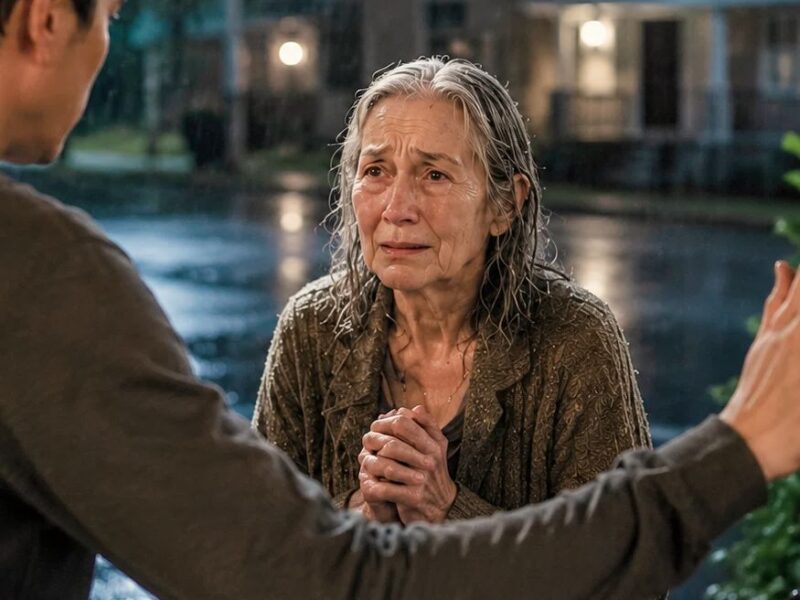
In 1963, in a small American town, a teenage girl walked into a world that had already decided her future for her. She was only 16 years old, carrying a secret that society at the time considered unforgivable. She was pregnant.
Her name was Jacklyn Gise.
She was not famous. She was not wealthy. She did not have influence, connections, or a powerful voice that people were forced to listen to. She was simply a young girl facing a situation that thousands of women before her had faced in silence. But what made Jacklyn different was not that life was easy for her. It was that when life tried to close every door in front of her, she refused to walk away.
In the early 1960s, teenage pregnancy carried a heavy stigma. There were no conversations about support, second chances, or understanding. A young unmarried mother was often viewed not as someone needing compassion, but as someone who had brought shame upon herself and her family.
For Jacklyn, that judgment arrived quickly.
She was a junior in high school when she became pregnant. The message from the school was clear: they wanted her gone. Quietly. Without attention. Without disrupting the image of a traditional high school where everything was expected to look perfect.
They told her she would not be allowed to continue her education.
For many teenagers in that era, that would have been the end of the story. They would have disappeared from classrooms, from yearbooks, from graduation ceremonies, and eventually from the dreams they once carried.
But Jacklyn Gise did something unexpected.
She fought back.
Years later, she explained her mindset with simple words that revealed the strength hidden behind them: “It didn’t make any sense to me, so I pushed back and I kept on pushing back.”
Those words sound ordinary, but they describe something extraordinary.
Because sometimes courage does not look like a dramatic speech or a public protest. Sometimes courage looks like a teenage girl standing alone in a room full of adults and saying, “No. I belong here.”
Eventually, the school changed its decision. But acceptance came with conditions. Jacklyn could return, but she would not be allowed to live the same life as other students. She was separated socially from her classmates. She was denied the normal experiences teenagers dreamed about. And when graduation arrived — the moment she had worked toward for years — she was excluded from the ceremony.
The stage she had earned was taken away from her.
But the diploma was not.
Jacklyn accepted the restrictions because she understood something important: sometimes the first victory is simply refusing to quit.
She finished high school.
The world tried to convince her that becoming a mother meant the end of her ambitions. Instead, she began building a life that would eventually inspire millions.
On January 12, 1964, Jacklyn gave birth to a baby boy. She named him Jeffrey Preston Jorgensen.
At only 17 years old, she became a mother.
The road ahead was not easy.
Her marriage to Jeff’s biological father, Ted Jorgensen, a young unicyclist, ended when their son was only 17 months old. Suddenly, Jacklyn found herself raising a child alone.
She had no fortune. No safety net. No guarantee that things would work out.
She needed to survive.
Jacklyn took secretarial classes and found a job typing documents. Her monthly salary was only about $190 — barely enough to pay for rent and necessities. She could not even afford a telephone in her apartment.
But she had something more valuable than money.
She had family.
Her father, Lawrence Gise, understood that his daughter was fighting a battle that no young mother should have to fight alone. He worked as a regional director at the U.S. Atomic Energy Commission, but despite his professional success, the thing that mattered most to him was helping his daughter and grandson.
So he created an unusual solution.
He installed a walkie-talkie system connecting his home to Jacklyn’s apartment.
Every morning at seven o’clock, the small device would come alive.
A crackling voice would come through.
Jacklyn would hear her parents.
They would hear her.
It was not a luxury. It was not modern technology. It was not something that appeared impressive from the outside.
But to a young mother struggling alone, that little radio connection represented something priceless.
It meant she was not forgotten.
It meant someone was still there.
It meant she had people believing she could make it.
That kind of support can change the direction of an entire life.
And Jacklyn was not finished chasing her own dreams.
Even while working and raising a child, she refused to abandon her education. She enrolled in night classes, determined to earn the opportunities she had once been told she no longer deserved.
But there was one problem.
She could not afford childcare.
So she found another solution.
She chose professors who allowed her to bring her toddler son to class.
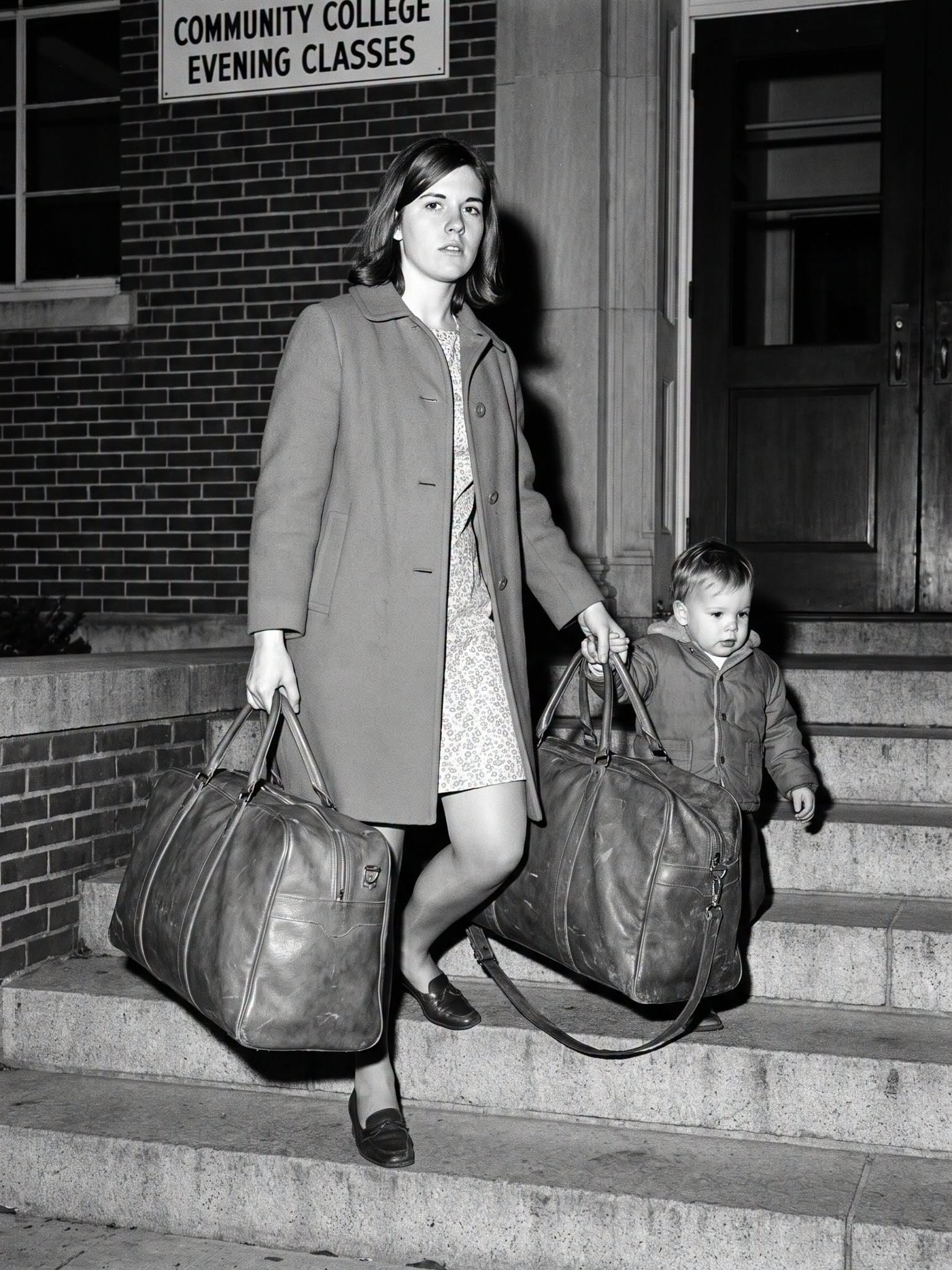
Every evening, Jacklyn arrived carrying two large duffel bags.
One contained her textbooks.
The other contained everything a young mother needed: cloth diapers, bottles, blankets, and small toys to keep her little boy occupied while she studied.
Imagine that scene.
A young woman walking into a classroom after a full day of work, exhausted, carrying not only books but the responsibility of raising a child. While other students worried about exams, friendships, and weekend plans, Jacklyn carried the weight of an entire future on her shoulders.
But she kept showing up.
Night after night.
Class after class.
Because somewhere deep inside, she believed education was not just about getting a degree.
It was about proving that her circumstances did not define her.
And then, during one of those night classes, another unexpected chapter of her story began.
A quiet young man named Miguel Bezos entered her life.
Miguel, who was often called Mike, understood struggle in a way few people could. He had arrived in America as a teenager through Operation Pedro Pan, a program that brought thousands of Cuban children to the United States alone during the political upheaval following the Cuban Revolution.
Like Jacklyn, he knew what it meant to leave behind the familiar.
Like Jacklyn, he knew what it meant to start over.
He arrived in America with very little, but he carried something powerful: determination.
When Jacklyn and Mike met, they recognized something in each other.
They were both survivors.
They were both builders.
They both understood that a person’s beginning does not have to decide their ending.
Their relationship grew, and in 1968, they married.
Soon after, Mike made a decision that would forever change a young boy’s life.
He adopted four-year-old Jeff.
Not as a responsibility.
Not as an obligation.
But as his son.
And that distinction mattered.
Because families are not always created only through biology. Sometimes they are created through commitment, through sacrifice, and through a promise to love someone every single day.
The little boy who once traveled to night classes with his teenage mother would now grow up in a home built on resilience.
A daughter named Christina and a son named Mark would later join the family.
The Bezos household became what Jacklyn had always fought for: a place where love was stronger than circumstances.
But there was still one unfinished chapter in Jacklyn’s own life.
The teenage girl who had been denied her high school graduation stage still carried that memory.
And decades later, she decided it was time to finish what she had started.
For many people, unfinished dreams quietly disappear with time. Life becomes busy. Responsibilities grow. The years pass. The things we once hoped to accomplish become memories of a different version of ourselves.
But Jacklyn Bezos was not someone who allowed time to erase the promises she had made to herself.
The teenage girl who had been told she was no longer welcome in her own high school carried that wound quietly for decades. She had built a family. She had raised children. She had supported her husband. She had survived hardships that would have broken many people.
Yet somewhere inside her remained the young woman who had once stood outside a graduation ceremony she deserved to attend.
She had earned that moment.
It had simply been taken away.
And eventually, she decided she would reclaim it.
Years after becoming a mother, after moving through different chapters of life, after raising her children and watching them grow, Jacklyn returned to the classroom.
Not because she needed a career.
Not because someone demanded it of her.
She did it because learning had always been part of who she was.
She enrolled in college courses as an adult student, sitting beside people much younger than herself. While other students were just beginning to discover their futures, Jacklyn was returning to complete a journey that had been interrupted decades earlier.
She studied during the day. She attended classes. She completed assignments. She proved something that she had always known: a person’s dreams do not have an expiration date.
Then came the day she had waited for.
At the age of 40, nearly two decades after she had been denied the high school graduation ceremony she had dreamed about as a teenager, Jacklyn Bezos walked across a stage at the College of Saint Elizabeth in New Jersey.
This time, nobody could stop her.
Nobody could tell her she did not belong.
Nobody could decide that her past mistakes mattered more than her achievements.
The applause she heard that day was not only for a college graduate.
It was for the 17-year-old girl who had refused to disappear.
It was for the young mother who carried diapers in one bag and textbooks in another.
It was for the woman who worked, studied, and raised a child while the world underestimated her.
Jacklyn later described the feeling of that moment by saying she felt “ten feet tall.”
And perhaps she did.
Because sometimes the greatest victories are not about proving other people wrong.
They are about proving to ourselves that we were never as limited as others believed.
But the biggest chapter of Jacklyn’s story was still ahead.
A chapter that would connect her life to one of the most transformative companies in modern history.
The year was 1995.
Her son Jeff was no longer the little boy sitting beside her in night classes. He had grown into a successful young man working on Wall Street.
From the outside, his life looked secure.
He had a good job.
A promising career.
A comfortable future.
Most parents would have been thrilled.
But Jeff had another idea.
He believed the internet was going to change the world.
At that time, many people thought the internet was nothing more than a passing trend. Online businesses were experimental. Few people trusted the idea of buying things through a computer. The technology was young, uncertain, and risky.
But Jeff saw something others did not.
He imagined a future where people could purchase books online from anywhere in the world.
He wanted to leave his Wall Street career and start an online bookstore.
From a garage.
In Seattle.
To many people, it sounded unrealistic.
Maybe even foolish.
Friends questioned him.
Investors rejected him.
People who heard the idea struggled to understand why someone would abandon a successful career for something so uncertain.
But Jeff had learned something from his mother.
He had watched Jacklyn fight against impossible odds his entire life.
He had watched her refuse to accept the limits others placed on her.
That lesson stayed with him.
When Jeff sat down with his parents to explain his idea, he did not hide the risks.
He was honest.
He reportedly told them there was a significant chance they could lose their investment. He warned them that the business might fail. He even joked that he wanted to be able to come home for Thanksgiving without them being angry if everything went wrong.
This was not a guaranteed success story.
There was no promise that Amazon would become a global giant.
At that moment, it was simply an idea.
A risky dream.
A small company with an unusual name that most people had never heard before.
And then Jacklyn and Mike made a decision that would forever change history.
They believed in their son.
They believed in his vision.
They believed because they knew something about taking risks.
They knew what it meant to start with nothing.
They knew what it meant to build a future without guarantees.
So they invested $245,573 into Jeff’s company.
For them, this was not just spare money.
It represented years of work.
Years of saving.
Years of building a secure life together.
They were putting a large portion of everything they had earned behind their son’s dream.
In exchange, they received a stake in a company called Amazon.
At the time, almost nobody knew what Amazon would become.
There was no massive warehouse network.
No millions of customers.
No global empire.
There was only a young entrepreneur, a garage, and two parents willing to believe.
Two years later, Amazon went public.
The company that once sounded impossible began transforming into one of the most powerful businesses on Earth.
And the investment that Jacklyn and Mike made with faith rather than certainty became one of the most extraordinary investments in history.
Their original stake grew dramatically over the years.
By 2018, reports estimated that their early investment had become worth billions of dollars.
The teenage mother who once earned $190 a month and could not afford a telephone had become one of the wealthiest women in the world.
But numbers alone cannot explain Jacklyn Bezos.
Because if we only remember her as the mother who invested in Amazon, we miss the heart of her story.
The money was not the miracle.
The miracle was the journey.
The miracle was a young woman who refused to let shame define her.
The miracle was a mother who kept studying after everyone expected her to give up.
The miracle was a family that chose love over circumstance.
The miracle was a son who carried those lessons into the future.
Jacklyn and Mike never forgot where they came from.
Despite their extraordinary wealth, they remained deeply committed to helping others.
Together, they established the Bezos Family Foundation, focusing on areas they understood deeply: childhood development, education, and opportunities for young people.
Their belief was simple.
Every child deserves the chance to reach their potential.
Perhaps that belief came from Jacklyn’s own experience.
She knew what it felt like when society looked at a young person and saw only a problem instead of a possibility.
She knew what it felt like when doors closed before someone had the chance to prove themselves.
And she spent much of her later life helping create doors for others.
Through their foundation, Jacklyn and Mike supported education initiatives, scientific research, and programs designed to improve the lives of children and families.
Their generosity was not about recognition.
It was about creating opportunities they wished every young person could have.
In 2023, the Bezos family made a historic $710.5 million gift to the Fred Hutchinson Cancer Center in Seattle, one of the largest private donations ever made to cancer research.
For Jacklyn, giving back was not separate from her life story.
It was the continuation of it.
The same woman who once depended on her father’s walkie-talkie for connection had spent decades helping connect resources with people who needed them most.
The same woman who once carried cloth diapers into classrooms had helped create educational opportunities for future generations.
The same woman who had once been told she did not belong had spent her life making sure others had a place.
But every extraordinary story eventually reaches its final chapter.
And for Jacklyn Bezos, that chapter arrived in 2025.
On August 14, 2025, Jacklyn Bezos passed away peacefully at her home in Miami.
She was 78 years old.
For several years, she had lived with Lewy body dementia, a condition that gradually affected her memory and abilities. But in her final moments, she was surrounded by the people who mattered most — her children, her grandchildren, and the man who had walked beside her for more than half a century.
Miguel “Mike” Bezos was there.
The Cuban teenager who arrived in America with almost nothing.
The young man she met in a night class when both of them were searching for a better future.
The man who chose to become a father to a little boy who was not biologically his.
The man who stood beside her through every chapter of life.
Their story had begun with two people who understood struggle.
It ended with a family built on love.
But when the world remembered Jacklyn Bezos, many people focused on the billions connected to her family name.
They talked about Amazon.
They talked about wealth.
They talked about the extraordinary success of her son.
But those things, while remarkable, were never the true measure of her life.
Because Jacklyn Bezos’ greatest achievement was not the fortune that came later.
It was everything she overcame before anyone knew her name.
It was the courage of a 17-year-old girl standing against a system that wanted her hidden.
It was the determination of a young mother who refused to accept that one mistake meant the end of her future.
It was the strength of a woman who worked for $190 a month while raising a child alone.
It was the quiet bravery of carrying two duffel bags into night classes — one filled with books, the other filled with diapers and baby supplies.
It was the patience to keep learning when life gave her every reason to stop.
It was the humility to remember where she came from even after unimaginable success arrived.
The world often celebrates people who achieve greatness after receiving every advantage.
But Jacklyn Bezos represented something different.
She represented the millions of people who achieve greatness while carrying disadvantages nobody else can see.
She was not born into privilege.
She was not handed a clear path.
She was not protected from judgment.
In fact, her early life was defined by people telling her what she could not become.
She simply refused to believe them.
And perhaps that was the greatest gift she gave her son.
Long before Jeff Bezos built Amazon, before he became one of the most recognized entrepreneurs in the world, he was a child watching his mother fight for a better life.
He watched her persistence.
He watched her discipline.
He watched her choose hope when giving up would have been easier.
Children do not only learn from what parents tell them.
They learn from what parents do.
And Jacklyn showed him something more powerful than any advice:
Impossible does not always mean impossible.
Sometimes it simply means nobody has succeeded yet.
When Jeff Bezos decided to leave Wall Street and start an uncertain internet company, perhaps part of him remembered the lessons his mother had taught him.
He remembered that success often begins with a decision that looks unreasonable to everyone else.
A teenage girl refusing to leave school.
A young mother returning to education.
A Cuban immigrant rebuilding his life in America.
A son leaving a safe career to chase an uncertain dream.
The entire Bezos family story was built on people choosing courage over comfort.
That pattern did not begin with Amazon.
It began years earlier, on a high school campus where a young woman decided she would not disappear.
There is something deeply powerful about that moment.
Because history often remembers the winners after they become successful.
But it rarely remembers the moments when they were still unknown.
Before there was Amazon, there was a mother carrying diapers into classrooms.
Before there were billions of dollars, there was a woman counting every dollar she earned.
Before there were headlines, there was a young girl standing alone against criticism.
Before the world knew Jeff Bezos, there was Jacklyn Gise.
And that may be the most important part of the story.
She was not simply the mother of a billionaire.
She was the person who helped create the foundation that allowed that billionaire to exist.
Not through money.
Not through connections.
But through character.
Through resilience.
Through showing what it means to keep moving forward even when life feels impossible.
Her journey reminds us that people are often shaped in the moments when nobody is watching.
The late nights.
The difficult choices.
The quiet sacrifices.
The battles that never appear in photographs.
The world saw the success of Amazon.
But Jacklyn saw the years before success.
She knew that behind every achievement was a long road filled with uncertainty.
She understood that greatness is rarely created in comfort.
It is created when people continue despite fear.
It is created when someone gets rejected and tries again.
It is created when someone falls and decides to stand back up.
That was Jacklyn Bezos.
A woman who spent her entire life proving that circumstances do not have the final word.
The school that once tried to erase her story could not.
The struggles that once seemed overwhelming could not.
The doubts of others could not.
Because every time life closed a door, Jacklyn found another way forward.
And perhaps that is why her story continues to inspire people far beyond the world of technology and business.
Because not everyone will build a company worth trillions.
Not everyone will become famous.
Not everyone will have their name remembered around the world.
But everyone faces moments when life tells them to quit.
Everyone experiences rejection.
Everyone encounters a door that seems impossible to open.
Jacklyn Bezos’ life carries a simple but powerful message:
Keep walking.
Keep believing.
Keep pushing.
Because sometimes the door that seems permanently closed is only waiting for someone determined enough to push against it one more time.
The teenage girl who was told she should disappear became the woman whose strength helped shape one of the greatest success stories of the modern era.
She did not change the world because she was wealthy.
She changed the world because she refused to surrender.
And in the end, that may be the greatest legacy anyone can leave behind.
Not the money they accumulated.
Not the titles they earned.
Not the recognition they received.
But the lives they influenced.
The courage they passed on.
And the doors they opened for everyone who came after them.
Jacklyn Bezos was a mother.
She was a student.
She was a survivor.
She was a believer in second chances.
And long before the world knew the name Amazon, she was already building something extraordinary.
A family.
A future.
A legacy.