PART 2
Bella rode behind me without asking questions.
She didn’t ask why I had risked my life for her.
She didn’t ask where we were going.
She simply kept watching the trail behind us.
That told me plenty.
This was a woman who had survived by trusting almost no one.
Finally she spoke.
“They won’t stop.”
“I know.”
“They’ll come after you now too.”

I gave a tired smile.
“I stopped worrying much about my own skin a long time ago.”
Several minutes passed.
Then she asked the question I had been avoiding myself.
“Why did you save me?”
I could have said anybody would have done it.
We both knew that wasn’t true.
I had nearly ridden away.
“Because I still could,” I finally said.
My cabin came into view before noon.
It wasn’t much—a weathered log house, narrow porch, small stable, corral, and an old water tower leaning to one side.
But it had one advantage.
From the property, I could see anyone approaching for nearly a mile.
Bella dismounted and immediately studied the windows, stable, fence line, trees, and surrounding rocks.
She wasn’t looking at a home.
She was studying a battlefield.
Inside, I handed her a rifle.
She opened the action, checked the chamber, examined the mechanism, then closed it with practiced ease.
“You’ve used one before.”
“My father taught me.”
Something changed in her face.
“His name was Toban Flint. He scouted for the Army. He knew these valleys better than any map.”
Then her voice tightened.
“He tried to convince the railroad men to negotiate with our people. He told them the water belonged to everyone.”
I already knew the ending before she said it.
“They shot him.”
I placed ammunition on the table.
“How many?”
“Four.”
Then Bella looked toward the window.
“The men coming after us will be more.”
Hoofbeats echoed in the distance.
We had maybe thirty minutes.
We barricaded the rear entrance, filled buckets with water, loaded rifles, and spread ammunition around the cabin.
Bella found weaknesses in my defenses that I had never noticed in five years of living there.
That was when I stopped thinking of her as someone I had rescued.
Bella Flint was a survivor.
Eventually she told me her name.
“My people call me Bella Flint. At the mission school they insisted on calling me Sara. That name never belonged to me.”
“Bella it is.”
“And you?”
“Most people just call me old.”
A small smile appeared.
“Tired men talk like you. Old men would have surrendered already.”
Before I could answer, a voice called from outside.
“Brand Kate!”
Bella’s smile vanished.
“We know the Apache woman is inside. Give us Bella Flint and nobody else has to die.”
Six riders waited beyond the cabin.
Brad Holt and Nick Scalder were among them.
But another man held my attention.
He sat on a black horse wearing a clean dark coat and polished boots.
Calm.
Still.
He didn’t need to threaten anyone to look dangerous.
“That must be Dax Stone,” I murmured.
“You know him?”
“No.”
I watched him.
“But I know his kind.”
Dax rode forward.
“I’ve heard about you, Brand Kate. They say you were a good marshal.”
“People say plenty of foolish things.”
His expression barely moved.
“Give me the Apache woman.”
“No.”
“Pity.”
Dax raised one hand.
A man behind him lit an arrow.
“Down!”
The first burning arrow struck the roof.
Then another.
Then another.
Flames began racing across the dry wood.
Bella soaked a blanket, climbed into the loft, and attacked the fire without hesitation.
Gunfire erupted.
A bullet tore through the window.
I fired back.
Then wood shattered behind me.
Two men rushed the rear door.
My Winchester dropped the first before he crossed the threshold.
The second fired.
His bullet tore through the wall beside my head.
I fired again.
He fell across the porch.
Bella came down from the loft covered in ash, grabbed her rifle, and took position at a window.
She fired once.
One of the riders dropped from his horse.
For several minutes, gunshots and smoke filled the house.
Then everything stopped.
Dax’s voice came through the burning air.
“You can hold us off for a few more minutes, Brand. But wood always burns.”
He was right.
Then another horse came racing toward the property from behind us.
“Brand! Don’t shoot! It’s me!”
I recognized the voice.
Rusk Navarro.
I hadn’t heard it in two years.
He burst through the rear of the cabin carrying ammunition—and four sticks of dynamite.
He looked around at the smoke and bullet holes.
“I thought I’d find an old man fixing fences.”
“So did I.”
Rusk had heard the rumors in town.
Southern Pacific had hired someone to eliminate a witness.
Dax Stone.
Suddenly Bella understood how serious the pursuit had become.
Rusk planted dynamite near the stable while Bella studied our defenses.
Using charcoal, she marked likely firing positions on an old map of my property.
“My father said a hunter should always look for the place where he would hide himself.”
Rusk glanced at me.
“I’m beginning to understand why they’re so afraid of her.”
That evening, during a rare quiet moment, Bella finally asked why two men were willing to die for her.
I told her about Mira.
How I had stopped living after she died.
How I filled my days with fences, horses, and silence.
“This morning,” I said, “I realized that wasn’t living.”
Bella was quiet.
Then she told me something her father used to say.
“Fear kills before bullets do.”
Later, as darkness settled around us, Bella opened a leather pouch.
Inside was a folded map.
She pointed toward a section near the Apache settlement.
“I saw them emptying barrels into the water at night. The next day fish died. Then horses. A week later, children became sick.”
Rusk leaned closer.
Then Bella revealed the piece we hadn’t known.
Her father had been collecting evidence.
Maps.
Receipts.
Names.
Dates.
Documents.
After he was killed, Bella continued his work.
“Where are those documents?” Rusk asked.
“Hidden.”
That was when we finally understood.
Dax wasn’t only hunting Bella because she was a witness.
He needed the evidence before it reached government authorities.
If those papers survived, the men behind the poisoning could face accusations involving murder, fraud, and stolen land.
Then the forest outside went quiet.
Bella lifted her head.
“They’re here.”
Just before sunrise, Dax attacked.
The first bullet smashed through a window.
Burning arrows followed.
The stable caught fire.
Three men tried to use the smoke to circle behind us.
Rusk waited until they were close.
Then he triggered the dynamite.
The explosion shook the entire valley.
Wood, earth, and fire erupted into the air.
But Dax still had men.
Three rushed the porch.
Bella shot one before he reached the steps.
Rusk stopped another.
I fired through the front door and dropped the third.
Then Dax stepped out from behind the rocks.
Slowly.
Calmly.
He actually applauded.
“I underestimated the three of you.”
Nobody answered.
The cabin was burning around us.
Dax looked directly at Bella.
“One final offer. Give me Bella Flint, and I’ll let you and Rusk walk away alive.”
I looked at her.
Bella stepped toward the shattered window.
“I’ve spent too many years running.”
Her hands tightened around the rifle.
“Today it ends.”
Dax stared at her.
“It’s a shame. My employers preferred you alive.”
His hand moved toward his revolver.
“But I don’t have that problem.”
He fired.
The window exploded.
Bella spun around and collapsed.
Blood immediately spread across the side of her dress.
“Bella!”
I dropped beside her.
She was breathing, but barely.
Something inside me snapped.
I fired through the window until my Winchester was empty.
Then I drew my Colt, kicked open the door, and went after Dax.
He was waiting for me.
“Now I recognize you, Marshal.”
His first bullet grazed my shoulder.
I fired twice.
One shot caught him in the shoulder.
Then we collided.
Both guns flew away.
We hit the dirt fighting with fists, knees, and elbows.
Dax was younger.
Faster.
Stronger.
He knocked me down and wrapped both hands around my throat.
My vision began to darken.
“You should have taken the offer.”
My strength was disappearing.
I thought of Mira.
I thought of Cal.
And then I heard Bella scream.
Dax turned.
Too late.
Bella was standing behind him, barely able to remain upright.
In her hands was the old Apache knife that had belonged to her father.
She drove it into Dax.
His grip released.
I sucked air into my lungs.
Bella struck him again until he finally collapsed into the dirt.
Then the knife slipped from her fingers.
So did her strength.
I caught her before she hit the ground.
Blood soaked her clothes.
“No. No, you’re not dying.”
She struggled to breathe.
Then, somehow, she whispered, “You’re heavier than you look.”
I laughed and cried at the same time.
“If you’ve got enough strength to insult me, you’ve got enough strength to stay alive.”
Rusk raced for a doctor.
I remained with Bella, pressing both hands against her wound.
For the first time since Mira died, I prayed.
Not for myself.
For Bella Flint.
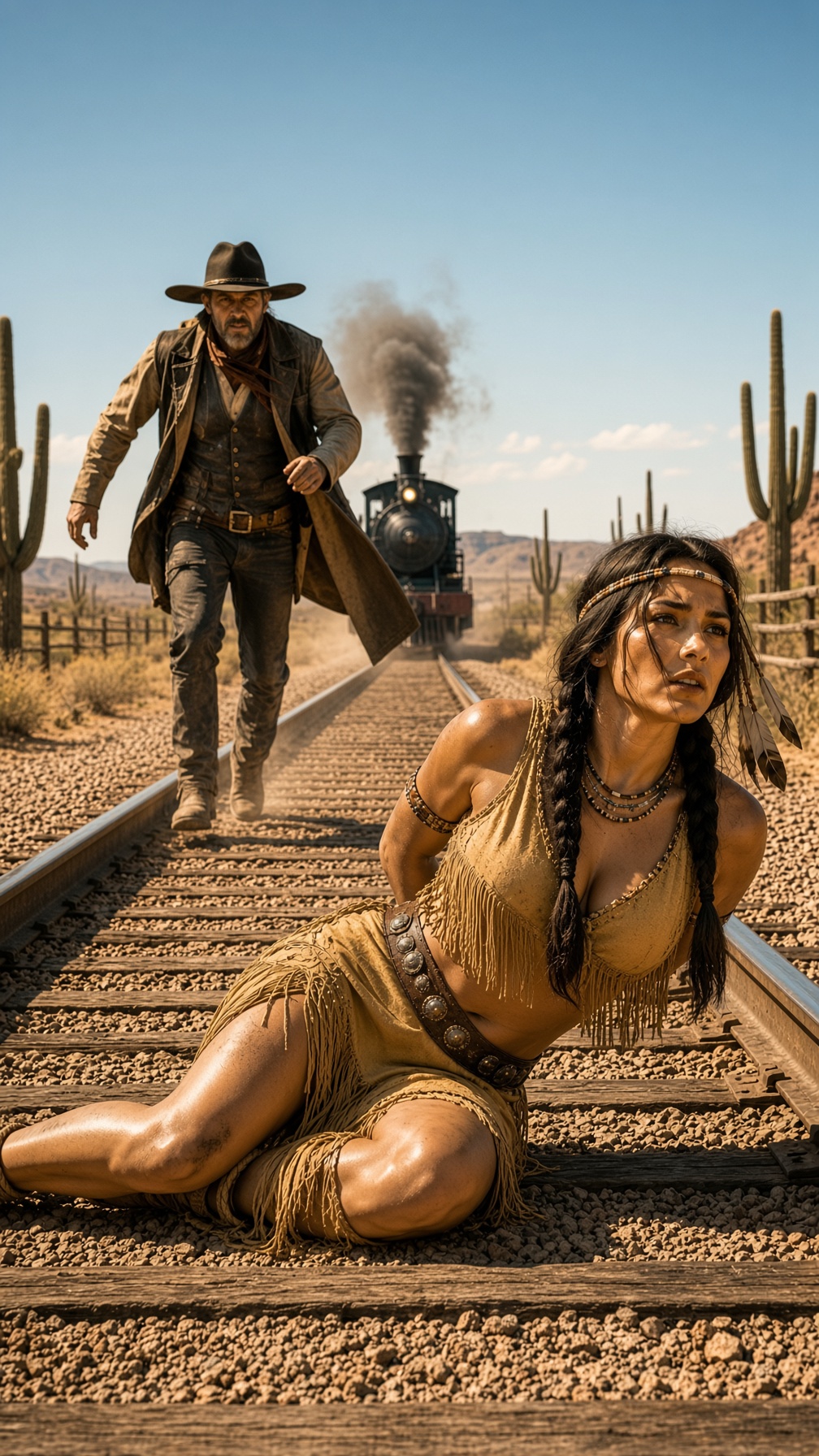
The woman I had pulled from those railroad tracks had somehow pulled me back into life.
Rusk eventually returned with Doc Bane.
The doctor cut away the fabric surrounding Bella’s wound and worked by lamplight while I held her hand.
Finally, the blood-covered bullet dropped onto the table.
“The worst part is over,” Doc Bane said. “Now it’s up to her.”
For two nights, I barely left Bella’s side.
On the second morning, her eyes finally opened.
“Brand?”
I nearly stopped breathing.
“You scared us half to death.”
Her voice was weak.
“You still make too much noise when you sleep.”
I laughed harder than I had laughed in years.
That afternoon, Sheriff Maddox arrived with two deputies.
While examining the property, Rusk searched Dax Stone’s saddlebags.
Inside were contracts.
Maps.
Payment records.
Signed instructions.
Private correspondence.
Documents tying powerful men connected with the Southern Pacific operation to what had happened.
Bella still had her father’s hidden evidence too.
This time, it would reach government officials.
The truth had survived.
About a month later, Bella was strong enough to ride again.
Representatives of the Apache Council came to see her.
Her father’s work—and her own—had created an opportunity.
An investigation was beginning.
But the Apache people needed more than documents.
They needed someone who could speak both languages.
Someone who understood Apache life but also understood the white man’s legal system.
They needed Bella.
When the council representatives walked back toward their horses, Bella remained beside my fence.
“I knew this moment would come,” I said.
“So did I.”
She looked toward the mountains.
“When I was lying on those tracks, I thought I would die before finishing my father’s work.”
“Now you can finish it.”
She looked at me.
“And you?”
I glanced at my repaired cabin.
“Probably keep fixing fences.”
She laughed.
“You’re still a terrible liar.”
She was right.
I had hidden long enough.
Then Bella told me the council needed someone else too.
A man who understood white law.
“Not as a marshal,” she said.
“As a friend.”
Those words meant more than any badge I had ever worn.
For years I believed honoring Mira meant remaining alone with her memory.
But Mira had never lived that way.
She had helped anyone who needed her—white, Apache, rich, poor.
She would have told me to keep walking.
So I did.
“Give me a month,” I told Bella. “I’ll put things in order here. Then I’ll come.”
She held out her hand.
“Thank you for not riding away that morning.”
I shook my head.
“No. Thank you for reminding me who I was before grief decided for me.”
Bella left that afternoon with the Apache Council.
A month later, I kept my promise.
In the years that followed, I helped read contracts, explain laws, and stop people from signing papers that could cost them what little land they still possessed.
Bella became something even more important.
A bridge between two worlds that had spent too long fearing each other.
And no—we never became husband and wife.
Life doesn’t always give people the love story others expect.
But whenever our work brought us together beside a fire, one look between us was enough.
We both remembered the railroad tracks.
The train.
The decision.
I had saved Bella’s life that morning.
But she had saved mine just as surely.
I learned something in those years that wearing a badge had never taught me.
Redemption isn’t erasing what happened yesterday.
It’s choosing what kind of person you will be when tomorrow puts you to the test again.
Some nights, I still wake remembering the whistle of that train.
But I don’t remember it with fear anymore.
I remember it with gratitude.
Because that morning I didn’t simply cut an Apache woman loose from the railroad tracks.
I cut myself free too.
For five years, grief had kept me tied to a life that was no longer really living.
Bella Flint reminded me that as long as a man can still choose to do what is right, his story isn’t finished.
And maybe that is the question all of us eventually face:
When the easy road tells you to keep riding…
and doing the right thing demands that you stop…
which road will you choose?
Disclaimer: This story is fictional and created for entertainment purposes only.
Any names, characters, places, or events are fictitious or used fictitiously.
No real person or organization is intended to be portrayed.