The Baby Who Arrived With Nothing — Except a Family’s Faith and a Voice That Would Change the World
On a cold January night in 1946, deep in the mountains of East Tennessee, a baby girl entered the world inside a tiny one-room cabin.
There were no bright hospital lights.
No modern equipment.
No comfortable waiting room.
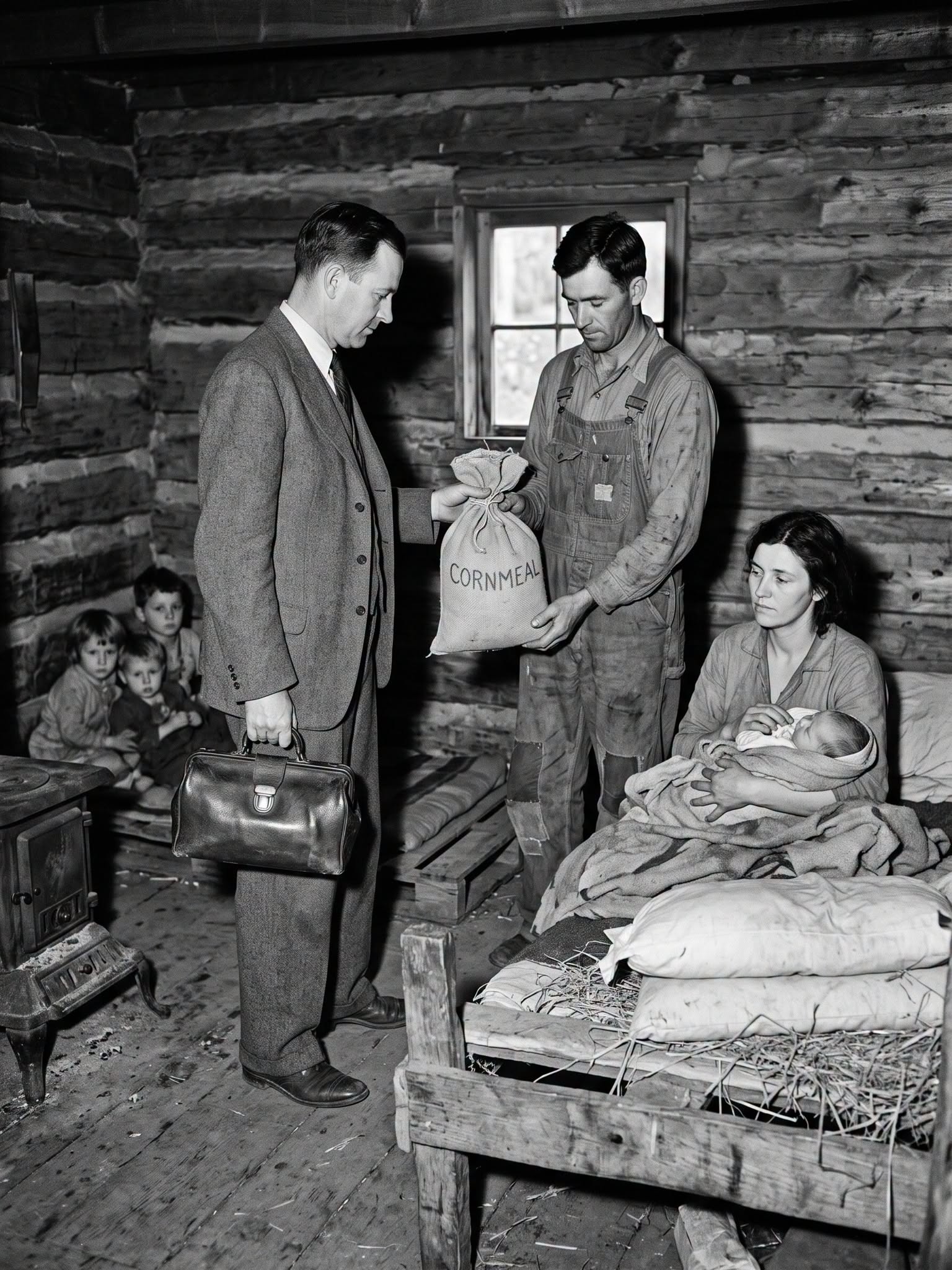
Only a small mountain home, a worried family, and a country doctor named Robert F. Thomas who traveled through the Appalachian hills to help deliver a child.
When the delivery was finished, the family faced a difficult truth.
They had no money.
They could not pay the doctor’s bill.
The family had almost nothing of material value.
So they gave him what they had.
A sack of cornmeal.
That simple exchange became part of one of America’s most remarkable stories.
Because the baby born that night would grow up to become one of the most successful entertainers in history.
A woman whose songs would reach millions.
A woman whose generosity would change the lives of children around the world.
A woman who never forgot where she came from.
Her name was Dolly Rebecca Parton.
And before she became a global icon, she was simply a little girl growing up in the mountains of Tennessee, surrounded by poverty, family, faith, and music.
A Childhood Where There Was Almost Nothing — Yet Somehow Everything That Mattered
The Parton family lived in Sevier County, Tennessee, in a small community surrounded by the beauty and isolation of the Appalachian Mountains.
The family was large.
Very large.
Dolly was one of twelve children born to Robert Lee Parton and Avie Lee Parton.
Their home was a small cabin with no electricity.
No running water.
No modern conveniences.
Life was difficult.
The winters were especially harsh.
Cold air slipped through cracks in the walls.
Snow and wind found their way inside.
The children often slept several to a bed, not because it was comfortable, but because sharing warmth was necessary for survival.
The family did not have much food.
They did not have much money.
They did not have many possessions.
But they had something that poverty could not take away.
They had love.
And they had music.
The Sound That Filled the Cabin
Although the Parton family lacked many things, their home was never empty.
It was filled with voices.
Dolly’s mother, Avie Lee, was deeply connected to Appalachian music traditions.
She sang old hymns passed down through generations.
Songs carried from Europe by early settlers.
Songs that survived because families continued singing them.
Music became a language inside the Parton home.
It was not something they bought.
It was something they created.
Robert Lee Parton played instruments.
The children joined their voices together.
The little cabin that lacked electricity was often filled with something brighter than any lamp:
Hope.
For Dolly, those childhood sounds became the foundation of everything that came later.
Before she performed on giant stages.
Before millions of people knew her name.
Before awards and fame.
There was a little girl sitting in a mountain cabin listening to her family sing.
The Coat of Many Colors That Became a Symbol for Millions
One of the most powerful memories from Dolly’s childhood involved a simple handmade coat.
When Dolly was young, her family could not afford to buy her a proper winter coat.
So her mother created one from whatever materials she could find.
Pieces of fabric.
Different colors.
Different patterns.
Nothing matched.
But Avie Lee did not see a collection of scraps.
She saw love.
As she stitched the coat together, she told Dolly the biblical story of Joseph and his coat of many colors.
To young Dolly, the coat was beautiful.
It was special.
It represented her mother’s creativity and sacrifice.
She proudly wore it to school.
But the other children did not see it the same way.
They laughed.
They made fun of her.
They saw something poor.
Dolly saw something precious.
That moment stayed with her for years.
Many people would have allowed that pain to become a wound they carried forever.
Dolly transformed it into art.
Turning Childhood Pain Into a Song That Touched Generations
Years later, while traveling with the Porter Wagoner Show, Dolly wrote a song inspired by that childhood memory.
The song was called:
“Coat of Many Colors.”
It became one of her most beloved songs.
The lyrics told the story of a little girl who wore a handmade coat and discovered that love was more valuable than anything money could buy.
The song connected with millions because the message was universal.
Many people know what it feels like to be different.
Many people know what it feels like to be judged.
But Dolly offered another perspective:
Your value does not come from what others see.
Your value comes from who you are.
A coat made from scraps became a symbol of dignity.
A painful childhood memory became a source of comfort for generations.

The Young Girl Who Knew She Was Meant for Music
Dolly’s connection to music appeared early.
By the time she was a child, she was already performing.
She sang on local radio programs.
She performed at churches.
She developed the confidence that would eventually carry her around the world.
At only ten years old, she was already working professionally.
By thirteen, she recorded her first single.
She was still a teenager, but she already understood something important:
Music was not just entertainment.
Music was her way of telling stories.
Her way of connecting with people.
Her way of sharing the emotions she had carried since childhood.
Leaving Tennessee With a Guitar and a Dream
In 1964, Dolly graduated from high school.
The very next day, she left for Nashville.
She was eighteen years old.
She had a suitcase.
She had a guitar.
And she had a dream.
Nashville was the center of country music.
But arriving there did not guarantee success.
Thousands of talented musicians came to the city hoping for the same opportunity.
Dolly had no famous family connections.
No wealthy background.
No easy path.
What she had was determination.
She worked.
She performed.
She wrote songs.
She learned.
And slowly, people began noticing something different.
Dolly Parton was not simply a singer.
She was a storyteller.
The Career That Made Her a Legend
The list of Dolly Parton’s achievements is almost impossible to summarize.
She created some of the most recognizable songs in American music history.
“Jolene.”
“I Will Always Love You.”
“9 to 5.”
Her songwriting ability became legendary.
Other artists recorded her songs.
Millions of fans connected with her lyrics.
She became one of the most respected figures in country music.
Her success expanded beyond music.
She appeared in films.
She became a television personality.
She created Dollywood, a theme park that became one of Tennessee’s major attractions and an important employer in her home region.
She earned countless awards.
She became a member of prestigious halls of fame.
But despite all the fame, one thing remained constant:
She remembered the little girl from the cabin.
The Money Was Never the Most Important Part
Many celebrities become known for what they earn.
Dolly Parton became known for what she gave.
Her success allowed her to help others in ways she once could only dream about.
She understood poverty because she lived it.
She understood children who lacked opportunities because she had been one of them.
Her generosity was not based on theory.
It came from experience.
The Gift of Books That Reached Millions of Children
One of Dolly’s most meaningful projects began in honor of her father.
Her father, Robert Lee Parton, was a hardworking man.
But he never learned to read.
Dolly later said that his inability to read was something he carried with embarrassment.
She wanted to create something that would help children avoid facing the same barrier.
In 1995, she created the Imagination Library.
The idea was simple:
Give children free books.
Not only wealthy children.
Not only children with special access.
Every child.
The program began in Tennessee.
But it grew far beyond that.
Children across multiple countries received books delivered directly to them.
Millions of families became part of the program.
The little girl who grew up without much had created a way to give children something powerful:
A doorway to imagination.
Helping Families After Disaster
In 2016, devastating wildfires struck the area around Gatlinburg, Tennessee.
Thousands of structures were damaged or destroyed.
Families lost homes.
Communities were devastated.
For Dolly, this tragedy was personal.
These were the mountains where she grew up.
These were her people.
She created the My People Fund to support families who lost everything.
Instead of providing only one-time assistance, the program offered monthly financial support.
Because Dolly understood something important:
Recovery does not happen instantly.
Families need help rebuilding their lives step by step.
Supporting Medical Research During a Global Crisis
In 2020, during the COVID-19 pandemic, Dolly made a major donation to medical research at Vanderbilt University Medical Center.
Her contribution supported scientists working to better understand the virus and develop solutions.
The gesture showed another side of her character.
She did not only support entertainment or cultural causes.
She supported science.
Education.
Human progress.
The Quiet Love Story Behind the Public Legend
While Dolly Parton’s professional life was lived in front of millions, her marriage remained private.
She married Carl Dean in 1966.
Unlike many celebrity spouses, Carl rarely appeared publicly.
He preferred a quiet life away from cameras.
For decades, he supported Dolly from behind the scenes.
Their relationship lasted through fame, success, and enormous public attention.
It was a rare example of a private partnership in a very public world.
The Woman Who Never Forgot the Cabin
Today, Dolly Parton is recognized around the world.
She is an entertainer.
A songwriter.
A businesswoman.
A philanthropist.
But perhaps her greatest achievement is something simpler.
She never forgot.
She never forgot the cabin.
She never forgot the cornmeal that paid the doctor.
She never forgot the handmade coat.
She never forgot the children who felt ashamed because they were poor.
She never forgot the family that had almost nothing but still had music.
Those memories shaped everything she became.
The Legacy of Dolly Parton
Many people measure success through wealth.
Through awards.
Through fame.
But Dolly Parton’s greatest legacy cannot be counted that way.
It is measured through children who received books.
Families who received help.
People who found comfort in her songs.
Communities that benefited from her generosity.
A little girl born in a one-room cabin became someone who gave millions of people something priceless.
Hope.
Her story proves that beginnings do not determine endings.
A child can grow up in poverty and still dream.
A painful memory can become a beautiful song.
A small act of kindness can become a movement.
The Doctor Who Accepted Cornmeal — And the Woman Who Spent a Lifetime Giving Back
In 1946, a country doctor helped deliver a baby girl.
The family could not pay him with money.
They paid him with cornmeal.
At that moment, nobody knew the child would one day become one of the most influential entertainers in the world.
Nobody knew she would write songs that touched generations.
Nobody knew she would help millions of children discover books.
Nobody knew she would turn personal hardship into compassion for others.
But perhaps that is the most beautiful part of Dolly Parton’s story.
Greatness does not always begin with wealth.
Sometimes it begins with a small cabin.
A loving family.
A song.
And a person who never forgets where they came from.
The little girl from the mountains grew up.
But she never left that cabin behind.
She carried it with her.
And she spent her life building something bigger than fame.
She built a legacy of kindness.
:::