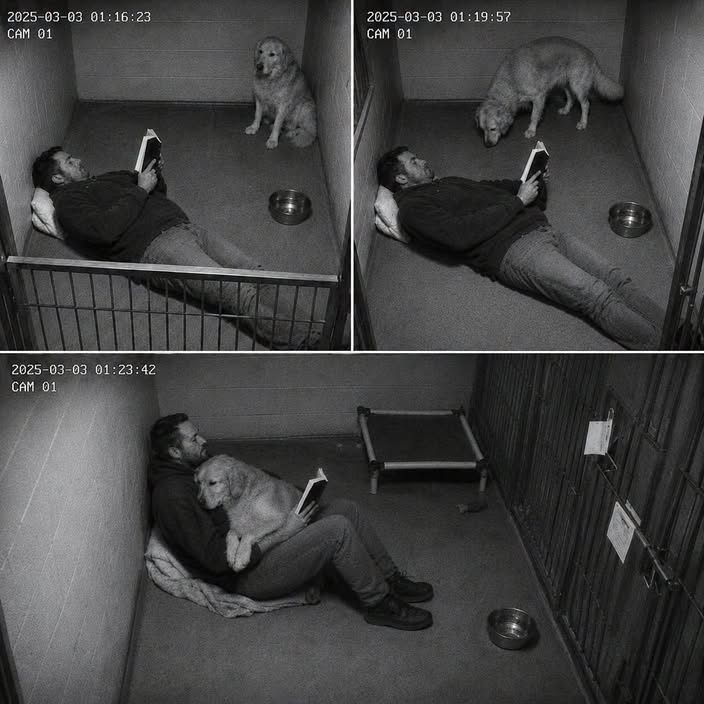
When shelter staff checked the overnight security footage, they expected to see nothing unusual. The hallways were quiet, most of the dogs were sleeping, and the building looked exactly as it did on countless other nights.
Then they noticed Cooper.
The Golden Retriever had spent months trying to disappear into the farthest corner of his kennel. But this time, he was not alone.
Sitting beside him on the floor was a man named Michael, quietly holding a book.
There were no treats scattered around the kennel. No toys. No commands. No attempt to force Cooper to interact.
Michael was simply reading.
And beside him, Cooper was asleep with his head resting gently in the man’s lap.
For shelter workers who had watched the anxious dog retreat from almost every person who approached him, the sight was difficult to believe.
Something had changed.
And it had happened without anyone forcing Cooper to change at all.
The Dog Nobody Seemed to Notice
Golden Retrievers are usually associated with happy personalities, wagging tails and an almost endless desire to be around people.
Cooper seemed like the complete opposite.
When he arrived at the shelter, he appeared overwhelmed by everything around him.
Whenever someone approached his kennel, he moved backward. If visitors stopped to look at him, he often lowered his head and pressed himself against the wall.
He was not aggressive.
He was afraid.
While other dogs barked excitedly or rushed toward the kennel doors when potential adopters arrived, Cooper usually remained hidden in the back.
That made him easy to overlook.
People came into the shelter hoping to feel an immediate connection. They naturally noticed the dogs who greeted them first.
Cooper did not know how to do that.
Day after day, visitors passed his kennel.
Some looked inside for a few seconds before continuing down the hallway. Others tried calling his name but lost interest when he refused to move closer.
Shelter staff knew that Cooper was more than the frightened dog people saw through the kennel door.
But he had not yet learned how to show them.
Fear had become his protection.

Staff Refused to Give Up on Him
Volunteers tried to help Cooper feel more comfortable.
They spoke softly near his kennel. They offered treats. They brought toys and spent time sitting nearby.
Some days he seemed slightly more relaxed.
Other days, even a sudden sound or unfamiliar movement could send him retreating again.
Progress was slow.
That is one of the most difficult things about working with fearful animals.
A physical wound can often be cleaned, treated and monitored.
Fear is different.
You cannot simply explain to a frightened dog that he is safe now.
You have to show him.
Again and again.
And even then, the decision to trust must eventually come from the animal himself.
The shelter staff understood that rushing Cooper would not help.
What he needed was someone who did not expect anything from him.
Then Michael walked into his kennel.
Michael Did Something Nobody Expected
Michael did not bring a bag full of treats.
He did not try to call Cooper toward him.
He did not reach out his hand and wait impatiently for the dog to respond.
Instead, he sat down on the floor.
Then he opened a book.
And he began to read.
At first, Cooper stayed exactly where he normally stayed.
Far away.
Michael continued reading.
Minutes passed.
Then more time passed.
To anyone watching from outside the kennel, it might have looked like absolutely nothing was happening.
But Cooper was paying attention.
He watched Michael from across the small space.
The man was not staring at him.
He was not moving toward him.
He was not asking him to perform a command or accept affection.
He was simply there.
And slowly, Cooper became curious.
He raised his head.
Then he shifted slightly closer.
Michael continued reading as though nothing had happened.
That may have been exactly what Cooper needed.
One Small Step Changed Everything
Eventually, Cooper stood up.
He took a cautious step toward Michael.
Then another.
Each movement seemed carefully measured.
Michael did not react.
He did not suddenly reach toward the dog.
He allowed Cooper to decide what happened next.
Little by little, the distance between them disappeared.
Soon Cooper was standing beside him.
For a dog who had spent months moving away from people, that alone was remarkable.
Then something even more unexpected happened.
Cooper leaned his body against Michael.
The man stayed still.
A moment later, the Golden Retriever lowered his head into Michael’s lap.
And then his eyes closed.
He fell asleep.
It was the first time shelter workers could remember seeing Cooper relax so completely beside another person.
The frightened dog who normally stayed alert whenever humans came near had finally decided that, for this moment, he did not need to protect himself.
He felt safe enough to sleep.

Trust Cannot Be Forced
There was no complicated training technique behind what happened between Michael and Cooper.
The most powerful part of the interaction was its simplicity.
Michael allowed Cooper to control the distance between them.
He did not force contact.
He did not demand trust.
He gave Cooper time.
That difference matters enormously for fearful animals.
People often want quick results.
We want the nervous dog to take the treat. We want the shy animal to let us touch him. We want proof that our kindness is working.
But fear does not disappear just because someone has good intentions.
Trust grows through experiences.
It grows when nothing bad happens.
It grows when boundaries are respected.
It grows when someone stays calm enough to let the frightened animal make his own decision.
Michael’s patience gave Cooper something he may not have experienced in a long time.
Control.
And once Cooper realized that nobody was going to force him closer, he chose to come closer himself.
More Than Just a Shelter Dog
Cooper’s story also carries an important lesson about animals living in shelters.
The behavior people see behind a kennel door does not always reveal the animal’s true personality.
Shelters can be stressful places.
There are unfamiliar smells, barking dogs, new people, cleaning equipment and constantly changing routines.
Some animals become excited.
Others shut down.
A dog who hides in the corner may eventually become a playful companion in a quiet home.
A dog who refuses to approach strangers may one day sleep beside someone on the couch every night.
But those possibilities are easy to miss when people make decisions after only a few seconds.
Cooper had been overlooked because fear made him difficult to know.
Michael changed that by giving him something different.
He gave him time without expectations.
And beneath all that anxiety, Cooper finally revealed what the shelter workers had hoped was still there.
A dog who wanted connection.
He simply needed to believe that connection could be safe.

Sometimes Healing Looks Like Nothing at All
The most powerful moments are not always dramatic.
There was no sudden transformation.
Cooper did not wake up one morning completely fearless.
He simply moved a few feet across a kennel.
But those few feet represented months of emotional distance.
That is why seeing him asleep in Michael’s lap meant so much.
To someone who did not know Cooper, the scene might have looked ordinary.
To the people who had watched him retreat day after day, it was extraordinary.
It meant he was beginning to trust.
Beginning to believe.
Beginning to understand that not every human who entered his space would hurt him or demand something from him.
Healing often happens this way.
Slowly.
Quietly.
One tiny decision at a time.
Someone Was Finally Willing to Stay
Michael did not rescue Cooper with some heroic gesture.
He sat on the floor and read a book.
That was enough.
He gave Cooper patience when the dog expected pressure.
He gave him quiet when he expected attention.
Most importantly, he stayed.
One cautious step became another.
Fear became curiosity.
Curiosity became closeness.
And closeness became trust.
Eventually, the Golden Retriever who had spent months hiding in the corner rested his head in a man’s lap and fell asleep.
There was no magic involved.
Just compassion.
Just patience.
Just someone who understood that trust cannot be demanded.
Sometimes a wounded heart does not need someone to pull it out of hiding.
Sometimes it simply needs someone willing to sit nearby long enough for it to come out on its own.
And for Cooper, one man with a book finally became that person.