Chapter 1: The Betrayal
I have never moved that fast in my life.
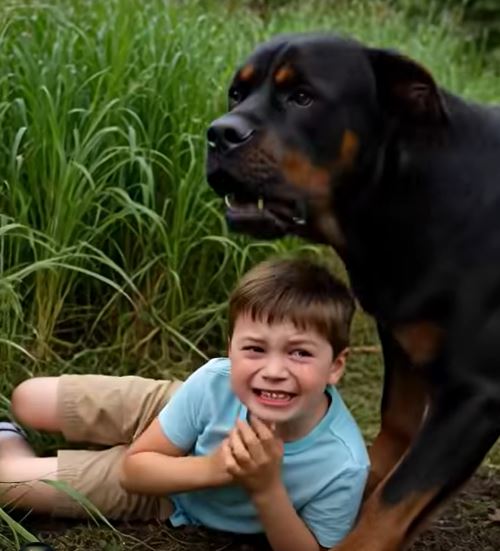
You hear about “dad reflexes” or hysterical strength, but until you see a muscular, eighty-pound Rottweiler mix lunge at your eight-year-old son, you don’t know what adrenaline really is.
It was supposed to be the perfect Fourth of July. The kind you see in commercials.
We had the grill fired up, searing burgers and hot dogs. The cooler was stocked with ice-cold beer. The air was thick with the smell of charcoal and cut grass, typical for a suffocatingly hot afternoon in suburban Ohio.
My wife, Jenna, was over by the patio table, laughing with the neighbors, holding a glass of white wine that was sweating in the humidity.
And Cody? Cody was doing what he always did. He was throwing a slobbery, chewed-up tennis ball toward the back of the yard, near the tree line where the manicured lawn gives way to wild brush.
“Go long, Tank! Get it, boy!” Cody’s voice was pure joy.
Tank, the dog we’d adopted only four months ago, took off like a shot.
I had fought against getting Tank. I wanted a Golden Retriever. Or a Lab. Something with a soft mouth and a reputation for being a nanny dog.
But Jenna had found Tank at the shelter. He was on the “urgent” list. A big, block-headed mutt with scars on his muzzle and eyes that looked like they had seen too much of the dark side of humanity.
“He chose us, Mike,” Jenna had said, tearing up in the shelter parking lot. “Look at how he leans on you.”
I gave in. I always give in. And for four months, Tank had been a ghost. Quiet. Watchful. He never barked. He just followed Cody around like a shadow.
I thought he was guarding him.
Now, watching him sprint across the yard, I realized I had been watching a predator stalk its prey.
The ball bounced weirdly, hooking left toward a patch of tall, ornamental grass near the old oak tree.
Cody laughed and chased after it. “I’ll get it!”
Tank was faster. But he didn’t go for the ball.
He ignored the bright yellow fuzz completely.
Instead, he lowered his shoulder, accelerated, and slammed into my son.
The impact was sickening. It sounded like a car crash.
“No!” The scream tore out of my throat, raw and burning.
Cody hit the ground hard, the air driven out of his small lungs with a ‘whump’ that I felt in my own chest.
Before Cody could even scramble up, Tank was on top of him.
The dog stood over my boy, stiff-legged, his hackles raised like a razorback boar.
A low, vibrating growl erupted from the dog’s chest. It was a sound of pure, unadulterated violence.
Jenna dropped her wine glass. It shattered on the pavers, but nobody heard it.
The backyard fell into a dead silence, broken only by that terrifying growl and Cody’s high-pitched, terrified sobbing.
“Daddy! Daddy, help!”
My brain short-circuited. I didn’t think. I just reacted.
I had a heavy metal spatula in my hand. I gripped it like a weapon and sprinted across the forty yards of grass separating me from the nightmare.
“Get off him! Tank! NO!” I roared.
The neighbors were screaming now. I could hear Dave from next door yelling for someone to call 911.
Tank didn’t move. He kept his front paws pinned on Cody’s shoulders, pressing the boy flat into the dirt.
Cody was thrashing, trying to kick out, but the dog was an anchor.
“Tank, get back!” I reached them, my chest heaving, my vision tunneling red.
I raised the spatula, ready to strike the dog I had been feeding for months.
Tank looked up at me.
That’s the image that haunts me. He didn’t snap at me. He didn’t bare his teeth at me.
He looked me dead in the eye, and he barked. One sharp, deafening crack of sound.
His amber eyes were wide, showing the whites. He looked… panicked.
But I was too blind to see it.
“Get. Off. My. Son.”
I dropped the spatula and grabbed Tank by his thick leather collar. I twisted it, cutting off his air, and yanked backward with every ounce of strength I had.
“Mike, get him away! Get him away!” Jenna was shrieking, running toward us, her face a mask of absolute terror.
I hauled the dog back. Tank’s claws tore deep furrows into the lawn. He fought me, scrambling for traction.
But he wasn’t fighting to get away. He was fighting to get back to Cody.
“You son of a bitch!” I screamed, adrenaline flooding my veins. I dragged him five feet, ten feet.
Tank was whining now, a high, desperate keen that sounded like a crying child. He kept twisting his massive head, looking back at where Cody was lying in the dirt.
Jenna scooped Cody up, clutching him so tight I thought she might break his ribs. She turned and ran for the house, not looking back.
“Check him for bites! Check his neck!” I yelled after her, struggling to hold the eighty-pound muscle of muscle and fur.
Tank let out a howl. It wasn’t angry. It was mournful.
He dug his back legs in, refusing to be moved further. He was fixated on that patch of ornamental grass where Cody had fallen.
“Stop it! You’re done. You are done!” I wrestled the dog toward the garden shed at the side of the house.
Tank was strong, but I was fueled by the rage of a father who almost lost his child.
I basically threw him into the shed. He skidded across the plywood floor, scrambling to regain his footing.
He didn’t turn to attack me. He didn’t cower.
He immediately ran to the shed window, jumped up, and started clawing at the glass, staring frantically back at the yard.
I slammed the heavy wooden door and threw the bolt lock.
My hands were shaking so bad I could barely engage the latch.
Silence fell over the backyard again. The neighbors were standing at the property line, staring, whispering, their phones out.
I stood there, panting, staring at the shed door. Inside, Tank was throwing his body against the wood. Thump. Thump. Thump.
“Mike?” Dave called out from next door. “Do… do you want me to get my gun?”
The question hung in the humid air.
I looked at the shed. I looked at the house where my wife and crying son were.
“No,” I croaked, wiping sweat and maybe a tear from my eye. “I’ll handle it. Call Animal Control. Tell them… tell them I have a dangerous animal.”
I turned and walked toward the house. I needed to see Cody. I needed to make sure he wasn’t bleeding.
I walked into the kitchen. Jenna had Cody on the counter. She was stripping his t-shirt off, her hands trembling.
“Where is it? Where’s the blood?” she was sobbing.
I moved in, scanning his small, pale body.
There were red marks on his chest. Welts where Tank’s heavy paws had pinned him down.
There was dirt on his face. Tears streaming down his cheeks.
But there was no blood.
No puncture wounds. No torn skin.
“He… he didn’t bite me, Dad,” Cody hiccuped, wiping his nose.
Jenna froze. We both looked at the red welts.
“He just pushed me,” Cody whispered. “He pushed me really hard. It hurt. But he didn’t bite.”
“He was about to,” Jenna snapped, though her voice wavered. “He was seconds away, Mike. You saw his face. You saw that look.”
“I know,” I said, leaning against the granite island, feeling the adrenaline crash leaving me weak. “I know.”
“He can’t stay here. Not one more night,” Jenna said, her voice turning hard. “I don’t care what the shelter said. That dog is unstable.”
“I called Animal Control,” I lied. “Or Dave did. They’re coming.”
Cody looked down at his sneakers. “He looked scared, Dad.”
“He’s a vicious animal, Cody,” I said, trying to convince myself as much as him. “He attacked you.”
“But—”
“No buts!” I snapped, too loud. Cody flinched. I softened my tone. “Buddy, I love you. I can’t let anything hurt you. Tank crossed a line.”
I kissed Cody on the forehead and told Jenna to give him a bath to wash the dirt off.
I needed air. I needed a drink.
I walked back out to the patio. The party was effectively over. The neighbors had retreated to their own yards, likely gossiping about the ‘psycho dog’ next door.
The grill was still smoking. The burgers were burned into hockey pucks.
I grabbed a warm beer from the table and cracked it open, taking a long, bitter swig.
From the shed, the thumping had stopped. Now, there was just a low, rhythmic whining. It sounded broken.
I felt a pang of guilt, sharp and sudden. I pushed it down. He attacked my son.
I looked across the yard. The tennis ball was still lying there, near the tall grass.
Something bothered me.
I replayed the scene in my head. The way Tank had run. He hadn’t run at Cody. He had run to intercept him.
And when he had him pinned… why didn’t he bite? A dog that size, in that state of arousal… if he wanted to kill, Cody would be in surgery right now.
And why was he staring at the grass?
I finished the beer in one gulp and crushed the can.
I needed to clean up the yard. I needed to get that damn tennis ball.
I stepped off the patio and walked across the grass. The sun was starting to dip, casting long, eerie shadows across the lawn.
The silence in the yard was heavy. No birds were singing. Even the cicadas, usually deafening this time of year, seemed to have paused.
I approached the spot near the old oak tree.
The grass was flattened where Cody had fallen. I could see the drag marks from my heels where I had fought the dog.
I bent down to pick up the slobbery tennis ball.
That’s when I heard it.
A sound.
Not from the shed. Not from the house.
From the ground.
It was a soft, dry rasping sound. Like sandpaper rubbing against stone.
I froze, my hand hovering inches above the tennis ball.
I looked at the patch of ornamental tall grass—the spot Tank had been staring at. The spot he had been desperately trying to get back to.
The grass was moving.
There was no wind. The air was dead still. But the grass was swaying, rhythmically, violently.
And then I saw the hole.
It wasn’t a sinkhole. It wasn’t a gopher hole.
It was hidden beneath the thick thatch of dry grass, invisible unless you were standing right on top of it. Or unless you had a nose that could smell what was coming out of it.
The earth around the rim of the hole was shifting, crumbling inward.
And something was rising out of it.
I took a step back, the hair on my arms standing up straight.
The sound got louder. A hiss. A distinct, mechanical hiss that triggered a primal fear in the lizard part of my brain.
I realized then, with a jolt of nausea that nearly brought me to my knees, exactly where Cody had been standing.
He had been standing directly on the rim.
If Tank hadn’t hit him… if Tank hadn’t pinned him to the ground five feet away…
I leaned forward, squinting into the gloom of the tall grass.
A head emerged from the hole.
It wasn’t a snake. It wasn’t a rat.
It was yellow. And black. And it was big.
My blood ran cold.
I turned to look at the shed. The whining had stopped. Tank was silent, waiting.
He knew. He had known the whole time.
I looked back at the hole, and my heart hammered against my ribs like a trapped bird.
I wasn’t looking at a simple animal den.
I was looking at a collapse. And what was crawling out of the darkness wasn’t just one creature. It was a swarm.
Chapter 2: The Swarm
I stood frozen, my brain struggling to process the image in front of me.
It was a wasp.
But it wasn’t like any wasp I had ever seen buzzing around a trash can at a picnic. This thing was enormous, nearly two inches long, with a thick, pulsating abdomen banded in jagged stripes of sulfur-yellow and obsidian-black.
It crawled out of the fissure in the earth with a jerky, mechanical motion, twitching its antennae as if tasting the air.
Tasting my fear.
And then, another one crawled out over its back. And another. And another.
The sound I had heard—that dry, rasping hiss—wasn’t just air escaping. It was the sound of thousands of chitinous legs scraping against dirt and against each other. It was the sound of a subterranean army waking up.
The ground beneath the ornamental grass, the exact spot where Cody had been standing seconds ago, wasn’t solid earth. It was a paper-thin crust. Beneath it was a void. A massive, hollowed-out cavern teeming with death.
If Tank hadn’t hit him…
The thought hit me harder than the dog had hit my son.
If Tank hadn’t tackled Cody, my eight-year-old boy wouldn’t have just stumbled. He would have broken through. He would have fallen waist-deep, maybe deeper, into a pit of tens of thousands of agitated, venomous yellowjackets.
He wouldn’t have survived. The anaphylactic shock alone would have killed him before I even reached him.
“Oh my God,” I whispered, the spatula still lying in the grass somewhere behind me.
The first wasp, the scout, took flight.
It didn’t circle lazily. It launched straight at me.
I swatted at it, a reflex action, but it was fast. It bounced off my forearm and I felt a sharp, electric sting, like a cigarette burn, right above my wrist.
“Ow!” I yelped, slapping the spot.
But looking down at my arm was a mistake. Because when I looked back up, the hole in the ground had erupted.
It looked like a volcano of black smoke. But the smoke was alive.
A dark, vibrating cloud rose from the earth, expanding rapidly. The hum turned into a roar, a low-frequency drone that vibrated in my teeth.
They were swarming. And I was the only target.
“Run,” I told myself.
I turned and sprinted toward the house.
“Jenna! Close the door! Lock the door!” I screamed, my voice cracking with panic.
I didn’t look back, but I could feel them. I could hear the angry buzz closing the distance.
I felt a sharp impact on the back of my neck. Then another on my ear.
The pain was blinding. It wasn’t just a pinch; it was a thumping, burning injection of fire.
I slapped my neck, crushing something crunchy and wet against my skin, but the stinger stayed in.
“Open the door!” I roared, hitting the patio steps three at a time.
Jenna was standing in the kitchen, staring at me through the sliding glass door, her eyes wide with confusion. She saw a crazy man screaming, waving his arms.
She didn’t see the cloud behind me yet.
“Open it!”
She unlocked the latch and slid the door open. I practically dove inside, stumbling over the threshold.
“Mike? What is—”
“Close it!” I spun around and slammed the glass door shut, locking it just as the first wave hit.
Thwack. Thwack. Thwack.
It sounded like hail hitting the window.
Dozens, then hundreds of large, aggressive wasps slammed into the glass, bouncing off and crawling over the surface. Within seconds, the view of our backyard was obscured by a crawling, writhing curtain of yellow and black.
Jenna screamed, backing away from the door, clutching her chest. “What is that? Mike! What is that?”
I leaned against the kitchen island, gasping for air, my hand clutching my burning neck. My ear felt like it was expanding, pulsating with heat.
“A nest,” I wheezed, my heart rate hovering somewhere around a heart attack. “A ground nest. Huge. Under the old oak.”
Cody ran into the room, wrapped in a towel, his hair still wet from the bath. “Daddy? What’s that noise?”
“Stay back, Cody!” I barked. “Stay away from the window!”
Jenna looked at the window, then at me. Her face went pale as she processed the sheer number of insects. “Oh my god. There are thousands of them.”
“They were under the grass,” I said, the realization washing over me again, making my knees weak. “Right where Cody was standing. The ground… it was hollow.”
I looked at my wife, tears pricking my eyes—not from the pain of the stings, but from the horror of the alternate reality I had just narrowly avoided.
“Jenna,” I choked out. “Tank didn’t attack him.”
She looked at me, confused, her hands shaking. “What?”
“Tank knew,” I said, pointing at the swarming window. “He could hear them. Or smell them. Dogs can hear that buzzing underground. He knew the ground was dangerous.”
I grabbed Jenna’s shoulders. “He didn’t tackle Cody to hurt him. He tackled him to knock him away from the hole. He was saving him.”
Jenna’s mouth opened, but no sound came out. She looked at the window, where the wasps were trying to find a way in, their stingers tapping against the glass.
“If Cody had stepped there…” I couldn’t finish the sentence.
“He would have fallen in,” Jenna whispered, the horror dawning on her. She looked at Cody, who was watching us with wide, scared eyes. She rushed to him, hugging him again, burying her face in his wet hair.
“We punished him,” I said, my voice hollow. “We beat him. And I locked him up.”
The realization hit me like a physical blow.
The shed.
I spun around and stared out the kitchen window.
The shed was about forty yards away, near the edge of the property. Near the oak tree.
Near the hole.
“Oh no,” I breathed.
“What?” Jenna asked, looking up.
“Tank,” I said. “I locked Tank in the shed.”
I pressed my face close to the glass, ignoring the wasps crawling on the other side.
The swarm wasn’t just attacking the house. They were agitated, spreading out in a widening circle of aggression.
And the epicenter of their rage was the backyard.
The shed was covered.
I could see them swarming around the eaves, around the door frame.
And then I remembered the window.
The shed had a window. It didn’t have glass. It had a wire mesh screen. A screen meant to keep out flies and mosquitoes.
But these weren’t mosquitoes. And that screen was old. It was rusted in the corners.
And Tank was inside.
“He’s trapped,” I said, panic rising in my throat again. “Jenna, he’s trapped in there with them.”
As if on cue, I heard it. Even through the double-paned glass of the house, over the drone of the swarm outside, I heard a sound that made my blood freeze.
It was the sound of a dog screaming.
Not barking. Screaming.
It was a high-pitched, frantic yelping, the sound of an animal in absolute agony.
“Tank!” Cody yelled, breaking free from Jenna’s grip. “Dad! Tank is hurting!”
“Mike, you have to do something!” Jenna cried, her eyes filling with tears. “He saved Cody! You have to save him!”
I looked at the backyard. It was a kill zone.
Stepping out there was suicide. I had taken two stings and it felt like I’d been hit with a hammer. There were thousands out there now.
But I could hear him.
Yelp. Yelp. Thud.
He was throwing himself against the door. He was being stung. Over and over again.
I looked at my arms. I looked at the spatula on the counter.
I was a coward. I had been ready to kill him for being a “monster,” when he was the only hero in the family. And now, I was letting him die alone in the dark, being eaten alive by the very thing he saved my son from.
“No,” I growled.
“Mike?”
“Get the keys,” I ordered, moving toward the mudroom. “Get the truck keys.”
“What are you going to do?”
“I’m going to get my dog.”
I ran into the garage. I needed armor.
I grabbed my heavy winter Carhartt jacket from the hook, throwing it on over my t-shirt despite the ninety-degree heat. I zipped it up to my chin.
I grabbed my leather work gloves.
I looked around frantically for something to cover my head.
A motorcycle helmet. I didn’t own one.
A ski mask? Too thin.
I saw the roll of duct tape on the workbench. And a plastic painter’s tarp.
“Jenna!” I shouted. “The keys!”
She ran into the garage, tossing me the keys to my Ford F-150. “Mike, be careful! If you get swarmed…”
“Stay inside,” I ordered. “Do not open that door for anything unless it’s me.”
I wrapped the painter’s plastic loosely around my head and neck, tearing eye holes, and then duct-taped the bottom of the plastic to the collar of my jacket. It looked ridiculous. I looked like a demented spaceman. But it would keep them off my skin.
I taped my gloves to my sleeves. I taped my jeans to my boots.
I was sweating already. The heat inside the suit was instant.
“Daddy, bring him back!” Cody pleaded from the doorway.
“I will, buddy. I promise.”
I hit the button for the garage door opener.
The motor whirred, and the heavy door began to roll up.
The sunlight poured in.
And with it, the sound.
The buzz was louder now. Angry. Pervasive.
A few stragglers flew into the garage immediately, confused by the light.
I didn’t wait. I sprinted for the truck door, yanked it open, and dove inside.
I slammed the door and locked it.
Safe. For a second.
I started the engine. The V8 roared to life.
I reversed out of the garage, crushing a kid’s bicycle I hadn’t put away, but I didn’t care.
I spun the truck around in the driveway and drove onto the lawn.
My neighbors must have thought I had lost my mind. I was driving my truck through my own manicured garden, tearing up the turf, heading straight for the backyard.
I crested the small hill by the patio and saw the shed.
It was worse than I thought.
The shed was black with them. The air around it was thick, like static on a TV screen.
I drove the truck right up to the shed door, bumping the bumper against the wood.
I could still hear Tank inside. But the yelping was weaker now. More sporadic.
He was going into shock.
“Hold on, buddy,” I whispered, my hands gripping the steering wheel so tight the leather squeaked.
Here was the problem: The shed door opened outward.
And I had bolted it from the outside.
I couldn’t just open it from the truck.
I had to get out.
I had to step into the cloud, unlock the bolt, open the door, grab an eighty-pound terrified dog, and get us both back into the truck before we were stung to death.
I looked at the dashboard thermometer. 92 degrees outside. Inside my suit, it was probably 110.
I took a deep breath. It tasted like duct tape and fear.
“For Cody,” I said. “For Tank.”
I opened the truck door.
The sound hit me instantly. It was deafening.
I jumped out and slammed the door.
Immediately, they were on me.
I felt them hitting the plastic around my head like rain. Tap-tap-tap-tap-tap.
I saw them crawling on the clear plastic, inches from my eyes. Their stingers were pulsing, trying to find purchase.
I kept moving.
I reached the shed door.
My gloved hands fumbled with the bolt lock. It was stiff.
“Come on!” I screamed, wrestling with the metal.
A wasp found a gap. A tiny, microscopic gap where the duct tape on my left wrist had wrinkled.
I felt the sting. Then another. Then another.
They were inside the sleeve.
I screamed in pain, thrashing my arm, but I didn’t let go of the bolt.
With a final, adrenaline-fueled yank, I slid the bolt back.
I threw the door open.
Tank was huddled in the corner, under the workbench.
He was unrecognizable.
His face was swollen to twice its size. His eyes were shut tight. He was covered in them. They were crawling in his fur, on his ears, on his belly.
He didn’t move when the door opened. He just shivered.
“Tank! Come on!” I yelled.
He whined, but didn’t get up. He couldn’t get up.
I had to go in.
I stepped into the dark shed. The air inside was thick with the smell of old gasoline and the pheromones of angry insects.
I grabbed Tank by his collar.
“I got you. I’m sorry. I’ve got you.”
I hauled him up. He was dead weight.
I dragged him toward the light.
As we crossed the threshold, the swarm refocused. They sensed the fresh victim.
They descended on Tank.
I threw my body over his, trying to shield him with the jacket, and dragged him toward the passenger side of the truck.
I fumbled for the keys in my pocket with my stinging, burning hand.
I hit the unlock button.
I yanked the back door open.
“Up! Get up!”
I lifted his front paws and shoved him onto the backseat. He scrambled weakly, helping me just enough.
I shoved his back end in.
I slammed the door.
I ran around to the driver’s side, trailing a cloud of wasps.
I jumped in and locked the doors.
I sat there for a second, hyperventilating.
There were wasps inside the truck. Ten, maybe twenty of them that had followed us in.
I smashed one against the windshield. I swatted another off my leg.
I looked in the rearview mirror.
Tank was lying on the backseat, breathing in shallow, ragged gasps. His tongue was lolling out, purple and swollen.
He wasn’t moving.
“No, no, no,” I said. “Don’t you die on me. Don’t you dare die on me.”
I put the truck in drive and floored it.
I tore across the lawn, smashing through the wooden fence panel at the side of the house because I didn’t want to slow down for the driveway.
I hit the street and turned left, tires squealing.
The nearest emergency vet was twenty minutes away.
I had maybe ten.
I looked at my left arm. It was throbbing, turning a violent shade of red. My fingers were sausages.
But the pain was nothing compared to the sound coming from the backseat.
The silence.
Tank had stopped whining.
“Stay with me!” I shouted, reaching back blindly to touch him while I weaved through traffic.
My fingers brushed his fur. It felt hot. Too hot.
I dialed Jenna on the truck’s bluetooth.
“I got him!” I yelled when she picked up.
“Is he okay? Mike, are you okay?”
“He’s bad, Jenna. He’s really bad. I’m heading to the Vet Clinic on Route 4. Call them. Tell them I’m coming in hot. Tell them massive hymenoptera envenomation. Tell them anaphylaxis.”
“Okay! Okay!”
“And Jenna?”
“Yeah?”
“Don’t go outside. Do not go outside. The yard is gone.”
I hung up and ran a red light, dodging a Honda Civic that honked long and hard.
I looked in the mirror again.
Tank’s eyes were open. Just a slit.
He was looking at me.
Even through the swelling, even through the pain, I saw it.
That same look he gave me in the yard.
He wasn’t angry. He was trusting me.
He had trusted me when I dragged him to the shed. And he was trusting me now.
“I’m sorry, boy,” I choked out, tears finally spilling over and burning the sting on my cheek. “I am so sorry.”
The truck engine roared as I pushed it to ninety.
But as I sped down the highway, I noticed something.
My throat felt tight.
My tongue felt too big for my mouth.
I scratched at my neck. It was hard as a rock.
My vision blurred at the edges.
The sting on my neck. The one from the first scout. And the three or four on my wrist.
I was allergic to bees as a kid. I hadn’t been stung in thirty years.
I thought I had outgrown it.
The steering wheel felt miles away. My hands were numb.
“Oh no,” I wheezed. The air coming into my lungs whistled.
I was going into shock too.
I was driving a three-ton truck at ninety miles an hour, with a dying dog in the back, and my own windpipe was closing up.
The exit for the vet was coming up in one mile.
The world started to spin.
Stay awake, I screamed internally. Get him there.
I slapped my own face, trying to use the pain to focus.
But the darkness was creeping in from the corners of my eyes, black and fuzzy.
I saw the exit sign.
I yanked the wheel.
The truck drifted. Too fast.
I hit the shoulder. The gravel sprayed.
I overcorrected.
The truck fishtailed.
I saw the guardrail coming at me fast.
I didn’t have the strength to turn the wheel back.
“Cody…” I whispered.
And then the world went black.
Chapter 3: The Silent Passenger
The first thing I tasted was airbag dust. It tasted like burnt corn and chemicals.
I coughed, but no air moved. My throat was a solid block of concrete.
My eyes fluttered open. The world was sideways.
The truck was resting at a forty-five-degree angle in a drainage ditch. The windshield was spiderwebbed with a thousand tiny cracks where my head must have hit it, or maybe the airbag had shattered it.
Silence.
No. Not silence.
A hissing sound. Steam from the radiator? Or wasps?
Panic surged through me, cutting through the fog of the concussion.
I thrashed against the seatbelt. My hands felt like boxing gloves, swollen and useless.
“Tank?” I tried to say it. It came out as a gurgle.
I turned my head. It took every ounce of strength I had.
The back seat was a mess of tossed tools and fast-food wrappers that had gone flying in the crash.
Tank was there.
He had slid off the seat and was wedged in the footwell behind the passenger seat.
He wasn’t moving. Not a muscle.
“No…” The word was just a bubble of air in my throat.
I clawed at the door handle. It was jammed against the mud of the ditch.
I hammered on the glass with my swollen fist. Thump. Thump.
Shadows appeared outside.
“He’s alive! Hey! Over here!” A voice. A woman.
“Call 911! Get a crowbar!” A man’s voice. Deep. Authoritative.
A face appeared at the window. A guy in a baseball cap, eyes wide with concern.
“Buddy? Can you hear me? Don’t move. You might have a neck injury.”
I shook my head violently. I pointed a trembling, sausage-like finger toward the back seat.
“D… D…” I couldn’t form the word “Dog.” My tongue was too big.
“Drink? You want a drink?” the guy asked, confused.
I grabbed my throat. I made a choking sound.
“He’s choking! Or… damn, look at his face! He’s swollen up like a balloon!”
“Allergic reaction!” the woman shouted. “Does anyone have an EpiPen?”
I banged on the glass again. I pointed backward. Look at the dog. Save the dog.
The man didn’t understand. He thought I was hallucinating.
“Hang on, help is coming. You hear those sirens? That’s for you.”
I heard them. The wail of approaching salvation.
But they were too late for Tank. I knew it. He hadn’t moved. He hadn’t made a sound since the shed.
I felt the darkness creeping back in. It was a warm, heavy blanket pulling me down.
Don’t sleep, I told myself. If you sleep, he dies alone.
The glass next to me shattered.
I flinched as safety glass rained down on my lap. A firefighter was there, masked and gloved.
“Sir! Can you tell me your name?”
I grabbed his heavy turnout coat. I yanked him closer.
I pointed to the back seat.
The firefighter looked. He shined a flashlight.
“We got a K9 in the back!” he shouted to his partner. “Looks unresponsive.”
Unresponsive. The word was a knife in my gut.
“Get him out,” I wheezed, my vision tunneling to a pinprick of light.
“We gotta get you out first, pal,” the firefighter said, reaching for my seatbelt buckle.
I fought him. I weak, pathetic struggle. I pushed his hands away.
I pointed at Tank again. My eyes begged him. Please.
The firefighter paused. He looked at me, really looked at me. Beneath the swelling and the bruises, he saw the desperation of a father who had failed his child.
“Okay,” he nodded. “Jack! Get the back door! Get the dog!”
I watched as they pried the back door open with the Jaws of Life. The metal shrieked.
Two men reached in. They lifted Tank out.
He looked like a ragdoll. His head flopped back. His tongue dragged on the grass.
They laid him on the shoulder of the highway.
I saw a paramedic kneel over him. She put a stethoscope to his chest.
She paused. She looked up at the firefighter.
She shook her head.
My heart stopped.
I saw her mouth the words. No pulse.
My scream was silent. It died in my closed-up throat.
Then, the darkness didn’t just creep in. It slammed into me like a freight train.
The last thing I saw was the blue sky above the highway, and the paramedic starting chest compressions on my black and tan best friend.
Chapter 4: The Monster in the Mirror
Beep. Beep. Beep.
The rhythm of life. Electronic and cold.
I woke up because my throat hurt. It felt like I had swallowed a handful of razor blades.
I tried to swallow. It was agony.
I opened my eyes. White ceiling. Fluorescent lights. The smell of antiseptic and floor wax.
Hospital.
I tried to sit up, but a hand gently pushed me back down.
“Easy, tiger. You’re okay.”
It was Jenna.
She was sitting in a plastic chair next to the bed. Her eyes were red-rimmed and puffy. She was wearing the same clothes from the barbecue, but they were wrinkled and stained with… dirt? Tears?
“Cody?” I rasped. My voice sounded like gravel grinding together.
“He’s with my mom,” Jenna said, stroking my hand. “He’s fine. Shaken up. He won’t stop talking about the ‘monster bees.’”
I closed my eyes, the memory of the swarm flooding back. The sound. The vibration.
Then I remembered the highway.
I shot up in bed, ignoring the pain in my ribs and the IV tugging at my arm.
“Tank.”
Jenna flinched. She looked down at her lap.
The silence in the room was deafening. The beeping of the monitor seemed to speed up, matching my racing heart.
“Jenna,” I said, my voice breaking. “Tell me.”
She took a deep breath. Her chin trembled.
“He’s at the University Veterinary Hospital,” she said softly. “The paramedics… they got a heartbeat back. On the side of the road.”
I let out a breath I didn’t know I was holding. “He’s alive?”
“Barely, Mike,” she said, and her voice cracked. “He’s in critical condition. He took… they stopped counting the stings at five hundred.”
Five hundred.
I felt sick. Physically ill.
“The venom caused severe hemolysis,” Jenna continued, reciting the medical terms like she had memorized them to keep from falling apart. “His red blood cells are bursting. His kidneys are shutting down. He’s on dialysis. He’s in a coma.”
“I did this,” I whispered.
“Mike, you didn’t know—”
“I threw him in there!” I shouted, startling a nurse passing by the door. “He saved our son, and I threw him in a death trap and locked the door! I called him a killer!”
I put my face in my hands. The shame was hotter than the stings.
I remembered how I had twisted his collar. How I had dragged him. How he had looked at me.
He trusted me.
“What are the chances?” I asked through my fingers.
Jenna didn’t answer immediately. That was answer enough.
“The vet said the next twenty-four hours are the deciding factor,” she finally said. “If his kidneys don’t start responding… there’s nothing else they can do.”
“I need to go to him,” I said, throwing the covers off.
“You can’t,” Jenna said, standing up. “You went into anaphylactic shock, Mike. Your airway closed completely. They had to intubate you in the ambulance. You’ve been out for six hours.”
“I don’t care,” I said, swinging my legs over the side of the bed. My head spun. The room tilted. “I am not letting him die in a metal cage alone. Not again.”
“Mike, stop!” Jenna pushed me back. “He’s not alone. The vet staff is with him. And… I went to see him before I came here.”
She pulled out her phone. She swiped to a photo and held it up.
It was Tank. He was lying on a stainless steel table, hooked up to more tubes than I was. His fur was shaved in patches. His body was swollen so badly he looked like a different breed.
But right next to his head, resting on the metal table, was a familiar object.
The chewed-up, slobbery tennis ball.
“I brought it to him,” Jenna sobbed. “I told him he was a good boy. I told him he caught it.”
I broke.
I sat there in that hospital gown, a grown man, and I wept. I cried for the dog I had judged. I cried for the guilt that would never leave me.
“We have to save him, Jenna. Whatever it costs. Sell the truck. Refinance the house. I don’t care.”
“We’re doing everything,” she promised.
Just then, my phone buzzed on the bedside table.
I grabbed it. It was an unknown number.
“Hello?”
“Is this Michael Brennan?” A woman’s voice. Professional. Serious.
“Yes.”
“This is Dr. Aris from the University Vet Clinic.”
My heart hammered against my ribs. “Is he okay? Did something happen?”
“Mr. Brennan, Tank has gone into cardiac arrest again,” she said, her voice clipped and urgent. “We are performing CPR now. But I need to know…”
She paused. The silence on the line was the loudest sound in the world.
“Do you want us to keep going?” she asked. “His heart is very weak. If we bring him back, he might have brain damage from the oxygen deprivation. He is suffering, Mr. Brennan.”
I looked at Jenna. She knew. She could see it on my face.
“Don’t let him go,” I whispered into the phone. “Please. Don’t stop.”
“We’re losing him, Mike,” the vet said, her voice softening, losing its professional edge. “I’ve been doing compressions for two minutes. I’m not getting a rhythm.”
“TRY HARDER!” I screamed into the phone. “HE DIDN’T QUIT ON MY SON! YOU DON’T QUIT ON HIM!”
“Doctor!” I heard someone shout in the background of the call. “I’ve got a rhythm! Wait… it’s fading.”
“Mike,” the vet said, her voice tense. “He’s fighting. But he’s slipping. You need to talk to him. I’m going to put the phone to his ear.”
“What?”
“Do it now! He needs to hear you!”
There was a fumbling sound, and then a static hiss.
“Tank?” I choked out. “Tank, buddy? It’s Dad.”
I heard a beep. Then a long, flat tone.
Then silence.
“Tank! Listen to me! You are a good boy! You are the best boy!”
I waited.
“Tank!”
And then, through the speaker of the phone, I heard a sound.
It wasn’t a bark. It wasn’t a whine.
It was a low, rattling exhale.
And then the line went dead.
Chapter 5: The Bargain
The dial tone was the loudest sound I had ever heard.
“Hello? Dr. Aris?” I screamed at the phone.
Nothing. Just the dead, electronic hum of a disconnected line.
I didn’t think. I didn’t call back. My brain was stuck on that last sound—that rattling exhale. The death rattle.
I ripped the IV tape off my arm. The needle tore out, and blood welled up, dripping onto the pristine white sheets. I didn’t feel it.
“Mr. Brennan! What are you doing?” The nurse appeared in the doorway, a tray of medication in her hand.
“I have to go,” I said, swinging my legs off the bed. My hospital gown flapped open. I grabbed my jeans from the chair where Jenna had left them.
“Sir, you can’t leave. You were in anaphylactic shock less than eight hours ago. Your airway—”
“My dog is dying!” I roared. The volume of my own voice made my head spin. “If I don’t get there, I don’t forgive myself. Ever.”
She saw the look in my eyes. It wasn’t anger. It was desperation.
“I’ll get the AMA forms,” she sighed, defeated. “But you’re making a mistake.”
“I’ve made plenty today,” I muttered, hopping on one foot to pull my boots on.
I didn’t wait for the forms. I walked out.
I called an Uber from the elevator. My hands were still swollen, making it hard to type. The driver, a guy named Khalid, took one look at my bruised, puffy face and the hospital bracelet and didn’t ask a single question. He just drove.
The ride to the University Veterinary Hospital took twenty minutes. It felt like twenty years.
Every red light was a personal insult. Every slow driver was an enemy.
I ran into the lobby. It was quiet. It was 3:00 AM now.
The receptionist looked up. “Can I help you?”
“Tank,” I wheezed, leaning on the high counter. “Tank Brennan. The dog from the wasp attack.”
Her face changed. It softened. That pitying look. I hated it.
“Oh. Mr. Brennan. Dr. Aris is in the back. Let me page her.”
“Is he dead?” I demanded. “Just tell me. Is he dead?”
“Please, have a seat. The doctor will—”
I didn’t sit. I paced. I looked at the photos of happy pets on the wall. Golden Retrievers catching frisbees. Cats sleeping in sunbeams.
It felt like a mockery.
The double doors swung open. Dr. Aris walked out. She looked exhausted. Scrub cap in hand. Scrub top stained with sweat.
I stopped pacing. I held my breath.
“He fought us,” she said.
My knees buckled. I grabbed the back of a chair to stay upright.
“He fought the tube,” she clarified, a tired smile touching her lips. “He woke up during CPR, Mr. Brennan. He bit the laryngoscope.”
Air rushed back into my lungs. “He’s alive?”
“He is,” she nodded. “We got the rhythm back. It was touch and go. His heart stopped for almost forty seconds. But he came back.”
She motioned for me to follow her.
“I have to warn you,” she said as we walked down the sterile hallway. “It’s not pretty. He’s on dialysis for his kidneys. He’s on strong pain meds. He’s swollen everywhere.”
“I don’t care.”
She opened the door to the ICU.
It was a room filled with the beeping of machines. In the center cage, lying on a thick memory foam mat, was Tank.
He looked small.
My big, powerful, eighty-pound protector looked small.
He was hooked up to a machine that was cycling his blood. His head was wrapped in bandages. His eyes were swollen shut.
I walked over to the cage. I fell to my knees on the cold tile.
“Hey, buddy,” I whispered. My voice broke.
His ear twitched. Just the tip.
He couldn’t see me. He couldn’t move. But he knew.
I reached through the bars and touched his paw. The pads were hot and dry.
“I’m here,” I said, tears dripping onto the metal floor. “I’m not leaving you again. I promise.”
Dr. Aris stood behind me. “The next forty-eight hours will determine if his kidneys recover. If they don’t… we’ll have to talk about quality of life.”
“Do whatever it takes,” I said, not looking up. “I don’t care if I have to sell my house.”
“We’re doing everything.”
I sat there for hours. I watched the numbers on the monitor. I watched his chest rise and fall.
Around 6:00 AM, my phone buzzed. It was Jenna.
“Mike? The nurse said you left.”
“I’m with him. He’s alive, Jenna. He’s holding on.”
She cried with relief. “Thank God. Mike, I’m at my mom’s with Cody. But you need to go to the house.”
“The house?” The thought of that place made my skin crawl. “Why?”
“The police called,” she said. “And a specialist. They’ve been digging in the yard all night.”
“Digging? For a wasp nest?”
“It’s not just a nest, Mike,” she said, her voice dropping to a whisper. “The guy on the phone… he said he’s never seen anything like it. He said the ground under the oak tree collapsed further.”
“So fill it in.”
“They can’t,” she said. “Mike, they found something in the hole. Something that wasn’t dirt.”
Chapter 6: The Super Nest
I didn’t want to leave Tank, but Dr. Aris kicked me out. She said my presence was keeping his heart rate elevated because he was trying to wake up for me.
“Go home,” she ordered. “Get some rest. He needs sleep to heal.”
I took another Uber back to the house.
When we turned onto my street, I saw the lights.
Not police lights. Construction lights.
There were two white vans parked on my lawn. One said “State Dept of Agriculture.” The other said “Verminators Inc – Extreme Pest Removal.”
There was yellow caution tape wrapped around the entire perimeter of my backyard.
I got out of the car, my body aching. The swelling in my face had gone down a bit, but I still looked like I’d gone ten rounds with Tyson.
A man in a beige jumpsuit walked toward me. He was older, skin like leather, chewing on an unlit cigar. He looked like a man who had seen every nasty thing nature had to offer.
“Mr. Brennan?”
“Yeah.”
“I’m Red. State Ag sent me. They said you had a yellowjacket problem.”
“That’s putting it mildly,” I said, looking toward the backyard. “Is it gone?”
Red laughed. It was a dry, humorless sound. “Gone? Son, we’re just getting started.”
He motioned for me to follow him. “Put this on.”
He handed me a mesh hood. I put it on over my head, flinching as the fabric touched my sore ear.
We walked into the backyard.
My jaw dropped.
My beautiful, manicured lawn was gone. In its place was a crater.
It looked like a bomb had gone off near the old oak tree. The hole was now ten feet wide and, from where I stood, looked deep.
Men in full hazmat-style bee suits were down in the pit, using vacuums and shovels.
“German Yellowjackets,” Red said, pointing at the activity. “Usually, a nest has maybe three, four thousand workers. Big one has five.”
He spit a piece of tobacco on the ground.
“We stopped counting at two hundred thousand.”
I stared at him. “What?”
“It’s a perennial nest,” he explained. “See, usually, the cold kills ’em off in winter. Queens start over in spring. But sometimes… if they find a heat source… if they find a warm place deep underground… the colony doesn’t die. It keeps growing. For years.”
“Years?” I felt sick. “We’ve been living on top of this?”
“Tank knew,” Red said, looking at me. “Your dog. He could hear the chewing. They never sleep, Mr. Brennan. They’re always expanding. Chewing dirt. Chewing wood.”
“Wood?”
“That’s the thing,” Red said, walking closer to the edge of the pit. “Come look at this.”
I stepped to the edge. The smell hit me first. A sweet, rotting, musky smell.
I looked down into the excavation.
The “nest” wasn’t just paper combs in the dirt. It was a massive, grey, pulsating structure that looked like a melted engine block made of paper.
But what they had uncovered at the bottom was what made my blood run cold.
The wasps hadn’t just dug a hole. They had excavated around something.
Buried about six feet down, beneath the roots of the oak tree, was a concrete slab.
And in the center of the slab was a rusted iron hatch.
“What is that?” I asked.
“Storm shelter? Septic tank? We don’t know yet,” Red said. “But the nest was built right on top of the seal. The heat coming from inside that hatch was keeping them alive through the winters.”
I looked at the hatch. It was old. Heavy.
“We vacuumed out the bulk of the swarm,” Red said. “But we can’t finish the job until we see what’s in that void. If the Queen is down there, they’ll just come back.”
“Open it,” I said.
Red nodded to his guys. Two of them moved in with crowbars.
They jammed the metal bars into the seam of the hatch.
“On three!” Red shouted. “One, two, three!”
With a screech of grinding metal that set my teeth on edge, the hatch popped open.
A puff of stale, warm air blew out.
It didn’t smell like a sewer.
It smelled like… formaldehyde. And old paper.
“Flashlights!” Red ordered.
He shined a high-powered beam into the hole.
I leaned over, squinting.
It wasn’t a septic tank. It was a room. A small, concrete room.
There was a metal ladder leading down.
And at the bottom, sitting on a wooden chair that had partially rotted away, was a figure.
I recoiled. “Is that a body?”
Red adjusted the light. “No. It’s… a mannequin?”
It looked like a dummy. It was wearing a tattered suit.
But that wasn’t what drew my eye.
The walls of the underground room were covered in something.
Photos.
Hundreds of Polaroids taped to the concrete walls.
Red moved the beam across them.
They were pictures of a house. My house.
Pictures of the backyard. Pictures of the kitchen window.
And pictures of a boy.
My stomach dropped out of my body.
There were dozens of photos of Cody. Playing in the yard. Walking to school. Sleeping in his bedroom through the window.
“Who…” I couldn’t breathe.
Red shined the light on the mannequin again. In its lap, it held a notebook.
And crawling all over the notebook, crawling out of the mannequin’s clothes, were the last of the wasps.
“They weren’t guarding a heat source,” Red whispered, his voice trembling for the first time. “They were guarding a shrine.”
He looked up at me, his face pale under the mesh hood.
“Mr. Brennan… how long have you lived here?”
“Two years,” I whispered.
“This hatch,” Red said, shining the light on the rusted hinges. “It’s been welded shut from the inside until recently. Someone broke out of here.”
I stared at the black hole.
Tank hadn’t just been protecting Cody from the bugs.
He had been standing on top of the devil’s door.
And if the wasps were coming out… that meant the thing that lived down there had already left.
Chapter 7: The Man Beneath The Floor
I stood on the edge of that hole, swaying on my feet. The world felt like it was tilting on its axis.
The wasps were bad. God, they were a nightmare. But this? This was a violation so deep it made my skin crawl worse than the insects ever could.
“Step back, Mr. Brennan,” Red said, his voice grim. “This is a crime scene now. A real one.”
Within twenty minutes, the backyard was a disco of red and blue lights.
Detectives in suits were pulling on Tyvek booties over their dress shoes. A forensic photographer was snapping pictures of the hole, the flashbulb popping like lightning in the pre-dawn gloom.
I sat on the tailgate of the ambulance, a thermal blanket wrapped around my shoulders. I was shivering, but not from the cold.
“Mr. Brennan?”
A woman with a badge on her belt and a tired, no-nonsense face approached me. She introduced herself as Detective Miller.
“We need to ask you some questions about the previous owners of the house.”
“They were an old couple,” I stammered, my swollen lip making it hard to enunciate. “The Hendersons. They moved to Florida. Why?”
Miller looked at her notepad, then back at the hole.
“That bunker isn’t new. But the modifications are. Someone has been living down there, Mr. Brennan. And not just sleeping. They’ve been… curating.”
“Curating?”
“The photos,” she said, her expression tightening. “They aren’t just taped up randomly. They’re a timeline. The oldest ones are from the day you moved in. The newest ones…”
She hesitated.
“Tell me,” I demanded.
“The newest one is dated yesterday morning,” she said softly. “It’s a picture of your son eating cereal at the kitchen island.”
My blood turned to ice.
“That’s impossible,” I whispered. “The blinds were closed. I remember closing them.”
Miller turned and pointed to the house. specifically, to the foundation.
“We found a secondary tunnel,” she said. “The hatch in the yard was the emergency exit. The primary entrance… it connects to your crawlspace.”
I looked at my house. My sanctuary. The place where I tucked my son in at night.
It looked different now. It looked like a skull grinning at me.
“You’re saying he could get in?”
“I’m saying he didn’t need to break in,” Miller said. “He had access to the vents. The crawlspace under the kitchen. He could see up through the floor grates. He could hear your conversations. He could smell your cooking.”
I threw up.
I leaned over the side of the ambulance and retched until there was nothing left but bile.
I thought about all the times Tank had barked at the floor vents.
We had yelled at him. “Tank, shut up! It’s just the furnace!”
He wasn’t barking at the furnace.
He was barking at the man breathing underneath our feet.
“Where is he?” I wiped my mouth, a fresh wave of adrenaline cutting through my exhaustion. “If he broke out of the hatch… where is he?”
“We have K9 units sweeping the woods,” Miller said. “But the rain last night washed away a lot of the scent. And frankly… the area is contaminated.”
“Contaminated?”
“The pheromones,” Red chimed in, walking over. He was holding a plastic baggie with a dead wasp in it. “The guy didn’t just live under the nest, Mr. Brennan. He was farming them.”
I stared at him. “You’re insane.”
“Look at the data,” Red said, pointing to the nest. “That colony is too big to be natural. And it was too aggressive. Someone was feeding them. Sugar water. Meat. Keeping them in a state of hyper-aggression.”
“Why?”
“A biological fence,” Miller said. “Who goes poking around an old oak tree when stepping near it gets you stung? It was the perfect security system. Until your dog broke it.”
Tank.
He hadn’t just saved Cody from a fall. He had declared war on the monster’s gatekeepers.
“I need to call my wife,” I said, fumbling for my phone. “I need to make sure they’re safe.”
I dialed Jenna. She picked up on the first ring.
“Mike? What’s happening? The news is saying there’s a police standoff on our street?”
“Stay at your mom’s,” I ordered. “Do not move. Lock the doors.”
“Mike, you’re scaring me.”
“I’m scared too, Jenna. I’m terrified.”
Just then, the radio on Detective Miller’s shoulder crackled to life.
“Unit One to Command. We found something in the woods. About half a mile out.”
Miller grabbed the radio. “Go ahead.”
“We found a campsite. Fresh. Sleeping bag, cooler. And… a jar.”
“A jar?”
“A glass jar filled with yellowjackets. And a map.”
Miller looked at me. “A map of what?”
“A map of the vet clinic on Route 4.”
The phone slipped from my hand and hit the pavement.
The vet clinic.
Where Tank was.
The man wasn’t running away. He wasn’t hiding in the woods.
He was going to finish the job.
“He knows,” I whispered, the realization hitting me like a physical blow. “He knows the dog is the reason he was exposed. He’s not fleeing. He’s seeking revenge.”
“Get in the car!” Miller shouted to her partner.
I didn’t wait for permission. I ran to the police cruiser and jumped in the back.
“You can’t come, civilian!” Miller yelled.
“That’s my dog!” I screamed back, my face purple with rage and swelling. “He’s helpless! He’s in a cage and he can’t move! If that psycho gets to him…”
Miller looked at me. She saw a man who had nothing left to lose.
“Drive,” she told her partner. “And step on it.”
Chapter 8: The Good Boy
We did eighty down the center lane, sirens wailing, cutting through the morning traffic like a knife.
My mind was a slideshow of horror.
The stalker living under my house. Watching my son. Feeding the wasps that nearly killed us.
And now, he was heading for Tank.
Why? Why target the dog?
Because Tank was the only one who knew. Tank was the only one who had challenged him. To a psychopath, that’s not just an animal. That’s a witness. That’s an enemy.
We screeched into the parking lot of the University Vet Clinic.
It was quiet. Too quiet.
“Stay here,” Miller ordered, drawing her weapon.
I ignored her. I was out of the car before it stopped rolling.
I ran to the glass double doors. They were locked.
I pounded on the glass. “Dr. Aris! Open up!”
No answer. The reception desk was empty.
“Breach,” Miller said into her radio. “Possible hostage situation.”
She used the butt of her baton to smash the glass. It shattered into a million diamonds.
We stepped over the frame.
“Police!” Miller shouted. “Come out with your hands up!”
Silence.
Then, a sound.
A low, mechanical humming.
It was coming from the back. From the ICU.
I ran. I didn’t care about the gun. I didn’t care about the protocol.
I burst through the double doors into the treatment area.
The scene froze in my mind.
Dr. Aris was on the floor, zip-tied to a radiator, tape over her mouth. Her eyes were wide with terror.
And standing over Tank’s cage was a man.
He was thin, gaunt, wearing dirty camouflage that looked like it had been buried underground for years. His skin was pale, translucent almost, covered in sores.
In his hand, he held a syringe. A large one. Filled with a bright blue liquid. Euthanasia solution.
He had the cage door open.
“Get away from him!” I roared.
The man turned. His eyes were frantic, bloodshot. He didn’t look human. He looked like a cornered rat.
“He ruined it,” the man hissed. His voice was scratchy, unused to speaking. “It was perfect. Quiet. Dark. He wouldn’t stop digging. He wouldn’t stop barking.”
He uncapped the needle.
“He has to go back to sleep.”
“Drop it!” Miller shouted, aiming her Glock at the man’s chest. “Drop the weapon!”
The man smiled. It was a broken, jagged smile.
“They sting when they’re angry,” he giggled.
He lunged toward Tank’s IV line.
Miller couldn’t shoot. The angle was bad; she would hit the oxygen tanks behind him.
I didn’t have a weapon.
But I had the dad reflexes.
I dove.
I tackled the man around the waist, slamming him into the bank of stainless steel cages.
We hit the floor hard. The syringe skittered across the tile.
He was strong. wiry strong. He smelled like earth and rotting meat.
He clawed at my face, his fingernails digging into my swollen, sensitive skin. I screamed in pain, but I didn’t let go.
“You touched my son!” I yelled, punching him blindly. “You sick freak!”
He kneed me in the gut. I doubled over, gasping.
He scrambled for the syringe. He grabbed it.
He raised it, ready to stab it into my neck.
“Mike! Move!” Miller shouted.
But she couldn’t get a clear shot. We were tangled together.
The needle came down.
And then… a sound.
A growl.
Not the weak whine of a dying animal.
A deep, chest-rattling rumble of pure dominance.
The man froze.
We both looked at the cage.
Tank was standing.
He was trembling. His legs were wrapped in bandages. His face was still swollen. He was hooked up to three different machines.
But he was standing.
And his eyes were locked on the man.
Tank didn’t bark. He didn’t hesitate.
With a burst of strength that defied medical science, Tank launched himself out of the open cage.
He ripped his IVs out. He tore the dialysis catheter loose. Blood sprayed.
But he hit the man like a furry missile.
Tank’s jaws, swollen but still powerful, clamped onto the man’s forearm—the arm holding the needle.
CRUNCH.
The man screamed. A sound of pure agony.
The syringe flew across the room and shattered against the wall.
Tank didn’t let go. He shook his head violently, thrashing the man like a ragdoll.
“Good boy!” I sobbed, scrambling backward.
“Tank! Release!” Miller commanded, moving in.
Tank didn’t release. He was finishing the fight he started in the backyard.
The man was sobbing, striking at Tank’s head, but Tank was made of iron and loyalty. He pinned the man to the floor, standing over him, growling directly into his face.
The man stopped fighting. He went limp, terrified into submission by the beast he tried to kill.
Miller Holstered her gun and pulled out cuffs.
“I got him,” she said, stepping on the man’s neck. “Tank… it’s okay. Stand down.”
Tank looked at me.
His amber eyes were clear. The panic was gone.
He opened his mouth and let the man’s mangled arm drop.
Then, Tank’s legs gave out.
He collapsed onto the cold tile floor, panting, blood pooling around his catheter site.
“Tank!”
I crawled over to him. Dr. Aris was already there, ripping the tape off her mouth with her bound hands.
“Get me loose!” she yelled. “He’s bleeding out!”
I found a pair of scissors on the counter and cut her zip ties.
She sprang into action. “Pressure! Put pressure here!”
I pressed my hands against Tank’s side, feeling the hot blood pumping out.
“Stay with me,” I begged. “You don’t get to die now. You won. You won, buddy.”
Tank licked my hand. A weak, sandy tongue.
He let out a heavy sigh, and his eyes fluttered closed.
Six Months Later.
The house on Oak Street was demolished.
We couldn’t live there. Not after we knew what was in the walls. We sold the lot to a developer who poured ten feet of concrete over the entire property before building a duplex.
We moved two towns over. A house with no crawlspace. No big trees. Just a flat, open yard.
It was a crisp October afternoon.
I sat on the back porch, watching Cody rake leaves.
“Faster, Dad! You’re missing the pile!”
“I’m coming, I’m coming,” I laughed, sipping my coffee.
I walked down the steps. My arm still ached sometimes when it rained—a phantom reminder of the stings.
“Tank! Come on!” Cody yelled.
Tank trotted out of the house.
He moved a little slower now. He had a permanent limp in his back left leg where the muscle had atrophied during his recovery. He had scars on his muzzle that would never grow fur back.
And his kidneys… well, he needed special food and medication three times a day. He wasn’t cheap.
But he was here.
He walked over to Cody, tail wagging in that slow, rhythmic thump-thump-thump.
Cody threw the tennis ball. It didn’t go far.
Tank didn’t sprint. He waddled over to it, picked it up gently, and waddled back.
He dropped it at my feet and leaned his massive head against my leg.
I reached down and scratched him behind the ears, right on the sweet spot.
“Who’s a good boy?” I whispered.
He looked up at me. Those amber eyes. The eyes I had misjudged. The eyes of a guardian angel in a fur coat.
He didn’t bark. He just leaned harder, taking my weight, holding me up.
I learned a lesson that summer. A hard one.
We think we rescue them. We pick them out of cages and think we’re saving their lives.
But looking at my son laughing in the leaves, and feeling the solid warmth of the dog against my leg, I knew the truth.
He rescued us.
END