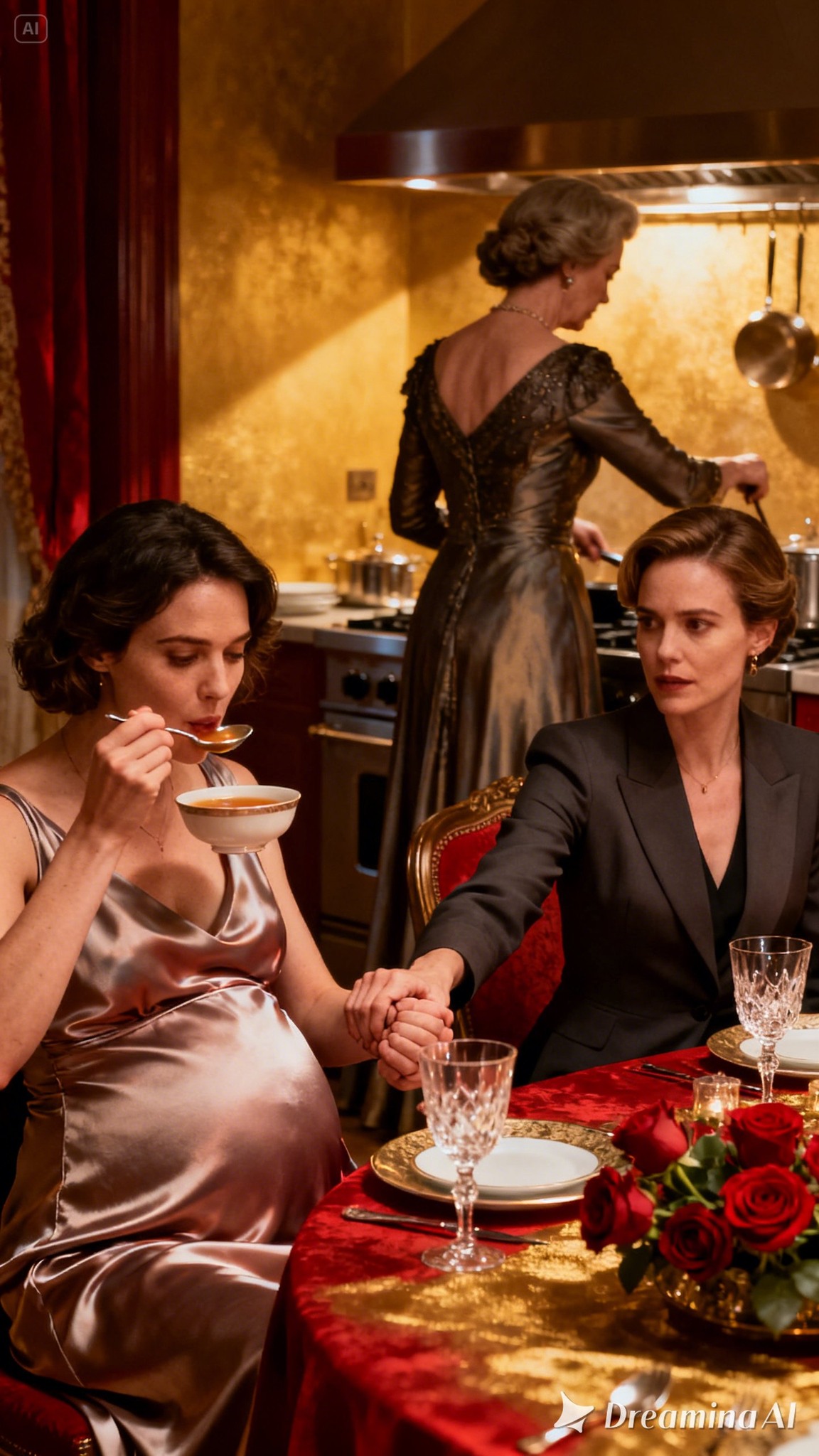
At dinner, my mother-in-law set the soup in front of me, her voice sugary enough to chill my spine: “Finish it, dear. It’s good for the baby.” I barely touched the spoon when Anna, my SIL, shot up: “Mom, give me the same soup.” My mother-in-law’s smile collapsed.
The air in the grand, mahogany-paneled dining room of the Blackwood estate was not just stagnant; it was suffocating. It hung heavy, not with the rich aroma of the roast beef or the scent of expensive beeswax candles, but with the oppressive, invisible pressure exerted by my mother-in-law, Margaret. The room was a museum of the family’s past glories, lined with oil portraits of stern-faced men who had built the empire. Tonight, under the flickering candlelight, Margaret looked like one of them—cold, imperious, and utterly devoid of warmth.
I, Sarah, sat at the long table, my hands clasped protectively over the gentle swell of my abdomen. I was six months pregnant. To me and my husband, Tom, this baby was a miracle, a bundle of joy we had already named Lily. We had also made the decision—one we announced proudly—that this would be our only child. But to Margaret, a woman obsessed with the almost medieval concept of securing a male heir to carry on the family name and inherit the vast family fortune, my pregnancy was not a blessing. It was a profound personal failure, a biological error, and the ultimate, unforgivable insult to her lineage.
She had spent the entire evening lecturing, her voice a low, cultured drone that was more menacing than any shout. She didn’t speak of nurseries or baby clothes; she spoke of “tradition,” of “bloodlines,” of “responsibility,” and of the sacred duty to continue the family legacy—a legacy that, in her eyes, required a Y chromosome.
“A girl is a lovely accessory, Sarah,” Margaret said, picking up her wine glass. Her smile was saccharine, a brittle mask of politeness that didn’t reach her cold, calculating eyes. “A little princess for the family to dote on. But let’s be honest with ourselves. A son… a son is the foundation. A son is the future. Without a male heir, the name dies. The legacy crumbles.”
She took a sip of wine, her eyes locking onto mine. “You surely understand that stopping after a girl is simply… selfish. It is a dereliction of duty.”
I tightened my grip on my stomach. “We are happy, Margaret. A daughter is a gift.”
“A gift, perhaps,” she countered smoothly. “But not an heir.”
The dinner, which should have been a celebration of new life, had transformed into a feast of danger. The tension was physical, a tightening noose around my neck. After the main course was cleared by the silent staff, Margaret personally rose from her seat. This was a rare act of service from a woman who usually commanded a small army of servants with the ring of a bell. She walked to the kitchen and returned moments later carrying a single, steaming bowl of soup on a silver tray.
It was a dark, murky herbal broth, smelling of earth and bitter roots.
“I had the cook prepare this specially,” Margaret said, placing the bowl in front of me with a flourish. “It is an old family recipe. A restorative herbal soup. It strengthens the blood and prepares the womb for… future endeavors. I insist you drink it all, Sarah. For your health.”
This was the lure. This bowl of soup was not an act of kindness. I knew, with a chilling certainty that went beyond mere suspicion, that this was an act of war. She intended to induce a miscarriage, to “correct” my failure, forcing me to continue bearing children until I fulfilled my dynastic duty and produced a grandson.
I stared down at the ornate porcelain bowl. The liquid was opaque, swirling with unrecognizable herbs. My survival instinct was screaming at me to run, but social convention and the sheer weight of Margaret’s personality kept me frozen in my chair.
I looked up, trying to find an ally. My husband, Tom, was at the other end of the table, engrossed in his phone, willfully oblivious to the undercurrent of violence his mother was projecting. But there was someone else.
The person who saved me was not myself. It was Anna, my sister-in-law.
Anna, Tom’s younger sister, sat across from me. She had always been a quiet ally, a gentle soul trapped in the gilded cage of her mother’s ambition. For years, I had watched Margaret bully and control Anna, criticizing her appearance, her choices, and her voice until Anna had learned to make herself small, to disappear into the background. She lived in a constant state of fear, utterly under her mother’s tyrannical control.
But tonight, Anna was watching.
Anna had seen the truth. Earlier, she had gone into the kitchen to fetch a glass of water. Through the crack in the pantry door, she had witnessed the unforgivable. She had seen Margaret, her back to the door, her movements quick and furtive. She saw her mother pull a small, unmarked vial from her pocket, uncapping it and slipping a generous amount of fine, white powder into the soup pot when she thought no one was looking. Anna had frozen in horror, the realization crashing down on her: her mother was poisoning her brother’s wife.
As I raised the heavy spoon to my lips, the steam warming my face, Anna suddenly spoke up. Her voice was uncharacteristically high and strained, a sharp, nervous sound that cut through the room’s tense silence like a jagged piece of glass.
“That smells wonderful, Mother,” Anna said. Her hands were gripping the tablecloth so hard her knuckles were white, but she forced a smile. “I’m feeling a bit weak myself today. I’m actually quite hungry. Could you pour me a bowl as well?”
The effect on Margaret was instantaneous. Her face, which had been a mask of triumphant benevolence as she watched me, instantly drained of all color. A flicker of pure, unadulterated panic flashed in her eyes before being quickly suppressed. She froze, her hand hovering near her own wine glass.
She could not, under any circumstances, risk serving the poisoned soup to her own daughter. The poison was meant to flush a pregnancy, but the dosage she had used was dangerous for anyone.
“Oh, no, darling,” Margaret said, her voice pitching up slightly, forcing a brittle, terrifying laugh. “This is a very specific recipe, just for Sarah’s… delicate condition. It contains herbs that wouldn’t be good for you, Anna. It’s strictly medicinal.”
“But it smells like the soup you made when I had the flu,” Anna pressed, her eyes wide and fixed on the bowl in my hands. “I really would like some.”
“No!” Margaret snapped, the mask slipping for a fraction of a second. She composed herself, smoothing her napkin. “I said no, Anna. Don’t be greedy. Let Sarah eat.”
Margaret turned away to the sideboard, feigning busyness with the dessert forks, her shoulders tense. She was terrified.
In that moment of distraction, Anna turned her gaze to me. Her eyes were wide, filled with a terror I had never seen before. She knew she couldn’t speak aloud. Margaret was listening to every breath we took. If Anna accused her mother now, Margaret would deny it, destroy the evidence, and we would be gaslighted into silence.
But Anna had to warn me. She had to communicate the lethal, imminent danger before the spoon touched my lips.
She placed her hand flat on the polished mahogany table, her fingers splayed. Then, she tapped.
Tap-tap… tap.
Two quick, sharp taps. One slow, deliberate tap.
My blood ran cold. The spoon froze halfway to my mouth.
The Code.
It was a secret signal, a silly game we had invented ten years ago when Anna was a teenager and I was newly dating Tom. We used to tap it on the table when Margaret was launching into one of her long, boring tirades, a secret way of saying, “Save me from this conversation.” But over the years, as Margaret’s control grew darker, the meaning had shifted. We hadn’t used it in a decade, but its definition was seared into my memory: “Lethal danger. The plan is active. Abort immediately.”
I looked at Anna. She tapped it again, harder this time. Tap-tap… tap.
I understood the signal with a terrifying, absolute clarity. The soup wasn’t just bad; it was a weapon.
I immediately set the spoon back into the bowl with a loud clatter. My hand was shaking so violently that a drop of the dark liquid splashed onto the pristine white tablecloth, sizzling slightly as it soaked in.
“Oh,” I groaned, clutching my forehead. I leaned forward, putting on the performance of my life. “I… I do apologize, Margaret.”
Margaret spun around, her eyes narrowing. “What is it? Drink the soup, Sarah. It will help.”
“I suddenly feel quite dizzy,” I said, injecting a tremor into my voice. “Nauseous. It must be the morning sickness coming back with a vengeance. The smell of the herbs… I can’t.” I pushed my chair back, the legs scraping loudly against the floor. “I think I need to go to the bathroom. Immediately.”
“Sit down, Sarah,” Margaret commanded, stepping forward. “It’s just a little nausea. The soup will settle it.”
“I’m going to be sick,” I said, and I ran.
I rushed out of the dining room, past the bewildered staff, and into the hallway. The moment I was out of her sight, I didn’t go to the guest bathroom. I sprinted into the master suite on the ground floor and locked the heavy oak door behind me.
My phone, which was in my pocket, vibrated. It was a text from Anna, who must have typed it blindly under the table. I opened it, my hands trembling so hard I almost dropped the device.
The message on the screen was stark, terrifying, and final:
“The soup is poisoned. I saw her put powder in it. Call the police. NOW.”
I wasted no more time. The fear vanished, replaced by a cold, maternal fury. I was a mother lion protecting her cub.
I dialed 911.
“Emergency services, what is your location?”
“I need paramedics and police at 14 Blackwood Manor immediately,” I said, my voice trembling but firm, the words tasting like ash in my mouth. “My mother-in-law has intentionally tried to poison me and my unborn child. I believe she used a chemical abortifacient. The evidence is in a bowl of soup on the dining room table. Do not let her dump it.”
“We are dispatching units now. Are you safe?”
“I am locked in the master bedroom.”
After I hung up, a clear-headed resolve took over. I remembered the bowl. If Margaret suspected anything, she would pour it down the sink. The evidence would be gone. I had to secure it.
I grabbed a large Ziploc bag from my travel kit in the bathroom. I unlocked the door and crept back toward the dining room. I could hear Margaret arguing with Anna.
“Why did you ask for the soup, you stupid girl?” Margaret was hissing.
I burst into the room. Margaret jumped. Before she could react, I grabbed the bowl from the table.
“Sarah, what are you doing?” Margaret shrieked.
“Taking this with me,” I said coldly. I dumped the contents—soup, spoon, and all—into the plastic bag and sealed it tight.
“Give that to me!” Margaret lunged, her face twisted into a mask of rage.
“Touch me, and I swear I will end you right here,” I said, my voice low and dangerous.
Five minutes later, the night was shattered by the wail of sirens. The police, followed by paramedics, swarmed the house, their blue and red lights flashing against the expensive oil paintings, a shocking intrusion into the insulated world of wealth and privilege.
The police secured the scene. The soup bag was handed over to the lead officer. A field test kit was brought in. The result was confirmed in minutes: the soup contained a massive concentration of Mifepristone and Misoprostol, crushed into powder. It was a chemical abortion cocktail, strong enough to kill the fetus and potentially cause me to hemorrhage.
Margaret stood by the fireplace, stripping off her diamond rings nervously. When the officer approached her with handcuffs, she drew herself up to her full height.
“This is a misunderstanding,” she spat. “I was trying to help her. It’s traditional medicine!”
“It’s attempted murder, ma’am,” the officer said. He spun her around. “Margaret Blackwood, you are under arrest for conspiracy to commit murder and endangering the life of a fetus.”
She was handcuffed right there at her perfectly set dining table, in front of her stunned husband and her weeping daughter.
Margaret’s collapse was absolute and spectacular. As they led her out, she screamed, not for a lawyer, but at us. “I did it for the family! We need a king, not a princess! You are ruining us!”
Her monstrous plot—to sacrifice her own grandchild in her obsessive quest for a male heir—was publicly and humiliatingly exposed. Her reputation, the thing she valued above all else, was destroyed in an instant.
The paramedics examined me. I was shaken, my blood pressure was high, but I was safe. I hadn’t ingested a single drop.
I sat on the sofa, the adrenaline fading, leaving me exhausted. I looked up to see Anna standing in the doorway, shivering.
I stood up and walked to her. I wrapped my arms around her, holding her tighter than I ever had. We stood there, two women in a house built by men, having survived the matriarch who tried to enforce their rules.
“You didn’t just save my life,” I whispered into her ear, tears finally streaming down my face. “You saved your niece’s life. You saved Lily.”
Anna sobbed into my shoulder. “She’s my mother,” she whispered, her voice broken. “But she was going to kill you. I… I couldn’t let the legacy be death.”
“You chose loyalty,” I told her. “You chose loyalty over blood. And that makes you more of a mother than she ever was.”
Margaret’s obsession with the male bloodline and her insatiable greed had cost her everything—her freedom, her family, and her honor. She would spend the rest of her days in a cell, with no heir to visit her.
In the end, I, the unwanted daughter-in-law, and my unborn daughter became symbols of survival. But the true hero was the quiet girl who tapped on the table.
The lesson was a brutal one, learned in a room full of lies and conspiracies. Loyalty does not come from DNA; it comes from a conscious, ethical choice. And in that room, the scorned daughter-in-law and the oppressed sister-in-law enacted the most profound and necessary justice. My daughter would be born into a world free from the poison of her grandmother, protected by the love of the aunt who had saved her life before she even took her first breath.