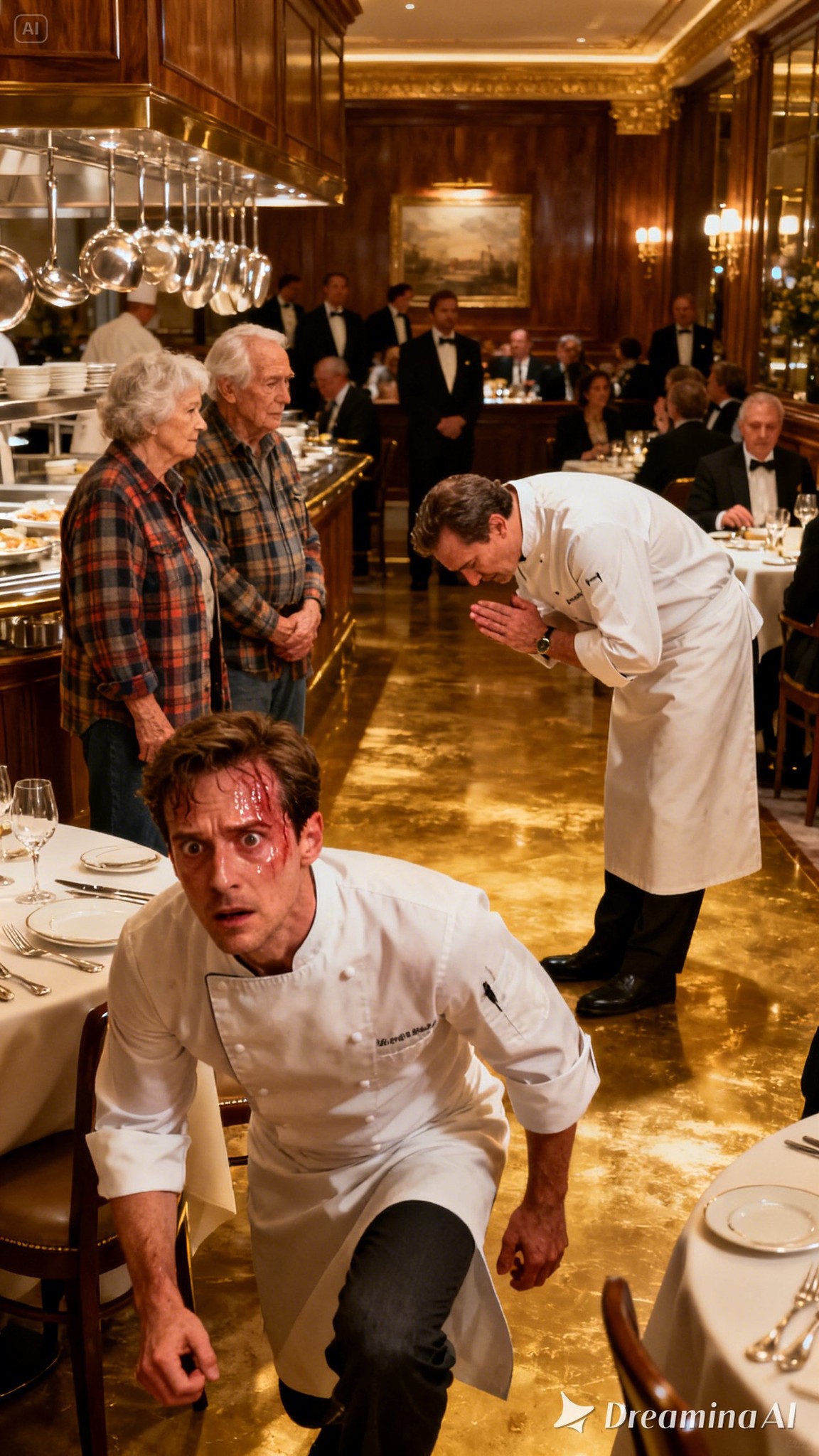
My brother-in-law had just become sous-chef at a five-star restaurant when he sneered at my parents. “Still slaving away in that tiny roadside shop? I cook for the elite now.” He proudly carried out a Beef Wellington. I tasted it, then spat it out. “The meat’s dry. The duxelles is raw.” Enraged, he called the head chef to throw us out. But when the head chef appeared and saw my parents, he bowed a full ninety degrees. My brother-in-law froze, utterly speechless.
The air inside “Le Chateau,” Manhattan’s most exclusive 5-star French restaurant, was kept at a crisp sixty-eight degrees, but the atmosphere at table four was suffocating.
I, Anna, sat with my parents, trying to make myself as small as possible in the velvet-upholstered chair. Across the table sat my brother-in-law, Mark. He was wearing his pristine, white chef’s whites, complete with the tall toque hat, despite being seated in the dining room. It was a breach of etiquette, but Mark didn’t care about etiquette; he cared about dominance.
Mark had just been promoted to Sous Chef at Le Chateau. To hear him tell it, he had been anointed the next culinary messiah. He had insisted—demanded, really—that my parents and I come to the restaurant for a “complimentary” tasting menu so he could “educate” us on what real food tasted like.
My parents, Joe and Martha, looked painfully out of place, or so Mark wanted them to feel. Dad was wearing his best flannel shirt, buttoned all the way to the top, and his cleanest pair of Wrangler jeans. Mom was in her Sunday church dress. Their hands were calloused, their skin weathered by the relentless Texas sun and the heat of hickory smoke.
They owned “Joe’s Smokehouse,” a roadside BBQ joint in rural Texas. It was a wooden shack with a tin roof that had been blackened by decades of smoke. To Mark, who dealt in truffles and foie gras, it was a pit of filth.
Mark signaled the waiter with an arrogant snap of his fingers. “Pour the 1982 Bordeaux. And don’t drip it.”
He turned to my father, a smirk playing on his lips. “So, Joe,” Mark began, his voice dripping with condescension. “Still slaving away in that grease trap you call a restaurant?”
My father smiled politely, picking up the heavy crystal water glass. “It pays the bills, Mark. People seem to like the brisket.”
Mark laughed, a harsh, barking sound that made the diners at the next table glance over. “Brisket. Please. That’s not cooking, Joe. That’s just leaving meat in a hot room and hoping for the best. Look around you.”
He gestured grandly at the gold-leaf ceilings and the Impressionist paintings on the walls.
“This is gastronomy,” Mark declared. “This is art. Tonight, I’m going to feed you food you couldn’t even dream of in Texas. I cook for Senators, for tech billionaires, for royalty. I don’t cook for truck drivers and farmhands.”
“Food is food, son,” Mom said gently. “It’s about feeding people.”
“No, Martha,” Mark sneered. “That is the mentality of a short-order cook. Tonight, you are in the presence of a chef. Try not to use the wrong fork. It would be embarrassing for me.”
I clenched my fists under the table. The arrogance was nauseating. Mark didn’t invite them here to share his success; he invited them here to crush them with it. He wanted to prove that his culinary degree and his New York address made him a superior species to the people who raised his wife.
The courses came and went. Escargot swimming in garlic butter that was slightly too salty. A lobster bisque that was lukewarm. Mark watched us eat like a zookeeper watching apes, waiting for us to be confused by the cutlery.
Then came the pièce de résistance. The main course.
Waiters arrived with a silver trolley. Mark stood up, preening.
“This,” Mark announced, “is my signature dish. I have been perfecting this for six months. The Beef Wellington.”
He carved the pastry log with a theatrical flourish. The knife sliced through the golden crust. He plated three thick slices and placed them before us.
“Eat,” he commanded. “And try to understand what you are tasting.”
I looked down at the plate. I had grown up in a kitchen. My parents might run a BBQ joint, but they had taught me everything about flavor, texture, and heat control. I knew food.
I saw the problem immediately.
I cut a small piece. I put it in my mouth. I chewed once, twice.
The texture was wrong. The flavor was muddy.
I didn’t swallow. I took my linen napkin, brought it to my lips, and spat the bite out.
The silence at the table was instantaneous. Mark’s eyes bulged. “Excuse me? Did you just… spit out my food?”
“I had to,” I said, my voice calm and carrying the projection of a judge delivering a verdict. “It’s barely edible.”
“How dare you,” Mark hissed, his face turning a violent shade of red. “You wouldn’t know quality if it hit you in the face, you little—”
“Mark, stop,” I interrupted, pointing at the slice on my plate with my knife. “You call this world-class? Look at the meat.”
I poked the center of the beef. It was grey.
“You ordered this medium-rare. This is well-done,” I critiqued, my voice sharp. “It’s dry. It’s grainy. You killed the tenderloin.”
“It’s lighting!” Mark argued, though his voice wavered.
“And that’s not the worst part,” I continued, relentless. I flipped the slice of Wellington over to reveal the bottom of the pastry. It was a soggy, wet, mushy mess that fell apart under my fork.
“Look at the pastry, Mark. It’s raw. It’s sodden. You didn’t cook the duxelles—the mushroom paste—long enough. You left too much moisture in the mushrooms. When you baked it, the water steamed out and destroyed the pastry base.”
I looked him in the eye.
“It’s a soggy bottom,” I declared. “This is the most basic error a first-year culinary student makes. You rushed the prep because you were too busy coming out here to brag. It’s amateur hour.”
The insult hit Mark like a physical slap. To be critiqued on technique—specific, undeniable technique—by his “ignorant” sister-in-law was too much for his fragile ego.
He slammed his fist onto the table, rattling the silverware.
“SHUT UP!” he roared. “You ignorant peasant! You know nothing! Duxelles? You probably read that in a magazine!”
He turned to my parents, pointing a shaking finger. “This is what I get for casting pearls before swine. You people eat burnt pig in a shack! I am a Sous Chef at Le Chateau! I am an artist!”
He was shouting now, drawing the attention of the entire restaurant.
“I will not be insulted by nobodies in my own dining room!” Mark screamed. “I am calling Chef Jean-Pierre! I will have him throw you out personally for slander! He will laugh in your faces!”
Mark waved frantically at the kitchen doors. “Chef! Chef Jean-Pierre! We have a situation!”
The swinging doors burst open.
The restaurant went dead silent. Executive Chef Jean-Pierre stepped out. He was a giant of a man, a legend in the culinary world known for a temper that could curdle milk. He had three Michelin stars and zero patience. He marched toward our table, his face a thundercloud, wiping his hands on a towel.
“What is the meaning of this noise?” Jean-Pierre demanded, his French accent thick and menacing. “Who is screaming in my dining room?”
Mark stepped forward, putting on his most sycophantic face.
“Chef, I apologize,” Mark said, pointing accusingly at us. “These… people. My in-laws. They are from Texas. They run a roadside shack. I tried to show them elegance, but they are disrespecting the food. They claimed the Wellington had a soggy bottom! They are slandering the reputation of Le Chateau. I want them removed immediately.”
Mark stood tall, crossing his arms, waiting for the explosion. He expected Jean-Pierre to unleash his legendary fury upon my parents.
Chef Jean-Pierre frowned. He looked at the plate where I had dissected the failed Wellington. He saw the gray meat. He saw the wet pastry. His eyes narrowed.
Then, he looked up at the people sitting at the table.
His gaze swept over me, over my mother, and landed on my father.
Joe was sitting calmly, holding his fork, looking back at the furious French chef with a mild, bemused expression.
Chef Jean-Pierre froze. The color drained from his face. The terrifying scowl vanished, replaced by a look of utter, bewildered shock.
He blinked, as if he were seeing a ghost.
“Master… Joe?” Jean-Pierre whispered.
Mark laughed nervously. “Yes, Chef, his name is Joe. He’s a nobody. Just tell him to leave.”
Jean-Pierre didn’t hear Mark. He threw his towel onto a nearby service table. He reached up and removed his tall executive chef’s toque—a sign of extreme deference that made the other line cooks gasping in the background.
The famous, angry French chef walked around the table. He didn’t yell. He bowed. He bent his waist in a deep, respectful ninety-degree bow directly in front of my father.
“Master Joe,” Jean-Pierre said, his voice trembling with emotion. “And Martha. Mon Dieu. Is it really you?”
Mark’s jaw hit the floor. “Chef? What are you doing? He’s a truck driver!”
Jean-Pierre stood up, his eyes wet. He ignored Mark and grabbed my father’s calloused hand, shaking it with both of his own.
“It has been twenty years,” Jean-Pierre said. “I did not think I would see you again.”
“Hello, Jean,” my father said, his voice like gravel and honey. “You’ve done well for yourself. Nice place.”
Jean-Pierre turned to Mark, his face twisting into a snarl. “You call him a nobody? You call him a truck driver?”
He addressed the entire room, his voice booming.
“This man,” Jean-Pierre pointed at my dad, “is Joe Miller. The owner of Joe’s Smokehouse.”
Mark scoffed. “Exactly! A BBQ pit!”
“Imbecile!” Jean-Pierre shouted. “Joe’s Smokehouse is a James Beard Award Winner! It is one of the five ‘American Classics’ recognized by the Culinary Institute!”
Mark froze. The James Beard Award was the Oscar of the food world.
“Twenty years ago,” Jean-Pierre continued, his voice fierce, “I came to America. I was young. I was arrogant. Like you, Mark. I thought French food was the only food. I ended up in Texas, broke and hungry. I walked into Joe’s place.”
Jean-Pierre looked at my father with reverence.
“He fed me. And then… I tasted his brisket. It was perfect. It was alchemy. It was heat and time and smoke controlled with the precision of a surgeon. It humbled me. I begged him to let me work. I spent one year scrubbing his floors and watching his fire. Joe is the man who taught me that an onion deserves as much respect as a truffle. He is my first Master.”
The revelation hung in the air. The “roadside shack” was a temple of American cuisine, and my father was the High Priest.
My father cleared his throat. He picked up his fork and poked the sad, wet piece of Beef Wellington on the plate.
“Jean,” Dad said quietly. “I taught you better than this.”
Jean-Pierre looked terrified. “Sir?”
Dad pointed to the soggy pastry. “Anna was right. You’re not teaching your boys heat control. The mushrooms were rushed. The pastry is steaming from the inside out. It’s like eating a wet sponge.”
He looked at the meat. “And you let a Wellington leave your pass at ‘Well Done’? If you did this in my smokehouse with a brisket, I’d have you cleaning the grease trap for a month.”
Jean-Pierre turned purple. He looked at the plate. He saw the undeniable failure. He tasted the sauce with his finger and grimaced.
“Who cooked this?” Jean-Pierre asked, his voice deadly quiet.
“I did, Chef,” Mark stammered, sweat pouring down his face. “But… but the oven… the humidity…”
“Silence,” Jean-Pierre commanded.
Jean-Pierre stepped into Mark’s personal space. The height difference seemed to double.
“You cooked this garbage,” Jean-Pierre said, holding up the plate. “You served this insult to the man who taught me how to cook. And then… you dared to call him a peasant in my kitchen?”
“Chef, please, I didn’t know…”
“You didn’t know because you are blind!” Jean-Pierre roared. “You are arrogant! You care about the title, not the food! You have no soul for this!”
Jean-Pierre reached out and grabbed the lapels of Mark’s chef jacket.
“Take it off,” Jean-Pierre ordered.
“Chef?”
“TAKE IT OFF!”
Mark, shaking, unbuttoned his jacket. He stripped off the white coat, revealing his undershirt. He looked small, pale, and utterly defeated.
“You are fired,” Jean-Pierre declared. “Get out of my restaurant. And do not bother applying anywhere in New York. I will call every Executive Chef in this city tonight. I will tell them you served a soggy Wellington to Joe Miller and insulted him. You will never hold a knife in this town again.”
Two waiters stepped forward to escort Mark out. He looked at me, then at my parents, his eyes pleading for help.
My mother just sipped her water. My father didn’t look up from the menu.
I stood up. I picked up the discarded chef’s jacket from the floor and tossed it at Mark.
“You said you cooked for the elite, Mark?” I asked, my voice cutting through the room. “It’s a shame. Today, you had the privilege of serving legends—people the ‘elite’ wait in line for hours just to eat with. And you served them raw dough and arrogance.”
“You burned your own career, Mark,” I said. “Now, go home. I think you have some packing to do. My sister doesn’t date the unemployed.”
Mark was dragged out the back door, into the alley, where the garbage belonged.
Jean-Pierre turned back to my father, bowing again. “Master Joe. Martha. Please. Allow me to cook for you myself. No charge. I have some beautiful A5 Wagyu. I will treat it with respect.”
“That sounds good, Jean,” Dad smiled. “Just… keep it simple.”
We dined like kings that night, while outside, Mark stood on the sidewalk, realizing that in the world of true mastery, there is no place for a soggy bottom.