My husband locked me outside in the pouring rain, shivering and soaked—until my wealthy grandmother pulled up. She looked at me, then at the house, and whispered something that changed everything…
Part 1: The Invisible Wife
I had been on my feet since 4:00 AM, a silent, tireless ghost in my own home. I had personally arranged the towering centerpieces of white orchids, imported at a staggering cost from a specialty grower in South America, because Kyrie, my husband, had declared that roses were “too pedestrian.” I had spent a full hour in a tense, one-sided argument with the caterers about the precise temperature of the filet mignon, a battle I waged with the ferocity of a general defending a critical outpost. I had even, in a final, intimate act of service, ironed Kyrie’s Italian silk suit myself, pressing my love, my hope, my desperate plea to be seen, into every single seam. I hoped that tonight, finally, celebrating his fortieth birthday and the closing of a landmark deal, he would look at me and see his wife, not just the highly efficient, unpaid woman who managed his life.
I stood in the corner of the grand, double-height living room, clutching a heavy silver tray of champagne flutes like a lifeline. My legs ached in my sensible, low-heeled shoes. My dress, a simple, modest navy blue, was something I’d bought off the rack at a department store. Kyrie always insisted that we needed to be “fiscally responsible” with our personal spending, a cruel irony given the lavish, six-figure parties he threw to burnish his own image. I wore my favorite head wrap, a beautiful, patterned silk pressed crisp and clean, a small, personal crown of dignity in a room full of shimmering, professionally styled designer blowouts.
I watched him. Kyrie was holding court near the massive, carved-stone fireplace, a glass of vintage Bordeaux in one hand, gesturing expansively with the other as he spun a familiar, well-polished anecdote. He looked magnificent, I couldn’t deny that. He radiated a potent, intoxicating brand of success. But as I watched him laugh, a deep, booming sound, at a joke made by a potential investor, a sharp, physical pain pierced my chest.
He hadn’t introduced me to a single person all night.
I began to move through the glittering crowd, a silent, smiling automaton offering drinks. When I finally reached Kyrie’s circle, I held the tray out, my arm trembling slightly from its weight.
“Water, honey?” I whispered, my voice barely audible over the din of self-important chatter.
He didn’t even turn his head. He just waved a dismissive, impatient hand in my general direction, continuing his conversation without missing a beat. To him, and therefore to everyone else in this room, I was just part of the hired help.
I swallowed the bitter bile rising in my throat and forced a smile for the wives of his business partners. They looked me up and down with a casual, open disdain, their eyes lingering for a moment too long on my simple shoes. They were draped in Gucci and Prada, shimmering like a flock of exotic, predatory birds, while I, in my sensible navy, faded into the expensive, hand-painted wallpaper.
Keep it together, Keziah, I told myself, my own voice a desperate, internal mantra. Don’t ruin his night. This is for him. His success is our success.
But the carefully constructed atmosphere, the very foundation of my long-suffering patience, shifted the moment the heavy, oak front doors swung open.
The chatter died down, not all at once, but in a slow, rolling wave. Heads turned. A hush fell over the room that was louder and more profound than the expensive jazz trio playing softly in the corner.
Vianne had arrived.
She looked as if she had been poured, molten, into her dress—a sparkling, blood-red crimson gown that hugged every single curve and left very, very little to the imagination. Her dark hair cascaded in perfect, glossy, professionally styled waves over her bare shoulders, and her makeup was flawless, a masterpiece of seductive artistry. She didn’t just walk; she prowled. She moved with the terrifying, unshakeable confidence of a woman who knows, without a single doubt, that she owns every room she enters.
But it was Kyrie’s reaction that shattered me into a thousand, invisible pieces.
His face, which had been a carefully curated mask of polite, professional charm, lit up with a genuine, boyish excitement I hadn’t seen directed at me in years. He abandoned his conversation and the potential investor mid-sentence and strode toward her, his movements eager, almost desperate.
“Vianne! What a surprise!” he exclaimed, his voice booming with a delight that was utterly, painfully authentic, though his eyes told me he had been waiting for this exact moment all night.
She wrapped herself around him, a graceful, predatory vine, pressing her body against his expensive silk suit without a single shred of shame or discretion. “Happy birthday, handsome,” she purred, her voice low and husky, yet loud enough for the entire, silent room to hear.
I stood frozen, the heavy silver tray shaking in my hands, the champagne flutes rattling a frantic, metallic rhythm. The public humiliation was a physical blow, a punch to the gut that left me breathless. But then, it got worse.
Eudora, my mother-in-law, emerged from the kitchen, a triumphant smile on her face. This was the woman whose swollen, gout-ridden feet I had washed and massaged when she was sick. The woman I dutifully drove to her dialysis appointments three times a week. She usually looked at me with a barely concealed sneer. But now? She rushed toward Vianne with her arms wide open, her face beaming with a genuine warmth she had never, not once, shown to me.
“Well, look who it is!” Eudora sang out, her voice ringing with joy. “You look absolutely gorgeous, baby girl! Come, let me introduce you to the right people. There are some very important families here tonight.”
She hooked her arm through Vianne’s and paraded her, like a prize, into the very center of the room. “Everyone, this is Vianne. She comes from such a good family, top of her class at Wharton in marketing. Doesn’t she just look like a movie star?”
I felt the blood drain from my face. My legs felt weak. I was the lawful wife. I was the one who had eaten ramen noodles with Kyrie in a tiny, roach-infested studio apartment when we had nothing but each other. I was the one who had sold my late mother’s precious, irreplaceable jewelry to fund his first risky investment. And here I was, invisible, a ghost in my own home, while his mistress was being proudly, publicly paraded as the queen.
Something inside me, some deeply buried, long-suffering part of my soul, snapped. It was a quiet snap, like a dry twig in the dead of winter, but it was absolute. And it was final.
Part 2: The Storm Breaks
I set the heavy silver tray down on a nearby side table with a loud, deliberate clang that made several people jump. I walked toward them, my legs shaking but my spine as straight and unbending as a steel rod.
I planted myself directly in front of Kyrie and Vianne. He was leaning down, whispering something in her ear that made her giggle, a high, tinkling, triumphant sound.
“Kyrie,” I said. My voice cracked on his name, but I pushed through, fueled by a decade of suppressed rage. “What is the meaning of this? Why is this woman here, in our home, behaving as if she is the lady of the house?”
The room went deathly, unnervingly silent. Someone in the corner turned off the music.
Kyrie’s warm, affectionate smile vanished, replaced by a look of cold, dead-eyed fury. “Keziah, don’t start,” he hissed, his voice a low, menacing growl. “Don’t you dare make a scene at my party.”
Vianne let out a soft, mocking, theatrical laugh. “I just came to celebrate the man I love, Keziah. You should really try not to be so uptight and jealous. You’re completely ruining the vibe.”
The rage that surged through me was hot and blinding. “This is my house,” I said, my voice rising, gaining strength with every word. “And he is my husband. I am asking you to leave right now, Vianne. You are not welcome here.”
Eudora stepped between us, her face twisted into a snarl of pure, unadulterated venom. “What a stunning lack of respect! How dare you speak to an important guest that way? Vianne has class, style, and ambition, something you clearly wouldn’t understand. You are embarrassing all of us with this pathetic, jealous outburst.”
“I am embarrassing you?” I stared at her in utter disbelief. “I am the one who—”
Kyrie grabbed my wrist. His grip was hard, bruising, merciless. “That’s enough.”
He dragged me. He physically, brutally dragged me through the foyer of my own home, past the dozens of staring, whispering guests who averted their eyes, their silence a form of complicity.
“Kyrie, stop! You’re hurting me!” I pleaded, stumbling in my sensible, low-heeled shoes.
He didn’t stop until we reached the heavy, imposing front door. He wrenched it open with a violent tug.
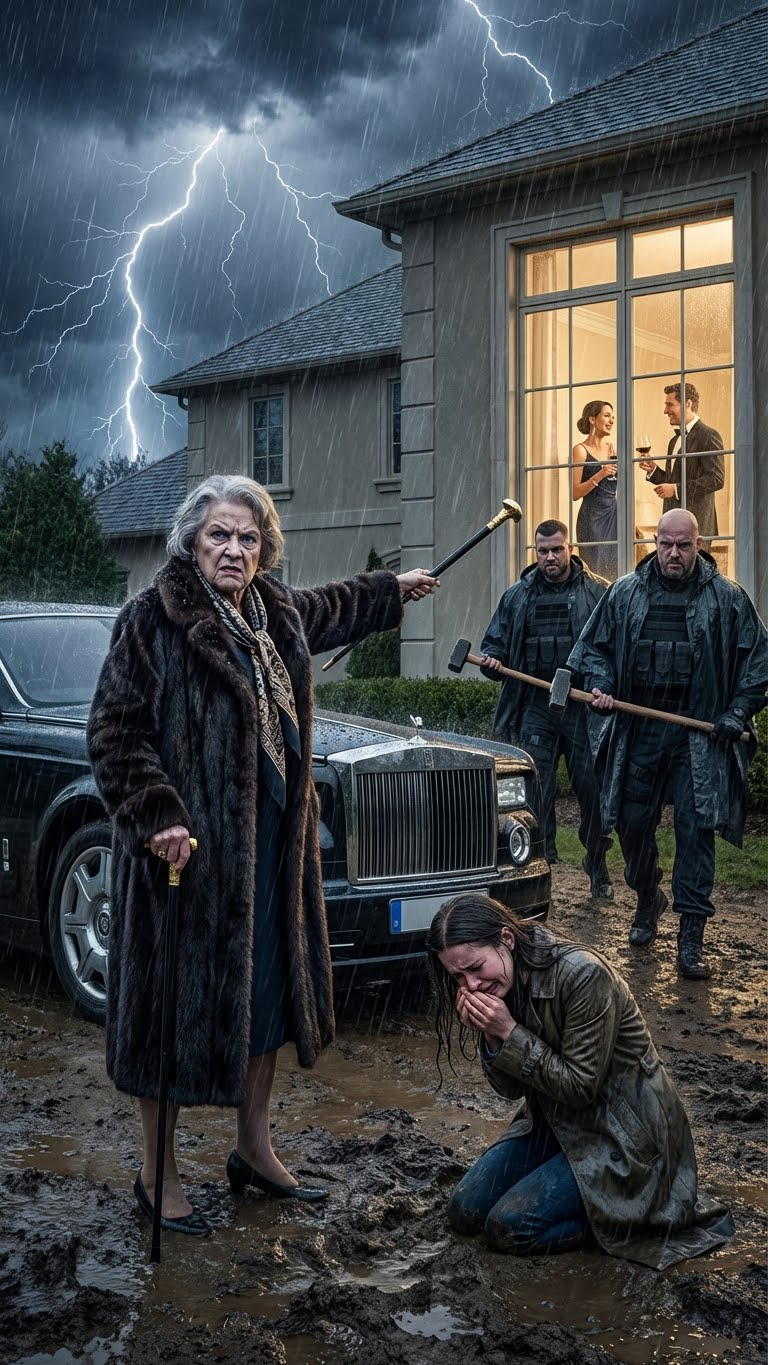
Outside, the world was ending. A ferocious thunderstorm was raging over Atlanta, the sky a black, boiling cauldron, rain coming down in thick, wind-driven sheets. The wind howled like a wounded animal, a perfect symphony for the destruction of my life.
“If you can’t accept Vianne,” Kyrie shouted over the roar of the thunder, his face a mask of cold, implacable rage, “then you have no place in this house. I want her here. If she goes, I go.”
“Kyrie, please,” I begged, the cold, driving rain already soaking my simple navy dress, my carefully pressed head wrap. “It’s pouring. Don’t do this.”
“Take this as your choice, Keziah,” he spat, his face inches from mine, his breath smelling of expensive wine and betrayal.
He shoved me. Hard. I stumbled backward, my worn-out heels losing their footing on the slick, marble porch tiles, and I fell, hard, to my knees in the flooding, muddy garden bed.
Slam.
The sound of the heavy oak door closing was as final as a coffin lid. Then came the sound that broke my heart completely, irrevocably: the sharp, metallic click of the deadbolt sliding home.
I scrambled to my feet, my hands and knees covered in mud, and pounded on the unyielding wood. “Kyrie! Open the door! It’s freezing out here! Please!”
Silence. Then, faintly, I heard the sound of the jazz music starting up again inside. The party was continuing.
I stumbled around the side of the house, my body shaking with a violent, uncontrollable cold, to the large bay window of the living room. Through the rain-slicked, distorted glass, I watched.
They were laughing. Kyrie was standing by a massive, multi-tiered birthday cake, Vianne pressed tightly to his side, her red dress a garish slash of color in the warm, golden light. They held the knife together, a grotesque parody of a wedding. He fed her a piece of the cake. She, in turn, wiped a smudge of frosting from his lip with a playful, intimate gesture. Eudora stood beside them, clapping, her face glowing with a pride I had never, not once, seen her direct at me.
They were eating the food I had ordered. They were celebrating in the house I had cleaned and prepared. They were living the life I had helped to build, on the foundations of my sacrifice.
I slid down the cold, brick wall, collapsing onto the muddy patio pavers. The relentless rain mixed with my hot, silent tears. I was shaking so hard my teeth chattered, a painful, rattling sound. I felt my spirit beginning to dim, the profound, penetrating cold seeping not just into my bones, but into my very soul.
God, I prayed, my voice a voiceless whisper, lost in the roar of the wind. If this is the end, please, don’t let this injustice stand.
My vision began to blur at the edges. I saw headlights cutting through the darkness, twin beams of blindingly bright light sweeping up the long, winding driveway.
A car stopped at the gate. Not a guest’s car, not a sleek, modern sports car. This was a monster of a vehicle—a sleek, impossibly black Rolls Royce Phantom, a car that whispered, not shouted, its immense, unimaginable wealth.
A chauffeur in a crisp, dark uniform jumped out, opening a massive black umbrella with a soft whoosh. He hurried to the rear door and opened it.
A woman stepped out. She leaned heavily on a cane with a gleaming, solid gold handle. She wore a thick, impeccably tailored wool coat, but I knew that walk. I knew that proud, unbending silhouette.
“Grandma?” I whispered, the name a disbelieving puff of air.
It was Hattie. My grandma from down south, the woman who always showed up for holidays with bushels of collard greens and mason jars of homemade jam. The woman I thought lived on a fixed, modest income in a small, rustic country shack.
She saw me, a crumpled, soaking heap on the ground. Her face, usually so soft and creased with age and kindness, hardened into a mask of cold, unforgiving stone. She marched toward me, her pace surprisingly brisk, ignoring the mud that splashed onto her expensive, polished leather boots.
“Keziah, baby,” she said, her voice trembling with a fury so profound it was almost silent as she knelt and touched my freezing, rain-streaked face. “What have they done to you?”
She took off her own heavy, cashmere-lined coat and wrapped it around my shaking shoulders. Two large, imposing men in dark suits—her security detail—appeared, as if from the shadows, behind her.
Grandma Hattie looked up at the house, at the warm, golden light spilling from its windows. She looked at Kyrie and Vianne through the bay window, laughing, warm, and dry.
She didn’t scream. She didn’t cry. She turned to the head of her security detail, a man with a face like a clenched fist, pointed her elegant, gold-handled cane at the magnificent mansion, and spoke three, quiet words that changed everything.
“Tear it apart.”
Part 3: The Reckoning
The command hung in the humid, storm-charged air, heavier and more dangerous than the thunder rolling overhead.
“Tear it apart,” Grandma Hattie repeated, her voice devoid of mercy, as cold and final as a judge’s sentence.
The security team didn’t hesitate. They didn’t ask for clarification. They moved with a swift, silent, military precision toward the front door.
The chauffeur, a gentle giant of a man, helped me to my feet. “Easy now, Ms. Keziah,” he murmured, his voice a low, comforting rumble as he held the massive umbrella over me. I leaned into him, my body convulsing with violent, uncontrollable shivers, as my grandmother took my hand. Her grip was surprisingly strong, her skin warm and dry against my ice-cold, numb fingers.
We followed the men to the door.
The lead bodyguard, the man with the clenched-fist face, didn’t bother knocking. He didn’t ring the doorbell. He stepped back, raised a heavy, polished boot, and drove his heel directly into the lock mechanism with a terrifying, calculated, and explosive force.
CRACK.
The solid oak splintered. The door flew open, banging violently against the interior wall with a sound that echoed through the house like a cannon shot. The storm rushed into the pristine foyer, bringing with it the smell of ozone, wet earth, and a righteous fury, instantly extinguishing the delicate, perfumed air of the party.
Inside, the jazz music cut out instantly. The silence that followed was absolute, profound, and filled with a collective, terrified gasp.
Kyrie was standing near the buffet table, a forkful of my carefully selected cake halfway to his mouth. He dropped it. The heavy, antique silver clattered against the marble floor like a gunshot. Vianne, her face a mask of shock, shrank behind him. Eudora’s mouth hung open, a piece of shrimp toast frozen in her hand.
Kyrie, predictably, recovered first. The blinding arrogance that had fueled him all night surged back, overriding his shock. He stormed toward the foyer, his face twisted into a mask of pure, unadulterated rage.
“Who the hell do you think you are?” he bellowed, puffing out his chest like a territorial animal. “You are violating private property! This is my house! Get out of here right now before I call the police!”
He reached out a hand to shove the lead bodyguard. It was like trying to shove a granite monument. The guard didn’t even blink; he simply swatted Kyrie’s arm away with a backhanded motion so casual, so dismissive, it was profoundly insulting. Kyrie stumbled backward, crashing into a delicate side table laden with hors d’oeuvres, sending a shower of canapés and broken crystal to the floor.
“Secure the perimeter,” the guard said, his voice a low, calm command into his earpiece. “No one leaves.”
Grandma Hattie stepped over the threshold, her feet now on the marble floor of the house. The rhythmic tap-tap-tap of her gold-handled cane echoed through the silent, cavernous room. I walked beside her, dripping water and mud, looking like a drowned ghost returning to haunt the living.
A ripple of shock and frantic whispers went through the remaining guests. Is that Keziah? What happened to her? And who is that old woman?
“Well, well,” Eudora sneered, trying desperately to regain her composure, to reassert her dominance. She stepped forward, smoothing the front of her expensive dress. “I thought we were being robbed by thugs. But it turns out it’s just Keziah’s little country grandma. What a pathetic, theatrical scene.”
Vianne, seeing Eudora’s lead, relaxed, a cruel, mocking smirk playing on her lips. “Came all the way to the city to beg for some leftovers, did you? This is a private party, for important people. You don’t belong here.”
My grandmother stopped directly under the massive, glittering crystal chandelier. She lifted her chin, her eyes sweeping over the trio—Kyrie, Vianne, and Eudora—with a look of such profound, withering disgust that the guests nearest to her instinctively took a step back.
She struck the marble floor with her cane. Thud.
“I haven’t come to ask for anything,” Grandma Hattie said. Her voice wasn’t loud, but it was imbued with a power and a resonance that projected to every corner of the room. It was the voice of a woman who was used to being obeyed, instantly and without question. “I have come to take back what three ungrateful, parasitic creatures should never have been allowed to touch.”
Kyrie let out a short, incredulous, barking laugh. “What in God’s name are you talking about, you senile old bat? This house is mine. Keziah, get your crazy relative out of here. She’s tracking mud all over my floor.”
My grandmother didn’t even look at him. She turned her head slightly and gave a sharp, almost imperceptible nod to her security team.
And then, the chaos erupted. But it was not a wild, uncontrolled chaos. It was a cold, methodical, and terrifying deconstruction.
One bodyguard walked calmly to the multi-tiered, exquisitely decorated cake. He placed both of his large hands on the silver stand and shoved. The entire confection—hundreds of dollars of fondant, buttercream, and sponge—crashed to the floor in a sickening, silent ruin of frosting and crumbs.
Guests screamed.
Another guard walked to the long, lavish buffet table. He gripped the edge of the heavy silk tablecloth and yanked. Crystal platters, silver chafing dishes filled with the filet mignon I had argued over, and dozens of bottles of expensive wine shattered and splattered against the floor. The sound was a deafening, cacophonous symphony of destruction.
“Hey! Stop that! That’s my property!” Kyrie screamed, lunging forward again. This time, two guards intercepted him, their bodies forming an impassable wall, blocking his path without ever laying a hand on him.
A third guard walked to the wall where Kyrie had, with a staggering lack of taste, hung a massive, pretentious, air-brushed portrait of himself and Vianne, painted to look like royalty. He ripped it from its hook, held it up for a moment, and then smashed it cleanly over his knee.
“My furniture! My decor! My Ming dynasty vase!” Eudora shrieked, watching in horror as a guard methodically tipped over a display of expensive, imported vases. “You’re destroying everything!”
Grandma Hattie stood amidst the beautiful, calculated destruction, as calm as the eye of a hurricane. She pulled a smartphone from the pocket of her coat—not an old, outdated flip phone, but the latest, most advanced model—and tapped the screen.
Suddenly, the lights in the mansion flickered. Then, total darkness. A collective gasp went through the room.
A moment later, the backup emergency lights kicked on, casting long, eerie, dramatic shadows across the ruined room. The guests, whatever morbid curiosity or loyalty they might have had to Kyrie, panicked. They scrambled for the exits, tripping over broken glass and ruined food, their expensive shoes slipping in pools of spilled wine, desperate to escape the judgment that was so clearly, so powerfully falling on this house.
Within five minutes, the room was empty of all spectators. It was just us. Me, my grandmother, her silent, efficient team, and the three of them, standing amidst the wreckage of their own party.
Grandma walked to the plush, velvet sofa—Kyrie’s “throne”—and sat down. She rested her cane against her knee. A man in a suit, who I now realized was a doctor who had arrived with the entourage, rushed to my side. He wrapped me in a thick, warm thermal blanket and gently checked my pulse.
“You’re going into shock, Ms. Keziah,” he murmured, handing me a silver thermos of hot, sweet tea. The warmth hit my stomach, a small, spreading sun, and I finally felt like I was back inside my own body.
Grandma Hattie signaled to her personal assistant, a sharp, elegant man holding a leather briefcase. He opened it and pulled out a thick, navy blue folder. He handed it to Hattie.
She tossed the folder onto the coffee table in front of Kyrie. It landed with a heavy, final thwack.
“Kyrie,” she said, her voice now dangerously soft. “Before you embarrass yourself further by actually calling the police, I suggest you read that.”
Part 4: The Unveiling of an Empire
Kyrie was panting, his face a blotchy, furious red, sweat beading on his forehead. But the absolute confidence, the bedrock of his arrogance, was cracking. He approached the table warily, as if it were a bomb. He picked up the folder and opened it.
I watched his eyes. He read the first line of the cover letter. He frowned. He flipped the page.
And then, the color drained completely from his face, leaving him looking like a corpse. His hands started to shake so violently that the papers rattled.
“No,” he whispered. “No, this… this isn’t right. It’s a mistake.”
Vianne, her curiosity overriding her fear, snatched the folder from him. “What is it? What does it say?” She read the letterhead at the top of the first page and gasped, dropping the papers as if they had burned her.
Eudora, now on her hands and knees, scrambled on the floor to pick them up. “What does it say?”
The folder contained the deed to the mansion. The loan agreements for the luxury cars in the garage. And a debt acknowledgement and equity transfer agreement from Kyrie’s company for four million dollars.
But the name on the deed, the name of the lender, the name on the equity agreement, wasn’t Kyrie’s. It was Sterling Legacy Group.
“For the last seven years,” Grandma Hattie said, her voice as cold and clear as ice, “I have been the anonymous angel investor behind your company. I invested for one, and only one, reason: I wanted my granddaughter, my Keziah, to have a comfortable and secure life. I hid my identity, I worked through a series of shell corporations, so that you wouldn’t feel emasculated, Kyrie. I wanted you to feel like a man, a provider.”
She leaned forward, her dark eyes pinning him in place. “And what did you do with my generosity? You cheated on my baby. You siphoned company funds—my funds—to buy this house, these cars, and expensive gifts for your mistress. And tonight, you kicked the very woman who made you, the woman whose inheritance you were secretly living off of, out into the rain.”
Kyrie looked at her, his eyes bulging with a dawning, horrified comprehension. “You? You’re Sterling Legacy? But… you bring us collard greens! You live in the sticks in a shack!”
“I own the sticks,” Hattie replied dryly. “And the bank that holds your mortgage. And the building your corporate office is in.”
Eudora, her face a mask of terror and sycophantic desperation, began to crawl on the floor toward the sofa. “Ms. Hattie… I mean… Mother… please! We didn’t know! It’s all a terrible misunderstanding! We are family, after all!”
“Family?” Hattie scoffed, the sound a whipcrack of contempt. “Family doesn’t lock their daughter out in a thunderstorm to die.”
My grandmother looked at her elegant, diamond-encrusted watch. “Under the terms of the fraud clause in your primary investment contract, which you just read, Kyrie, all assets purchased with misappropriated funds are to be seized immediately. That includes this house, the cars in the garage, and, technically, the clothes on your backs.”
She stood up, the picture of regal, righteous fury.
“You have ten minutes to get off my property. You will leave with nothing. No bags. No suitcases. Just yourselves. If you are still here in ten minutes and one second, my men will physically remove you. And I assure you, they will not be gentle.”
Kyrie looked at the ruined room, the shattered remnants of his stolen life, then at me. “Keziah,” he pleaded, his voice cracking as he reached out a hand. “You can’t let her do this to me. I’m your husband. I built this life for us!”
“You built nothing!” Hattie’s voice roared, a sudden, shocking explosion of sound. “You stole it!”
Kyrie spun around, his mind clearly fracturing under the pressure. “I need my things! My wallet! My watch collection!” He bolted toward the grand staircase.
Two of the bodyguards moved with a silent, blurring speed and stepped into his path, crossing their arms. They didn’t say a word. They didn’t have to.
“This is illegal!” Kyrie screamed, his voice high and shrill, spittle flying from his lips. “You can’t just throw us out on the street!”
“You left her in the rain,” I said softly, my first words since the chaos began. My voice was raspy, but it carried across the ruined room. “You locked the door. You heard me knocking. You watched me from the window.”
Kyrie flinched as if I’d slapped him.
Vianne, who had been inching away toward the patio doors, saw her chance. She clutched her small, diamond-encrusted designer purse to her chest. “I’m leaving,” she stammered. “This has nothing to do with me.”
Grandma Hattie lifted a single, elegant finger. The head of security moved in a blur. He blocked Vianne’s path and held out a hand.
“The bag,” he ordered, his voice a low growl.
“It’s mine!” Vianne shrieked. “You can’t take it!”
He snatched it from her grip with an effortless motion and dumped its contents upside down on the coffee table. Jewelry spilled out. Gold rings, a diamond bracelet, a heavy, antique pearl necklace.
“My jewelry!” Eudora gasped, scrambling to her feet. “She stole my jewelry! She must have taken it when she hugged me!”
“Thief!” Eudora lunged at Vianne, her carefully manicured nails clawing at her face. “You were hugging me and picking my pockets, you little tramp!”
“Get off me, you old hag!” Vianne screamed, shoving her away with surprising force.
“Enough,” Hattie said, her voice cutting through the sordid scene. She checked her watch again. “Time is up.”
The bodyguards moved in. They grabbed Kyrie by the back of his expensive, now-ruined silk suit. They grabbed Eudora by her arm. They grabbed a still-struggling Vianne.
They didn’t walk them to the door. They marched them.
Kyrie kicked and screamed like a petulant child, grabbing at doorframes, his fingernails leaving deep, desperate scratches in the paint. “Keziah! Help me! Don’t do this! I love you!”
I sat on the sofa, wrapped in the warm, dry blanket, sipping my hot tea. I watched them pass. And I felt nothing. The love I had once felt for him, the deep, abiding love of a wife, had been washed away in the cold, unforgiving rain outside.
They reached the front door. The bodyguards shoved them, unceremoniously, out onto the porch, into the teeth of the still-raging storm.
Slam.
The heavy oak door closed. The new, splintered wood groaned. The deadbolt clicked.
I walked to the window, the very same one I had looked through, heartbroken and freezing, just an hour ago.
Outside, they were pounding on the door. The rain was torrential. Their expensive hair was plastered to their skulls. Vianne’s perfect makeup was running in black, tragic rivers down her face. Eudora was wailing, her arms wrapped around herself. And Kyrie, he looked up at the house, at the warm lights inside, his face a mask of utter disbelief and a dawning, soul-crushing horror.
Grandma Hattie came and stood beside me. She put a strong, comforting arm around my shoulders.
“Have the staff clean this up,” she told her assistant, who was already on his phone, coordinating. “Gather their personal effects—photographs, legal papers. Burn the rest. Donate the clothes. I don’t want a single trace of their toxic energy left in this house by sunrise.”
Outside, the small, desperate group was already fracturing. I watched as Vianne began shouting at Kyrie, her hands gesturing wildly. She shoved him, hard. She then waved down a passing taxi—a miracle in this weather.
Kyrie tried to follow her, to get into the car with her. I saw Vianne slap his hand away from the car door. She jumped in, and the taxi sped off, leaving Kyrie and his mother standing alone in the mud and the rain.
I watched as Kyrie, a man who had always been so obsessed with his image, his status, reached into his pocket, likely for his wallet, his phone. He pulled out the lining. It was empty. Vianne had taken whatever cash he had.
He stood there, soaked, broke, and homeless, staring up at the window where I stood, dry and warm and safe.
The justice was poetic. It was brutal. And I knew, with a certainty that was as cold and hard as a diamond, that it was just beginning.
Epilogue: The New Reign
The descent was swift, and it was total.
Kyrie and Eudora spent that night on a cold, wet bench in a public park, shivering under a scavenged newspaper. The next morning, disheveled and smelling of wet wool and despair, Kyrie tried to enter the gleaming, impressive Sterling Legacy tower in downtown Atlanta.
He marched up to the glass doors, trying to summon the last vestiges of his old authority. “I am Kyrie Vance, the Director of Acquisitions,” he told the security guard at the front desk. “Let me in.”
The guard, a man Kyrie had never bothered to learn the name of, looked down at a printed memo and then back at him, his expression impassive. “You’re on the blacklist, sir. Your employment was terminated, effective immediately, for felony embezzlement and gross misconduct.”
“I want to see the memo! I want to speak to Hattie Sterling!” Kyrie screamed, his voice cracking.
The guard simply pointed to the paper taped to the inside of the glass door. It had Kyrie’s picture on it, under the bold, red words: DO NOT ADMIT.
He went to the bank. His accounts were frozen, pending a corporate fraud investigation. He went to a pawn shop with the expensive-looking watch Vianne had given him. He was told it was a cheap, worthless fake. He had been scammed years ago and had never even known.
Within a week, Kyrie and Eudora were living in a damp, single-room rental in a rough, forgotten part of the city, the first month’s rent paid for by selling his last remaining suit for pennies on the dollar. The walls were covered in a creeping black mold. Eudora’s cough, which had started that night in the rain, turned into a deep, rattling sound in her chest. They ate rice and beans on a rusty hot plate.
Meanwhile, my life was transforming. Grandma Hattie didn’t just give me money. She gave me power.
“Money without character just makes a person a wealthier fool, Keziah,” she told me one afternoon as we sat in her vast, book-lined study at her main estate—a sprawling, breathtaking mansion in Buckhead that made Kyrie’s house look like a gardener’s cottage. “I’m going to teach you how to wield it. How to make it work for you.”
She taught me how to read a P&L statement. She taught me the art of a hostile takeover. She taught me that my kindness was not a weakness, as Kyrie had always insisted, but that it had to be guarded by iron boundaries.
I traded my worn, sensible dresses for tailored suits in shades of cream and gold. I started wearing my head wraps not as a modest covering, but as a fashion statement, a crown, high and proud. When I walked into the Sterling Legacy boardroom three months later, introduced by Hattie as the new interim CEO, the entire, all-male board of directors stood up.
I saw a news report about a week later. Kyrie was working as a day laborer at a wholesale market, loading heavy crates of produce onto trucks. He was taking a break, sitting on a wooden crate, when he looked up at a large TV screen in a nearby shop window.
It was me. I was being interviewed by a national news anchor about a new, multi-million dollar affordable housing initiative my company was launching. I looked radiant. Powerful. Strong.
I heard later, through the grapevine of gossip, that he had dropped his sandwich and just stared, silent tears streaming down his face. He had finally, completely, understood what he had thrown away.
The end came on a Tuesday. It was raining again, a soft, miserable, gray drizzle.
Kyrie and Eudora were being evicted from their squalid rental room. They sat on the wet curb, their few, meager belongings in black trash bags beside them.
A black car, a different one this time, but just as imposing, rolled silently down the alleyway. The neighbors, who had been watching the pathetic scene with a mixture of pity and contempt, stopped to stare.
The tinted window rolled down.
Kyrie stood up, his face a mask of gaunt, hopeful disbelief. “Keziah?” he rasped. He looked ten years older. He was dirty, and he was broken.
Eudora, her face a mess, tried to crawl toward the car. “Baby! Oh, thank God! You came for us! I knew you would! We’re family! We’re blood!”
I stepped out of the car. My bodyguards, two new, even larger men, instantly held umbrellas over me, shielding me from the rain. I remained distant, an unbridgeable, Grand Canyon-sized gap between my pristine Italian leather boots and their muddy, worn-out sneakers.
My personal assistant handed Kyrie a crisp, manila envelope.
“Money?” Kyrie asked, a desperate, pathetic hope flaring in his eyes.
“Divorce papers,” I said, my voice as calm and cool as the rain. “Sign them. Now.”
He crumpled, his shoulders slumping. “Keziah… please. We can start over. I’ve learned my lesson. I’ve changed.”
“You haven’t changed, Kyrie,” I said, my voice devoid of any emotion. “You just got caught.”
I pointed to a single white envelope lying on the wet pavement, a few feet from his feet. “There is five hundred dollars in cash in there. It is not alimony. It is charity. A final act. Use it for food. After you sign those papers, you are both strangers to me.”
“Don’t leave us like this!” Eudora wailed, her voice a shrill, desperate sound. “Keziah! Please!”
I turned my back on them. I got back into the warmth of the car.
“Drive,” I told the chauffeur.
As the car pulled away, I glanced in the rearview mirror one last time. Kyrie was on his knees in the rain, clutching the divorce papers, his body wracked with sobs. The storm that had so spectacularly destroyed his life was still falling, but inside my car, it was warm, it was quiet, and for the first time in my entire life, I was completely, utterly, and magnificently free.