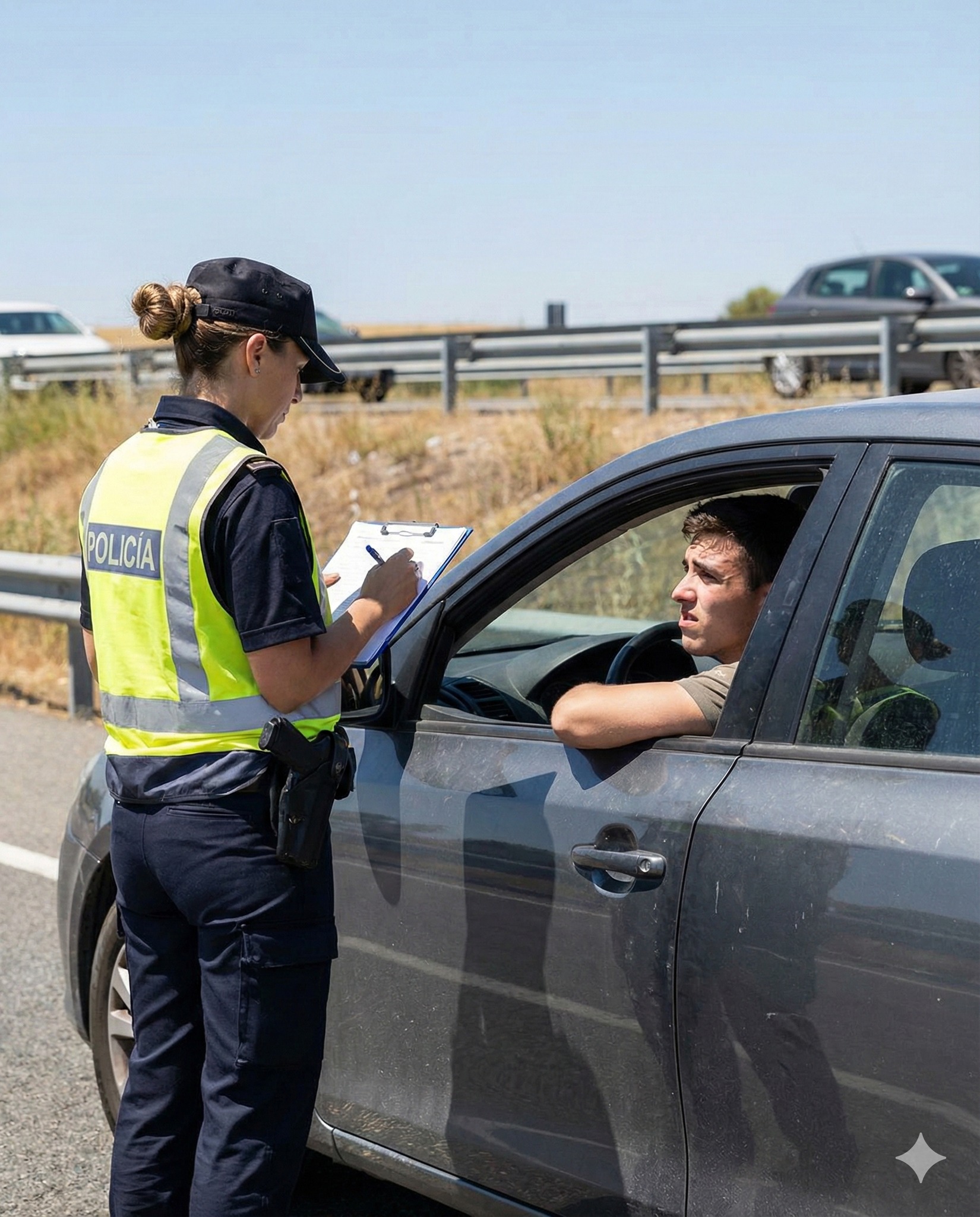
It was a sweltering Tuesday in July on the A2 motorway, Madrid South exit. The asphalt seemed to melt under the relentless 2:30 p.m. sun, distorting the air with heat waves that made the horizon dance. Officer Carmen Ruiz, of the Civil Guard Traffic Unit, adjusted her sunglasses and looked at the radar. A black BMW had just sped past like a ghost, registering 142 kilometers per hour in a 90 km/h zone
Routine. She’d done it thousands of times in her three years of service. She turned on the blue lights, the siren let out its short, authoritative wail, and she gave chase. The black vehicle didn’t try to flee; it slowed down and pulled over to the shoulder with a docility that contrasted sharply with her previous career. Carmen parked the patrol car behind it, checked her immaculate uniform—an armor that concealed more than it revealed—and approached the driver’s window, ticket book in hand, ready to hear the usual excuses: “I didn’t see,” “I’m in a hurry,” “The speedometer isn’t working.”
The driver rolled down the window. The air conditioning inside the car hit Carmen’s face, but it was what she saw that truly chilled her blood.
The man behind the wheel looked to be about thirty-five. He wore a wrinkled white shirt, his tie loosened as if it were choking him, and his hands gripped the steering wheel so tightly his knuckles were white. But that wasn’t what stopped Carmen’s heart. It was his eyes. Dark, bloodshot eyes that screamed a silent, terrifying despair. And then she saw it. A thin white scar on his left temple.
Time stood still. The noise of the highway traffic disappeared. Carmen felt a sudden vertigo that dragged her back twelve years, to a November night filled with black smoke and roaring flames.
—Documents, please—Carmen said, but her voice sounded strange, distant, as if it belonged to someone else.
The man looked at her, but didn’t see her. His eyes pierced her, focused on some unseen horror. He handed her the license with trembling hands. “Diego Navarro,” she read in her mind. The name she had searched for in vain for over a decade. It was him. The man who had entered the inferno of a burning building in Vallecas when she was just a fourteen-year-old girl, trapped and suffocating. The stranger who had carried her out in his arms, risking his own life, only to disappear amidst the sirens and chaos without expecting a single thank you.
Carmen swallowed, trying to maintain her professional composure. She was going to say something, break protocol, and ask if he remembered the fire, but then her gaze shifted to the passenger seat. There was a crumpled piece of paper with a hospital logo: “Pediatric Oncology – Urgent Appointment – 3:00 PM.” And on the back seat, a small pink suitcase with unicorn stickers.
He looked at his watch: 2:35 p.m. La Paz Hospital was on the other side of the city. With the afternoon traffic, it was impossible to get there in less than forty minutes.
“I know,” the man said, his voice breaking, interpreting Carmen’s silence as a condemnation. “I know I was going fast. Give me the ticket, arrest me if you want, but please… I need to get there.”
A single tear rolled down Diego’s cheek, and he angrily wiped it away, ashamed. He wasn’t running recklessly. He was running against death.
Carmen looked at the half-written ticket. She looked at the scar on the man’s temple, the mark he got the day he saved her. Fate, with its strange sense of humor, had brought them together twelve years later, reversing their roles. Now it was he who needed saving. And she had the power to do it, or the power to destroy him.
Officer Ruiz put the pen away. She took off her sunglasses and looked him directly in the eyes, breaking down the barrier between authority and citizen.
“Are you going to La Paz Hospital?” he asked in a firm voice.
Diego nodded, confused by the change in tone.
—Yes, my daughter… I have to get there before three. It’s… it’s vital.
Carmen nodded only once.
—Follow me.
—What? —Diego blinked, incredulous.
—I said follow me. Stick to my rear bumper and don’t let go no matter what
Carmen turned around and ran to her motorcycle. She wasn’t going to write a ticket today. Today she was going to pay a debt. She turned on the sirens, not with the tone of “stop,” but with the wail of a full-scale emergency, and launched herself into traffic, clearing a path like an icebreaker on a frozen sea.
The journey was a blur of blue lights and risky maneuvers. Carmen drove with surgical precision, forcing cars to move aside, creating a lane where none existed. In the rearview mirror, she saw the black BMW glued to her wheel, trusting her completely.
“Come on, Diego, don’t fall behind,” she whispered from inside the helmet.
Every second counted. Carmen knew she was breaking half a dozen regulations. Her partner was yelling at her over the radio, asking what the hell she was doing escorting a civilian at that speed without authorization. She turned off the radio. She couldn’t explain that this man had given her a second life and that she wasn’t going to let him lose his.
They arrived at the emergency room entrance of La Paz Hospital at 2:54 p.m. Six minutes before the deadline.
Diego got out of the car almost before it came to a complete stop. He grabbed the pink suitcase from the back seat and ran toward the entrance, but stopped for a second. He turned to Carmen, who had taken off her helmet. He looked at her with a mixture of amazement and immense gratitude.
“Thank you!” she cried, her voice breaking with emotion. “I don’t know why you did this, but thank you!”
Carmen just nodded, her throat tight. She wanted to tell him, “You did more for me,” but it wasn’t the right time. Diego disappeared through the automatic doors, running toward his daughter’s life.
Carmen stood there for a moment, listening to the buzz of adrenaline in her ears. She felt exhausted, but strangely whole. However, the story didn’t end there. Curiosity and a strange sense of responsibility wouldn’t leave her alone. That night, instead of resting, Carmen searched for Diego Navarro’s name online.
What she found broke her heart.
Diego wasn’t a wealthy executive with a fast car. He was a former volunteer firefighter—that explained his bravery in the fire years ago—who had left the force after his wife died in a car accident five years earlier. He worked in a factory, raising his daughter, Luna, alone. And seven-year-old Luna had acute lymphoblastic leukemia.
Recent articles in the local press reported a desperate campaign to find a bone marrow donor. Chemotherapy wasn’t working. Luna was running out of time.
Carmen turned off the computer and was left in darkness in her small apartment. She remembered the pink suitcase with unicorns. She remembered the despair in Diego’s eyes. He had saved Carmen from the fire, but now he faced a fire he couldn’t extinguish with water: his own daughter’s illness.
“The universe can’t be that cruel,” Carmen thought. “It couldn’t have put me in his path just so I could escort him to watch his daughter die.”
The next day, Carmen went to the donor center.
“I want to get tested,” she said with determination. “For bone marrow donation.”
The nurse explained that the odds of being a match with a specific person were infinitesimal, like looking for a needle in a haystack the size of a city. Carmen didn’t care. She had to try. She filled out the forms, had her blood drawn, and waited.
Those were weeks of agonizing silence. Carmen continued patrolling the A2, and every time she saw a black car, her heart leapt. She wondered if Luna was still alive, if Diego was holding her hand in a sterile room.
And then, the phone rang.
“Agent Ruiz,” a professional voice said on the other end, “we’re calling from the Bone Marrow Donor Registry. We have a preliminary match.”
Carmen’s world stopped.
“Is it… is it for the girl?” she asked, knowing they couldn’t give her details because of data protection laws.
“We can’t give you details about the receiver,” the voice replied, “but yes, it’s a high-priority match. We need you to come in for urgent confirmatory testing.”
The tests confirmed the impossible. Carmen was a match. Not just a match, it was a perfect match. It was the miracle Diego had been waiting for.
The procedure was scheduled quickly. Carmen didn’t hesitate for a second. She underwent the bone marrow extraction, a painful and uncomfortable process, with a smile on her lips. As she lay in the hospital bed, recovering from the anesthesia, she imagined her blood, her life, flowing into the body of that little girl she didn’t know, the daughter of the man who had given her life. It was like closing a perfect circle, a dance of destinies intertwined through time.
But there was one strict rule: anonymity. For a year, donor and recipient could not know each other’s identity. Carmen couldn’t just go and say to Diego, “It’s me, the traffic officer, the girl from the fire, the one who saved your daughter.”
She had to settle for anonymous reports. “The transplant was a success.” “The patient is responding well.” “There is complete remission.” Every little bit of news was a victory that Carmen celebrated in solitude, toasting with a glass of wine in her living room, whispering, “Live, Luna, live.”
Months passed. Life returned to normal, but Carmen felt that something had changed within her. She was no longer the same solitary woman focused on her career. She felt connected to something greater.
One day, eight months after the transplant, fate intervened again.
Carmen was off duty, walking through Retiro Park in Madrid, enjoying a spring afternoon. She sat down on a bench to read a book when a ball rolled to her feet.
“Sorry!” shouted a child’s voice.
Carmen looked up and saw a little girl running towards her. She was wearing a pink cap and had short hair, growing back strong after she had lost it. Her cheeks were flushed from the effort.
A man was coming behind her.
Carmen froze. It was Diego. He looked ten years younger than he had that day on the highway. The wrinkled shirt and tie were gone, replaced by a casual t-shirt and jeans. And most importantly, the despair had vanished from his eyes.
Diego stopped when he saw her. He squinted, recognizing her but initially unable to place her outside of her uniform.
“Excuse me…?” he began, and then he recognized her. “My God! It’s you! The A2 agent!”
Carmen smiled nervously.
“Hello.”
Diego approached, and for a moment it seemed he was going to hug her, but he stopped himself
“You have no idea how much I’ve thought about you,” he said, with an intensity that made Carmen blush. “That day… if you hadn’t helped us get there… the doctors said we would have missed the window for pre-treatment. We arrived just in time.”
He looked at the girl, who was now hugging his leg.
—This is Luna.
Luna looked at Carmen with curiosity.
“Hello,” said the girl. “Are you the speedy police officer?”
Carmen laughed, and the sound was like a release.
—Something like that. Hi, Luna. I’m so glad to see you doing so well.
“Dad says an angel gave me his blood,” Luna said with the brutal innocence of children. “And another angel drove us. Are you the angel who drove us?”
Diego had tears in his eyes.
—Yes, darling. She’s the car’s guardian angel.
Carmen felt a lump in her throat. She wanted to shout, “I am the two angels! It’s me!” But she couldn’t. There were still four months to go before the anonymity would be lifted.
“I’m glad I was able to help,” Carmen said simply.
Diego insisted on inviting her for coffee. Carmen accepted. That coffee turned into dinner the following week. And that dinner into Sunday walks. Carmen became a constant presence in Diego and Luna’s lives. She fell in love with Luna’s infectious laughter and Diego’s quiet, kind strength. And Diego, little by little, began to look at Carmen not only with gratitude, but with something deeper, something warm and promising.
But the secret weighed heavily. Carmen felt like an imposter every time Diego spoke of the “anonymous donor” with such reverence, wondering who he was, where he was, wishing she could thank him for her daughter’s life.
Finally, the year was over.
Carmen received the official letter that allowed her to reveal her identity. That same day, Diego had invited her to dinner at his house. He had prepared something special, and Luna was excited that Carmen was going to be there.
During dinner, the atmosphere was magical. There was a comfortable intimacy between the three of them, as if they had always been a family. When Luna went to bed, Diego poured two glasses of wine and sat next to Carmen on the sofa.
“Carmen,” he said, taking her hand, “this past year has been… it’s been the best of my life after so much darkness. And you’ve been a huge part of that. I don’t know what the future holds, but I know I want you in it.”
Carmen squeezed his hand, feeling like her heart was going to burst.
—I want you in my life too, Diego. But… there’s something you need to know. Something I’ve kept to myself for a long time because I couldn’t tell you.
Diego’s expression changed to one of concern.
—What’s wrong? Are you okay?
Carmen took the letter from the hospital out of her bag and put it on the table.
“Twelve years ago,” Carmen began, her voice trembling, “there was a fire in Vallecas. A fourteen-year-old girl was trapped inside. No one dared to go in, but a young man, a stranger, went into the fire and pulled her out. He saved her life and left without saying his name. I only saw a scar on his temple.”
Diego froze. He unconsciously brought his hand to the scar on his head. His eyes widened.
“You…?” he whispered. “Was it you?”
“Yes,” Carmen said, now crying. “It was you, Diego. You gave me life. That’s why, when I saw you on the highway that day, I knew I had to do something. But it wasn’t just escorting you.”
Carmen pushed the letter towards him.
—When I found out about Luna… I looked to see if we could be compatible. I couldn’t let the man who saved me lose what he loved most.
Diego read the letter. His hands trembled so much the paper rustled. He read the words that confirmed Carmen Ruiz was the bone marrow donor.
The silence in the room was absolute, dense, laden with twelve years of history, pain and miracles.
Diego looked up. His face was bathed in tears, an expression of wonder and love so pure that Carmen’s chest ached.
“You…” Diego’s voice was barely a whisper. “You saved my daughter. You’re the donor.”
“You saved me first,” she replied. “I just returned the gift.”
Diego collapsed. He leaned forward and hugged Carmen with desperate force, burying his face in her neck, sobbing like a child. Carmen hugged him back, stroking his hair, feeling her own tears soak his shirt.
“Thank you,” he repeated over and over. “Thank you, thank you, thank you.”
“We are at peace,” she whispered.
But it wasn’t just peace that existed between them. It was an unbreakable bond, forged in fire and sealed with blood.
A few minutes later, a small figure appeared in the hallway, rubbing its eyes.
—Dad? Carmen? Why are you crying?
Diego quickly wiped his face and stretched out his arms toward his daughter. Luna ran toward them and jumped onto the sofa.
“We cried tears of joy, Princess,” Diego said, gazing at Carmen with boundless adoration. “Do you remember when I told you about the angel who gave you his blood to heal you?”
Luna nodded gravely.
“Yes.”
Diego took Carmen’s hand and placed it on top of Luna’s
—Well, the angel has been here the whole time. It’s Carmen.
Luna’s eyes widened. She looked at Carmen as if she were seeing a superhero. And then, with that overwhelming naturalness, she threw her arms around her neck and hugged her tightly.
—Thank you, Mama Carmen —whispered the girl.
Carmen’s heart stopped, then began beating stronger than ever. That word, spoken by mistake or by intuition, sealed her fate.
Two years later, the wedding wasn’t a big social event, but it was the most emotional celebration anyone could remember. Carmen and Diego were married in a garden at sunset. Luna, now completely healthy and radiant, carried the rings.
During the voting, Diego didn’t talk about empty promises. He talked about circles.
“Life is a circle,” he said, looking into the eyes of the woman he loved. “Sometimes the arc is so wide we can’t see where it’s going. I threw a stone into the water fourteen years ago when I walked into that building, not knowing the ripples would come back to me when I needed them most, bringing me the person who would save my entire world. Carmen, you gave me my daughter’s life, and then you gave me yours. I promise you that every day I have left will be to honor that gift.”
Carmen, with her dress uniform stored in the wardrobe and dressed in white, replied:
—I thought I was repaying you a debt, but I realized that love isn’t an accounting. There are no debts, only love that flows and returns. You saved me from the fire so I could save Luna from illness, so the three of us could save ourselves from loneliness.
Today, if you drive along the A2 motorway, you might see a veteran officer who looks at drivers not as offenders, but as people whose stories she has yet to hear. Carmen knows that behind every speeding violation, behind every tired face, there may be a tragedy, a hope, or a miracle waiting to happen.
And every night, when she gets home, where a man with a scar on his temple and a healthy girl are waiting for her for dinner, Carmen gives thanks for that hot Tuesday in July, for the fine she didn’t write, and for the wonderful, mysterious, and perfect architecture of destiny that teaches us that, in the end, everything we give comes back to us multiplied.
Because no one is saved alone. And sometimes, to find your own way home, you have to help someone else find theirs.