On My Birthday, Dad Sent A Message: “We’re At Your Sister’s Dinner, Enjoy Your Night Alone.” Mom Added, “I Used Your Bonus For The Decor.” I Blew Out My Candle And Replied With One Word: “Sure.” Minutes Later, I Posted Something They Could Never Unsee.
Sinatra hummed softly from a tinny speaker on the kitchen counter, the kind of old, velvety song that made you feel like you were supposed to be wearing pearls instead of an oversized hoodie. The light above the sink flickered once—like it couldn’t decide whether to commit to the night either—and then steadied. In the quiet, even small sounds felt loud: the click of the fridge motor turning on, the faint drip of condensation sliding down a glass of iced tea, the tiny crackle of the candle I’d just lit.
On the fridge door, a chipped U.S. flag magnet held up a handwritten list I’d made weeks ago: “Pay off credit card. New laptop. Emergency fund. One nice thing for myself.”
It was my birthday. Twenty-seven. And on the table in front of me was a single cupcake I’d bought from the grocery store bakery because I didn’t want to walk into a fancy shop and have the cashier ask if this was for a party.
The candle leaned like a tired soldier.
I stared at the flame and tried to pretend the night was mine. I tried to pretend that being alone was a choice, not a sentence.
My phone buzzed hard enough to rattle against the wood.
Dad: We’re at your sister’s dinner. Enjoy your night alone.
For a second, I thought I had misread it. Like maybe the words would rearrange themselves into something softer if I blinked. I blinked. They didn’t.
Another buzz. Almost immediately.
Mom: I used your bonus for the decor.
I didn’t move. It felt like someone had poured cold syrup down my spine. My mouth went dry, and I could suddenly taste frosting even though I hadn’t taken a bite.
My bonus.
Seven thousand dollars, earned from overtime nights where I fell asleep in my work chair and woke up with keyboard marks on my cheek, from weekends when I watched the sun rise through the office windows while the city was still half-asleep, from the kind of hours people brag about when they want to sound “driven,” but never mention the nausea, the headaches, the constant feeling that your life is slipping through your hands.
Seven thousand dollars I’d planned to use to breathe.
I stared at the texts until the screen dimmed.
And then, like the universe wanted to make sure the knife twisted, my phone buzzed again—this time with an image.
A photo.
Madison.
My sister, glowing in a dress the color of expensive champagne, standing beneath a floral arch so thick with roses it looked unreal. It was the exact style I’d saved months ago in my private folder titled “Someday,” the one I’d told myself I’d buy for my own celebration whenever I finally had something to celebrate that belonged to me.
There was a caption attached, not from Madison, but from an account tagged in the photo—Lakeview Events: Setting the standard for luxury celebrations.
I zoomed in. There, just behind Madison’s shoulder, was Mom’s hand clutching the edge of the arch like she owned it. And in the background, Dad’s smile—wide, proud, effortless. The kind of smile he never wore for me.
My phone buzzed again.
Dad: Your sister’s sponsors are here. Don’t ruin tonight with drama. Be grateful.
Be grateful.
I stared at the cupcake. The candle burned steadily, like it didn’t care about family politics or favoritism or the way some children grow up like they’re always auditioning for love they’ll never quite earn.
My chest tightened, and I realized I was holding my breath.
The flame wavered.
I leaned forward and blew it out.
Smoke curled up in a thin gray ribbon, drifting toward the window glass like a little ghost trying to escape. For a moment, I watched it smear against the reflection of my own face—eyes glossy, jaw clenched, a person trying to look normal while something in her breaks.
I picked up my phone and typed one word.
Sure.
My thumb hovered for a heartbeat.
Send.
The silence after that felt different. It wasn’t resignation. It was… clarity. Like the room had been foggy for years and someone had finally opened a window.
Across the table, my laptop sat closed, a sticky note on it that said “Call landlord” in my handwriting. The life admin of someone who never got to be the favorite.
My phone lit again.
Madison: lol don’t be weird. we’re literally busy. talk later.
And that did it. Not the money, not even the cruelty—cruelty I was used to. It was the casualness. The way she dismissed my life like a notification she didn’t feel like swiping open.
I stood up so fast my chair legs screeched across the tile. I walked to the hallway closet where I kept things I didn’t want anyone else to know about—old journals, a shoebox of letters, and a folder on my phone I’d named “Vault” like I was joking.
I wasn’t joking.
My hands didn’t shake when I opened it. They were weirdly steady, almost gentle, like my body had switched into emergency mode. In the Vault were screenshots, voice recordings, messages forwarded to myself. Things I had saved for years because some part of me always knew I would need proof. Not for them. For me. So I couldn’t be gaslit into believing I was “too sensitive” or “misunderstanding” or “making things up again.”
I tapped the first audio file.
Dad’s voice, slurred, laughing in the background of some party years ago: “Madison is the chosen one. Olivia is just… dead weight. Always has been.”
Another clip—Mom, brisk and cold: “Don’t worry about the invoice. I’ll pull Olivia’s bonus. She won’t say anything. She never does.”
A screenshot of Madison in a group chat with her friends, the little bubbles like poison candies: “She’s the backup plan. If I mess up, they’ll just make Olivia fix it. That’s literally her purpose.”
My throat tightened as I scrolled. There was more. A bank alert from last month where my account dipped suddenly—$2,900 withdrawn—and Mom’s text right after: “Had to borrow. You’ll survive.” A photo of a signed contract for Madison’s Brand Dinner with the numbers circled like it was a trophy: $19,500 for décor and florals.
On a normal day, I would have cried. I would have called my friend Tessa and said, “Maybe it’s my fault,” because that’s what I did when I didn’t want to believe my own family could be this deliberate.
But tonight wasn’t a normal day.
Tonight, the candle smoke had cleared something in me.
I opened my social media app. The one my parents loved because it was public enough to show off Madison and curated enough to look respectable. The one where Dad posted “Proud father” captions and Mom posted smiling family photos with comments like Blessed beyond words.
I selected the receipts.
One by one.
Audio clips. Screenshots. The bank alert. The event contract. Madison’s chat.
My finger hovered over “Post.”
For a moment, I pictured Dad’s face when his carefully polished image cracked. I pictured Mom’s smile freezing in place. I pictured Madison’s eyes narrowing, calculating which version of the story would still make her look like the victim.
And then I pictured myself at thirteen, standing in the doorway of the living room while they clapped for Madison’s dance trophy, and Dad turning to me afterward and saying, “Maybe if you tried harder, you’d have something to celebrate too.”
I didn’t write a caption.
The truth didn’t need one.
I hit post.
The screen refreshed like it had swallowed a bomb.
For ten seconds, nothing happened.
Then the first notification came in. A like. Then another. Then comments—fast, frantic. My phone buzzed so much it felt alive. The numbers climbed like a heartbeat.
Tessa called immediately.
“Oli—what did you just do?” she demanded, but her voice was half laughter, half awe.
“I posted it,” I said.
“Everything?”
“Everything.”
There was a pause. “Oh my God. I’m—wait, are you okay?”
I looked down at my hands. Still steady. “I think I am.”
Within minutes, my feed looked like a storm. People I barely knew were tagging others. My coworker Brian commented a single flame emoji like he couldn’t find words. A woman from my building wrote: “I always knew something was off. Stand your ground, Olivia.” Someone else wrote: “This is private family business, you shouldn’t air it.” Another person replied to them: “Stealing someone’s money is private? Interesting.”
My phone stacked missed calls—twenty-nine in the corner like a countdown.
Dad. Dad. Mom. Madison. Aunt June. Uncle Patrick. Even Grandma, who never called anyone unless someone was dying.
A message came through from my cousin Sierra, who lived three states away and only visited at holidays: I’m at the dinner. This is INSANE. Everyone is reading. Do NOT come here alone, okay?
Then another message from a number I didn’t recognize: This is Derek from Lakeview Events. Please contact me immediately regarding the posts you made about our client’s event. This could be defamatory.
Defamatory.
I laughed once, a sharp sound that surprised me.
Tessa was still on the phone. “Tell me you’re not going there,” she said quickly. “Tell me you’re not walking into their little sponsor circus.”
Before I could answer, Dad’s text slammed onto the screen.
Dad: Come to the restaurant now.
The message that followed was worse.
Dad: Delete the post tonight. Or don’t call me Dad.
My heart gave a single hard thud. Not because I was afraid. Because it finally felt like a door was closing that I’d spent my whole life trying to wedge open with my fingertips.
I ended the call with Tessa. “I’m going,” I said, and before she could protest I added, “But I’m not going alone.”
I grabbed my coat and called my neighbor, Mrs. Patel, who had watched me carry groceries up the stairs more times than she could count and had once handed me soup when I was sick without asking for details.
She picked up on the second ring.
“Mrs. Patel,” I said, breathless, “I need a favor. Can you come with me somewhere?”
There was a brief pause, and then her voice turned sharp with concern. “Are you safe?”
“I’m safe,” I said, “but… I need someone to witness.”
“I’ll be downstairs in two minutes,” she replied, like she’d been waiting her whole life to become the kind of woman who shows up when younger women need backup.
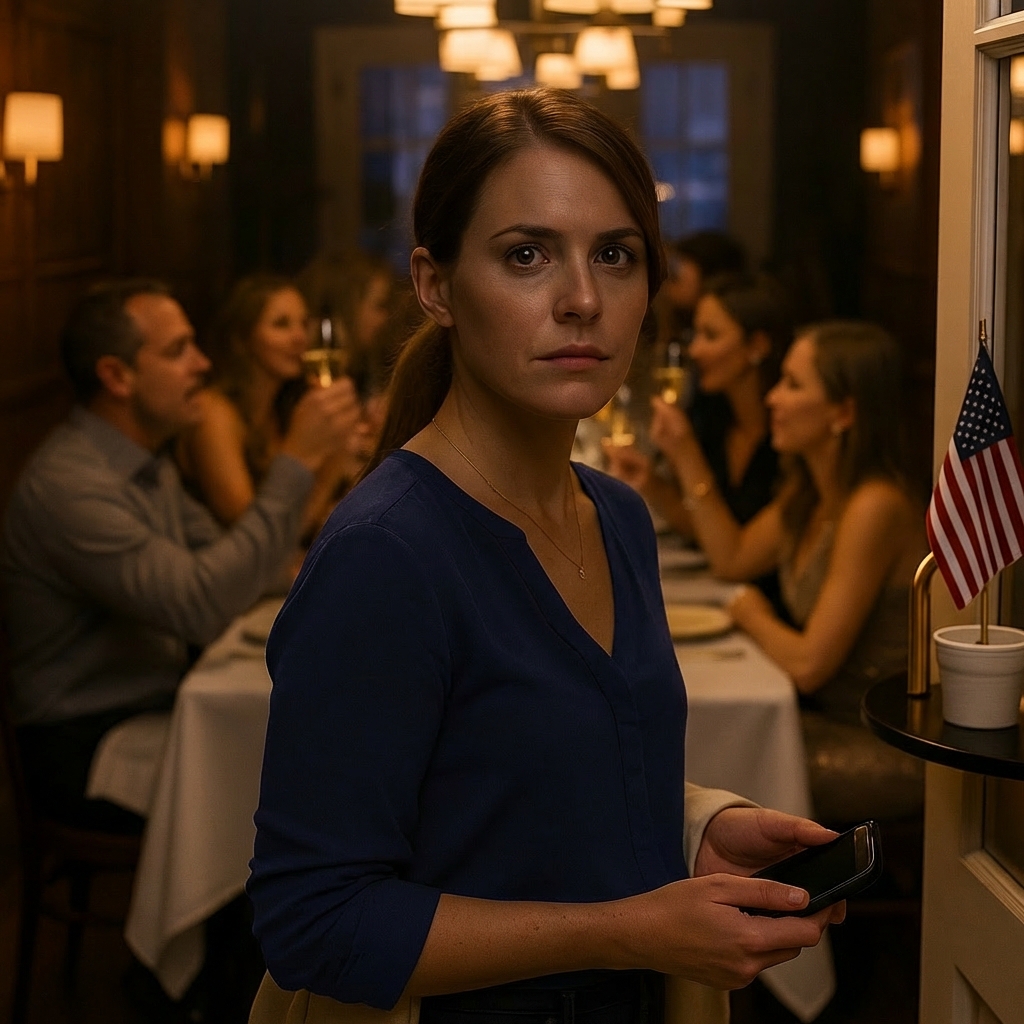
We walked into the restaurant together. It was one of those places that smelled like money—polished wood, soft lighting, white tablecloths, servers moving like choreography. I recognized it immediately. Madison had mentioned it once in passing, like it was nothing: “Ugh, Dad booked the private room at Bellamy’s.”
The private room was at the back.
As we approached, I could already feel it—the tension leaking through the door like heat. I heard laughter that sounded forced, brittle. A fork clinked too loudly against a plate. Someone murmured, “Is that her?”
When I pushed the door open, the room went still.
Every phone on the table lay face up.
Every screen glowed with my post.
The floral arch from the photo was recreated in miniature behind Madison’s chair, as if the restaurant had been dressed up for a photoshoot. White roses, gold ribbons, a banner that said Madison Monrose: Brand Launch Dinner. Around the table sat people I didn’t recognize—men in tailored suits, women with glossy hair and strategic smiles. Sponsors.
Madison sat at the center like a queen whose crown had just fallen into the soup.
Her face was red. Her mascara looked a little smudged. The perfect image had cracked.
Dad stood halfway out of his chair, one hand on a wine glass, knuckles white. Mom leaned back, expression icy, like she was already rehearsing how to spin this for the next person who asked.
“Olivia,” Dad said, voice low but carrying. “What the hell is wrong with you?”
Madison’s chair scraped as she stood. “You embarrassed us in front of the sponsors,” she hissed, her voice dropping into a venomous whisper. “Do you know how much money is on the line tonight?”
One of the women at the far end—sleek suit, sharp eyes—glanced between us. “This is your sister?” she asked Madison, not hiding the disdain in her tone.
Madison’s smile twitched. “Yes, but she’s—she’s emotional.”
Dad snapped, “Delete it. Now.”
I stepped forward slowly. Mrs. Patel stayed beside me, calm as stone.
I looked around the table at the sponsors, the influencers, the people who probably thought they were here to celebrate a brand and instead got a live family implosion as entertainment. I saw Sierra in the corner, eyes wide, phone halfway raised like she was debating whether to record. Behind her, my uncle Patrick looked like he wanted to disappear into the wall.
“Hi,” I said, voice steady. “Happy birthday to me.”
A couple of people shifted uncomfortably. Someone let out a nervous laugh that died immediately.
Madison jabbed a finger toward me. “Don’t you dare make a scene.”
I met her eyes. “A scene was made when my parents used my overtime bonus to pay for your décor.”
Mom’s lips curled. “Don’t be dramatic. It’s family money.”
“It was in my account,” I said simply. “And you admitted it. In writing.”
Dad slammed his glass down hard enough that the liquid trembled. “You’re trying to destroy your sister’s future because you’re jealous.”
Jealous.
I inhaled slowly, the air smelling like expensive perfume and roasted garlic.
“I’m not jealous,” I said. “I’m tired.”
Madison’s voice rose, losing its polished edge. “You’re always tired. You’re always the victim. Do you know how hard I work?”
A man in a navy suit—one of the sponsors, judging by his pin—cleared his throat. “Excuse me,” he said, addressing Dad, “is it true you took money from your daughter without consent? Because if that’s true, that’s—”
“Family business,” Dad snapped, cutting him off.
Another sponsor, a woman with bright red lipstick, lifted her phone. “This is all over,” she said, sounding more curious than horrified. “My assistant just texted me. People are tagging our company.”
Madison’s face went pale. “No, no, no—”
Mom finally spoke, voice cold and controlled. “Olivia, you think posting this makes you strong? Pathetic.”
The word landed like a slap. My stomach tightened, but my voice didn’t move.
“Using my bonus for your favorite daughter’s party,” I replied, “is what’s pathetic.”
A ripple went through the table. Not quite shock—more like the thrill people get when they realize they’re witnessing something real. Something they didn’t pay for but will talk about later.
Dad leaned toward me, eyes hard. “Delete the post tonight,” he said again, quieter this time, like he was offering mercy. “Or don’t call me Dad.”
I looked at him. Really looked. At the man who had hugged Madison after every performance and forgotten my college graduation because Madison “had a shoot.” At the man who told me I was “too sensitive” when Mom used my savings for Madison’s first “brand consultant.” At the man who built a family story where I existed only as a supporting character.
And suddenly, his threat didn’t feel like punishment.
It felt like freedom.
I nodded once. “Maybe that’s the most honest thing you’ve said to me in years.”
Madison let out a choked sound, like she couldn’t believe I wasn’t crumbling. “You can’t do this,” she whispered. “You’re ruining everything.”
I tilted my head. “Everything that was built on my back?”
Her mouth opened, and for the first time in my life, she had nothing pretty to say.
At the end of the table, a small voice rose.
“Enough.”
Everyone turned.
It was Grandma.
She sat hunched in her chair, hands folded tightly in her lap. Her eyes were watery but sharp, like she had been watching this family rot from the inside for a long time and finally couldn’t stomach the smell anymore.
Dad’s face tightened. “Mom, don’t—”
“No,” Grandma said, louder. “I said enough.”
Silence.
Even the sponsors stopped whispering.
Grandma looked at me, then at Dad and Mom. “You’ve treated her like she’s disposable,” she said, voice trembling with fury. “I’ve watched it. I’ve kept quiet because I thought you’d grow a conscience. But you didn’t. You just got better at pretending.”
Mom scoffed, but there was a crack in it. “You don’t understand what Olivia is like—”
Grandma cut her off. “I understand exactly. Olivia is the only one in this room who earned anything honestly.”
Madison’s eyes filled with tears—not the soft kind, but the angry kind. “Grandma, you’re taking her side?”
Grandma’s mouth tightened. “There shouldn’t be sides. There should be decency.”
I felt my throat close for a second, not from sadness, but from the strange shock of someone finally saying what I’d swallowed for years.
Dad looked around, realizing the room wasn’t his anymore. The sponsors were watching him like he was the scandal, not me. Sierra’s phone was fully up now, recording without shame.
Mrs. Patel leaned in slightly and whispered, “You don’t have to stay.”
I exhaled.
I stepped forward, reached into my pocket, and set my phone down gently on the white tablecloth in front of them—like placing evidence on a courtroom table.
“They wanted me alone tonight,” I said, voice calm and clear, “but maybe the ones under the light are them.”
Dad’s jaw tightened. Madison stared at the phone like it was a grenade. Mom’s eyes flicked to the sponsors, calculating damage control.
I straightened my shoulders.
“Enjoy your dinner,” I said.
And then I turned and walked out.
Behind me, the room erupted into overlapping voices—Dad barking orders, Madison crying, Mom hissing something sharp, a sponsor asking questions, Grandma’s voice rising again like thunder. But the sound faded with every step I took down the hallway, like a storm I was finally leaving behind.
Outside, the night air hit my face cool and clean. The streetlights made the sidewalk shine as if it had been freshly washed. Mrs. Patel walked beside me without saying anything, offering her presence like a shield.
My phone buzzed in my pocket again and again, but I didn’t look. Not yet.
We reached my car. I leaned against it and let out a breath I felt like I’d been holding for years.
Mrs. Patel patted my shoulder. “You were very brave,” she said softly. “But bravery doesn’t always feel loud. Sometimes it just feels… steady.”
I nodded, swallowing hard. “I didn’t plan it,” I admitted. “I just—couldn’t stay quiet.”
“That’s how truth works,” she said. “It escapes.”
A few seconds later, my phone buzzed with a new message. Not from my parents.
From Tessa.
I’m proud of you. Come over. I have cake. Real cake. And we’re turning your phone off for at least an hour.
I stared at the message, and for the first time that night, something warm moved through my chest. Not forgiveness. Not relief exactly. More like a door opening to a life that didn’t require me to beg for crumbs.
I looked up at the sky. No fireworks. No grand cinematic moment. Just the quiet hum of the city and the distant sound of a car passing.
It was enough.
I got into the driver’s seat, started the engine, and drove toward a place where no one would tell me to enjoy my night alone like it was a joke.
Behind me, my family’s perfect dinner was still unfolding in that private room, lit by chandeliers and ruined illusions.
Ahead of me, my birthday finally belonged to me.