The first time I learned how to disappear in a room, I was fifteen.
It was my brother’s varsity banquet. A long table of trophies gleamed under the cafeteria lights, and my mother laughed too loudly at the coach’s jokes while my father slapped my brother’s shoulder like he’d personally invented the American Dream. I sat at the end of the table with my paper cup of punch, smiling until my cheeks hurt. When the coach asked if anyone wanted to say something about the “future leaders,” my father leaned toward the microphone and said, “We already have one in the family.”
He didn’t look at me when he said it.
Nineteen years later, I’d gotten very good at that kind of smile.
“Ally! There you are,” my mother chirped, as if I’d been missing and not deliberately quiet. She reached for my sleeve, fingers catching on the sharp crease of my service dress. “Come stand closer. People should see you.”
People. Not family.
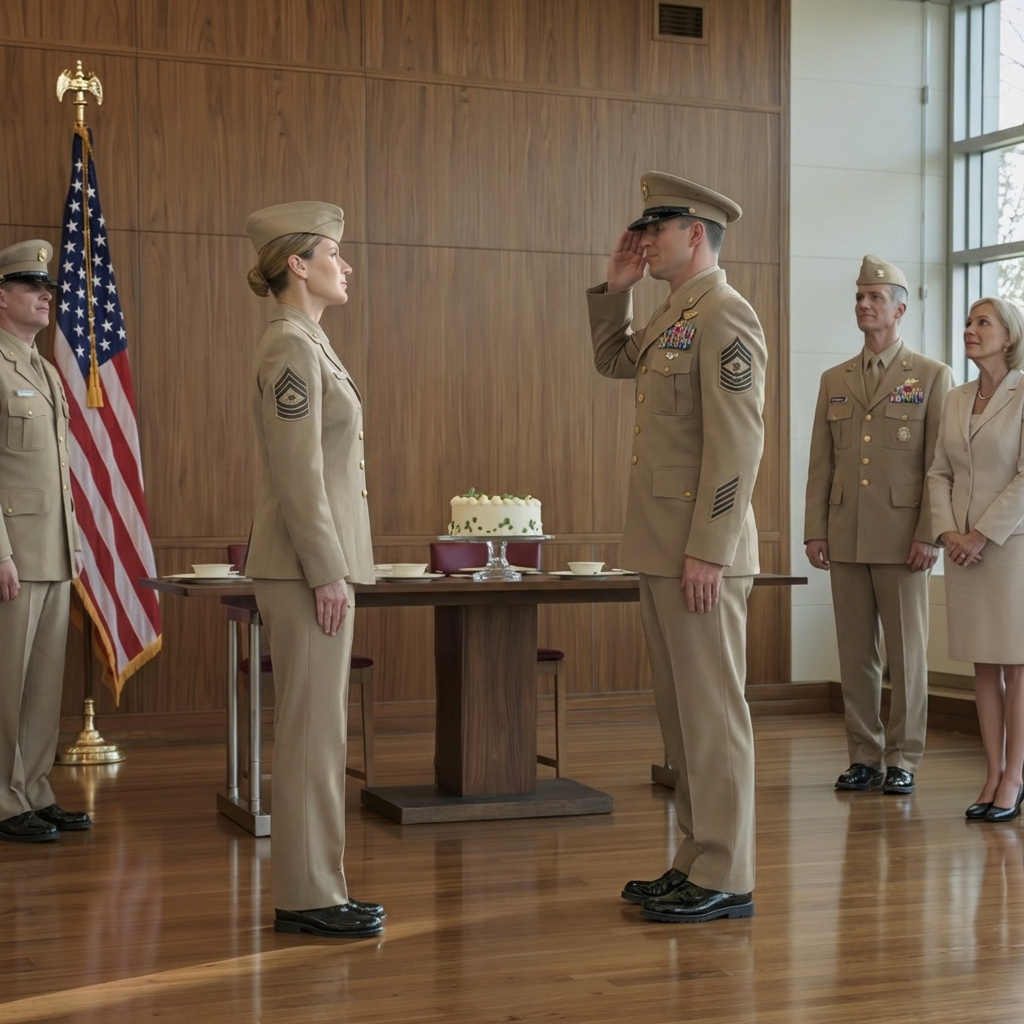
I let her tow me forward through the wood-paneled reception room like I was a prop she’d forgotten to place. The space smelled like floor polish and burned coffee, with a faint sugar-icing note from the sheet cake sweating under plastic wrap. A banner hung near the podium—CONGRATULATIONS, CAPTAIN JAMES—its letters slightly crooked, as if even the tape didn’t care enough to align properly.
My brother, Captain Evan James, stood near the cake table in his new blues, beaming like he’d just been crowned. His buddies clustered around him in a tight ring, laughing and clinking cups. They looked relaxed in the way only people who have always been praised look relaxed—shoulders loose, eyes bright, not a care in the world about whether they deserved any of it. Evan had always worn applause like it was skin.
I stayed a few paces behind my mother’s shoulder, where the light from the overhead fixtures caught the silver oak leaves on my collar. Lieutenant Colonel. Nineteen years in uniform. Four deployments. Hundreds of flight hours. A stack of citations that lived in a file drawer and in the tight-lipped nods of people who actually knew what they meant.
My mother raised a plastic cup. “To our hero!” she announced, voice pitching high in that public way she did—loud enough for strangers, sweet enough for photos.
“To our hero!” echoed my aunt, Diane, sweeping her phone up to record. Aunt Diane was the kind of woman who documented everything because attention, like oxygen, had to be constantly replenished. She angled the camera toward Evan and then—without even trying to be subtle—zoomed in so I was cropped out.
My father chuckled, stepping beside Evan with his cup raised. “Finally,” he said, winking at the room, “someone in this family doing something useful.”
Laughter rippled like a reflex.
It was meant to be a joke. It always was.
My smile stayed in place. I’d learned to let comments pass like weather. You don’t fight a storm; you wait it out and check what’s broken afterward.
Evan grinned wider, soaking it up, and then his eyes flicked toward me with that same old expression—half apology, half satisfaction—as if he wanted me to know he hadn’t asked for this and also that he didn’t mind it.
My husband, Mark, stood at the edge of the crowd with a cup of coffee in his hand, watching me the way he always did when my family was involved: careful, alert, ready to step in if I so much as blinked wrong. Mark was civilian—engineer, calm, steady. The kind of man who didn’t raise his voice because he didn’t need to. He gave me a small look that asked, Are you okay?
I gave him my practiced answer: a slight nod that meant, I’m fine, don’t make this worse.
“Ally!” Evan called out, as if remembering I existed. “Come here. Get in the photo.”
There it was. The invitation. Not to be honored—just to be included in the evidence that the family was supportive.
I stepped forward, joining them beside the cake. Aunt Diane shifted the phone again to frame Evan in the center. My mother fussed with my collar like I was ten.
“You should wear your hair down,” she whispered. “It makes you look softer.”
“Softer isn’t the point,” I murmured, but it was too low for her to register.
My father squinted at my rank. “Lieutenant Colonel,” he said, like the words tasted strange. “That’s… pretty high, isn’t it?”
“Yes, sir,” I replied automatically, the phrase slipping out on habit. Not because he was my father—because he was a man and I’d spent two decades responding to men who expected a yes, sir.
He snorted. “Well. Good for you.”
That was all. Good for you. Like I’d finished a hobby project.
Evan’s coworker—some man with an overconfident handshake—leaned toward me. “So you fly?” he asked, loud enough to sound interested.
“I have,” I said.
“What kind?” he pressed, and I could tell from his smile that he didn’t actually care; he just wanted to prove he could talk military.
“Enough,” Mark said suddenly, voice polite but edged. The man blinked, thrown off by the civilian who wasn’t playing along.
I felt my mother’s tension spike beside me. She didn’t like it when Mark interrupted the family dynamic. To her, he was an uninvited referee.
“Oh, Mark,” she said brightly, turning on him like a spotlight, “I didn’t even see you. Are you getting enough to eat? There’s cake. Evan loves cake.”
Mark smiled the way he did when he wanted to be respectful but not submissive. “I’m good, thank you.”
She stared a beat too long, then returned her attention to Evan, where it belonged.
The room swelled with chatter again. People moved around us, a tide of uniforms and dresses and name tags. A few of Evan’s colleagues came to greet my parents with handshakes and admiration. No one spoke to me unless they needed to fill a pause.
I let it happen. I told myself what I always told myself: It’s one night. It doesn’t matter. You’re here for your brother.
Then the door opened.
It wasn’t dramatic at first—just a shift in air, the faint squeak of hinges. But something in the room changed anyway. A hush in the laughter. A subtle straightening. Military spaces have their own instincts, and they recognized a certain kind of presence before the eyes did.
A man in a flight suit stepped into the doorway.
His posture was tight, precise, the kind that looked natural on someone who’d been trained to hold himself together under pressure. His name patch read HAIL. Major. His boots were scuffed the way boots only get scuffed when the person wearing them actually uses them.
He scanned the room quickly. Efficiently. Not searching for applause—searching like he expected to have to make decisions.
Then his gaze landed on me.
He stopped so abruptly the person behind him bumped his shoulder. His face did something only people who have shared a radio frequency under fire recognize. A flicker—recognition, disbelief, relief.
He didn’t look at Evan. Didn’t look at the cake. Didn’t look at my parents.
He walked straight through the crowd.
Conversations faltered as he moved. Heads turned. In a room full of people accustomed to hierarchy, the purposeful walk of an officer was a kind of announcement.
Mark’s hand shifted toward my lower back, not touching, just hovering—ready.
The Major stopped directly in front of me, close enough that I could see the fine dust ground into the seams of his flight suit. His eyes were focused in a way that felt like a beam.
“Ma’am,” he said, voice not loud but perfectly controlled, the kind that carried without effort. “You’re the one from Helmand.”
The room seemed to stop breathing.
The punch ladle paused mid-air. Someone’s laughter died halfway into a syllable. Evan’s grin faltered, and for the first time all evening, my father’s cup sank slightly, as if his arm suddenly didn’t know what to do.
My mother blinked, confusion crawling across her face. “Helmand?” she repeated like it was a foreign word.
The Major came to attention.
The salute snapped up crisp enough to slice the silence.
For a fraction of a second, I was back under a different sky—dust hanging in the air, a headset pressing into my ear, a voice coming through the radio with an edge of panic. I felt the familiar click in my body, muscle memory taking over.
I returned the salute automatically, every eye in the room tracking the arc of our hands.
“It’s an honor,” Major Hail said. His voice softened just enough to make it personal. “I never got to thank you properly.”
I held his gaze. “Major,” I replied, my voice steady because I’d learned how to keep it steady even when the ground shifted.
He looked past me for a moment, eyes flicking toward Evan’s name banner, then back at me. “Captain James,” he called over his shoulder, and the way he said it—firm, crisp—made Evan straighten instinctively.
Evan took a step forward, startled. “Yes, sir?”
“Your sister,” Hail said, and his tone left no room for teasing, “is a hell of an officer. I hope you know that.”
The words landed like a verdict.
Evan’s mouth opened, then closed. He looked at me, and for the first time I saw him not as my brother, but as a man watching a narrative slip from his hands.
My father stared at the Major, then at me, as if trying to reconcile my face with the version of me he’d minimized for years.
My mother’s lips parted. “What was that about?” she whispered, but it came out louder than she intended in the silence.
“We served together,” I said simply. “Once.”
Aunt Diane, who had been recording the toast, swung her phone toward the Major with predatory excitement, sensing content. “Oh my gosh,” she breathed, already half-whispering into the camera, “this is incredible.”
Mark’s hand finally settled against my back, a steady warmth that grounded me.
Major Hail didn’t move away. He stayed in front of me like I was the point of his mission.
“I was a lieutenant,” he said, and his eyes didn’t leave mine. “That day. The convoy got hit. We were pinned. We called for air and… I didn’t even know if the call went through.”
I didn’t respond. I didn’t need to. The memories didn’t require narration.
Hail swallowed. “Then you came on the net. Calm. Clear. Like the world wasn’t exploding. You walked us through it. You brought the birds in, you held them steady, you kept the whole thing from turning into a mass casualty.”
He turned slightly, addressing the room without performing for it. “We got out because of her.”
Someone exhaled. It sounded like grief and awe at the same time.
My mother’s face tightened, caught between pride and panic. Pride was unfamiliar territory where I was concerned. Panic was her default whenever attention shifted away from Evan.
“That’s… that’s very kind,” she said, voice trembling as she tried to sound like the moment belonged to the family. To her.
Major Hail glanced at her, then back at me, and something in his eyes hardened—not cruel, just clear. “It’s not kindness, ma’am,” he said. “It’s fact.”
Evan’s cheeks colored. “I—uh—Ally never—” he started, then stopped, because he realized he didn’t actually know anything about what I had done. He knew my rank. He knew I deployed. He knew enough to brag to strangers, maybe. But he hadn’t asked. Not once.
My father cleared his throat, a small desperate sound. “Well,” he said, trying to reclaim his role as narrator, “of course she did. That’s… that’s our Ally.”
Our Ally. Like I was a family heirloom.
Mark shifted beside me, and I felt his restraint like a coiled wire.
Major Hail’s gaze moved to Evan again. “Congratulations on your promotion, Captain,” he said formally. “It’s a good milestone.”
Evan’s shoulders lifted, relieved to be acknowledged, but the relief didn’t settle right. It was like applause arriving late.
Hail turned back to me. “Ma’am,” he said quietly, voice low now so only I could hear, “I’m sorry. I didn’t realize this was… your family event.”
I gave him a small nod. “It’s fine.”
But it wasn’t.
Because the air had changed. The truth had entered the room, and truth is disruptive. It rearranges everything.
My mother stepped closer, eyes wide. “Why didn’t you ever tell us?” she demanded, as if my silence had been a betrayal.
I almost laughed. The irony would’ve been sharp if it didn’t sting. “You didn’t ask,” I said, not loud, but not soft either.
She flinched as if I’d slapped her.
My father’s jaw worked. “We… we didn’t want to pry,” he said, which was the most generous lie I’d ever heard him tell about himself.
Evan tried to recover, tried to insert himself back into the center. “Ally,” he said, forcing a laugh, “come on. You know how Mom is. She just gets… excited. This is a celebration.”
“For you,” I said.
He blinked. “What?”
Mark’s hand pressed slightly against my back, a wordless warning: Don’t burn it down unless you want to.
But I had spent nineteen years letting things pass like weather. And sometimes you don’t realize you’re freezing until someone opens a door.
The Major stepped back, clearly sensing the private earthquake. “Ma’am,” he said, “if you ever need anything—”
“I appreciate it,” I replied, and meant it.
A woman in a navy-blue dress stepped forward from the crowd, face tight with something like guilt. She had introduced herself earlier as Rachel—Evan’s girlfriend, the one my mother called “practically family” after meeting her twice.
Rachel looked at me now as if she was seeing me for the first time. “Lieutenant Colonel James,” she said, voice careful, “I’m… I’m sorry. I didn’t realize. I’ve heard Evan talk about you, but—”
“But not like this,” I finished, not unkindly.
Rachel’s eyes flicked to Evan, then away. “No,” she admitted.
A different man—older, wearing a suit instead of a uniform—moved forward too. Mr. Pritchard, one of the base’s civilian leaders. He offered his hand to me with respect that felt automatic. “Colonel James,” he said warmly, “it’s good to see you here. We’ve heard your name in the right rooms.”
My mother’s head snapped toward him. Right rooms. That phrase bothered her. It implied there were rooms she wasn’t in.
I shook his hand. “Thank you, sir.”
Aunt Diane’s phone was up again, capturing every second. Her eyes glittered with excitement like she’d stumbled into a reality show.
“This is going to go viral,” she whispered, not quietly enough.
I turned my head toward her, my smile still in place but now edged. “Diane,” I said, “put your phone away.”
She froze. “Oh, Ally, it’s just—”
“Put it away,” I repeated. The command voice came out. The one that didn’t invite negotiation.
Aunt Diane lowered the phone with offended slowness, like I’d stolen something from her.
My mother’s mouth tightened. “You don’t have to be so—”
“So what?” I asked, turning to her. “So firm?”
She faltered, glancing around as if hoping someone would rescue her from being held accountable.
My father attempted a laugh. “Come on,” he said, “let’s not make a scene.”
My eyes met his. “You made scenes my whole life. You just called them jokes.”
Silence again, thicker now, because people understood this wasn’t about military heroics anymore. This was about family. The mess no uniform could fix.
Evan’s voice cut in, sharper. “This is my night,” he said, finally dropping the grin. “Can you not—can you not do this right now?”
There it was. The truth of it. Not, I’m proud of you. Not, I’m sorry. Not, I didn’t see you. Just: Don’t interrupt my spotlight.
I looked at him, really looked. His face was red, his eyes shining with frustration and embarrassment. He wasn’t evil. He was just… accustomed. Accustomed to being the center. Accustomed to me orbiting.
Mark exhaled slowly beside me. “Ally,” he said gently, a reminder that I could choose my moment.
I chose it anyway.
“I’m not doing anything,” I said to Evan. “I’m standing here. Existing. That’s the part you can’t handle.”
Evan’s mouth opened, but nothing came out.
My mother’s eyes went shiny. “We’re your family,” she said, voice trembling into the familiar place where she turned herself into a victim. “We love you. We’re proud of you. You’re just… you’re so private.”
I nodded once. “I am private,” I agreed. “Because every time I showed you something that mattered, it got ignored or turned into a comment about Evan.”
My father bristled. “That’s not fair.”
I tilted my head. “Isn’t it?”
His face hardened. “We did the best we could.”
That line. The universal excuse.
I looked at the cake, the crooked banner, the plastic cups, the room full of people who had just watched a Major salute me like I was someone important. The irony sat heavy in my chest.
“I’m not here to fight,” I said quietly. “I’m here to draw a line.”
My mother’s eyes widened. “A line?”
Mark’s hand slid into mine, fingers interlacing. Warm. Solid.
“I’ve covered bills,” I continued, voice even, “plane tickets, emergency repairs, ‘just a rough month’ for years. I’ve been the quiet solution to problems you didn’t want to solve. That stops.”
My father’s cup trembled slightly. “What are you saying?”
“I’m saying,” I replied, “I’m done financing disrespect.”
Evan’s face went pale. “Ally, seriously? You’re going to do this at my promotion?”
“You’re right,” I said, calm. “This is your night. So I’m not going to make it dramatic.”
I reached into my clutch and pulled out my phone.
My mother gasped, thinking—what? That I was about to call someone? Announce something?
Instead, I opened my bank app. My thumb moved with practiced precision, because this wasn’t an impulsive decision. It was one I’d rehearsed in my head for years and finally had permission to execute.
Two recurring payments. One for my parents’ car insurance. One for my father’s credit card “until he got back on his feet,” which somehow had lasted eighteen months.
Delete. Delete.
No speech. No slideshow. Just logistics.
My mother stared at my phone as if it were a weapon. “Ally,” she whispered, voice cracking, “you can’t—”
“I can,” I said. “And I am.”
My father’s face flushed. “You’re being ungrateful,” he snapped, because anger was easier for him than shame. “After everything we did for you—”
I looked at him and felt something in me go still. “Name one thing you did for me,” I said softly, and the softness made it sharper.
He opened his mouth, then closed it.
Evan’s voice rose. “This is insane. You’re punishing them because Dad made a joke?”
“It’s not the joke,” I said. “It’s the pattern. The years. The way you let them treat me like background noise.”
Rachel flinched beside Evan, as if she’d just realized the kind of family she’d walked into. Her hand hovered near his arm but didn’t touch.
Major Hail stood off to the side now, still present, his expression unreadable but attentive. He didn’t intervene. He didn’t need to. His earlier words had already done the damage. Or the repair.
My mother’s eyes darted around the room, desperate for allies. Some people stared politely at their cups. Others watched with open curiosity. A few looked uncomfortable, like they’d stumbled into a private conversation. But no one laughed now. No one could pretend it was a joke.
“You’re humiliating us,” my mother hissed.
“No,” I corrected. “I’m letting you feel what it’s like to not be centered.”
Her face twisted. “After all your sacrifices, this is what you do? You cut us off?”
I nodded once. “Yes.”
My father’s voice dropped. “You think you’re better than us,” he muttered.
I thought about the desert, the radio, the weight of responsibility, the nights in a tent pretending not to be scared. I thought about the calls home where my mother talked for thirty minutes about Evan’s problems and ended with, “Anyway, stay safe.”
“I don’t think I’m better,” I said. “I think I’m done begging to be seen.”
Mark squeezed my hand, and I felt my own pulse slow.
I turned toward Evan. “Congratulations,” I said, and my voice held no bitterness—just finality. “I hope you do good work.”
His face crumpled, anger and confusion fighting for space. “So that’s it?” he whispered. “You’re just leaving?”
“Yes,” I said. “Because staying would mean shrinking again, and I can’t afford that anymore.”
My mother stepped forward as if to block me. “Where are you going?”
I met her gaze. “Somewhere I’m not tolerated,” I replied. “Somewhere I’m respected.”
She looked like she might cry, but I’d seen her cry before. Her tears were often tools, not truths.
I glanced toward Aunt Diane. “If any video of this ends up online,” I said evenly, “I’ll know where it came from. And you won’t like the consequences.”
Aunt Diane swallowed hard, suddenly remembering that consequences existed.
Major Hail moved closer, not to save me—just to escort, like a professional who understood how to end a situation cleanly. “Ma’am,” he said quietly, “if you’d like, there’s a quieter hallway.”
I nodded. “Thank you.”
As Mark and I turned toward the exit, my father’s voice rose one last time, sharp and panicked. “You’re making a mistake!”
I paused at the door. The room behind me was still, waiting for my response like they were waiting for a punchline.
I looked back at him. “No,” I said, calm as a cockpit voice. “I’m correcting one.”
Then I stepped out.
The hallway smelled like cooler air and old paint. My shoulders loosened in a way I hadn’t realized they were tense. Mark exhaled beside me like he’d been holding his breath for hours.
“You okay?” he asked.
I nodded, but it was a different nod than before. This one was real. “I will be,” I said.
Major Hail stood a respectful distance away, hands clasped behind his back. “Ma’am,” he said, “for what it’s worth… some of us never forgot.”
I looked at him, and the tightness in my chest eased. “I didn’t do it for thanks,” I said.
“I know,” he replied. “That’s why it matters.”
My phone buzzed in my hand. A message preview flashed on the screen.
Mom: Please don’t do this. We didn’t mean it. Call me.
Another buzz.
Dad: If you walk away, don’t come back asking for anything.
A third.
Evan: Are you seriously doing this? Everyone’s looking at me like I’m trash.
I stared at the screen for a moment, then did what I’d promised myself I would do.
Two messages deleted.
Boundary set.
I opened my email app and pulled up a document I’d been sitting on—orders paperwork I’d delayed signing because part of me had believed, stupidly, that staying close to home might fix something. The assignment was clear: a new position, a new wing, a new place where my work would be the loudest thing about me, not my family’s narrative.
My thumb hovered. Years of habit tried to tug it back. Don’t change things. Don’t upset them. Be good. Be quiet. Be helpful.
Then I heard Major Hail’s voice in my head: We got out because of her.
And I thought, maybe I deserved to get out too.
I signed.
The confirmation pinged, bright and final.
Mark leaned over my shoulder, reading the line on the screen. His eyes widened slightly. “You did it.”
“I did,” I said, and my voice sounded lighter than it had in years.
He smiled, not triumphant—relieved. “Where does it send you?”
I inhaled slowly, tasting freedom in the sterile hallway air. “Exactly where I need to be,” I said.
Behind us, the reception room roared back to life in muted waves—voices rising, chairs scraping, people trying to fill the silence with normalcy. Somewhere in there, my mother would be explaining. My father would be blaming. Evan would be performing.
And for the first time, none of it was my job to manage.
I slipped my phone into my clutch, squared my shoulders, and walked toward the exit with my husband beside me and a Major at my back like a quiet escort out of an old life.
No dramatic explosion. No screaming match. No cinematic music.
Just something sharper and rarer.
A clean cut.
And the sound of my own breath finally returning.