When the sunrise was still just a promise behind the mist, Mara stepped down from the cart with a cloth bag clutched tight against her chest. Inside, she carried two changes of clothes, an old coat, and a lifetime of silences. No one walked her to the entrance of the hacienda. No one fixed her hair; no one said, “take care.” Her mother had left only a short, dry message, like someone handing over a package: “It’s her. She’s good for heavy work. Keep her.”
That was how life was lived in the backlands in those times, when a person’s face was worth more than their heart. In San Roco, families tended to beauty as if it were an inheritance, and the “pretty” daughters were protected from the sun and strain, as if sweat might ruin their future. The others… the others were sent where no one wanted to look. Mara knew perfectly well where the world had placed her: the place of the unnecessary, the one who doesn’t draw attention, the one whom, if she disappeared, no one would ask about.
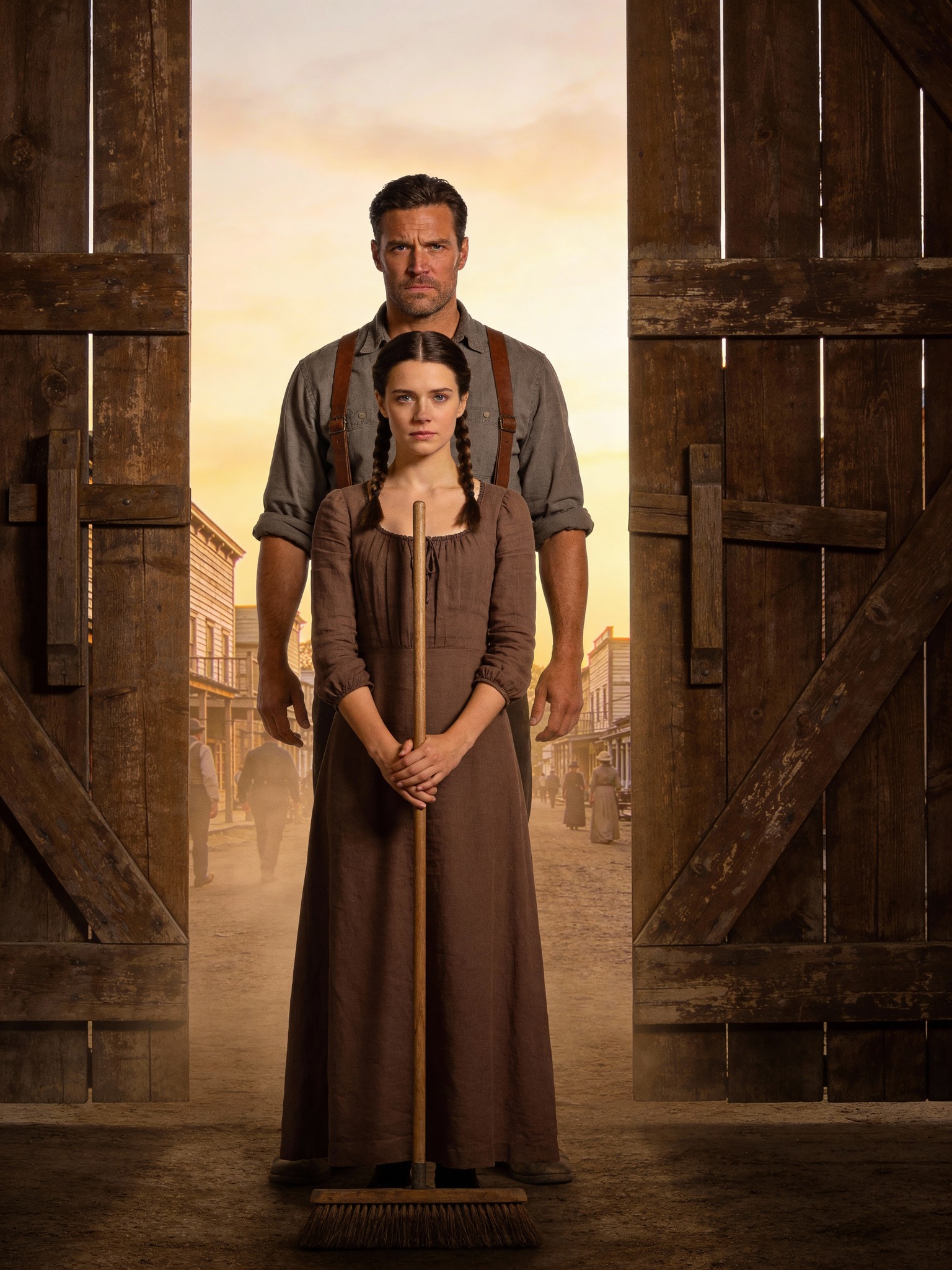
The Valdes Hacienda appeared at the end of the road like its own country: a big house, corrals, pasture as far as the eye could see, and an old barn next to the stable, made of dark wood and smelling of hay. That was where they sent Mara: “to clean the barn.” As if her destiny were to sweep away the lives of others.
Tomas, the foreman, received her with a quick glance and a question devoid of affection but also devoid of mockery: “Are you the new help?” “Yes, sir… I’ve come to clean the barn,” she replied quietly, without raising her eyes too much. “Start inside. The boss arrives today. Make sure everything is in order.”
Mara entered the barn and took a deep breath. The smell of hay filled her throat, but what hit her hardest was something else: silence. A silence different from that of her home, where silence was punishment and contempt. Here, it was just… stillness. No one was evaluating her every second. No one was waiting for her to stumble so they could point it out. For the first time, even if it was inside a barn, she felt she existed without being measured. That morning she worked until her arms burned. And just as the sun began to go down, she heard firm footsteps at the entrance. She didn’t turn immediately. She was used to the idea that when someone important arrived, it was better to make oneself small.
“Mara?” asked a male voice, young but hard, like dry earth.
She turned slowly, gripping the broom with both hands. “Yes, sir. It’s me.”
Julian Valdes stood in the doorway. The owner of the hacienda. The only son of a traditional family, respected and feared for his firmness. He had a body marked by the sun and the gaze of someone who commands without needing to shout. Mara expected the usual judgment, the gesture of disgust, or the phrase that would put her in her place. But Julian observed her differently: not like someone looking at a face, but like someone trying to read what life had hidden.
“What else did they tell you?” he asked. “To work and not complain,” she replied, as if repeating an old rule. Julian frowned, uncomfortable. “No one came here to live on their knees. There is work. But there is respect, too. Do you understand?”
Mara took a second to react. That word, “respect,” sounded alien to her. “No… I am not used to respect,” she confessed, “but I will try.”
That phrase stuck in Julian’s chest. Not used to respect. As if respect were a luxury for others.
The first turn of her life at the hacienda wasn’t a hug or a promise: it was a concrete decision. On the second night, Julian saw a little light trembling inside the barn and went in. He found Mara sitting on the ground, sewing a piece of cloth as if trying to invent a pillow. “Are you sleeping here?” he asked, with a severity that looked like anger. “It’s where they sent me… and I’m already used to it.” “Used to sleeping on the floor?” Mara swallowed hard. “Used to having no choice.” Julian took a deep breath, as if that answer had hit him harder than a lash to the hand. “Tomorrow they will prepare a room for you near the kitchen. You are not going to sleep in the cold anymore.” “But I don’t want to cause any trouble…” “The trouble is leaving someone on the floor,” he cut in. “Period.”
Mara lowered her gaze because she didn’t know how to give thanks. Gratitude grows where there was once care, and she had never been cared for. The next morning, a simple room awaited her: a bed, a blanket, a pitcher of water, and a small window. Mara stood for a long time, looking at the mattress as if it were a sacred object. It wasn’t happiness yet. It was relief. It was the first sign that her presence might matter.
Days passed and Mara remained quiet, not out of pride but out of habit. In the kitchen, she heard whispers; in the yard, she felt stares. “It’s the ugly one they sent,” they said without saying it. And one day, two women from the village dared to say it aloud near the corral: “They say the family handed her over because nobody wanted her.” “And with that face… who would want her?”
Mara heard the words like someone receiving a silent stone throw. She didn’t lift her head. She continued arranging the bucket, pressing her lips together until the trembling passed. She had learned since childhood that talking back only made things worse. But that afternoon, something different happened.
“We don’t talk like that here,” said a firm voice behind them.
The two women turned, startled. Julian Valdes was a few steps away, arms crossed and brow furrowed. He didn’t raise his voice, but he didn’t need to. “Boss… we were just commenting…” tried one of them. “Commenting is for the weather,” he replied. “What you did was humiliate. And on this hacienda, that is not permitted.”
The women left, murmuring hurried apologies. Mara remained motionless, her heart pounding against her ribs. She didn’t know what to do when someone defended her. Julian looked at her for a second longer, not with pity, but with something resembling serious respect.
“If it happens again, you tell me,” he ordered. “I don’t want problems, sir.” “Problems aren’t caused by those who exist, but by those who despise,” he said, and walked away.
That night, Mara couldn’t sleep. Not out of fear, but because something new was breaking through inside her, something she couldn’t name. Perhaps dignity. Perhaps the simple idea that she didn’t deserve to be treated like leftovers.
As the weeks went by, Julian began to notice things others didn’t see. That Mara always left the stables cleaner than anyone else. That the animals calmed down when she was near. That she fixed what she found broken without anyone asking her to. And, above all, that she never complained… not even when she shouldn’t be carrying so much weight.
One day he found her lifting a grain sack that was too big, all by herself. “That is not your job,” he told her, taking the sack from her hands. “You’re going to get hurt.” “If I don’t do it, nobody does,” she replied softly. “Here, no one takes advantage of another’s silence,” Julian replied. “Starting tomorrow, you will help in the garden and with the simple accounting. Tomas will teach you.” Mara looked at him in surprise. “The accounting?” “You know how to read, don’t you?” “Yes, sir… my grandfather taught me.” “Then that is sufficient.”
That change unleashed more whispers. Why did the boss favor the “ugly” one? What did he see in her? Some said it was pity. Others said the young rancher had lost his mind. Mara heard it all, but for the first time, she didn’t shrink away. Not because the words hurt less, but because she had learned they weren’t true.
The real turning point came months later, when a strong fever fell upon San Roco. Many fell ill, among them Julian. For days he lay prostrate, weak, without strength. The doctors were slow to arrive. The big house was restless. Mara, without anyone asking her, began to care for him. She brought him water, changed his compresses, and sat in silence so he wouldn’t wake up alone. She didn’t talk much. She was just there.
One dawn, Julian opened his eyes and found her there, half-asleep in a chair. “Why are you doing this?” he murmured, his voice broken. Mara hesitated. “Because no one should go through a fever alone.” Julian looked at her for a long time. In that look, there was no desire, nor pity, nor simple gratitude. There was recognition.
When he healed, something remained different between them. It wasn’t romance yet. It was a silent alliance. He began to entrust her with small decisions. She began to offer opinions, first with fear, then with more firmness. Mara discovered that her head was worth as much as her hands.
But the backlands do not forgive change without a fight.
One day, Doña Ines arrived at the hacienda, Julian‘s aunt, a woman with a heavy surname and a sharp tongue. As soon as she saw Mara in the big house, she wrinkled her nose. “And who is this?” “She is part of the team,” Julian replied. “Since when do ugly servants sit at the work table?” Mara felt the old impulse to disappear. But before she could lower her head, Julian spoke: “Since I understood that value is not measured in mirrors.” Ines laughed with contempt. “Don’t be naive. People are how they are. That girl will always be what she was born to be.” Mara looked up. Her hands were trembling, but her voice came out clear: “I was born to work, think, and live with dignity, ma’am. If that bothers you, I cannot change it.”
Silence fell heavily. Ines looked at her as if she had seen something impossible. Julian smiled barely, with quiet pride. That night, Ines warned Julian: “People talk. If you keep giving her a place, she will bring you problems.” “If giving someone a place is a problem,” he replied, “then the problem isn’t her.”
The conflict exploded weeks later when fraud was discovered in the hacienda’s old accounts. Missing money, altered documents. Tomas was the first to suspect a former administrator… but no one had proof. Mara did. Reviewing old papers, she found inconsistencies. Repeated numbers, fake signatures. She spent entire nights reviewing. When she took everything to Julian, he understood that without her, he would never have seen it. The fraud was resolved. The hacienda was saved from certain ruin. The news ran fast. The “ugly one” had saved Valdes.
And then came the final twist, the one no one expected. One day a letter arrived from Mara’s mother. Brief. Cold. It said her younger sister was getting married, and now that Mara “had served,” she could return if she wanted to help… but not as family, but as help.
Mara read the letter in silence. She folded it carefully. “I am not going back,” she said aloud, more to herself than to others. Julian heard her. “You don’t have to go where they don’t see you,” he said. “You have a place here.” She took a deep breath. “I don’t want a place out of pity, Julian.” “Then stay by choice,” he replied. “And because this hacienda is also yours, in what you build within it.”
Some time later, without grand announcements or parties, Mara ceased to be “the girl from the barn.” She officially took charge of the administration alongside Julian. She didn’t change her clothes immediately. She didn’t change her face. She changed her posture. The backlands looked at her differently now. Not because she was prettier, but because she no longer let herself be shrunk.
Years later, when San Roco told stories, they didn’t speak of the ugly daughter sent to clean a stable. They spoke of the woman who arrived with nothing and stayed with everything that matters.
And Julian, when someone asked him what he had seen in her from the beginning, always answered the same thing: “It wasn’t a dream. It was a truth that no one wanted to look at.”