The Vasconcelos estate rose like a polished promise in one of São Paulo’s most guarded neighborhoods—white stone, flawless glass, hedges trimmed so precisely they looked artificial. From the street, it was elegance and hush. But behind the house—where jasmine mixed with bleach, and the bins waited under the sun—life showed its less glamorous truth.
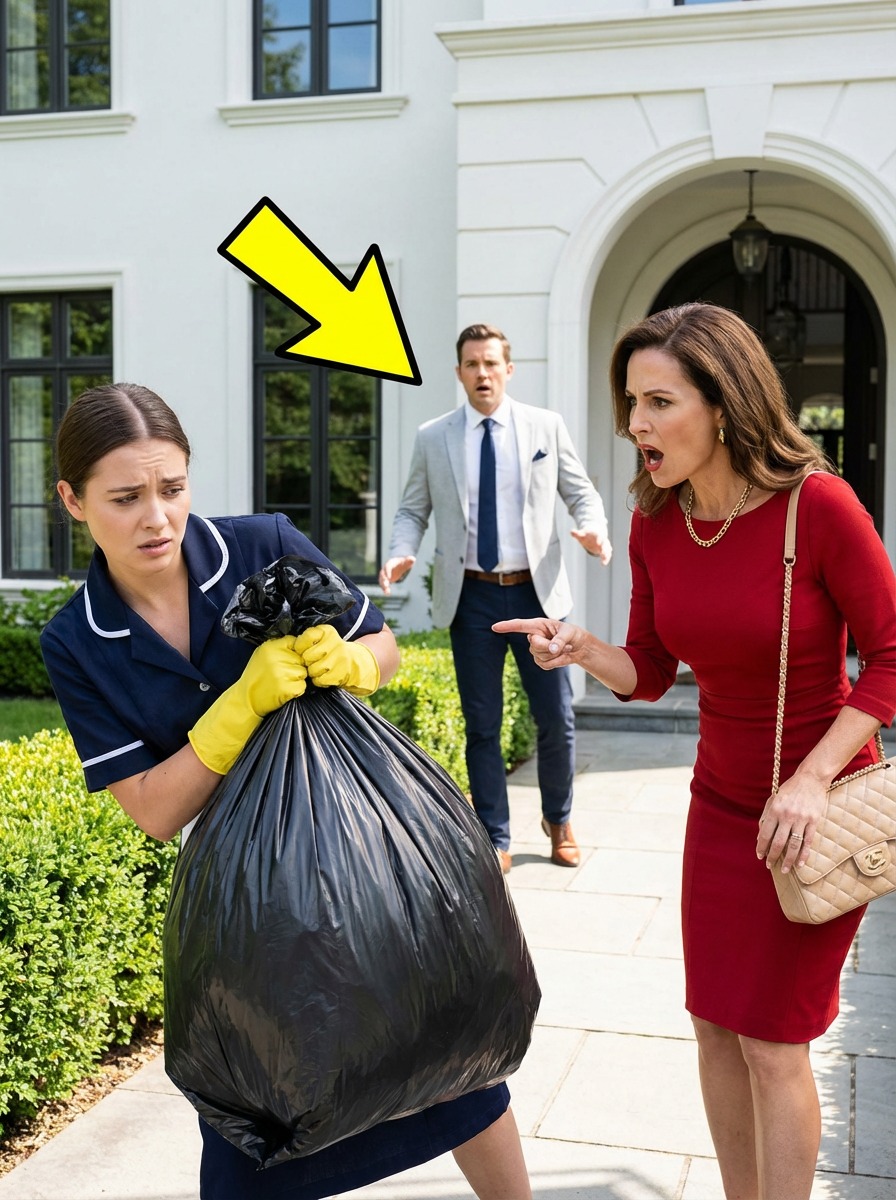
Camila Rocha, twenty-six, crossed the back courtyard with a heavy trash bag slung over her shoulder like a sentence. She’d arrived two weeks earlier with a worn suitcase, a careful smile, and the kind of hope people use when hope is the last tool left. She had a degree in education, dreams she still tried not to bury, and bills that didn’t care about pride. Most of all, she had a five-year-old daughter at home who asked every afternoon, “How was work today, Mom?”
Camila told herself it was temporary. Just a bridge. Just until she found something better.
What she didn’t realize was that she’d stepped into a house where cruelty wore designer perfume.
A few steps behind her stood Verônica Brandão, thirty-eight—Leonardo Vasconcelos’ girlfriend. Verônica had the kind of beauty that never needed to try, and the kind of confidence that grows when the world has clapped for you too many times.
She didn’t raise her voice because she was angry.
She raised it because she could.
“Move faster,” Verônica snapped, words sharp as broken glass. “Why does it take you so long to do something this simple? Or are you not even capable of carrying a trash bag?”
Her insults landed in front of the gardeners and staff like entertainment crumbs. No one laughed. No one moved. Not because they didn’t care—because they were afraid. Afraid of losing their jobs. Afraid of crossing a woman who was used to obedience like oxygen.
Camila’s jaw tightened. Her hands trembled—not from the weight, but from that sticky, humiliating heat that creeps up your skin when someone talks to you like you’re less than human.
Verônica flicked her gaze toward the gardeners, as if hunting for approval. “Look at our new girl. Can’t even handle a bag. How did she even get hired?”
Still no laughter.
Only grass shifting in the breeze—and Camila’s breathing, too loud in the silence.
And behind a stone column near the terrace, a man had arrived early and stopped so suddenly it was like the air had left his chest.
Leonardo Vasconcelos, thirty-five, had the kind of life people envy on reminder posters: companies, reputation, money, meetings stacked like skyscrapers. He’d known Verônica could be “difficult,” but he’d never seen this.
This wasn’t discipline.
This was enjoyment.
Leonardo stayed hidden—not out of strategy, but because shame glued his feet to the ground. A part of him that had been asleep for years whispered, Look. For once, actually look.
Camila reached the bins at the edge of the garden. Her shoulders burned. She dropped the bag. The thud was dull, but the quiet that followed was thunder.
Verônica’s smile faltered. The gardeners lifted their heads. Even the wind seemed to pause.
Camila turned.
There were tears on her cheeks, yes—but not the tears of surrender. They shone like something that refused to die.
Dignity.
She walked back toward Verônica one step at a time, as if each step carried every swallowed word she’d ever choked down in her life. Verônica, who was used to lowered eyes and bowed heads, felt a new, unsettling pinch of uncertainty.
When Camila stopped a few feet away, Verônica tried to reclaim control. “Why are you standing there?” she hissed. “Get back to work before I fire you.”
Camila lifted her chin. Her voice shook—not with fear, but with the strain of finally speaking after too much silence, the way an old wound stings when it opens.
“Do you really think you can talk to me like that?” Camila said, looking straight at her. “Do you think money gives you the right to humiliate anyone who works in your orbit?”
Verônica stiffened. In her world, staff didn’t question. They didn’t hold eye contact. They didn’t speak unless spoken to.
“How dare you?” she snapped, trying to tower over her. “You’re just an employee. You’re replaceable.”
“I might be an employee,” Camila answered—and her tone cooled into something stronger, steadier, like metal settling. “But I am a human being. And no human being deserves to be treated like trash.”
Work stopped everywhere.
Davi, the oldest gardener, gripped his tools with damp palms. In the kitchen doorway, Rosa pressed her apron to her chest like she was holding her heart in place. Leonardo felt something twist in him: this pristine mansion ran on people he hadn’t even learned to truly see.
Verônica tried to laugh, but it came out thin. “You have no idea who you’re talking to. One call and I can ruin you.”
Camila stepped closer—close enough that Verônica could see tears clinging to her lashes. “You can take this job from me,” she said. “But you can’t take who I am.”
And then the unthinkable happened.
Camila raised her hand.
Leonardo saw it like slow motion: the arm lifting, Verônica’s eyes widening, the air tightening.
The slap wasn’t loud.
It was final.
Dry. Clean. A door shutting.
Verônica clutched her cheek, stunned—not by pain, but by the unfamiliar sensation of consequences. No one screamed. No one moved. The whole garden held its breath.
Camila lowered her hand, trembling—not from regret, but from the dizzy certainty that life had just changed shape.
“Do you know what hurts most?” Camila said, voice clear now, coming from somewhere deep. “It’s not the bag. It’s not the exhaustion. It’s not you yelling in front of everyone. It’s the fact that someone can exist who truly believes money gives them permission to crush another person’s soul.”
Verônica opened her mouth, but words failed her. Rage burned in her eyes—alongside something closer to fear.
“You look at me like I’m invisible,” Camila went on, tears flowing freely now without shame. “Like I don’t have a family, dreams, feelings. But I have a name. I’m Camila Rocha. And I have a five-year-old daughter waiting for me. A little girl who believes in me. A little girl who will look into my eyes tomorrow and ask how my day went.”
Leonardo’s stomach dropped.
A daughter.
Two weeks, and he hadn’t even asked her basic story. To him she’d been “the new girl”—a uniform, a role, a background figure in his life.
But she was a whole person.
“I wake up at five,” Camila said. “I leave my child sleeping so I can come here and make this place look perfect—so you can live comfortably. And I do it with pride. Work doesn’t make me smaller. It makes me responsible. It makes me strong. And you think humiliating me makes you bigger.” She shook her head. “It only makes you smaller. Every single day.”
Davi stepped forward, voice rough. “She’s right.”
Rosa appeared at the threshold. “Camila is good. She works hard. She doesn’t deserve this.”
Verônica’s eyes darted around as control slipped through her fingers. “You’re all fired!” she shrieked, the threat cracking at the end. “Leonardo will hear about this! Leonardo will defend me!”
“I already did.”
The voice came from behind the column—low, heavy, tired with truth.
Leonardo stepped into view.
Verônica’s face brightened instantly, reaching for him like a shield. “Leo—thank God! Your employee attacked me! She needs to be arrested! Look at them—turning against me!”
But Leonardo didn’t comfort her.
He didn’t even touch her.
He stopped beside Camila and looked at her like he was seeing her for the first time. In her eyes there was no hatred. Exhaustion, yes. Pain, yes. But also something that disarmed him: a quiet, unbuyable dignity.
“I saw everything, Verônica,” he said softly, and the words landed like a verdict. “I saw you humiliate her. I saw how much you enjoyed it.”
“But she hit me!” Verônica insisted, breathless with disbelief.
“The only thing that happened today,” Leonardo replied, voice steady, “is that someone finally defended themselves from your cruelty. And I stood there hidden—ashamed to admit it, but it’s true.”
He turned to the staff, to the wet eyes and tense hands and cautious hope. Then back to Camila.
“I owe you an apology,” he said. “For not stopping it sooner. For letting anyone in my home believe they’re entitled to step on another person.”
Camila blinked, dazed. She’d expected punishment. A scream. A slammed door.
She got an apology.
And it hit her chest like an unexpected embrace.
Leonardo looked at Verônica with a new clarity. “This ends here,” he said. “I can’t be with someone who treats people like this. I won’t build a future on humiliation.”
Verônica recoiled like she’d been slapped again. “You’re choosing an employee over me?”
“I’m not choosing her over you,” he answered. “I’m choosing who I can respect when I look in the mirror.”
A different silence settled—less fear, more recognition. Like a door opening in the air.
The days that followed were a quiet earthquake.
Verônica called, threatened, pleaded, promised. Society whispered. Partners warned him. Friends mocked him for “letting staff embarrass him.”
And Leonardo—who had built his life on approval—felt something he’d never tasted before:
Freedom.
On Monday, Camila returned with her heart clenched tight, expecting the old order to snap back into place.
Instead, she found Leonardo waiting in the kitchen with coffee and a white envelope on the table. Rosa stood nearby, witness and support.
“Thank you for coming,” he said. “I don’t want what I said to be just words.”
He slid the envelope toward her.
“A new contract,” he continued. “Triple pay. Insurance for you and your daughter. Paid vacation. And support if you want to return to your work in education.”
Camila opened it with shaking hands. The numbers blurred her vision.
“Mr. Vasconcelos… I—”
“You don’t have to say anything,” he replied. “You already said what mattered. And you taught me what no boardroom ever did.”
Leonardo brought in labor consultants, formalized contracts, created an anonymous channel for reporting abuse, and adjusted schedules so people could live—not just work. He started eating breakfast in the kitchen, asking names, families, stories. Listening.
And in that small act—sitting down—his real transformation began.
Not everyone applauded.
Investors panicked. A partner called him unstable. Another warned him about “public perception.”
Leonardo listened like someone who no longer argued with ghosts.
“If my reputation survives only when I’m complicit in cruelty,” he said, “then it isn’t worth having.”
“I’d rather lose contracts than lose my soul.”
That afternoon, back home, he found Camila sitting in the garden with her daughter, Lia—curly hair, bright eyes, drawings scattered around her like confetti.
When Lia saw Leonardo, she ran up as if she’d known him forever. “Mr. Leo!” she shouted, pure joy in her voice.
She showed him a drawing: a big house, people holding hands, flowers, wide smiles. She pointed proudly.
“It’s about how everyone matters,” she explained with solemn seriousness. “Teacher says at work everybody has value—rich and poor.”
Leonardo swallowed hard. Five years of life, and that child already understood what so many adults refused to learn.
Camila watched him and said quietly, “I tried to explain what happened. I told her sometimes people forget to be kind, and we have to remind them: everyone deserves respect.”
Lia looked up at him, honest and unfiltered. “Mom says you helped her feel important again. Thank you for taking care of my mom.”
Leonardo blinked fast so the tears wouldn’t fall in front of a child who still believed goodness wins.
He crouched to her height. “Your mom was always important,” he said. “I just finally learned to see it.”
Months later, as certain doors closed in Leonardo’s old world, new ones opened—ones he’d never touched.
He converted part of the property into a community learning center with free courses for domestic workers. Not charity for cameras—structure. Dignity. Opportunity.
Camila resumed her studies and helped run educational programs. Davi became a supervisor. Rosa taught cooking classes, proud, passing down recipes that fed more than hunger.
On the day of the first graduation, the garden was full—maids, drivers, gardeners, cooks, people who’d spent years moving through other people’s homes without anyone saying their names with respect.
Lia insisted on giving a speech.
She stood in front of the adults with adorable seriousness and said, clearly:
“Kind people make the world better.”
The applause that followed wasn’t polite.
It was relief.
Like everyone had been waiting to hear that sentence forever.
As the sun set over the same garden where humiliation had once spilled, Leonardo approached Camila. Lia was asleep in her arms, exhausted from the day’s joy.
“Thank you,” he said, almost a whisper.
Camila looked surprised. “For what?”
“Because you taught me bravery isn’t the absence of fear,” he said, eyes on the center, the lights turning on, the people laughing. “It’s doing the right thing while you’re shaking inside. You showed me real wealth isn’t what you hoard—it’s what you protect. What you share. What you refuse to excuse.”
Camila smiled—no longer the smile of someone apologizing for existing. The smile of someone standing tall in a world that tried to bend her.
“I learned something too,” she said, adjusting Lia in her arms. “Defending my dignity wasn’t only for me. It was for my daughter. For the people who can’t speak. For those who’ve been swallowing words for years.”
Leonardo nodded, remembering the slap not as violence, but as an alarm clock. The moment life said: Look.
And he finally did.
Lia shifted in her sleep and hugged her mother tighter. Leonardo smiled, a tenderness that would’ve once felt naïve to him.
“Do you know what we’ll plant tomorrow?” he asked, half without thinking.
Camila raised an eyebrow. “What?”
“Seeds of kindness,” he said, looking at the ground where a trash bag once hit—and where laughter now landed instead. “So they grow everywhere.”
And walking back inside, the three of them—the mother who found her voice, the man who found his conscience, and the child who understood the world with her heart—carried the same quiet truth:
Sometimes everything changes in a single instant—when someone decides their dignity matters more than their fear, and someone else chooses to truly listen instead of looking away.
And from there, like seeds, the change spreads. One person. One family. One community at a time.