“We Don’t Treat Beggars Here”
The lobby was designed to keep pain outside.
Polished stone floors reflected the ceiling lights like calm water. Soft instrumental music floated through the air, blended with the faint scent of citrus and antiseptic. Every movement inside the private hospital was measured, controlled, almost reverent—as if suffering itself had been politely asked to wait beyond the glass doors.
People spoke in low voices. Shoes made no sound. Even urgency was wrapped in manners.
That was why the girl stood out immediately.
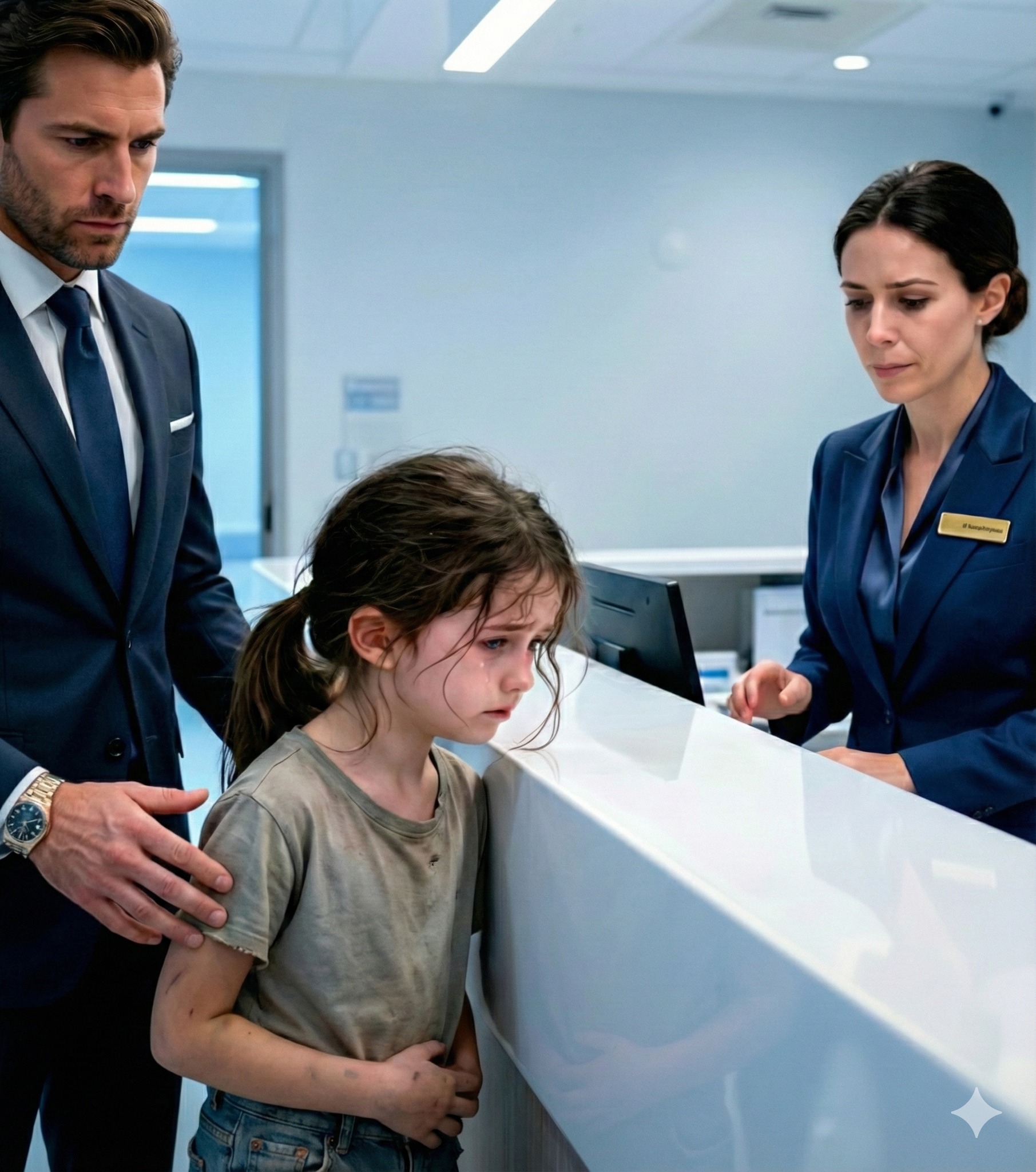
She was about eight years old. Barefoot. Her thin shoulders shook as she stood near the reception desk, struggling to remain upright. Her clothes were too large, frayed at the edges, and clearly unwashed. Dirt streaked her arms, and her hands left faint smudges on the spotless counter as she leaned forward for support.
Her voice was barely a whisper.
“Please… I need a doctor.”
The receptionist did not look up.
She continued typing, her expression neutral, her tone practiced.
“This is a private medical center,” she said. “We don’t treat beggars.”
The word landed harder than a slap.
The girl swallowed, her lips trembling.
“It hurts,” she murmured.
Two security guards exchanged a glance and began walking toward her.
Around them, adults looked away. A man adjusted his watch. A mother gently pulled her child closer. Someone pretended to check their phone. The silence thickened, heavy with discomfort and quiet permission.
The girl clutched the edge of the counter.
“Please,” she whispered again.
Her knees buckled.
She collapsed onto the cold marble floor.
No one moved.
The receptionist sighed and finally stood.
“Take her outside,” she ordered.
The Man Who Stood Up
A chair scraped softly against the floor.
A man rose from the waiting area. He was dressed simply—no suit, no luxury watch, no signs of status. Just a clean jacket, worn shoes, and a face marked by calm seriousness rather than anger.
He walked toward the child, slow but deliberate, and stopped beside her small, motionless body.
She looked impossibly fragile against the vastness of the lobby. Pale. Shivering. A child who did not belong in a place so polished and so unwilling to see her.
For the first time since she had entered, someone truly looked at her.
The man’s voice was steady.
“Give her to me.”
One guard hesitated. The other—whose name badge read Samuel—did not. He carefully lifted the unconscious girl and placed her into the man’s arms.
The receptionist rushed forward.
“Sir, you need documentation. A deposit.”
“She needs a doctor,” the man replied. “Now.”
“And who is going to pay?”
“I am.”
An administrator in a tailored suit stepped in, his expression tight with authority.
“Without proof of payment,” he said coolly, “we will escort her out and arrange transfer to a public hospital—where she belongs.”
The words were sharp, clean, final.
A Number That Changed Everything
The man reached into his pocket and pulled out his phone.
“Give me the account number,” he said, handing it to the hospital’s financial officer.
The lobby held its breath.
Seconds later, the officer’s eyes widened. His face drained of color.
The screen showed the updated balance.
Two million dollars.
No explanation. No conditions.
A whisper spread through the room.
“Who are you?” the administrator asked.
“That’s not important,” the man said. “Save her.”
Doctors rushed forward. A stretcher appeared. The girl was wheeled through double doors and vanished into the emergency wing.
The man turned back to the stunned staff.
“My name is Jonathan Hale,” he said quietly.
Several people froze.
“How many children,” Jonathan continued, “have you turned away because they weren’t profitable?”
No one answered.
Jonathan raised his phone.
“Emergency board meeting,” he said into it. “And prepare termination papers for Dr. Whitmore.”
Waiting Outside the Pediatric ICU
Hours later, Jonathan sat alone outside the pediatric intensive care unit.
The hallway was quieter here, stripped of its polish and pretense. Machines hummed softly behind closed doors. Nurses passed by with tired eyes and steady hands.
Jonathan stared at the floor.
Once, he had believed money could fix anything. That it could protect, replace, repair.
He had been wrong.
That belief had cost him everything.
A nurse approached gently.
“She’s stable,” she said. “Her name is Mia. No family records. No ID. She came alone.”
Jonathan closed his eyes.
The surgery had taken hours. When the surgeon finally emerged and nodded, relief washed over him in a way he had not felt in years.
Later, as they changed the girl’s clothes, they found something in her pocket.
A thin, handmade bracelet.
Worn. Faded.
A single letter: M
Jonathan’s breath caught.
His daughter—Madeline—used to make bracelets just like that.
A New Beginning
Two days later, the girl opened her eyes.
Her voice was small.
“Did they send me away?”
Jonathan leaned closer.
“No,” he said softly. “No one will ever do that again.”
She studied his face, unsure.
“Are you going to send me back?”
Jonathan shook his head.
“If you want… you can stay with me.”
She hesitated, fear and hope tangled together.
Then she nodded.
“Okay.”
And just like that, a child who had arrived alone was alone no longer.
One Year Later
The hospital lobby still shone.
But it felt different.
Children filled the space now—laughing, crying, waiting, being seen.
A plaque stood near the entrance:
THE MADELINE HALE FUND — NO CHILD TURNED AWAY
Mia stood beside Jonathan, holding a box of donated toys.
“This is where you helped me,” she said. “So we should help others too.”
Jonathan smiled.
And for the first time since he had lost his daughter, he was no longer just a powerful man.
He was a father again.