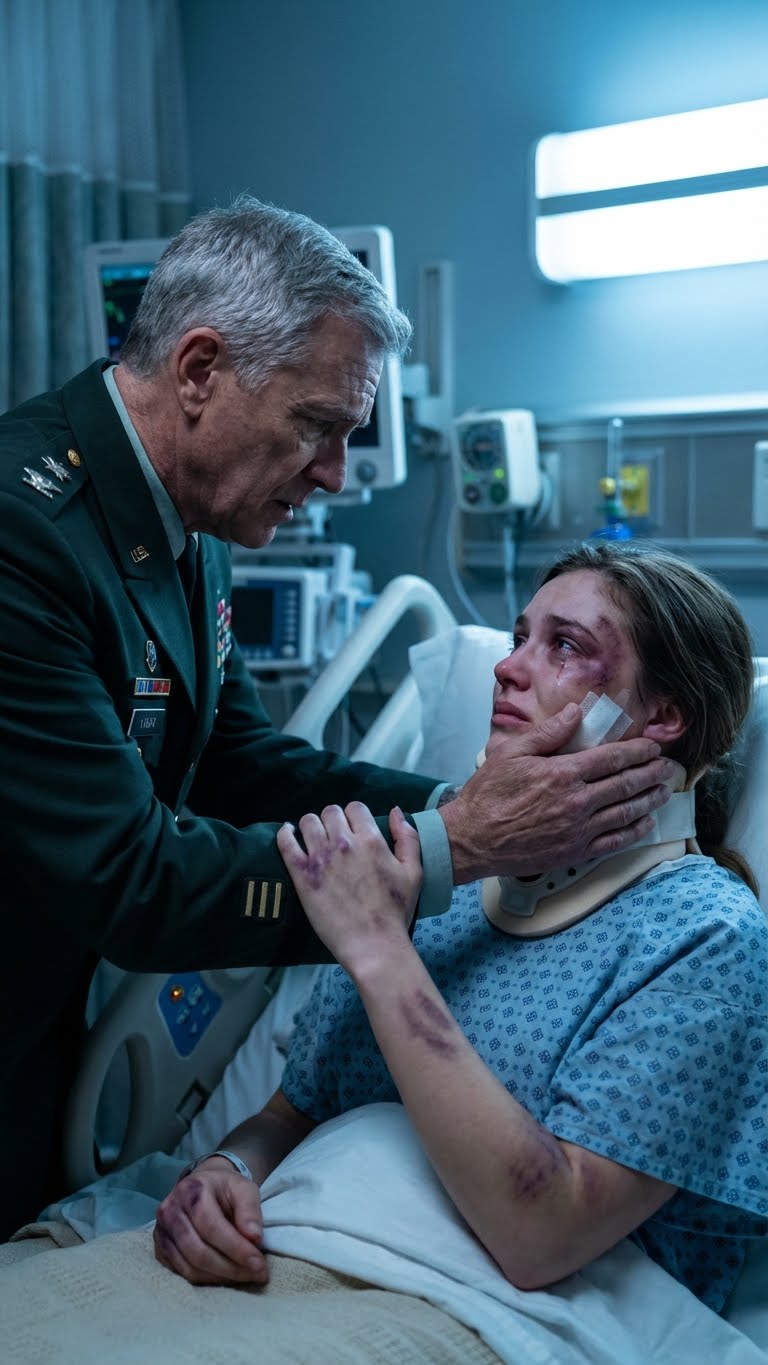
I never told my son-in-law I was a retired military interrogator. To him, I was just a harmless babysitter—easy to ignore, easy to use. Then, during dinner, my grandson whispered through tears, “Daddy hurts Mommy… there was so much blood.” I ran to her. My daughter was barely alive, bruises everywhere, breath shaking. “He beat me… for his mistress,” she whispered. I took her home and sent one message: “Come to my house.” He thought he was in control. He was wrong. Some invitations are not meant to be survived.
Chapter 1: The Flower Man
To the neighbors on Elm Street, I was just Arthur. Old Arthur. The man who wore beige cardigans, walked with a slight limp, and spent six hours a day meticulously pruning his petunias and hydrangeas. They saw a man whose hands were stained with soil, whose back was bent by time, and whose eyes were always a little too watery behind his thick bifocals.
They didn’t know that the limp came from a shrapnel wound in Fallujah. They didn’t know the watery eyes were a side effect of tear gas exposure that never quite cleared up. And they certainly didn’t know that the hands cradling the delicate root systems of a rosebush were the same hands that had once snapped a combatant’s neck in a silent mud-hut in Kandahar.
I liked it that way. I liked being the Flower Man. It was a penance. A way to create life after spending two decades taking it.
“Arthur! Are you deaf, old man?”
The voice cut through the serene morning air like a rusted saw blade. I didn’t flinch. I carefully tied a drooping stem to a bamboo stake before turning around.
Mark stood in my driveway, leaning against his polished black Audi. He was wearing a suit that cost more than my first car, and a sneer that cost him nothing but his soul. Behind him, sitting in the passenger seat with the window down, was his mother, Lydia. She was checking her makeup, utterly disinterested in the world around her.
“Hello, Mark,” I said, my voice soft and gravelly. “How is Sarah?”
“Sarah is fine,” Mark scoffed, checking his gold watch. “She’s packing the bags. We’re dropping her off for the weekend. Lydia and I are going to the winery. We need a break. She’s been… moody. Depressing, really.”
“Depressing,” I repeated, wiping dirt from my hands.
“Yes. Moping around. Crying over nothing. Honestly, Arthur, you raised a very fragile girl. She needs to toughen up.”
I looked at the car. The rear window was tinted, but I could see the silhouette of my daughter. She wasn’t looking at me. Her head was bowed. She was wearing a scarf, even though it was seventy degrees.
Assessment: Scarf to hide bruising on the neck. Head bowed to avoid eye contact—shame response. Mark’s knuckles on his right hand were red. Lydia’s indifference suggested complicity.
The Marine in my head—the Ghost—woke up. He whispered coordinates. He calculated windage. He highlighted the soft spot in Mark’s throat where a single thumb-press would collapse his trachea.
Six seconds to break his spirit. Four to break his body.
I pushed the Ghost back into his cage. I forced a smile.
“I’ll take good care of her, Mark. You go. Enjoy your wine.”
“Yeah, whatever,” Mark muttered. “Try not to bore her to death with your war stories. Oh wait, you were a cook or something, right? Potato peeling stories.”
He laughed. It was a hollow sound.
“Something like that,” I said.
Mark got back in the car. As they backed out, I saw Sarah look up. Just for a second. Her left eye was heavily concealed with makeup, but the swelling was undeniable. She pressed her hand against the glass—a silent, desperate wave.
I stood there, gripping the garden shears until my knuckles turned white. I wasn’t a cook. I was a Force Recon Marine. I was a ghost who walked through walls. But for Sarah, I had to be a father. I had to be safe.
I didn’t know that safety was no longer an option.
Chapter 2: The Bus Stop of Death
The weekend passed without them dropping her off. Mark texted on Friday night: Change of plans. Taking her with us. Don’t wait up.
I called Sarah’s phone ten times. Straight to voicemail. I sat in my kitchen, cleaning my fingernails with a pocketknife, staring at the silent phone. The feeling in my gut was familiar. It was the feeling of a mission going south.
Monday morning arrived with a cold, grey drizzle. At 5:00 AM, my phone buzzed on the nightstand.
I picked it up. A text from Mark.
Come get your daughter at the bus stop on 4th and Main. We don’t want her anymore. She’s broken. Defective product. No refunds.
My heart didn’t race. It stopped. Then, it turned into a block of ice.
I put on my boots. I didn’t grab a jacket. I drove my old Ford truck through the sleeping city, running three red lights. I didn’t feel the steering wheel. I was operating on pure, cold instinct.
The bus stop at 4th and Main was a desolate concrete slab in the industrial district. It was raining harder now.
I saw a bundle of clothes on the rusted metal bench.
I pulled the truck up onto the curb and jumped out.
“Sarah?”
The bundle moved slightly. I ran to her.
It wasn’t Sarah. It was a ruin.
Her face was unrecognizable. One eye was swollen shut, the size of a golf ball. Her jaw hung at a sickening angle. Her clothes were torn, muddy, and soaked in blood that was rapidly diluting in the rain. She was shivering so violently her teeth were clacking together—or the ones she had left.
“Baby,” I whispered, falling to my knees in the mud. “Baby, Daddy’s here.”
I touched her shoulder. She flinched, a guttural sound of terror escaping her throat. She tried to crawl away from me, pushing herself backward with broken fingers.
“No… no more… please Mark… please…”
“It’s me,” I said, my voice cracking. “It’s Dad. It’s Arthur.”
She stopped. She opened her good eye. It was hazy, unfocused, filled with blood.
“Dad?” she rasped. “He… he and Lydia… they laughed. They said I was trash. They threw me out… moving car…”
Her head lolled back. Her breathing became jagged, wet gurgles.
I scooped her up. She weighed nothing. She felt like a bird with broken wings.
I drove to the trauma center like a man possessed. I carried her into the ER, my shirt soaked in her blood.
“Help her!” I roared. The sound terrified the receptionist. It wasn’t an old man’s voice. It was a command from a battlefield commander.
A team of doctors swarmed us. They took her away.
I stood in the hallway for four hours. I didn’t sit. I stared at a crack in the tile floor.
Finally, Dr. Aris came out. He looked exhausted. He looked defeated.
“Mr. Vance,” he said softly. “She’s in a coma. The brain trauma is severe. There’s internal bleeding in the spleen and liver. We’re doing everything we can, but…”
He paused.
“But what?” I asked.
“Her vitals are dropping. The swelling in the brain is critical. You should prepare yourself. It would be a miracle if she wakes up. And if she does… she may never be the same.”
I nodded. I shook his hand. I thanked him.
Then I walked out of the hospital.
I didn’t cry. Crying is for grieving. I wasn’t grieving yet. I was working.
I drove home. I walked into my garage. I pushed aside the lawnmower and the rake. I moved the workbench. Behind it was a false panel in the wall.
I pried it open.
Inside lay a heavy, green canvas duffel bag. It smelled of canvas and gun oil. I hadn’t opened it in fifteen years.
I unzipped it. Inside were not guns—I didn’t need guns for what I was going to do. Inside were zip ties. Duct tape. A serrated combat knife. A tactical flashlight. And a pair of black leather gloves that had seen things no man should see.
I put the gloves on. They fit perfectly.
The Flower Man was dead. The Ghost was loose.
Chapter 3: The Midnight Visit
Mark lived in a gated community, the kind with security guards who slept in their booths and cameras that were mostly for show.
I parked my truck a mile away in a wooded area. I moved through the forest on foot. The rain had stopped, leaving the ground soft and silent. I didn’t snap a twig. I didn’t leave a footprint.
I reached the perimeter of Mark’s estate at 11:00 PM.
The house was blazing with light. Music was thumping from inside.
I crept up to the French doors leading to the patio. I peered inside.
They were celebrating.
Mark was sitting on the white leather sofa, holding a glass of scotch. Lydia was pacing, laughing, holding a cigarette.
“Did you see her face when you pushed her?” Lydia cackled. “Like a discarded doll. God, it feels good to have the house quiet again.”
“I told you, Mom,” Mark laughed, clinking his glass against the bottle. “She was weak. A bad investment. I’ll report the car stolen tomorrow, say she took it and ran off. By the time they find her body in some ditch, we’ll be in Cabo.”
“And the old man?” Lydia asked.
“Arthur?” Mark snorted. “He’s probably asleep. Or talking to his petunias. He won’t do anything. He doesn’t have the spine.”
I stepped back from the window.
Assessment: Two hostiles. Intoxicated. Unarmed. Overconfident.
I went to the side of the house. I found the main breaker box. I didn’t just flip the switch; I ripped the master fuse out with a pair of pliers.
The music died. The lights vanished. The house plunged into absolute, suffocating darkness.
“What the hell?” Mark’s voice. “Mom, did you hit a switch?”
“I didn’t touch anything! Mark, I can’t see!”
I opened the French doors. They made no sound. I stepped onto the plush carpet.
I was in the room with them.
“Mark, get your phone flashlight,” Lydia whined.
“I’m trying, I can’t find it! Who’s there?”
I picked up a heavy crystal vase from the side table and tossed it across the room. It shattered against the fireplace.
“Ah!” Lydia screamed. “Someone’s in here!”
“Who is that?” Mark shouted, his voice cracking. “I have a gun! Stay back!”
He didn’t have a gun. He was bluffing.
I moved behind the sofa. I could smell Lydia’s perfume—heavy, cloying, expensive.
I moved fast.
I grabbed Lydia first. I didn’t strike her. I applied a sleeper hold, pinching the carotid artery. She went limp in four seconds. I lowered her silently to the floor and zip-tied her hands and feet before she even hit the rug.
“Mom?” Mark called out. “Mom, stop playing around!”
I turned on my tactical flashlight. I set it on the mantle, pointing it directly at Mark’s face.
He screamed, shielding his eyes from the blinding beam. “Don’t shoot! Take the money! The safe is in the bedroom!”
“I don’t want your money, Mark,” I said.
My voice seemed to come from everywhere and nowhere.
Mark froze. He squinted into the light. “Arthur?”
I stepped into the beam. I was wearing all black. My face was smeared with garden soil—camo. I held the serrated knife loosely in my right hand.
“You said I didn’t have a spine,” I whispered, walking toward him.
Mark scrambled backward, tripping over the coffee table. He fell hard, scrambling like a crab on the floor. “Arthur… wait… listen… it was an accident! She fell!”
“You threw her out of a moving car,” I corrected. “You broke her jaw. You laughed.”
I stepped on his ankle. I applied just enough pressure to fracture the small bones.
Mark shrieked—a high, thin sound.
“The Marines taught me how to break a man’s spirit in six seconds,” I said, leaning over him. “And his body in four.”
I grabbed him by the collar and hurled him into the chair where Lydia had been sitting. I zip-tied him so tight his hands turned purple.
I ripped the duct tape. Rip. Rip.
I taped Lydia’s mouth shut as she began to stir. Her eyes went wide with terror when she saw me.
I turned back to Mark. I placed the tip of the knife against his eyelid.
“Now,” I said softly. “You are going to feel every ounce of pain my daughter felt. And then, when you are broken, I am going to bury you in my garden. Fertilizer is expensive, Mark.”
Chapter 4: The Call from the Beyond
Mark was weeping. Snot ran down his nose, mixing with the sweat of pure terror. He had pissed himself. The smell of ammonia filled the room.
“Please,” he blubbered. “Please, Arthur. I’m sorry. I’m so sorry. I’ll do anything. I’ll give you everything.”
“You have nothing I want,” I said. “You took the only thing I cared about.”
I pressed the knife. A bead of blood welled up on his cheek.
The Ghost was screaming in my head. Finish it. Slice. Sever. End him.
It would be so easy. A quick slash. Then the mother. Then clean up. I knew how to dispose of bodies. I knew how to disappear.
I tightened my grip on the handle.
Buzz.
My phone vibrated in my pocket.
I ignored it.
Buzz. Buzz.
It persisted. It was the specific ringtone I had assigned to the hospital contacts.
I froze. The knife hovered millimeters from Mark’s jugular.
If she was dead… if Dr. Aris was calling to tell me she was gone… then Mark was a dead man walking. I would peel him apart.
I pulled the phone out with my left hand, keeping the knife steady with my right.
“Vance,” I answered.
“Arthur?” Dr. Aris’s voice was breathless. “Arthur, are you there?”
“Tell me,” I said. My voice was devoid of humanity.
“It’s… I don’t know how to explain this medically,” the doctor stammered. “The swelling… it just stopped. Her stats spiked. She woke up, Arthur.”
The world tilted on its axis. The red haze in my vision flickered.
“She’s awake?”
“She’s weak. She can barely speak. But she’s asking for you. She keeps saying… she keeps saying, ‘Don’t let Dad do it. Don’t let Dad be sad.’”
The knife in my hand trembled.
Don’t let Dad be sad.
Even on the brink of death, she knew me. She knew what I was capable of. She knew the Ghost was out, and she was trying to call him back.
I looked down at Mark. He was a shivering, pathetic mess. A stain on the carpet.
If I killed him, I went to prison. Or I went on the run.
If I killed him, Sarah woke up alone. She recovered alone. She lived the rest of her life visiting her father through a glass partition, knowing that his love for her had turned him into a monster.
I looked at Lydia, her eyes bulging with fear.
I took a deep breath. The smell of the garden filled my memory—the petunias, the damp earth, the peace.
“I’m coming,” I told the doctor. “Tell her… tell her Dad is coming.”
I hung up.
I looked at Mark.
“You aren’t worth it,” I whispered.
I stood up. I wiped the knife on Mark’s expensive shirt.
I pulled out Mark’s phone from his pocket. I unlocked it using his face ID. I went to the voice recorder app. I pressed record.
“I’m leaving you like this,” I said to him. “The police will be here in ten minutes. I’m calling them now. If you try to run, I will find you. If you try to lie, I will find you. This is your one chance to live.”
I dialed 911 on his phone and put it on speaker, tossing it onto his lap.
“Emergency,” the operator said.
“There has been a break-in at 124 Oak Lane,” I said calmly. “Two suspects are restrained. They have confessed to the attempted murder of Sarah Vance. Send an ambulance for them. They seem to be in shock.”
I walked out the French doors. I disappeared into the woods.
By the time the sirens wailed in the distance, I was in my truck, driving toward the miracle.
Chapter 5: True Justice
The legal system is usually slow, but Arthur Vance’s evidence was thorough.
I didn’t just leave them tied up. Before I left the house, I had found the dashcam footage from Mark’s car—he was too arrogant to delete it. It showed the argument. It showed the door opening. It showed Sarah falling.
Mark and Lydia were denied bail. The charges piled up: Attempted Murder, Conspiracy, Aggravated Assault.
But I didn’t care about the courtrooms. My world was confined to Room 402 of St. Jude’s Hospital.
Sarah looked like a war victim. Her jaw was wired shut. Tubes ran in and out of her arms. Her head was shaved on one side where they had drilled to relieve the pressure.
But her eyes were open.
I sat in the chair next to her bed, holding her hand. My gloves were gone. My hands were washed clean.
“Dad,” she mumbled through the wires. It was barely a sound.
“I’m here, baby,” I said. “I’m right here.”
She squeezed my hand. Her grip was weak, but it was there.
“You… didn’t…”
She couldn’t finish the sentence, but I knew what she meant. You didn’t kill him.
“No,” I said softly. “I didn’t. Because you need me here. You need me to push your wheelchair. You need me to make you soup.”
She closed her eyes, a tear leaking out.
Recovery was hell. It took six months for her to walk again. It took a year for the scars on her face to fade to white lines.
During that year, I told her everything. I told her about the Marines. I told her about the things I had done in the dark so that others could live in the light.
“I thought you were just a gardener,” she said one night, sitting on my porch, watching the fireflies.
“I am a gardener,” I said. “But every gardener knows that sometimes you have to pull the weeds to save the flowers.”
“Am I a flower?” she asked, touching the scar on her jaw.
I looked at her—this woman who had survived being thrown from a moving car, who had fought her way back from a coma, who had testified against her husband with a voice of steel.
“No,” I said. “You’re not a flower. You’re an oak tree. You bent, Sarah. But you didn’t break.”
Chapter 6: The New Garden
Two Years Later
The sign over the gate read: The Sanctuary.
It was a community garden, built on the acre of land behind my house. Sarah ran it. It was a place for women—and men—who were recovering from domestic trauma. They came here to put their hands in the dirt, to watch things grow, to learn that life could bloom again after a hard winter.
I was tending to the prize hydrangeas near the back fence. My limp was a little worse these days, and my eyes were a little waterier.
“Dad!”
Sarah called out from the greenhouse. She was walking toward me, carrying a tray of seedlings. She wasn’t hiding under scarves anymore. Her scars were visible, but she wore them like medals. She looked vibrant. Alive.
“We have a new arrival,” she said. “Young girl. Nineteen. Scared of her own shadow. She needs someone to show her how to prune the roses.”
I wiped my hands on my apron. “I can do that.”
“I know you can,” Sarah smiled. She kissed my cheek. “You’re the expert.”
I watched her walk back to the group of survivors. She was laughing.
Mark was serving twenty-five years in a maximum-security prison. Lydia had died of a stroke six months into her sentence. The Ghost was gone. I hadn’t felt him in a long time.
I looked down at my hands. They were covered in rich, dark soil.
I thought about the night I held the knife to Mark’s throat. I thought about the six seconds it takes to break a man.
But then I looked at the garden. I looked at the people healing. I looked at my daughter.
It takes six seconds to break a man. But it takes a lifetime to build a human being.
I picked up my shears and turned to the new girl standing by the gate. She looked terrified.
I waved.
“Come on in,” I called out. “The gate is open. And you’re safe here.”
And for the first time in my life, I knew it was true.
The End.a