I Told My Grieving Stepdaughter to “Fix Herself or Leave” Because I Was Pregnant and Overwhelmed — But When I Opened Her Bedroom Door the Next Morning, One Painting Revealed the Family She’d Been Quietly Building Without Me
When my stepdaughter Iris came to live with us, she was fifteen years old, and I remember standing in the doorway of the guest room that had just become hers, watching her unpack silently, folding clothes with careful precision as if every movement needed to be justified, and telling myself over and over that I was prepared for this, that I understood what it meant to take in a grieving child, that I was emotionally mature enough to handle it.
Her mother, Elaine, had passed away barely three months earlier after a sudden illness, the kind that doesn’t give a family time to adjust or prepare, only time to react and then collapse inward. My husband Thomas had aged ten years in those few months, his hair more gray, his voice quieter, his eyes permanently rimmed with exhaustion. Iris barely spoke at all. She moved through our home like a shadow, always polite, always apologetic, always shrinking herself so much that sometimes I startled when I realized she was standing right behind me.
At first, I was gentle. Or at least, I thought I was. I gave her space. I didn’t push conversations. I told myself that silence was part of grief and that eventually she would come out of it. I told myself patience was love.
What I didn’t account for was the fact that I was six months pregnant, physically uncomfortable in ways I’d never experienced before, sleeping in short restless bursts, my body aching, my emotions stretched thin, my mind constantly racing with fears about money, childbirth, the baby’s health, and the terrifying question of whether I was actually ready to be a mother at all.
Grief and pregnancy do not coexist easily.
Every day, I woke up already tired. My back hurt. My feet swelled. My doctor kept reminding me to “reduce stress,” a phrase that felt almost laughable when stress had become the background noise of my life. Thomas worked longer hours to cover medical bills and keep us afloat, which meant I spent more time alone with Iris, navigating a relationship neither of us had been given instructions for.
She never caused trouble. That was the strange part. She never raised her voice, never slammed a door, never complained. She washed dishes without being asked, folded laundry quietly, and thanked me for meals even when she barely touched her food. She stayed in her room for hours, emerging only when necessary, her sketchbook tucked under her arm like a shield.
And somehow, that quiet obedience made everything feel heavier.
The house felt thick with sadness, like the air itself had weight. I couldn’t escape it. I felt guilty for wanting laughter when Iris was mourning, guilty for feeling resentful of a child who had already lost so much, and guilty for resenting my own guilt. I didn’t know how to make room for both her grief and my fear, so instead of expanding my heart, I began closing it off.
I started to see her sadness not as pain, but as presence—something constantly there, something pressing down on me.
One afternoon, after a particularly brutal night of no sleep and a morning filled with nausea and frustration, I came into the kitchen and found Iris sitting at the table, her sketchbook closed, staring at the wall as if she were watching something I couldn’t see. The sunlight streamed in through the window, illuminating dust particles in the air, and something about the stillness of the moment made my chest tighten.
I don’t even remember what triggered it. I just remember the sound of my own voice, sharp and unfamiliar.
“You can’t keep doing this,” I snapped. “Walking around like this all the time.”
She looked up at me, startled.
“Like what?” she asked softly.
“Like this house is some kind of grief hotel,” I said, the words tumbling out faster and crueler than I could stop them. “I’m pregnant. I’m exhausted. I can’t live in sadness all the time. You need to fix yourself or leave.”
The silence that followed was unbearable.
Iris didn’t cry. She didn’t argue. She didn’t raise her voice.
She just nodded once, small and quiet, as if I’d confirmed something she’d already believed, and closed her sketchbook.
“I understand,” she said, barely above a whisper.
Then she stood up and walked back to her room.
I spent the rest of that day trying to convince myself I’d done the right thing. I told myself I was protecting my peace, protecting my unborn baby, setting boundaries. That night, I lay awake with my hand on my belly, feeling the baby shift inside me, trying to ignore the knot of unease tightening in my chest.
The next morning, something felt wrong the moment I woke up.
The house was too quiet.
I made breakfast and realized Iris hadn’t come down. I told myself she was sleeping in. I cleaned the kitchen, folded laundry, and paced the living room until my nerves finally got the better of me. I decided we needed to talk, to clear the air, to maybe soften what I’d said the day before.
I walked down the hallway and stopped outside her bedroom.
The door was slightly open.
I pushed it gently and froze.
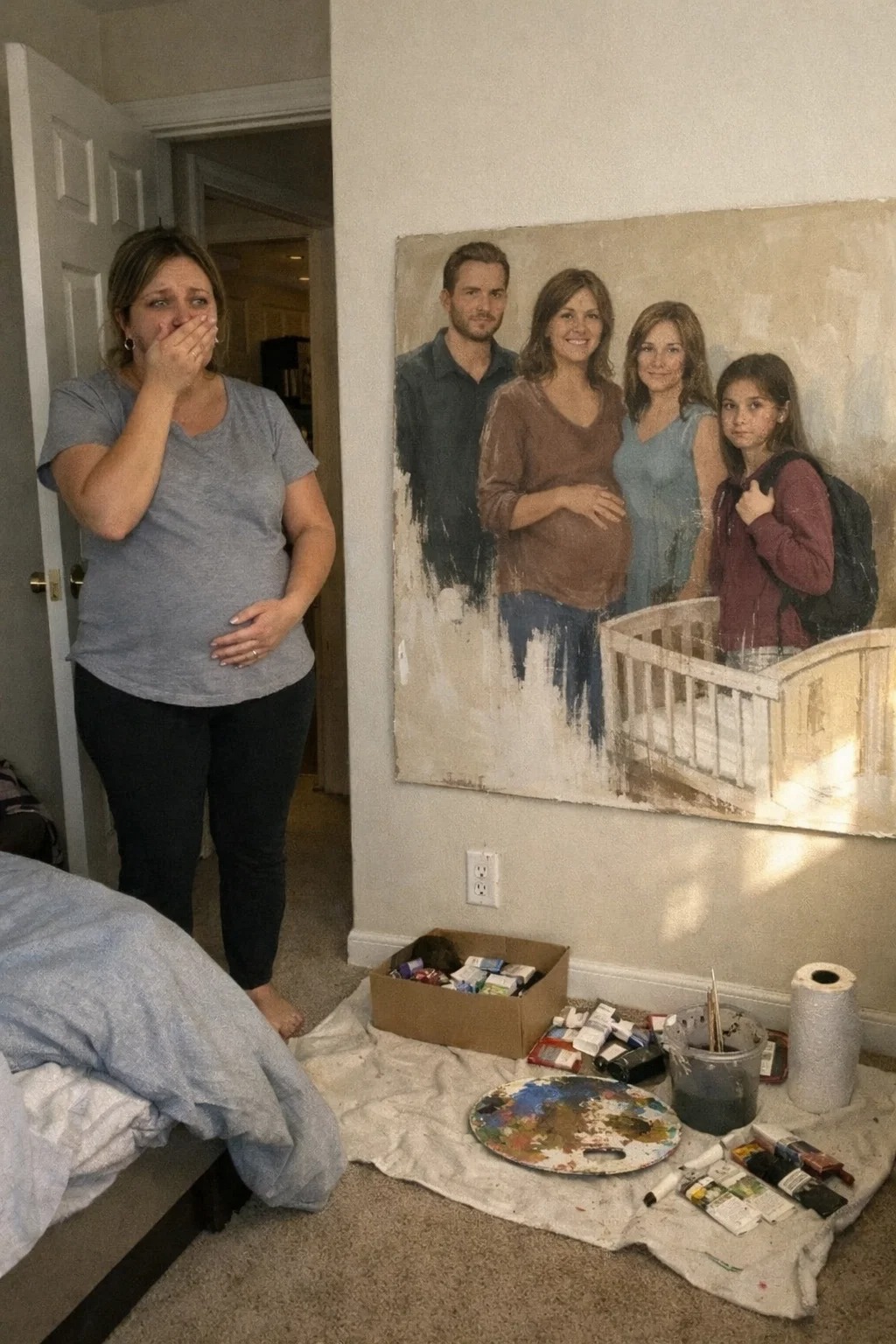
Propped against the far wall was a massive canvas, nearly as tall as Iris herself. Sunlight spilled across it, catching colors so vivid they seemed to hum. It wasn’t a sketch. It wasn’t a hobby piece.
It was art.
A family portrait.
At the center was Thomas, painted with warmth and detail, his expression soft in a way I hadn’t seen in months. Beside him was Elaine, her presence rendered gently, almost glowing, watching from above with a tenderness that made my throat close.
And then I saw myself.
I was standing there, one hand resting on my pregnant belly, the other clasped tightly with Iris’s hand. My face wasn’t perfect, but it was peaceful, strong, present.
At our feet was a crib. Inside it, a sleeping baby—my baby, her little half-sister—painted with care and hope.
My knees buckled. I sat down on the floor and sobbed.
She had never told me she could paint like that.
I had never asked.
In that moment, I saw everything I had missed. All the hours she spent in her room weren’t avoidance—they were creation. She wasn’t drowning in grief; she was trying to stitch together a future where we all belonged.
She wasn’t bringing sorrow into my house.
She was building a family in her heart and hoping I’d step into it.
When Iris came back from school that afternoon, I was sitting on her bed, the painting still leaning against the wall. She froze when she saw me, fear flashing across her face.
“I’m sorry,” I said immediately. “Please don’t run.”
She stood there, uncertain.
“I was wrong,” I continued, my voice shaking. “What I said to you was cruel. I failed you. I was scared, and tired, and selfish, and I didn’t know how to hold joy and grief at the same time. But that’s my failure, not yours.”
Tears filled her eyes.
“I just wanted us to be a family,” she whispered.
I pulled her into my arms, and she cried for the first time since she moved in, deep shaking sobs that soaked my shirt and broke my heart open all over again.
Everything changed after that.
We started talking. Really talking. About her mom. About her fears. About the baby. We visited Elaine’s grave together. Iris brought flowers. I brought stories. We laughed and cried and remembered.
Thomas noticed the change immediately. One night, he held my hand and said, “Thank you for seeing her.”
My baby is due in a few weeks now.
Iris helped paint the nursery. She talks to her sister through my belly. She smiles more. I do too.
We aren’t perfect.
But we are real.
And sometimes, family isn’t about fixing people.
It’s about making space for them to be exactly who they are.