The Boy in the Oversized Blue Sweater — “He Just Kept Sleeping,” the Mother Said Calmly, Until the Doctors Opened the File and Realized Sleep Had Been His Only Escape
There are children who cry when they are hurt, and there are children who learn very early that silence is safer.
Ethan Caldwell belonged to the second kind.
At five years old, he had mastered the art of disappearing while still standing in plain sight—shoulders tucked inward, eyes lowered, breathing shallow enough not to disturb anyone’s mood. Teachers described him as “quiet but polite.” Neighbors said he was “easy.” No one ever used the word afraid, though fear was the one thing that never left him.
The paramedics found him curled on the living room couch beneath an oversized blue sweater that dragged past his fingers, his small chest rising and falling so faintly that one of them had to press a hand against his ribs to be sure. His mother stood nearby, arms crossed, her voice unnervingly even.
“He just wouldn’t wake up,” she said. “I tried calling his name.”
She did not mention the pills.
She did not mention the nights.
She did not mention the way the sweater used to belong to someone else.
Three years earlier, Ethan had a brother.
Lucas was eight, loud, brilliant, always in motion. He loved dinosaurs and hated socks. He used to sit on Ethan’s bed every night and tell him stories about planets that swallowed sadness whole. Their mother used to laugh back then—real laughter, warm and careless.
Then Lucas died in a highway accident on a rainy afternoon that split the family into a before and an after.
The house never recovered.
Neither did Ethan.
After the funeral, his mother began reorganizing everything. Furniture shifted. Photos disappeared. Lucas’s room was sealed, then slowly emptied, its contents redistributed like relics.
Ethan woke up one morning to find his own clothes gone.
In their place, neatly folded on his bed, were Lucas’s sweaters.
“You’re about the same size now,” his mother said, watching him carefully. “And it’s wasteful to let good things rot.”
The sweater smelled faintly of detergent and something else—something old and unreachable. It swallowed Ethan’s frame, sleeves bunching past his hands, the collar brushing his chin. When he hesitated, his mother’s expression hardened.
“Put it on,” she said. “It keeps him close.”
Ethan learned not to ask what him meant anymore.
The pills came later.
Small, chalky tablets she called “vitamins,” dissolved into his juice at night, mixed into applesauce when he complained of stomach pain. They made his head heavy and his thoughts slow, wrapped the world in cotton until even fear dulled into something distant and manageable.
“Good boys sleep,” she told him, tucking him in early while the sun was still up. “Sleep keeps the bad thoughts away.”
Sometimes, when she thought he was unconscious, she would sit on the edge of the bed and speak—not to him, not really, but to the space he occupied.
“You should have been the one,” she whispered once, fingers gripping the sweater’s hem. “Lucas would have survived this world. You’re too soft.”
Ethan didn’t cry.
He stared at the ceiling and tried to imagine planets swallowing sadness whole.
On the morning he collapsed, Ethan woke up already exhausted.
His stomach burned, his limbs weak and trembling. He had found the pill bottle himself that night, tucked behind cleaning supplies beneath the sink, and swallowed extra—not because he wanted to disappear, but because staying awake had become unbearable.
At breakfast, his mother barely looked at him.
“You’re wearing it wrong,” she said sharply, tugging the sweater higher on his shoulders. “Lucas used to stand up straight.”
Ethan nodded, though the room tilted violently.
“I don’t feel good,” he whispered.
She sighed, irritation flashing across her face.
“You never do,” she replied. “Sit down.”
He didn’t make it to the chair.
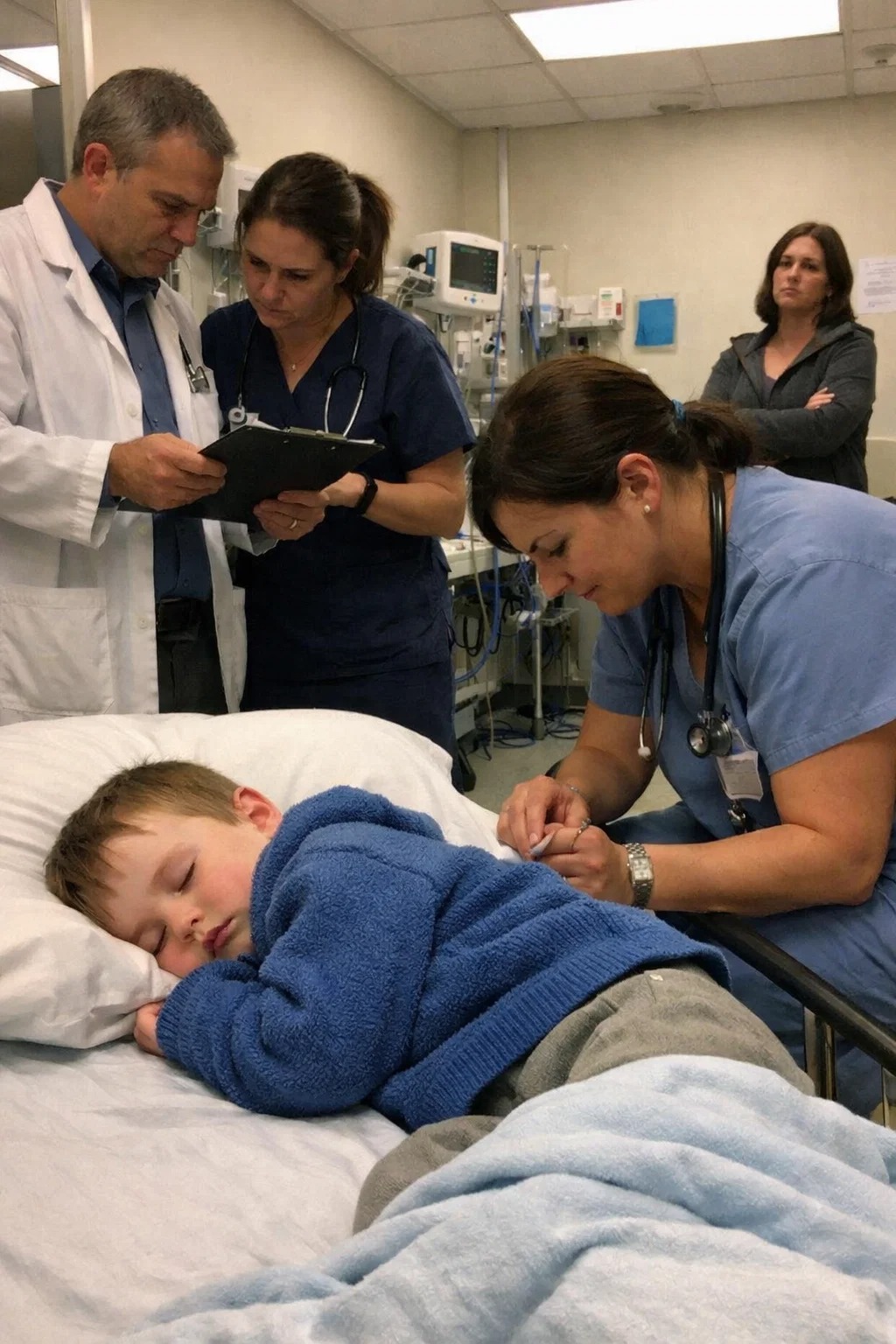
At the hospital, doctors moved quickly, their expressions tightening as tests returned results that didn’t align with the story they’d been given. A toxicologist frowned at the screen.
“These levels don’t come from a single dose,” she said quietly. “This is chronic.”
A pediatric nurse noticed the way Ethan flinched when hands came too close, the way his fingers curled instinctively around the sweater even while unconscious. She gently peeled it back and froze.
Beneath the thick fabric were bruises—not fresh, not dramatic, but layered. Old ones. Careful ones.
Not accidents.
A social worker was called.
Then another.
No one asked about forgiveness.
Ethan drifted somewhere far away.
He dreamed of floating, weightless, watching a small boy on a hospital bed surrounded by wires and strangers. The boy looked tired. Older than five. His sweater lay folded on a chair, suddenly just fabric, stripped of its power.
For the first time, the silence didn’t feel dangerous.
When he woke up, the lights were soft and the air smelled clean. A woman with kind eyes sat nearby, speaking gently.
“You’re safe,” she said. “You can rest now.”
His mother was not there.
She would not be for a long time.
Recovery was slow and uneven.
Ethan learned new words in therapy—autonomy, boundaries, grief. He learned that love should not hurt, that memory does not require punishment, that he was not responsible for keeping anyone alive.
The sweater was removed from his belongings.
His mother attended court-ordered counseling. His father—who had been there all along, silent and complicit—was forced to confront the cost of looking away.
Consequences arrived, not loudly, but permanently.
Years later, Ethan would grow taller, his voice steadier, his eyes clearer. He would sleep without pills. He would tell his story in fragments, then fully.
And when people asked about forgiveness—whether his mother deserved it—Ethan would pause, thoughtful but unburdened.
Then he would say:
“Forgiveness isn’t medicine for wounds that are still open.
And children aren’t responsible for curing adults’ grief.”
He would smile after that.
Not because everything was healed.
But because he had survived.
And survival, he had learned, was never something to apologize for.