“She Thought She Could Make My Little Girl Face The Wall Because I Was Deployed Overseas — Until I Walked Into The Classroom And Calmly Asked, ‘Who Decided She Didn’t Belong?’”
Chapter 1: Coming Home On Borrowed Strength
The smell of a military aircraft stays with you longer than the flight itself.
It clings to your clothes, your skin, even your thoughts.
After eighteen hours in the air, my body felt older than it should have. My knees ached. My eyes burned. My head throbbed from too much noise and not enough sleep. But I stayed awake for one reason only.
A photograph taped inside my helmet.
My daughter.
Five years old. Uneven pigtails. Missing front teeth. A smile that used to believe the world was gentle.
I didn’t tell anyone I was coming home early. Not my parents. Not my ex-wife. Not even Sophie. I wanted to surprise her. I wanted to see her run toward me, shouting “Daddy!” like she used to before deployment stretched time thin.
Straight from the airport, still in uniform, I went to her school.
Chapter 2: The Silence Before The Door
Oak Creek Elementary looked exactly the same as the day I left. Bright walls. Low windows. A flag hanging still in the morning air.
Inside, the hallway was quiet. Too quiet.
The secretary looked at my ID, then at my uniform, then at my face.
“She’s in Room 104,” she whispered, as if noise itself might break something.
“Thank you for your service.”
I nodded and walked on.
My boots echoed down the hallway. Each step sounded louder than it should have. Children’s artwork lined the walls — families holding hands, houses with chimneys, suns smiling too wide.
I stopped outside Room 104.
I didn’t open the door.
I looked through the window.
Chapter 3: The Corner No Child Should Know
At first, my mind refused to understand what I was seeing.
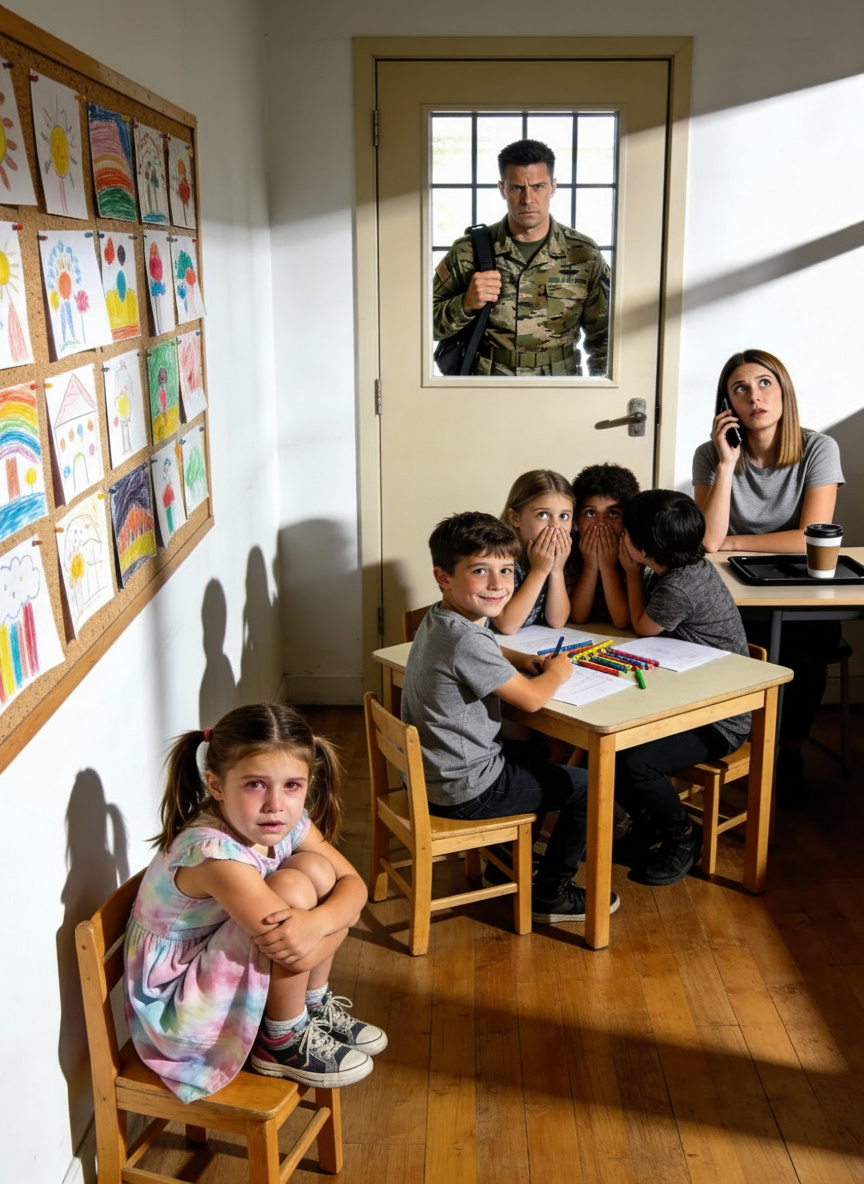
The classroom was full. Children sat together at tables, leaning close, sharing crayons, whispering, learning.
And then I saw the corner.
A small chair turned away from everyone else.
No desk.
No book.
No crayons.
On that chair sat my daughter.
Sophie was facing the wall.
Her back was straight. Too straight. Her hands were folded tightly in her lap. Her feet barely touched the floor. She wasn’t crying. She wasn’t moving. She wasn’t even fidgeting.
She looked like a child trying to disappear.
The teacher sat at her desk, coffee in hand, scrolling on her phone.
A boy glanced at Sophie and smirked. A girl whispered something and laughed.
Sophie didn’t react.
That was when I understood.
She wasn’t allowed to.
Chapter 4: The Door Opens
I opened the door.
The sound cut through the room like a blade.
Every child froze.
The teacher looked up sharply.
“Excuse me, you can’t just—”
Her voice faded when she saw me.
I didn’t look at her.
I walked past every desk, past every staring child, straight toward the corner.
Sophie sensed movement and stiffened.
“Hey,” I said softly. “Baby.”
She turned her head slowly.
Her eyes widened — not with joy, but with uncertainty.
“Daddy?” she whispered.
I knelt in front of her.
“Why are you sitting here?” I asked gently.
She looked past me, toward the teacher, then back down at her hands.
“I was told to face the wall,” she said.
“And not talk.”
Something inside my chest cracked.
Chapter 5: ‘Enough.’
I stood up slowly.
The teacher cleared her throat.
“Sir, I can explain—”
I didn’t raise my voice.
I didn’t shout.
I said one word.
“Enough.”
The room went silent in a way I had only heard once before — after a warning shot.
I turned to her.
“How long has she been sitting there?”
The teacher crossed her arms.
“She was disruptive this morning.”
“How long?” I repeated.
She hesitated.
“Since the first lesson.”
I looked at the clock.
Nearly noon.
I turned back to Sophie.
“Did you leave that chair at all?”
She shook her head.
“Did you get to play?”
“No.”
“Did you get to draw?”
“No.”
I took a breath so deep my chest hurt.
Chapter 6: The Lesson She Learned
“She needed to reflect,” the teacher said defensively.
“Children need consequences.”
I looked around the room.
“Consequences for what?”
“She wasn’t paying attention.”
A small voice came from one of the tables.
“She was drawing her dad.”
The teacher snapped, “That’s enough.”
“No,” I said quietly. “That’s exactly enough.”
I walked to Sophie’s chair, picked it up, and turned it back toward the class.
“Come here,” I said.
She stood slowly, like she wasn’t sure she was allowed to.
I put my hand on her shoulder.
“She doesn’t face walls,” I said.
“She faces forward.”
Chapter 7: Words That Don’t Wash Away
The teacher tried again.
“You can’t undermine classroom authority.”
I looked at her.
“You isolated a five-year-old because she missed her father.”
“She was emotional.”
“So was I,” I said. “When I left her.”
The room was so quiet I could hear the hum of the lights.
I knelt beside Sophie again.
“Did you think you were in trouble?” I asked.
She nodded.
“Did you think you were bad?”
Another nod.
That was when I stood up and faced the teacher fully.
“You taught her something today,” I said.
“You taught her that missing someone is wrong.
That being alone is a punishment.
That silence keeps her safe.”
My voice stayed calm.
“That lesson ends now.”
Chapter 8: The Office And The Excuses
The principal tried to smooth it over.
“She’s an experienced educator. Perhaps there was a misunderstanding.”
I didn’t argue.
I asked one question.
“If this were your child, would you make her face a wall for hours?”
He didn’t answer.
That told me everything.
Chapter 9: What Stayed Behind
That night, Sophie sat with her back to the couch.
Facing the room.
Facing me.
She drew pictures again.
Sometimes she still glances at corners.
When she does, I remind her gently:
“You don’t belong there.”
And she leans closer to me.