I am 40 years old, and I’ve spent almost half my life behind a grocery store register, which means I’ve become fluent in a quiet language made entirely of glances, hesitations, hurried breathing, shaking hands, and mothers counting coins twice, hoping the total will somehow shrink if they stare hard enough. I see who buys flowers and pretends they’re not lonely, who buys cake to celebrate something they will never tell us about, who swipes credit cards while silently praying it doesn’t decline, and who has trained themselves to smile as if everything is fine even when nothing is. By now, I can read despair as easily as barcodes.
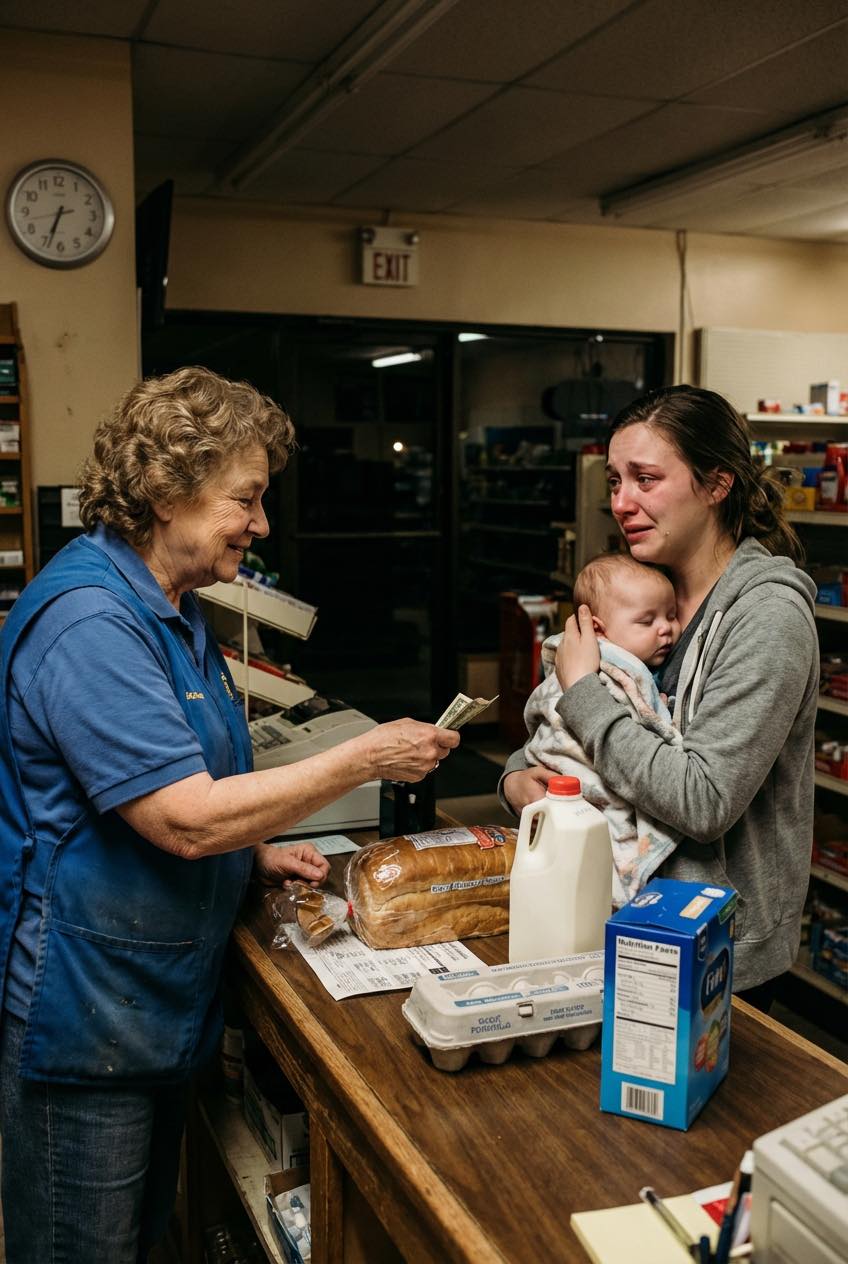
It was nearly 11 p.m., that strange hour when the store feels like it has exhaled and emptied its lungs; shelves hum tiredly; the fluorescent lights buzz like distant cicadas, and the last stragglers move through aisles as if they’re sleepwalking. I had already counted my drawer mentally, planned how I’d collapse onto my bed that night, and then she appeared. A woman carrying her baby in a worn carrier pressed close against her chest, the child’s head nestled beneath her chin, the kind of closeness you see when a mother is trying to shield her child from absolutely everything, including the reality she’s drowning in.
She didn’t have a full cart. Just essentials. Bread. Milk. Eggs. A few pieces of fruit. And the baby formula box that sat on top like both a promise and a weight. When I gave her the total, she searched through her wallet, then her coat, then her bag. Her fingers trembled more each second, like every failed dollar scraped away her dignity. Finally, she looked at me, her voice a cracked whisper.
“I’m short six dollars. Could you cancel the formula?”
There was no hesitation in my body. My hand was moving before my brain had time to disagree, sliding six crumpled bills from my pocket. “No,” I said, gently and without ceremony, “I’ve got it. Take everything. You and your baby go home. Feed your child.”
She stared at me—shocked, embarrassed, relieved, grateful, all at once. Her eyes filled so suddenly that it felt like I had broken something inside her, but in a good way, the way a too-tight knot loosens painfully at first. She mouthed thank you like she knew the words were too small. Then she pressed her cheek to her baby’s head, as if she were afraid joy might make her burst, and she left.
I didn’t think I’d ever see her again. That’s how these moments go. You live them, they lift you, and then they vanish into the machinery of daily life.
The next morning I clocked in, coffee half-finished, mind still thick with sleep, when the loudspeaker shattered everything calm.
“Megan, manager’s office. URGENT.”
Every cashier knows that announcement tone. It doesn’t sound like normal urgency. It sounds like trouble. My stomach tightened as my brain rifled violently through every shift memory. Did I forget to void something? Did I leave my register unlocked? Was corporate auditing us? Or worse… had someone complained about what I’d done?
I stepped into the office. My manager, Daniel, wasn’t his usual brisk, slightly sarcastic self. He looked strangely careful, like he was holding something fragile. He gestured for me to sit.
“Did you pay for someone’s groceries last night?” he asked.
My voice didn’t wobble. “Yes. Six dollars. She was short, and it was formula for her baby.”
He didn’t scold me. He didn’t lecture about policy. Instead, he exhaled, reached slowly into his drawer, and pulled out a sealed envelope. My name was written in neat handwriting, the kind that belonged to someone who grew up writing letters, not texts.
“This was left for you,” he said softly. “She came in early. Asked for you by name. Refused to leave until she knew we’d give it directly to you.”
A chill crawled up my spine in the most bizarre way. That envelope suddenly weighed far more than paper should.
Inside, there was a letter.
It smelled faintly like detergent and faintly like a home where a child slept in the next room and someone stayed up too late thinking. The handwriting was calm. Deliberate. Not rushed.
Megan,
You don’t know me. But I know you now.
Last night, you spent six dollars so my baby wouldn’t go to sleep hungry.
You probably think it was small.
It wasn’t.
Ten years ago, when I was sixteen, a cashier did the same for my mother. She didn’t know she was saving us from sleeping in a car that night. She didn’t know she was giving me enough strength to grow up believing people exist who don’t walk past pain.
I never forgot it. I built my whole life around it.
So today, I am not asking for help. I am returning it.
Please don’t refuse what’s inside.
It’s not charity.
It’s continuity.
My hands shook so badly I had to steady the paper against my knee. Inside the folded sheet was a cashier’s check.
$18,000.
I didn’t gasp quietly; I gasped in a way that echoed.
Daniel swallowed and nodded. “Yeah. I saw it too. And no, it’s not fake. I verified it. She came with paperwork. Proof. Verification. Everything. She knew we’d question it.”
I whispered, “Who is she?”
He hesitated. “That’s the part you might want to sit down for.” I was already sitting but somehow folded smaller. “She owns the construction company renovating the strip mall across the street. She built it herself from nothing after losing her husband in an accident. She’s known in the city, but she avoids the spotlight. Single mom. Fighter. Exactly the kind of person who would remember six-dollar kindness for ten years.”
That would’ve been enough. Truly. But fate wasn’t done yet.
Corporate got wind of it by noon. HR called. Then regional management. By afternoon, whispers slithered through employees: someone had donated a fortune, someone had done something suspicious, someone was under review. Suddenly a beautiful act of kindness floated in an office thick with legal words like “policy breach,” “favoritism,” “fraud screening.”
The kindness started to look like a liability.
And for the first time since last night, I shook—not from gratitude, but from dread.
What if I’d lose my job over six dollars?
Before fear finished gnawing through my ribs, the door opened again. Daniel motioned me inside with that same careful look, but this time I noticed something fiery under it, like conviction.
“There’s more,” he said.
Apparently, the woman hadn’t just donated money. She had spoken to corporate. She had told them exactly what their store meant when the lights were bright but people’s lives were dark. She’d talked about minimum-wage frontline workers who see heartbreak firsthand. She’d described kindness not as “policy risk” but as infrastructure that keeps communities from breaking completely.
And corporate, after legal checks and red stamp rituals, did something I didn’t expect from companies who usually care more about profit graphs than quiet decency.
They approved the gift.
Then matched it.
Not to me. That would’ve been too easy.
They created a permanent emergency grocery fund in my name.
A fund that would quietly step in whenever someone’s life fell apart at a checkout line—where dignity and hunger so often collide.
I cried—with my hands pressed to my face, with sound, with relief big enough to feel like grief releasing.
But the twist still wasn’t over.
That evening, while I was still hovering somewhere between gratitude and disbelief, the woman returned one last time. No cameras. No dramatic music. No social media. She wore tired jeans, her hair thrown back, baby asleep in the carrier again, but this time there was a steadiness in her posture that suggested she had carried storms and survived anyway.
“I didn’t come for thanks,” she said before I could speak. “But I came for honesty.”
She told me something nobody else knew. Something not in the check paperwork. Something that rewired everything I’d assumed.
Ten years ago, that cashier who helped her mother?
She never got to repay it.
Because three days after helping them, the woman was fired for “violating corporate policy.”
Her life spiraled.
No one came with an envelope for her.
There was silence where a miracle should have been.
“That,” she whispered, eyes burning—not with anger, but with grief shaped into resolve, “is why this had to be big. I wanted to finish her story. Through you. Through every person this fund helps. I wanted proof that kindness doesn’t need to die quietly just because the world often punishes it.”
My heart twisted in the strangest way—half for a stranger I will never meet, half for this woman who carried the memory like a torch she refused to let flicker out.
There are no words big enough for moments like that.
So I simply nodded and said, “We won’t waste what she started.”
She smiled the smallest, bravest smile. Then she left. Just like before. No applause. No spotlight. Just life moving forward.
That night, I went home. Placed six dollars on my kitchen table the way someone else might place a family photo. And I realized, as clearly as I ever understood anything, that it wasn’t money sitting there.
It was a chain.
A long, human, sometimes-battered chain of people doing something when they could have done nothing. It stretched backward into lives I’d never know and forward into lives I would never meet.
And suddenly, being “just a cashier” didn’t feel small at all. It felt like standing at a doorway where help can enter the world…and deciding to open it.
Lesson from the Story
Sometimes kindness feels like whispering into a hurricane, too small to matter against the chaos. But kindness doesn’t vanish. It doesn’t dissolve in the noise. It travels quietly through years and people, through grief and rebuilding, through single moms holding babies in the night, through cashiers paying six dollars they probably shouldn’t spare. The smallest act can echo so far that one day it returns holding proof that goodness is not foolish, not naive, not weak—it is continuous. And when we choose to participate in that continuity, we are not just helping one person; we are expanding the world in which help exists.