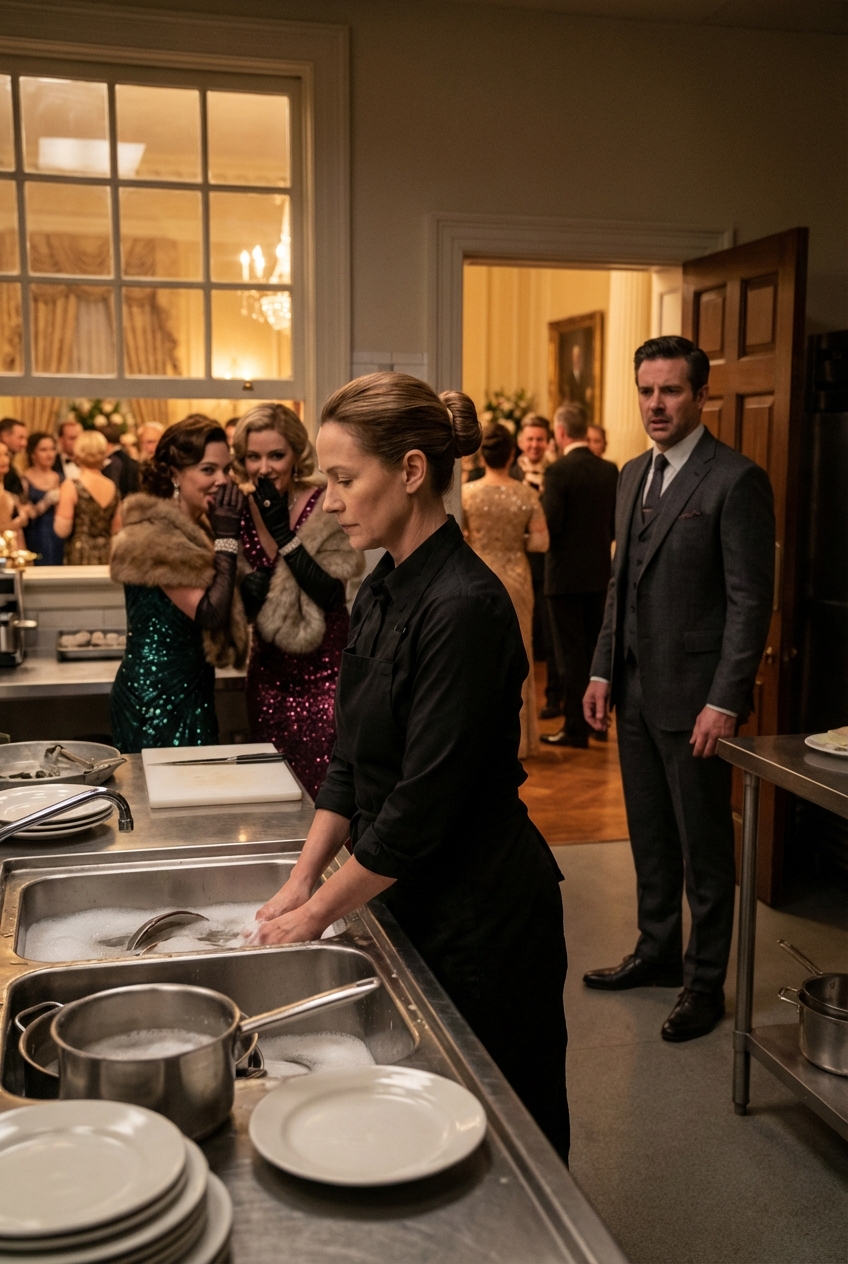
The water in the sink was too hot, but I didn’t lower the temperature. Maybe I wanted to feel it burn. Maybe it grounded me, reminded me that I was still here, still breathing, still capable of controlling something, even if it was just a faucet in the kitchen of a house everyone thought belonged to someone else.
Plates clattered against porcelain as I worked through a mountain of dishes I hadn’t dirtied, surrounded by conversations and laughter that seeped through the ceiling from the ballroom above. Expensive shoes clicked against marble floors, crystal glasses chimed, and forced laughter rippled through champagne-fueled arrogance. The guests upstairs were indulging in celebration — of wealth, of reputation, of self-importance — completely unaware that the woman standing in the kitchen with soap-stung hands and a tired heart was the very person whose name was on the deed.
My name is Emily Lawson Carter, and tonight I was invisible on purpose.
The Night That Was Supposed to Be Beautiful
If you saw headlines about my husband, Nathan Carter, you’d think of numbers first — market values, billion-dollar mergers, technological achievements. To the world he was the man who could tilt an industry with a single decision. To me, he was the man who insisted on making my tea himself every morning, even though we could afford a private chef from Paris if we wanted one. He was the man who talked to strangers kindly, tipped generously, and treated every doorman like they mattered.
This gala was his dream — a charity night dedicated to children battling chronic illness, an evening meant to raise millions while reminding powerful people why compassion mattered.
That was the plan.
But life has an ironic sense of humor.
Nathan was delayed — board negotiations, one of those high-stakes corporate situations where time becomes elastic and every minute bleeds importance. He texted to say he’d arrive late but that everything was under control.
Everything was not under control.
And I didn’t realize how badly until I tired of being the smiling, gracious host, always approached, always observed. So I slipped away. I changed into a catering uniform. I tied my hair into a bun. Just for curiosity.
Just to see.
Who were these people when they thought power wasn’t watching?
When Humanity is Measured Wrong
The transformation was instant.
No one looked into my eyes anymore. I ceased to exist as a person and became part of the background noise, a living tool meant to carry, hold, refill, obey.
People didn’t lower their voices near me — why would they? Staff existed beyond judgement.
Victoria Hayes — the kind of socialite whose reflection she valued more than her morality — was the first to strike.
“This champagne is practically lukewarm,” she sneered, thrusting the glass toward me without eye contact. “Are you new? Because it shows.”
“I’ll take care of it,” I murmured.
She wasn’t listening.
She was admiring herself in a decorative mirror.
Then came Margaret Ellington — organizer, reputation-chasing perfectionist, queen of passive cruelty wrapped in glitter.
“You,” she snapped, eyes assessing me like flawed merchandise. “Name?”
“Emily.”
“Well, Emily, slow service reflects poorly on the event. Try keeping up.”
From that moment forward, she watched me like a hawk studies prey.
And she enjoyed it.
When a server called out sick mid-event, she smiled the way only people in love with authority smile.
“Kitchen duty. Now.”
“I was assigned to ballroom service,” I answered calmly.
She stepped closer.
“You’ll do what I say.”
Several guests chuckled quietly nearby, entertained by the hierarchy.
So I walked into the kitchen.
Not because she controlled me.
Because the story wasn’t finished yet.
The Humiliation People Didn’t Know They Were Creating
The kitchen was chaos. Steam. Noise. Endless plates. A battlefield of porcelain and exhaustion. I rolled up my sleeves and scrubbed while laughter echoed above my head like thunder.
Victoria swanned in minutes later, her confidence now fueled by alcohol and entitlement.
“Well look at that,” she smirked, tilting her head at me. “You found your natural habitat. Soap suits you.”
Her voice dripped sugar-coated venom.
And in her laugh, in Margaret’s clipped commands, in the dismissive snaps and disrespectful orders of half the ballroom — I finally saw it clearly:
These were people who didn’t think cruelty defined them.
They thought superiority excused it.
They didn’t see humans.
They saw hierarchy.
They saw categories of value.
They saw worth determined by income.
Until they didn’t.
Until the kitchen door opened.
Until the laughter died.
Until a calm, controlled voice asked the question that shattered that room.
“Has anyone seen my wife?”
The Instant Everything Changed
Silence spread like a shockwave.
Conversation faltered.
Margaret stiffened.
Victoria froze, glass mid-air.
I didn’t need to turn.
I knew that voice.
Nathan Carter stepped into the kitchen — tired, composed, still in the tailored charcoal suit that made corporate executives nervous. His gaze scanned the room.
Then it found me.
Confusion.
Concern.
Love.
Then something colder.
Rage — quiet rage — the kind that doesn’t explode, but burns slow and dangerous.
He came toward me immediately, not caring who watched.
“Emily… what happened?”
Before I could answer, Margaret cleared her throat, trying desperately to regain control of a situation that had slipped violently through her fingers.
“Mr. Carter, sir — she never informed us she—”
“That,” Nathan cut sharply, “is exactly the issue.”
Eyes turned to me.
Now they saw.
Now they noticed.
Now the “maid” mattered.
Faces Drained Faster Than the Champagne Glasses
Nathan’s voice wasn’t loud.
It didn’t need to be.
“Let me understand,” he said calmly, deadly, “you had my wife washing dishes in her own home?”
Victoria’s jaw slackened.
Margaret swallowed.
“Sir,” Margaret began, tone wobbling, “we had no idea — she was disguised — you must understand—”
“What I understand,” Nathan said, “is that how you treat someone when you believe they hold no power is the clearest reflection of who you are.”
A guest tried to slip away.
Another pretended to talk on their phone.
Victoria tried to shrink behind a column.
She didn’t make it far.
“Victoria Hayes,” Nathan called without even turning his head. “Your husband has a pending negotiation with my company, doesn’t he?”
Her face went white.
“Yes…”
“Tell him it’s over. I don’t do business with people who degrade human dignity.”
A stunned gasp rippled through the room.
Margaret attempted one last stand.
“I was simply trying to maintain high standards—”
“High standards?” Nathan repeated slowly, “or high cruelty?”
The room was now silent enough to hear a heartbeat.
Mine.
Theirs.
Everyone’s.
The Twist No One Expected
I stepped forward.
Not as the billionaire’s wife.
Not as the owner of the mansion.
Just as a woman tired of watching the world confuse status with worth.
“If I had revealed who I was,” I said softly, “your tone would have changed instantly. But that doesn’t mean your hearts would have.”
Several people lowered their eyes.
Nathan wasn’t finished.
“This house isn’t impressive because it’s big,” he continued. “It’s meaningful because it’s supposed to represent compassion, not ego. Tonight’s event was meant to support children who face struggles beyond imagination. If you can’t treat staff — working human beings — with humanity, then what exactly do you think charity means?”
No one spoke.
And that silence was louder than any applause.
The Night Reshaped the City
Word didn’t just spread.
It erupted.
Businesses quietly withdrew partnerships from individuals known for treating workers poorly.
Margaret lost her iron grip on the charity world. No public scandal. Just powerful silence — people stopped calling.
Victoria disappeared from high-society events almost overnight, replaced not by someone richer, but by someone kinder.
But what mattered most were the letters.
Emails.
Messages.
From waiters.
From janitors.
From hotel staff.
From drivers.
From people who lived years swallowing humiliation to keep their jobs.
“Thank you for reminding them we matter too.”
“Thank you for speaking when we can’t.”
“Thank you for making dignity trend again.”
I read every single one.
I cried through most of them.
What My Husband Said After Everyone Left
Hours after the guests were gone, after lights dimmed and music died, the mansion finally breathed.
Nathan pulled me close on the balcony overlooking the city we had helped reshape.
“I wish you’d told me what you were planning,” he whispered.
“I didn’t know,” I admitted. “I just wanted to see something clearly. And now I have.”
He smiled softly.
“Then I’m glad you did. Because tonight wasn’t just a charity event anymore. It was a moral audit.”
And he was right.
Not every wealthy person is cruel.
But some forget they are human.
Tonight reminded them.
THE LESSON — WHAT THIS STORY SHOULD TEACH US ALL
Respect doesn’t belong to wealth.
It doesn’t belong to titles.
It doesn’t belong to influence.
Respect belongs to everyone.
Because dignity is not earned through status.
It is earned through being human.
And if the only time you’re kind is when someone can reward or punish you…
…then kindness was never kindness.
It was strategy.
So here’s the truth that still echoes through our halls:
“The real measure of character isn’t how you treat people above you…
It’s how you treat the ones you think are below you.”
And maybe the next time you hand your plate to a server…
You’ll look them in the eye.
And thank them.
Because respect shouldn’t depend on a uniform.
It should depend on your heart.