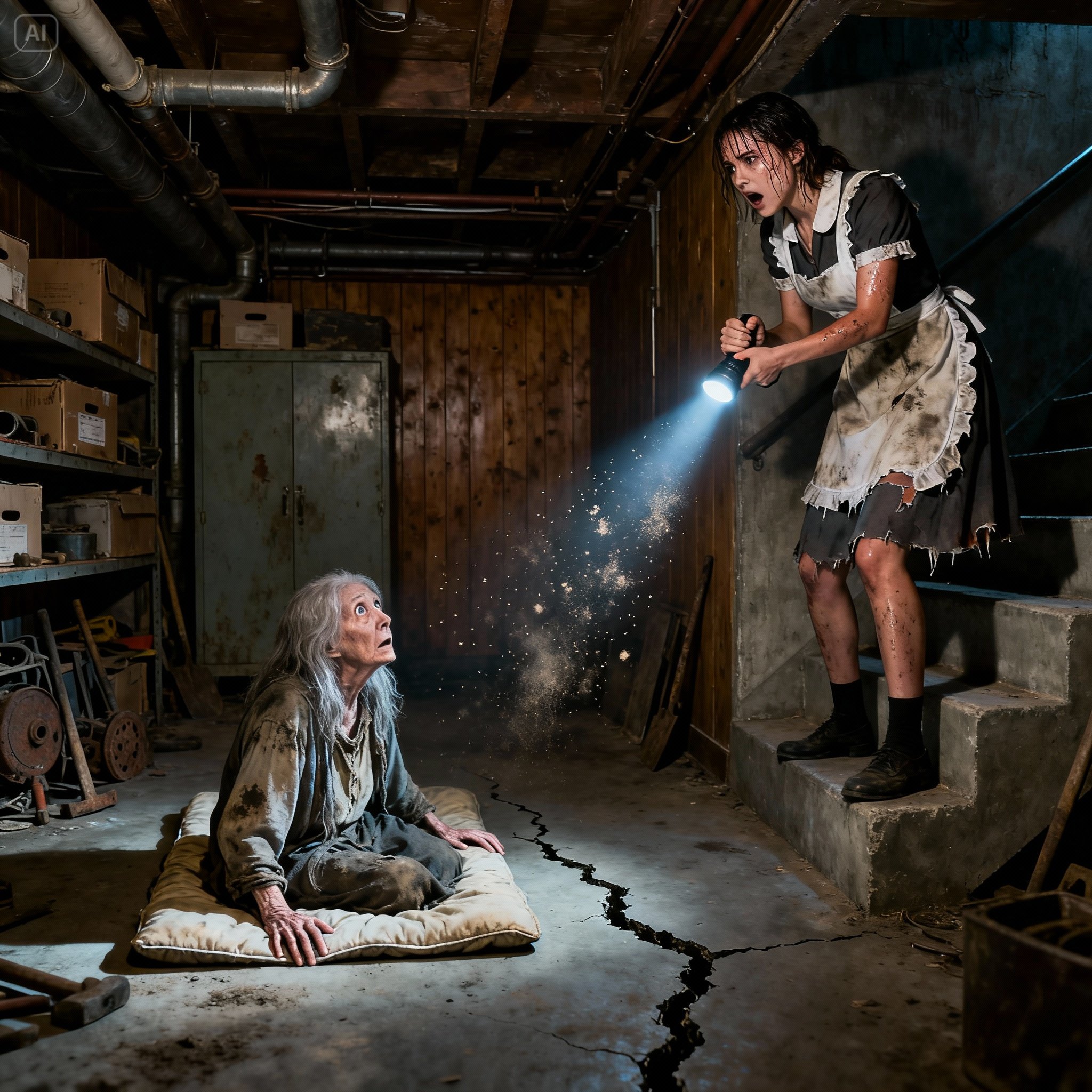
They called her the lady of the house, but Veronica was really a warden. Her prison was a palace, her captive the very mother of the man she called her husband. In this gilded cage, Clara arrived, seeking honest work. She expected drudgery, not a mystery. The mansion’s perfection was obsessive, a clear sign of something deeply unstable. Veronica’s beauty was a cold façade, her elegance a weapon used to enforce a terrible order.
The conflict between the two women was a quiet war from the start. Clara’s gentle diligence was a silent rebuke to Veronica’s manufactured perfection. The basement was the battlefield. Veronica guarded it with a zeal that went beyond mere privacy; it was the panic of someone guarding her greatest sin. Every whimper Clara heard through the floor, every suspicious order, every threat, only cemented her resolve. She realized she wasn’t just cleaning rooms; she was peeling back layers of a horrific deception.
The emotional core of the story lies in the two relationships Veronica sought to destroy. The bond between mother and son, severed by lies, and the basic human dignity of Doña Leonor, stripped away by captivity. Clara, an outsider, became the bridge to restore both. Her courage was not fearless, but it was selfless. When she was fired and disgraced, she fought not for her job, but for the woman in the dark who had no one else. The note she delivered was a lifeline thrown across a chasm of deceit.
Ricardo’s journey from oblivious heir to heartbroken son to righteous protector forms the story’s backbone. His trust was his vulnerability, exploited by the person closest to him. The moment of revelation in the basement was his personal earthquake. Everything he believed rearranged itself around the fragile figure of his mother. Facing Veronica, his anger was underscored by a profound betrayal. His decision to choose truth, even at the cost of his public image and marriage, was his redemption.
The story ends not with vengeance, but with restoration. Veronica faced legal justice, but the true justice was the healing of the family she tried to break. The mansion, once a monument to falsehood, was reclaimed by authenticity. Doña Leonor’s freedom was the ultimate victory. Clara’s role reminds us that heroes are not defined by their status, but by their actions in the face of hidden wrongs. Sometimes, saving a family requires the clear eyes and steady hands of someone who has nothing to lose but her own conscience.