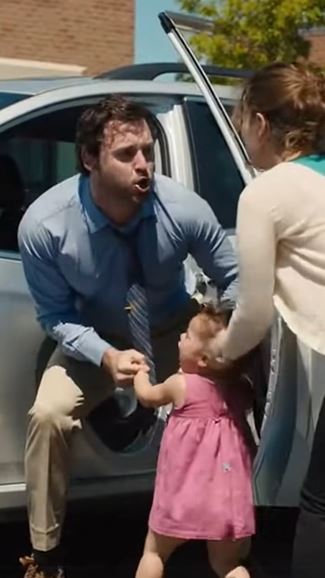
Life after loss is a quiet, gray landscape. You go through the motions, marking time with rituals of pain. I was an expert in this hollow existence. The last place I expected a revelation was a suburban parking lot, amid the clatter of shopping carts. Yet, it was there I saw her: a toddler with my dead daughter’s face, being dragged by a desperate man. While others averted their eyes, I could not. My inaction three years ago was a ghost that haunted me; this time, I would act. Little did I know I wasn’t just stepping into a conflict; I was stumbling into a hidden war.
The man’s rage was a mask for sheer terror. His car was a clue—a child’s prison, not a home. But it was the little girl’s silent plea, her familiar eyes meeting mine, that held me fast. When the birthmark revealed itself—that small, heart-shaped flaw I knew as intimately as my own—the ground fell away. This wasn’t a resemblance; it was a duplication. The emotional tsunami of finding her crashed instantly against the rocks of reality: this child was too young. She was a perfect, impossible copy, and her existence pointed to a truth more frightening than any random kidnapping.
Pursuing the truth meant becoming a detective driven by grief. The evidence—a receipt for disguises and sedatives—led to Mark Solano, a man who knew the monstrous origin of the girl he was trying to save. He wasn’t a monster, but a conscience-stricken scientist caught in his own nightmare. In a chilling confession under a flickering streetlight, he laid it bare: my daughter’s DNA, taken during a routine blood test, had been used as a blueprint. This child was a cloned replica, grown too fast and now slated for destruction because she remembered the love of a mother she’d never known.
His sacrifice bought our escape, but the fight had just scaled a terrifying peak. The text messages were clear: there was a Subject 8. My home was gone, my identity was being painted as that of a kidnapper. The system I might have turned to for help was now a weapon against me. Sitting in a dingy motel, watching this brave little girl sleep, my purpose transformed. This was no longer a rescue mission for one child. It was a crusade. They had not just copied my daughter’s cells; they had inadvertently copied my love for her, and that love was now a formidable, focused weapon.
Driving an old, rattling Buick toward the heart of the darkness, I felt a clarity I hadn’t known in years. The numbness was gone, burned away by righteous fury. The girl in the passenger seat, humming our song, was proof that connection transcends even science. The corporation saw her as faulty inventory. I saw her as my daughter, in every way that mattered. They believed they were dealing with a broken woman. They were wrong. They were dealing with a mother who had been to the depths of hell and had returned with a single, unwavering goal: to find every last one of her daughters and burn their cruel laboratory to the ground. The road ahead was dangerous, but for the first time since I lost Maya, I was truly alive, and I was coming for them.