For most of my life, I thought I understood my older brother, Keane. He was autistic and nonverbal, and our relationship was built in a quiet world of routines and unspoken understandings. I learned to interpret the subtle language of his movements—the way he lined up his pencils, the quiet hums he made, the distant smile he’d offer the whirring blades of a ceiling fan. After our parents passed, he came to live with my husband, Will, and me, just before our son, Owen, was born. Keane folded into our household with his familiar, silent order, a gentle presence in the corner of our bustling lives. I loved him fiercely, but I had long accepted that our connection would exist mostly in the spaces between words.
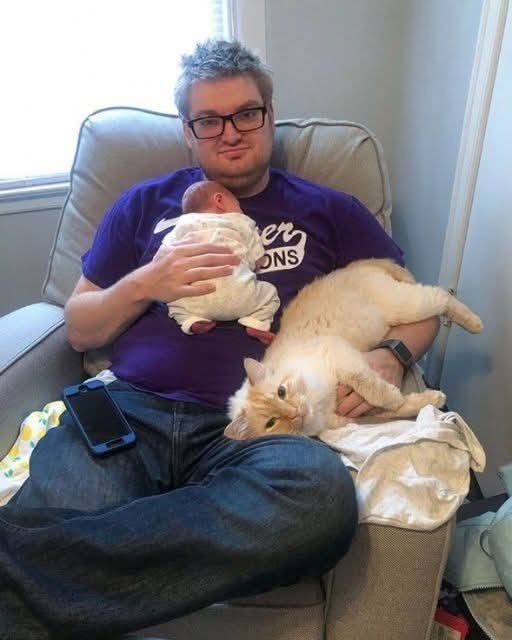
That assumption was shattered on an ordinary Tuesday. I was exhausted, a new mother hanging by a thread, and had stolen a desperate few minutes for a shower. Suddenly, Owen’s piercing cry cut through the water’s noise. I rushed out, panic-stricken, only to stop dead in the hallway. There, in my own armchair, sat Keane, holding Owen. He was cradling my son with a natural, tender precision I didn’t know he possessed, one hand rubbing Owen’s back in slow, perfect circles. Owen was peacefully asleep, a picture of contentment. Then Keane looked toward me and, in a voice so soft it was almost air, spoke. “He likes the humming,” he said. Those four words, his first direct sentence to me in years, felt like the world tilting on its axis.
In that instant, a door opened. The brother I thought I knew began to step through it. I learned that the low, constant hum he’d made for years was the same tune as a lullaby app on his tablet. Owen found it soothing. With cautious joy, I began to include Keane more in Owen’s care. He started helping with feedings, then diaper changes, organizing supplies with his meticulous care. He began to offer small, precious observations about our world. “The red bottle leaks,” he’d say, or “Owen likes pears better than apples.” Each sentence was a gift, and each one made me realize how much I had underestimated the vast, quiet continent of his inner life.
This beautiful awakening also brought a sharp pang of guilt. The more present Keane became, the more I saw how my own perception had confined him. I had loved the silent brother, but I had not fully believed he could be anything else. I had accepted a narrative of limitation, and in doing so, I had failed to invite him more fully into our world. That guilt crystallized one night when a small accident—Owen bumping the crib rail during a hand-off—sent Keane into a spiral of anxiety, convinced he had “ruined” everything. Holding him as he cried silent, shuddering sobs, I understood my real role wasn’t to manage him, but to see him. To reassure him that mistakes are human, and that he, in all his complexity, belonged.
Today, the silence in our home is different. It’s no longer a barrier, but a comfortable space between conversations. Keane volunteers at a local play center, sharing his unique calm with other children. Owen’s first word was “Keen,” a name uttered with pure adoration. The brother I once saw through a lens of gentle responsibility is now one of my closest friends and my son’s favorite person. Our story isn’t about a magical cure for autism; it’s about the transformative power of being seen. Sometimes, love isn’t about speaking. It’s about finally learning how to listen, and in that listening, discovering a person was there all along.