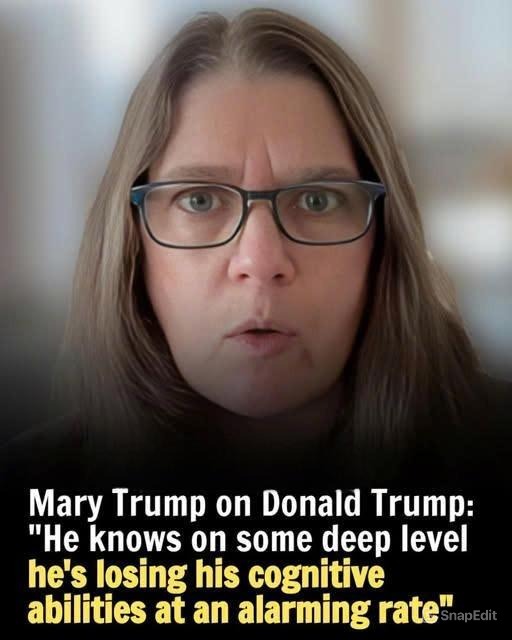
Mary Trump’s recent assessment of her uncle was clinically blunt: Donald Trump is, in her view, “losing his cognitive abilities at an alarming rate.” As a psychologist and an insider to the Trump family dynamics, her statement is a strategic intervention that recalibrates the entire debate over the former president’s fitness for office. This isn’t merely another critique from the opposition; it’s a kinship critique, carrying a unique psychological and political weight that could alter the electoral landscape.
Professionally, Mary Trump leverages her clinical credentials to frame observations the public has made for years—rambling speeches, tangents, and memory lapses—into a structured, alarming diagnosis. By doing so, she medicalizes the political critique. Opponents no longer just disagree with him; they can now point to a family expert who suggests he is deteriorating. This changes the attack from “he is wrong” to “he is incapable,” a far more fundamental challenge that strikes at the core of a leadership brand built on perceived strength and stamina.
Her timing is analytically precise. By explicitly connecting his cognitive state to his “terrible poll numbers” and “unpopular policies,” she creates a causal narrative for his political vulnerabilities. This provides a unifying theory for his setbacks: they are not just political missteps, but potential symptoms. For wavering Republicans or independents concerned about chaos, this offers a powerful, succinct explanation. It also boxes in Trump’s defenders, forcing them to argue not just against policies, but against a family member’s concerning health evaluation.
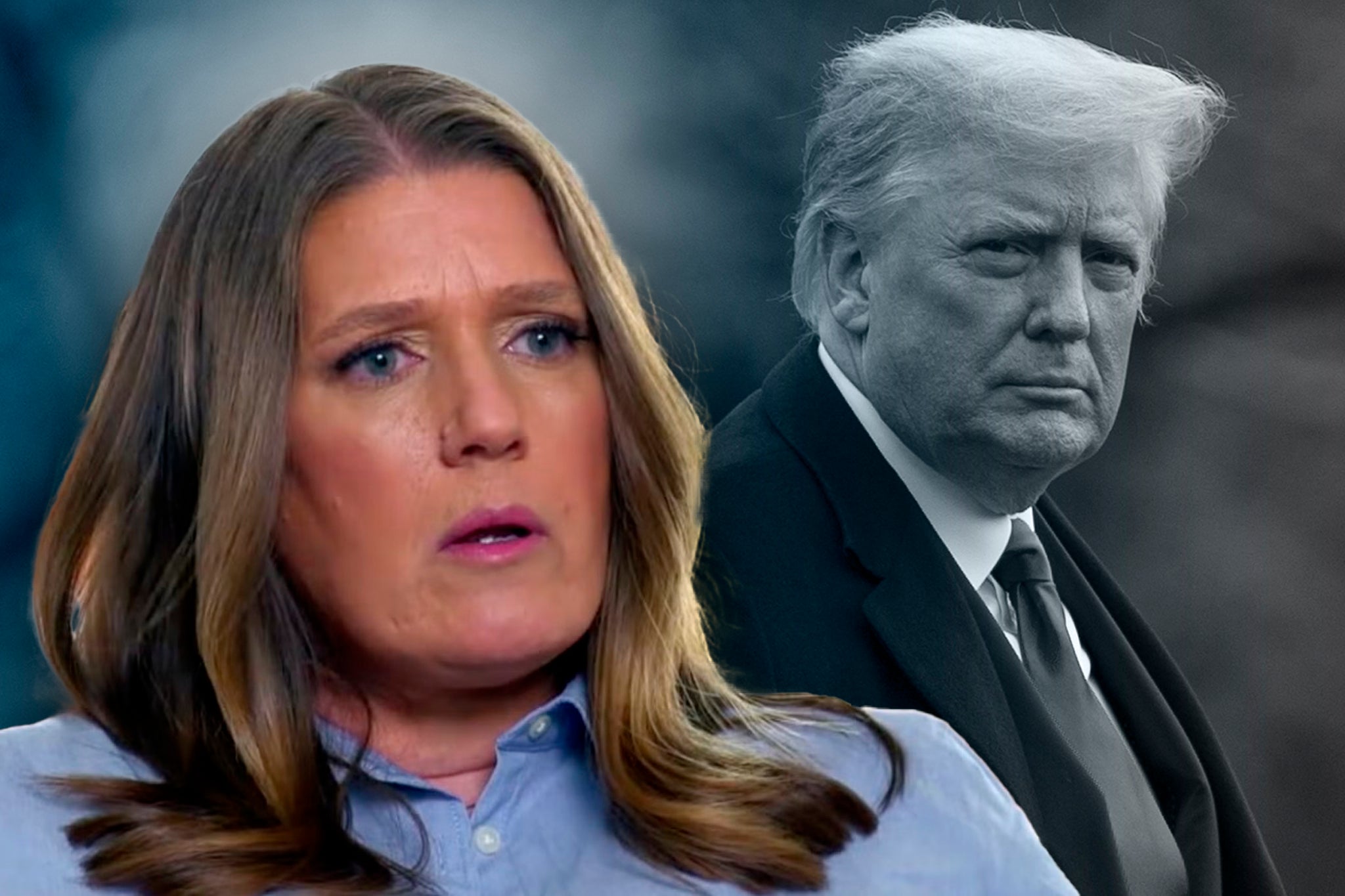
The family history here is not just background noise; it is central to the potency of the claim. The Trumps’ well-documented internal strife, particularly the bitter disputes over Fred Trump’s estate, provides Mary Trump with a motive in the eyes of his supporters. However, for neutral observers, it also provides her with a decades-long baseline for comparison. She isn’t judging a public persona; she’s comparing the private man she knew to the one she sees now. This insider perspective makes the allegation uniquely difficult to fully neutralize with standard political counter-spin.
Media and voter reception will parse this along predictable partisan lines, but with a new intensity. For anti-Trump media, it is a validating, high-credibility source to amplify. For pro-Trump outlets, it is the ultimate act of familial betrayal, to be dismissed and attacked. The key battlefield, however, is with low-information and moderate voters. For them, a niece—a family member—voicing such a dire warning cuts through the clutter of political ads and may cement a perception of instability that is hard to reverse.
Strategically, this places the Trump campaign and the GOP in a bind. Do they ignore it, potentially letting the narrative fester? Or do they engage, thereby elevating it? Any response must navigate the sensitive optics of attacking a family member discussing health. Looking forward, Mary Trump has injected a volatile, personal element into the campaign. She has ensured that questions of mental acuity will be asked with renewed force, potentially in debate formats or interviews, with her words hanging in the air. The “kinship critique” has moved from the realm of tabloids to the center of political risk assessment, creating a vulnerability that is profoundly personal and therefore uniquely challenging to manage.