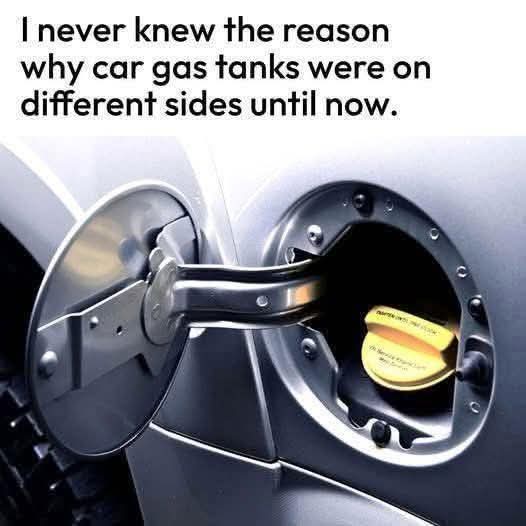
Have you ever pulled up to a gas pump and realized your car’s fuel door is on the opposite side? It’s a common moment of minor frustration that makes you wonder why car designers would choose such an inconvenient spot. The truth is, it’s rarely about inconvenience at all. The placement of your fuel door is the result of a careful balancing act performed by engineers long before your car ever hit the showroom floor. It’s a decision rooted in practicality, not randomness.
At its core, the location is dictated by what’s happening underneath your car. Engineers have to fit a fuel tank, lines, and a filler neck around a maze of other components: the exhaust system, the rear axle, the suspension, and the spare tire well. They choose the path of least resistance. If the left side is packed with hardware, the fuel system gets routed to the right. It’s a simple matter of spatial efficiency. Changing this late in the design process would be like trying to move a bathroom in a finished house—possible, but enormously complicated and costly.
Consumer habits and regional driving patterns also play a surprising role. In the United States, where drivers sit on the left, most fuel doors are also on the left. This lets you stay closer to your car and away from traffic lanes when pumping gas. In the UK and Japan, where drivers sit on the right, the fuel door is typically on the right for the same reason. It’s a thoughtful nod to convenience and safety, aligning the refueling process with the flow of local traffic.
You might have heard that safety is a factor, with some believing a passenger-side fuel door is safer in a crash. Studies have largely debunked this, showing no significant safety difference between sides. However, an unexpected benefit of having cars with tanks on different sides is gas station efficiency. If every car had a left-side tank, the lines for left-side pumps would be endless. The mix of left and right tanks helps balance the flow at busy stations, cutting down wait times for everyone.
So, next time you pull up on the “wrong” side, remember there’s a logic to it. And if you can’t remember which side your tank is on, just glance at your dashboard. Nearly every car has a tiny arrow next to the fuel gauge, pointing you in the right direction. As for the future, electric vehicles are shifting the conversation from fuel doors to charging port placement, but the same principles of engineering, convenience, and smart design will continue to guide where we “fill up.”