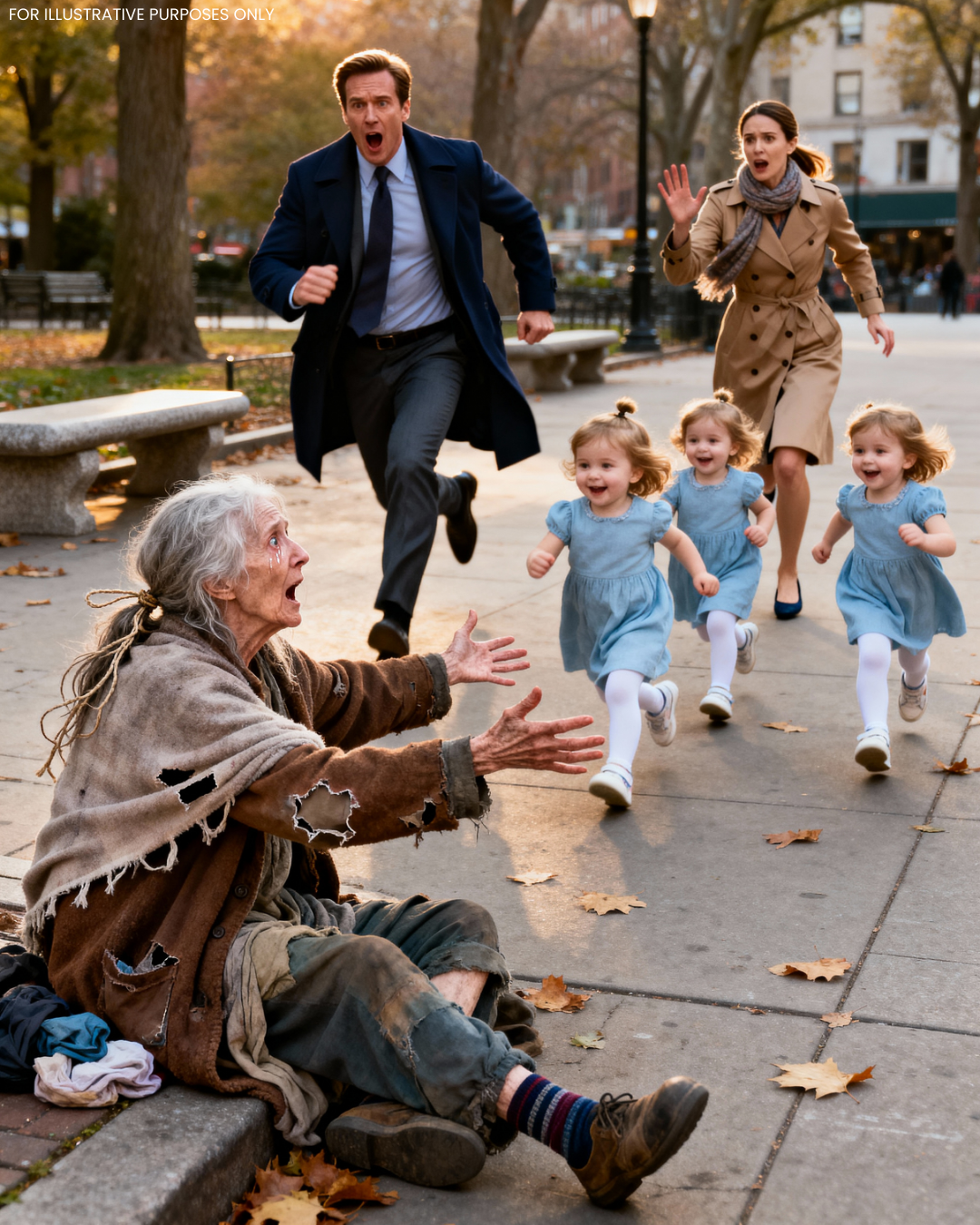
San Belluno’s afternoon sun warmed the ancient stones, but a chill seized Matteo Alvarez as he watched his daughters run. It was the grace that horrified him—the sure-footed dance around the violin case, the sidestep to avoid the pigeon-chasing boy. His triplets, blind for all six years of their life, moved through the crowded plaza like they could see.
Their target was an old woman by the fountain, her clothes worn, her silver hair catching the light. They fell into her embrace as if returning home. “Grandma,” they breathed, the word a key turning in a lock Matteo never knew existed.
When he reached them, his voice was steel. “Step away from my children.” The woman, Lucinda, looked up with eyes full of an old, familiar sorrow. “They found me,” she said. “I did not call them.”
Then his daughter turned. Her gaze, sharp and focused, pinned him. “Papa,” she asked, “why did you never tell us she existed?” In that moment, the meticulously ordered world of the wealthy industrialist—a world of doctors’ reports and special tutors—shattered.
That night, in the silence of his mansion, the girls chattered about the blue sky and the red shawl. They were recalling, not imagining. A terrible suspicion, dark and formless, began to take shape in Matteo’s mind.
The meeting with Lucinda the next day confirmed one truth and unveiled a darker one. She was the mother of his beloved Isadora, stolen away by deception years ago. The photographs she produced were incontrovertible. But she spoke of another woman, one who had swooped in as a guide, who had controlled access, who had managed the grief after Isadora’s death. The trusted guardian. The indispensable friend.
The pieces clicked with sickening finality. The excessive therapies. The isolation. The girls’ learned helplessness. It wasn’t blindness. It was a brilliantly cruel construct.
The confrontation in his study was quiet, devoid of drama. The caregiver offered no defense, only a cold rationale. “You were drowning,” she stated. “I gave you a story you could handle. Three blind daughters are a tragedy to manage. Three sighted, spirited girls you’d have lost to the world. I made you all need me. It kept your family intact.”
The investigation was a forensic unraveling of a fiction. The specialists’ new verdict was simple: the girls had always had sight. What they lacked was permission to use it.
Healing was the slow art of unlearning fear. Lucinda, with her patient eyes and soap that smelled of Isadora, became the anchor. The girls learned to trust not just their vision, but their own instincts, which had been the first thing stolen from them.
Matteo transformed his fury into a sanctuary for the betrayed—a center where light was literal and metaphorical. Years later, his daughter stood before a gathered crowd at its opening, no longer a victim but a witness. “Someone taught us the world was dark,” she said, her voice clear. “Then our grandmother taught us how to turn on the light.”
For Matteo, the clarity finally came. The most dangerous blindness is not of the eyes, but of the mind, willingly accepting a comforting lie over a devastating truth. And the most profound vision is the courage to see what has been hidden in plain sight all along.