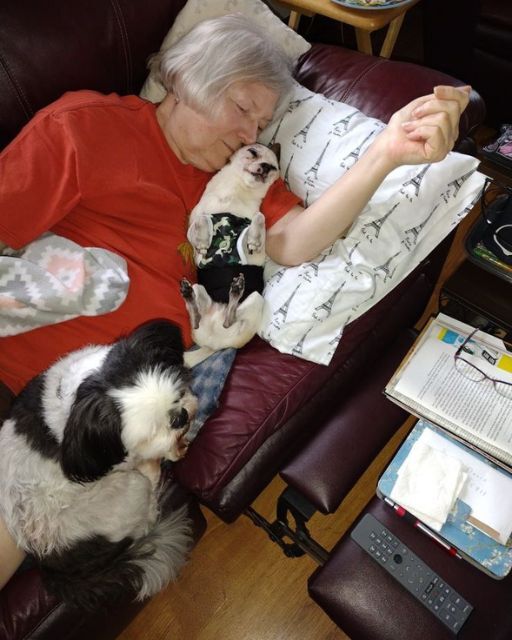
We all have our daily rituals, those small anchors that keep us tethered to normalcy. For my grandmother, hers came every day at four o’clock sharp: settling into her well-worn recliner with a sigh that seemed to sync with the house itself. Her two dogs, Max and Coco, were part of this ceremony, a living blanket of loyalty at her feet and on her chest. She used to say they loved the rhythm of her breathing. I never questioned it until the day that rhythm nearly stopped forever. The silence I walked into that afternoon was different—a thick, heavy quiet that made my skin prickle. The usual hum of life was gone, replaced by a stillness that felt all wrong.
Coco, her tiny Chihuahua, was pressed firmly against her neck as if holding her in place. My grandmother sat with her eyes closed, a faint smile on her lips, but she didn’t answer when I called her name. Up close, her skin was too warm, her breathing a shallow whisper. That’s when I saw it: the empty pill bottle beside her reading glasses. The floor seemed to tilt beneath me. Panic is a cold, efficient engine. I called for help, my voice trembling as I relayed the address. Max, the Shih Tzu, began to whimper and scratch at the door, a frantic echo of the terror tightening in my own chest.
The paramedics moved with a calm, swift urgency, gently lifting Coco away to reach my grandmother. The little dog, usually so timid, gave a low, protective growl, then strained toward her as they carried her out, as if her love alone could anchor my grandmother to this world. The hours that followed in the sterile hospital light were a brutal audit of everything I’d missed. The quiet she’d worn lately wasn’t peace; it was the heavy cloak of grief after losing my grandfather, a sorrow so deep it had nearly swallowed her whole.
When the doctor said she was stable, relief was a physical wave. But his next words held a different weight: she needed more than physical healing. She needed connection, honesty, support. Seeing her the next morning, small in the hospital bed, broke my heart anew. But when Coco was placed beside her, her eyes softened. She apologized for being a burden, and I cried—not just from fear, but from the realization of her profound loneliness. We talked then, truly talked. Not with solutions or arguments, but with listening ears and shared tears. We spoke of the void loss leaves, and how strong people can feel invisible.
Healing didn’t arrive in a dramatic flash. It came in the small stitches of daily life: scheduling therapy, taking slow walks with the dogs, weaving little threads of purpose back into her days. It came through laughter over silly things and the unwavering, silent devotion of two small creatures who had never judged her, only loved her. Weeks later, watching a sunset, she squeezed my hand. She said the dogs saved her twice—once by refusing to leave her side, and again by reminding her that love doesn’t always shout. Sometimes, it’s a quiet, stubborn presence that refuses to let go, teaching us that the most powerful plea for help can be a silent one, answered by a heart that simply won’t walk away.