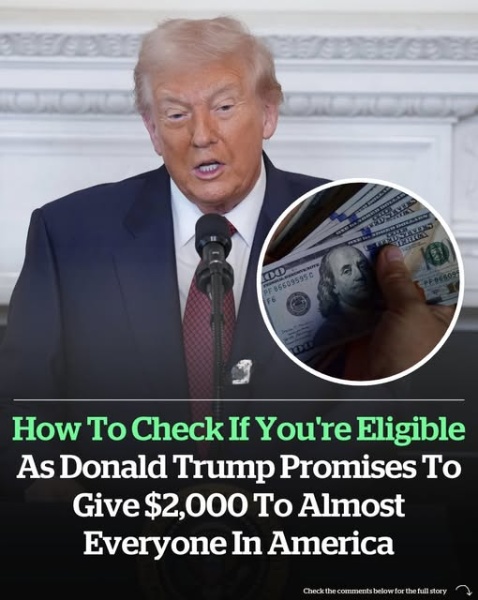
Former President Donald Trump has made a bold new pledge, capturing public attention with the promise of direct cash payments to most Americans. Through his Truth Social platform, he announced a plan to fund a “dividend” of at least $2,000 per person, explicitly excluding high-income individuals, by using the revenue generated from his proposed tariffs. This move places his aggressive trade policy at the very center of his economic agenda, framing it as a direct benefit to the everyday citizen. However, a closer examination reveals that this ambitious proposal is currently lacking in critical details, leaving many to wonder about its feasibility.
The concept itself is not entirely new for Trump. Earlier in the year, he floated similar ideas of “tariff rebate checks” or “American dividend payments,” though these initial suggestions failed to gain significant traction. Now, with tariff collections becoming a more prominent feature of the economic discussion and their legal standing under increased scrutiny, he has revived and amplified the proposal, making it a cornerstone of his populist economic message. The core argument is straightforward: tariffs on foreign goods will bring trillions of dollars into U.S. coffers, which can then be used to stimulate domestic investment and reward Americans directly.
Trump’s online statements have been filled with strong rhetoric in support of this plan. He has called opponents of tariffs “idiots” and credited them for a strong economy, record stock markets, and zero inflation. He has portrayed these trade measures as a near-miraculous tool that will not only fund the dividend payments but also allow the nation to pay down its enormous national debt. His message blends economic nationalism with a promise of financial fairness, suggesting that other countries have taken advantage of the U.S. for decades and that his tariffs are a necessary corrective action.
Despite the appealing promise, economists and analysts are raising serious questions about the math behind the proposal. Initial estimates suggest the cost of providing a $2,000 payout would be astronomical, ranging from $300 billion to over $500 billion depending on eligibility. This sum would represent a significant percentage of the nation’s GDP. Current tariff revenues, even with projected increases, fall dramatically short of this figure. Experts point out that funding such a large program solely through tariff income is mathematically implausible, as the revenue collected would be a fraction of what is needed.
Compounding the financial challenges are significant legal hurdles. The authority Trump has used to impose many of these tariffs is currently being challenged in court, with several lower courts already ruling that it constitutes an overreach of presidential power. The U.S. Supreme Court has now taken up the case, and a ruling against the administration could dismantle the entire financial foundation of the proposed dividend plan. Without these specific tariffs, the promised payments would have no dedicated funding source. For now, the $2,000 dividend remains a powerful political soundbite, but its path to becoming reality is filled with economic and legal obstacles.