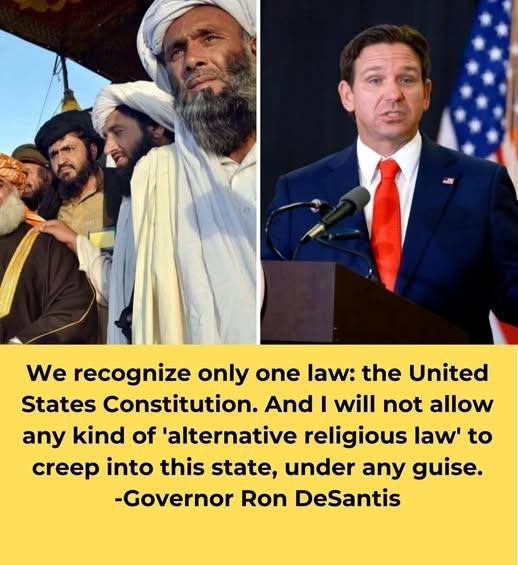
Governor Ron DeSantis of Florida has drawn a definitive line regarding the legal framework governing the state, publicly reaffirming the absolute supremacy of the United States Constitution. In a clear and unambiguous statement, the Governor declared that no alternative religious legal system, specifically naming Sharia law, would be permitted to influence or supplant constitutional law within Florida’s jurisdiction. “We recognize only one law: the United States Constitution,” DeSantis stated, framing his position as a defense of foundational American principles. This stance places Florida firmly within a long-standing national commitment to a secular legal system, where governance derives from a constitutionally-established legislative process, not from religious doctrine.

The Governor’s position addresses recurring concerns among some Americans about the potential encroachment of religious-based legal codes into the nation’s courtrooms. His statement serves as both a political reassurance to his base and a philosophical assertion about the nature of American law. It underscores the principle of the separation of church and state enshrined in the First Amendment, which guarantees religious freedom while prohibiting the establishment of any state religion. DeSantis argues that allowing religious laws to hold legal sway would undermine the secular, uniform application of justice that the Constitution guarantees to all citizens, regardless of their faith.
Critics and proponents alike recognize that the practical likelihood of Sharia or any other religious law overriding U.S. constitutional law in American courts is virtually nonexistent, as precedent consistently upholds the secular nature of the judicial system. However, DeSantis’s declaration is less about a present legal threat and more about a symbolic and political stance. It positions Florida as a bastion of traditional constitutional interpretation and aligns with a broader conservative narrative that emphasizes protecting American legal and cultural norms from perceived external influences. The Governor’s words reinforce the idea that religious observance is a matter of personal freedom, but that freedom ends where the imposition of religious rules on the broader civil society begins.
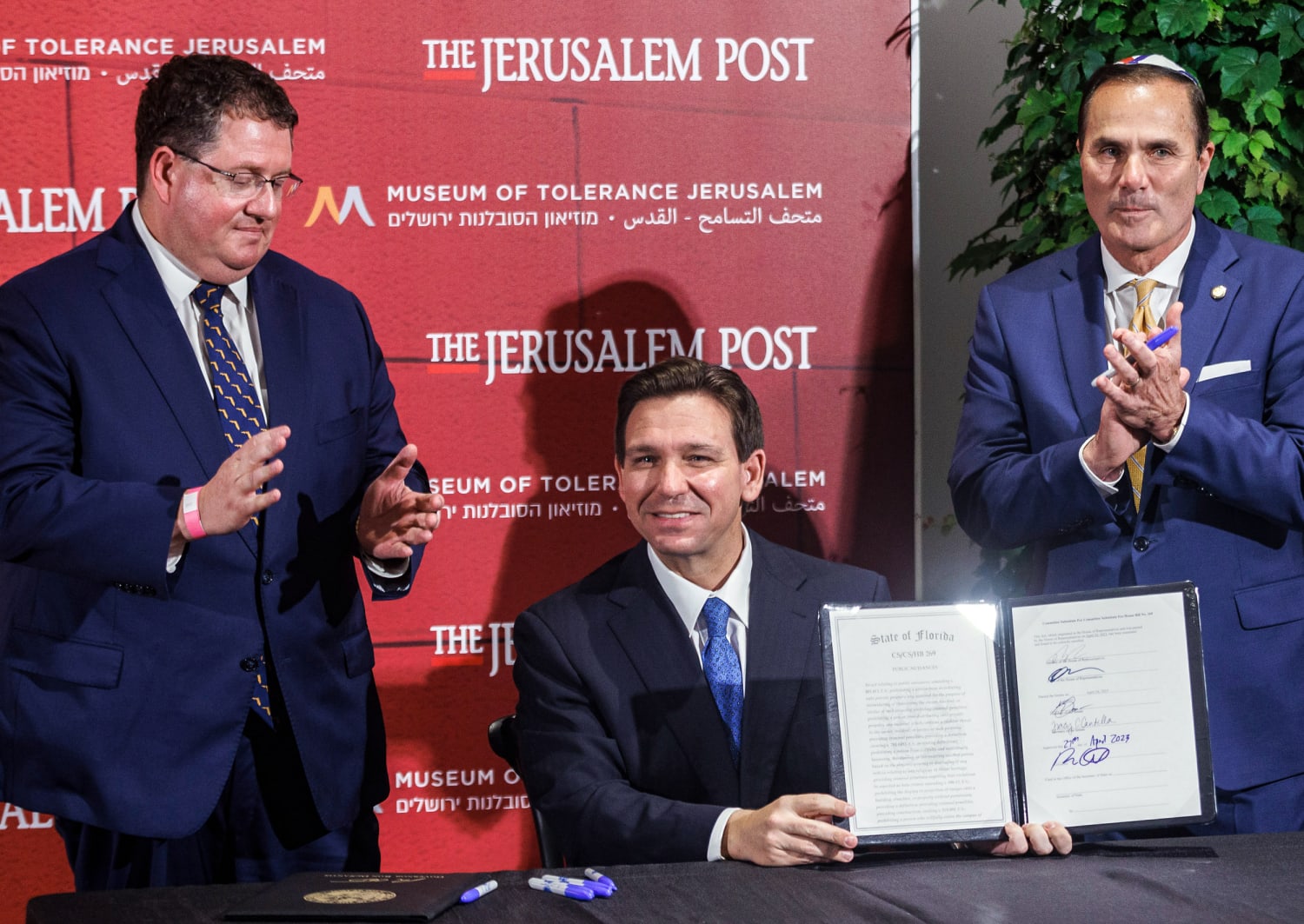
This firm stance has significant implications for Florida’s role in the national political landscape. By taking a high-profile stand, DeSantis elevates a constitutional principle into a current cultural debate, framing fidelity to the Constitution as an active bulwark against ideological change. Whether viewed as a necessary defense of foundational values or as a politically charged gesture in ongoing culture wars, the Governor’s position reiterates a core tenet of American civic life: in the United States, the Constitution is the supreme law of the land, and all other systems of belief operate within the freedoms it grants and the limits it imposes.