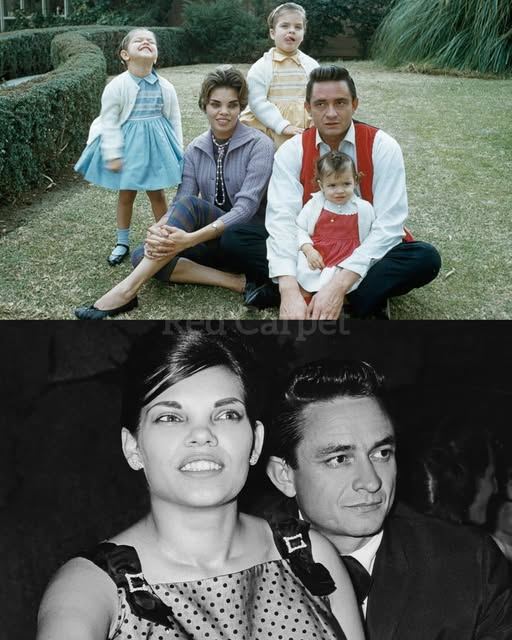
The legend of Johnny Cash is etched in American culture, a saga of rebellion, redemption, and a legendary romance with June Carter. Yet, the very foundation of that story rests with a different woman, whose name and contributions have often been lost in the shadow of the myth. Long before he was the iconic “Man in Black,” Johnny Cash was a young airman in Germany, finding solace and hope in love letters from Vivian Liberto, a woman back in Texas. Theirs was a quiet, genuine love story that unfolded across oceans through ink and paper, culminating in marriage in 1954 when Johnny was still just an aspiring musician with dreams bigger than his bank account.
For Vivian, marriage meant building a stable home while her husband chased his ambitions. She raised their four daughters—Rosanne, Kathy, Cindy, and Tara—largely on her own, creating a sanctuary from the chaos of the road. She was his first believer, a constant in his life as his star began its meteoric rise. It was for her that Johnny wrote one of his most enduring promises, “I Walk the Line,” a lyrical vow of fidelity born from his love and commitment to Vivian. For a time, the promise held, but the relentless demands of fame began to stretch it thin.
The distance between them grew, measured not just in miles but in emotional availability. Johnny’s life on the road was a world of pressures and temptations, and he increasingly sought escape in pills. Vivian stayed, managing the household and shielding their children, all while confronting a painful reality: the man she loved was slipping away, consumed by the very fame she had helped make possible. Her struggles were compounded by cruel external forces; due to her Sicilian heritage, she faced vicious racism, receiving hate mail and threats in an era of deep prejudice, a battle she fought with dignity while Johnny was often absent.
By 1967, the weight of holding a fragmenting family together became too heavy. The promises in the song no longer matched the reality of their lives. With profound courage, Vivian chose peace over perpetual pain. She filed for divorce, not out of a lack of love, but from a deep need to preserve her own well-being and that of her daughters. It was an act of strength, a decision to walk her own line after years of standing steadfast on one that was crumbling.

In the aftermath, history did Vivian a disservice. As Johnny’s narrative evolved to center on his tragic love story with June, Vivian was often reduced to a mere obstacle or a jealous footnote. This simplification is a profound injustice. Vivian Liberto Cash was the bedrock of Johnny’s early life and career. She provided the stability that allowed his talent to flourish, bore the brunt of his absences, and demonstrated incredible resilience in the face of public scorn. Her legacy is not one of bitterness, but of quiet, formidable strength—the story of the woman who loved Johnny Cash first, held his world together, and ultimately had the courage to let it go to save herself.