My husband’s chair sat empty at our kitchen table for months. After 42 years, the silence was a physical presence. His name was Richard, and he was my rock. When he passed, I found myself utterly lost at 63. The medical bills had taken everything. Our savings, our security—all gone with him. Our children lived far away, wrapped in their own lives. So I sold our home, moved into a tiny apartment, and did something I never imagined: I got a job.
I became the part-time receptionist at the Good Shepherd Senior Center. The pay was small, but it gave me a reason to leave the house. My bus route took me downtown, and I always got off a few stops early to walk. That’s when I first saw Samuel. He sat on a bench outside the public library every day, an older man with a kind face and a worn green jacket. He never asked for a thing. Something in his quiet dignity reminded me of my father. One morning, on a whim, I dropped a few dollars into his paper cup. He looked up and said, “God bless you.” I walked away with tears in my eyes.
It became a ritual. Every morning, I would stop and leave whatever I could spare—sometimes a few dollars, sometimes just my time to chat. I learned he was a retired history teacher. His pension was lost to fraud, his apartment sold out from under him. We were two lonely souls, finding solace in a few minutes of conversation. He asked about my new job, my family, my grief. In a year, this man I’d met through charity became my most genuine friend. He called me Mrs. Margaret, and his gentle wisdom was a balm to my weary heart.
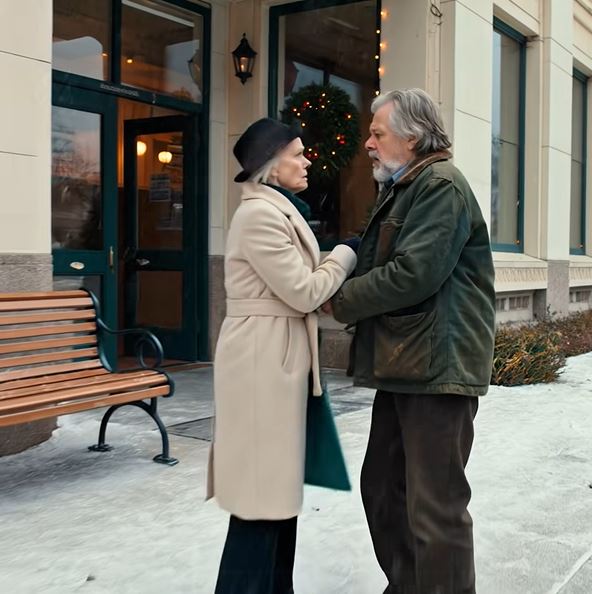
Then, one crisp March morning, everything changed. Samuel was waiting for me, standing anxiously. Before I could speak, he grabbed my arm, his grip firm and urgent. “Listen to me,” he said, his voice low. “Don’t go home tonight. Stay somewhere else. A hotel. Please, promise me.” I was stunned. He spoke of danger at my job, warned me about the new bookkeeper, and insisted something was terribly wrong. The fear in his eyes was real. Confused and scared, I promised. I went to work, my mind in turmoil, and endured a strange day where my boss, Patricia, confided that someone was stealing donation money. That night, I checked into a cheap motel, feeling foolish.
At two in the morning, the police called. There had been a fire in my apartment building. My unit was heavily damaged. If I had been home, I would not have survived. Samuel had saved my life. The next morning, I rushed to find him. He showed me a small notebook filled with meticulous notes. For weeks, he had listened as people—people who didn’t see the homeless man on the bench—plotted. They were stealing from the senior center, and they had decided I was a risk that needed to be eliminated. The ringleader was Patricia, my trusted boss. Samuel had gathered proof with an old phone, driven by the simple fact that I had treated him with respect when the world saw right through him.
With Samuel’s evidence, the police unraveled a massive fraud scheme. Patricia and her accomplices were arrested. My testimony, and Samuel’s, helped put them away. But the story didn’t end there. In the aftermath, I learned Samuel was severely ill, his body failing after years on the street. I fought for him as he had fought for me. We found him medical care, a home, and restored a piece of his stolen dignity. He now volunteers, teaching children again. We have coffee every week. I learned that the smallest kindness—a few dollars, a moment of attention—can create ripples that change destinies. My simple act of stopping at a bench didn’t just help him. It saved us both.