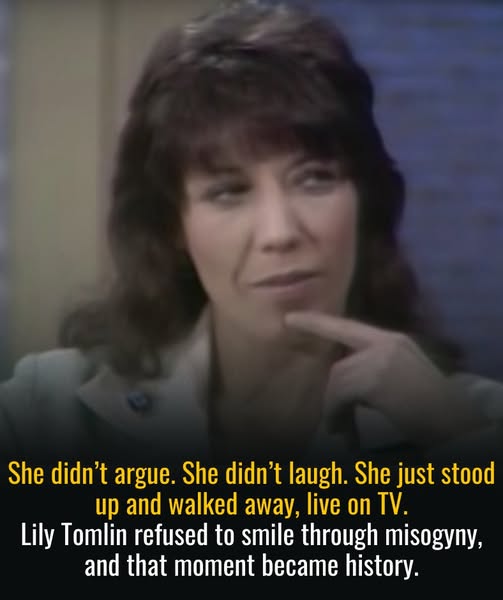
The career of Lily Tomlin is a masterclass in the power of presence. For over fifty years, she has commanded stages and screens not through loud spectacle, but through an unwavering authenticity that challenges every box the world tried to put her in. Her journey began not with a bang, but with a deliberate, resonant exit. On The Dick Cavett Show in 1972, faced with a guest’s blatantly sexist remark, Tomlin did something extraordinary: she removed her presence. By standing up and walking off, she demonstrated that a woman’s compliance is not a given, and that sometimes the most supportive act for other women is to refuse to be part of the conversation at all. That decision, made in a split second, set the tone for a lifetime of work that privileges integrity over convenience.

From her childhood in Detroit, Tomlin possessed a distinctive comedic eye, seeing the humor and irony in everyday life. Her move to New York City was a grind of odd jobs and small gigs, a period that forged her resilient and unique voice. When she landed on Laugh-In, she didn’t just tell jokes; she introduced America to fully realized, beloved characters. Ernestine, with her “one ringy-dingy” catchphrase, was more than a caricature—she was a commentary on bureaucracy and petty authority. Through these creations, Tomlin engaged in social critique disguised as sketch comedy, expanding the role of the female comedian from mere performer to insightful observer.

Tomlin’s artistry has always been rooted in a refusal to shrink. At a time when women in entertainment were pressured to fit specific molds, she succeeded entirely on her own terms. Her comedy was cerebral, her characters were complex, and her point of view was unmistakably hers. She collected Emmys, Grammys, and Tony awards not by following trends, but by setting them, proving that an audience would eagerly follow a woman who led with intelligence and heart. This quiet confidence made her a pioneer, opening doors not with a battering ram, but by calmly building her own house next door.
Her role in the iconic film *9 to 5* placed her at the center of a cultural phenomenon. The movie’s hilarious revenge fantasy against workplace misogyny resonated because it echoed real frustrations. Tomlin, as the pragmatic Violet, gave voice to the experience of countless women who were overlooked and underpaid. The film’s success was a testament to the idea that entertainment could be both uproariously funny and politically potent, and it solidified Tomlin’s status as an artist whose work was in dialogue with the pressing issues of her time, particularly the fight for gender equality and dignity at work.
Even into her later years, Tomlin’s career has been defined by groundbreaking choices. Grace and Frankie allowed her to explore aging, friendship, and identity with a humor and depth rarely afforded to women over seventy on television. By embracing this role, she challenged the industry’s ageism and inspired viewers by presenting a vibrant, flawed, and full life in later decades. Lily Tomlin’s enduring legacy is this: she consistently chooses to be fully, unapologetically present—in her art, in her principles, and in her representation of women’s lives. She shows us that a lifetime of small, courageous acts of authenticity is what truly changes the game.