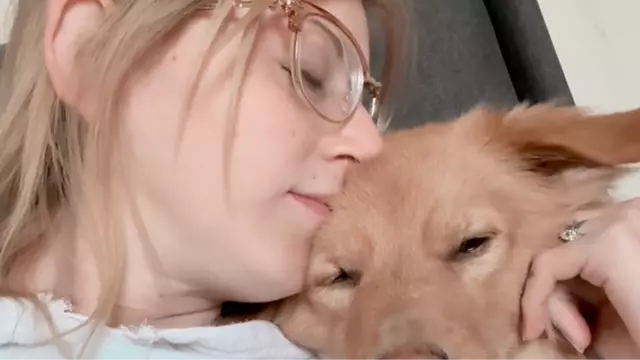
It started with a whine, a nudge, an unshakable fixation. For Kenzie Kinney Seymour, her rescue dog Sunny’s sudden odd behavior was the first sign of a hidden medical emergency. The two-year-old dog became “antsy,” obsessively hovering around Kenzie, licking her, and propping her head on her owner’s neck and shoulders. This was not typical playfulness or seeking affection; it was a focused, anxious behavior that deeply concerned Kenzie. She felt Sunny was trying to communicate something urgent, a feeling that was confirmed in the most frightening way possible.

The very next day, Kenzie was diagnosed with a brain aneurysm—a dangerous bulge in a blood vessel that can rupture without warning. She shared her story online, posting a touching video of Sunny resting her head on her shoulder, a moment captured just before the diagnosis. For Kenzie, Sunny’s alert was part of a pattern; the sensitive dog had previously shown she could detect Kenzie’s chronic blood clot issues. This history made the dog’s renewed anxiety even more nerve-wracking and significant, pointing toward a new, invisible problem.
The phenomenon of animals detecting human illness is both wondrous and increasingly documented. Responses to Kenzie’s video flooded in with similar stories: pets alerting owners to fainting spells, tumors, and other health crises. These experiences are far from mere coincidence. Dogs, in particular, have an extraordinary biological gift—a sense of smell so powerful it can detect the faintest chemical changes in human sweat, breath, and skin that accompany various diseases. This ability forms the basis for training medical alert dogs, but some pets, like Sunny, seem to possess this skill naturally.
View this post on Instagram
Science is beginning to catch up with what pet owners have long believed. Research has shown dogs can be trained to sniff out viruses like COVID-19 with high accuracy, and there are ongoing studies into their ability to detect cancers and other conditions through scent. These animals are not magic; they are incredibly perceptive beings using their finest natural tool to sense imbalances in the people they love. Sunny’s persistent behavior was likely a response to such a biochemical shift caused by the developing aneurysm.
Kenzie’s experience underscores a profound and potentially life-saving aspect of the human-animal bond. It reminds us that our pets are often acutely attuned to our well-being in ways we are just beginning to understand. While we should always seek professional medical advice for health concerns, paying attention to sudden, unexplained changes in a pet’s behavior toward us can be a crucial piece of the puzzle. In this modern age of advanced medicine, sometimes the earliest and most reliable alert comes from a loyal friend with a wet nose and a watchful heart.