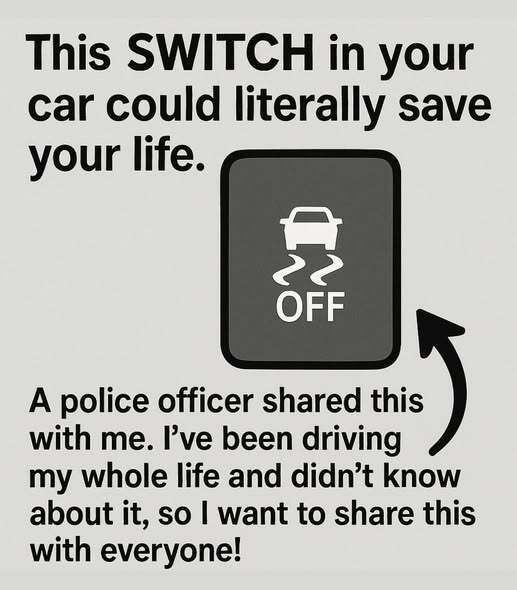
Most of us operate our vehicles with a basic understanding of the controls. We know how to signal a turn, turn on the headlights, and activate the windshield wipers. But nestled among the knobs and switches on your dashboard is a button many drivers have never pressed and a symbol they’ve never understood. It typically shows the icon of a car with two squiggly lines beneath it. This simple image represents one of the most important, yet most overlooked, safety features in modern vehicles: your car’s traction or stability control system. For decades, this technology has been working silently in the background to prevent accidents, yet a surprising number of drivers have no idea what it does or why it’s there.
This system is designed to help your car maintain grip on the road when conditions are less than ideal. When the feature is active, sensors constantly monitor the speed of each wheel. If the system detects that a wheel is beginning to spin faster than the others—a sign it’s losing traction on ice, rain, or loose gravel—it automatically intervenes. It can apply brake pressure to that specific spinning wheel or reduce engine power to help the tire regain its grip. This happens in milliseconds, often without the driver ever feeling more than a slight pulse in the brake pedal. Its primary job is to prevent you from skidding, fishtailing, or losing control during sudden maneuvers or on slippery surfaces.
The safety benefits of this feature are profound. Studies have shown that stability control systems significantly reduce the risk of single-vehicle crashes, especially those involving a loss of control. It acts as a digital co-pilot, helping to keep the car going in the direction you intend to steer. For new drivers, older drivers, or anyone caught in an unexpected downpour or patch of black ice, this system provides a critical layer of electronic assistance that can compensate for human reaction time. It’s so effective that it became mandatory on all new cars sold in many countries for good reason. For everyday driving, the rule is simple: leave it on.
You might wonder, then, why there’s an “OFF” switch at all. There are a few specific, limited scenarios where temporarily disabling traction control can be helpful. The most common is if you become truly stuck in deep snow, thick mud, or sand. In those situations, the system might interpret necessary wheel spin as a loss of traction and continuously cut power, preventing you from rocking the car free. Turning it off allows the wheels to spin with more force, which can sometimes help you escape. Once you’re back on solid ground, you should immediately reactivate it. For 99% of driving, this button’s only job is to stay untouched, keeping its vital protection active.
The next time you get in your car, take a moment to locate this symbol on your dashboard. Understanding its function transforms it from a mysterious icon into a reassuring piece of technology. It’s a testament to how far automotive safety has come—a powerful guardian operating quietly behind the scenes. By knowing what it does and when to use it (or, more accurately, when not to turn it off), you become a more informed and safer driver, equipped with knowledge that many on the road have overlooked for years.