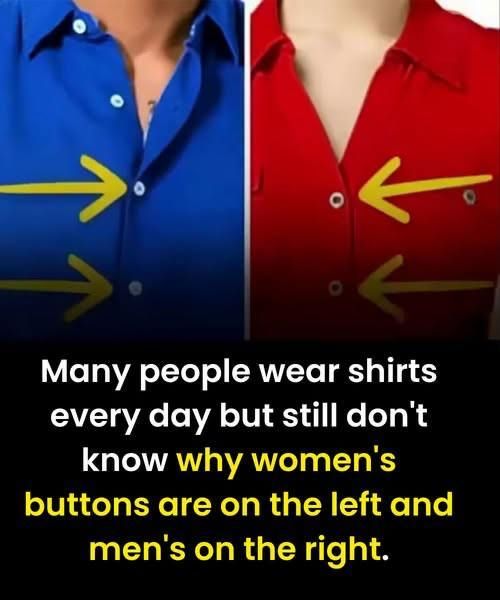
Most of us get dressed without a second thought. But if you look closely, you’ll find a quiet piece of history sewn into the very way we button our shirts. Men’s shirts are designed to close right over left. Women’s shirts, however, typically do the opposite, closing left over right. This is not a random choice or a modern design quirk. It is a direct line back to a world where daily life, social status, and survival needs shaped even the smallest details of what we wore. For generations, this subtle difference has carried meaning, and it remains one of fashion’s most enduring, silent traditions.
The story behind women’s buttoning begins in the ornate dressing rooms of the 18th and 19th centuries. Clothing for affluent women was often complex, featuring tiny buttons, laces, and hooks that were nearly impossible to fasten alone. These women relied on ladies’ maids for assistance. Since most people are right-handed, it was easier for a maid standing face-to-face with her mistress to button a garment if the fastenings were on the left-hand side of the garment from the wearer’s perspective. This practical consideration for the dresser, not the wearer, became standardized. Over time, left-side buttons evolved from a servant’s convenience into a subtle signal of wealth and refinement, implying a household where such assistance was the norm.
Men’s fashion developed for an entirely different reason, rooted in utility and preparedness. Historically, many men, particularly soldiers and gentlemen, carried weapons like swords or pistols. These were typically worn on the left hip to allow a right-handed draw. Having the shirt or coat open from the right side meant a man could swiftly reach across his body with his right hand, pull the garment open, and access his weapon in one fluid motion. In an era where speed could mean the difference between life and death, this design was a functional necessity. This martial practicality eventually filtered into all men’s civilian tailoring, cementing right-over-left as the standard.
Today, the original reasons for these designs have largely faded into history. Few people employ ladies’ maids, and even fewer carry a sword as part of their daily attire. Yet the tradition persists, woven into the very pattern of our clothing. It is a powerful example of how fashion often preserves customs long after their practical purposes have vanished. The design has become a self-perpetuating norm, a familiar expectation passed down from tailor to designer to consumer. When we buy a shirt, we instinctively know which way it will fasten based on who it’s for, a testament to how deeply ingrained this historical footnote has become.
So the next time you button your shirt, consider that you are engaging with a narrative centuries in the making. That simple act connects you to the dressing rituals of aristocrats and the ready stance of duelists. In our modern world of rapid fashion cycles, it’s a reminder that some of the most common items in our closet are also quiet archives, holding stories of practicality, class, and human behavior in every stitch and buttonhole.