I never understood how deeply my father’s service was woven into the fabric of our everyday life until a Veterans Day lunch at a crowded restaurant. My dad has a simple, non-negotiable rule when we eat out: he needs the seat that faces the exit. It’s not a preference or a quirky habit; it’s a deeply ingrained protocol for survival. Twenty years after coming home, a part of him is still deployed. I see it in the subtle tension in his shoulders when a plate clatters too loudly or in the way his eyes constantly scan the room. We never talk about it. He just wants to be my dad, not a veteran with a label.
The Texas Roadhouse was buzzing with the chaotic energy of a holiday. The air was thick with the smell of grilled steak and the sound of country music, punctuated by the laughter of children waving small flags. There’s a unique atmosphere on Veterans Day—a mix of gratitude and awkwardness, where people offer thanks but often struggle to hold a soldier’s gaze. My father sat across from me, his posture rigid, his attention subtly fixed on the door as if expecting an unseen threat.
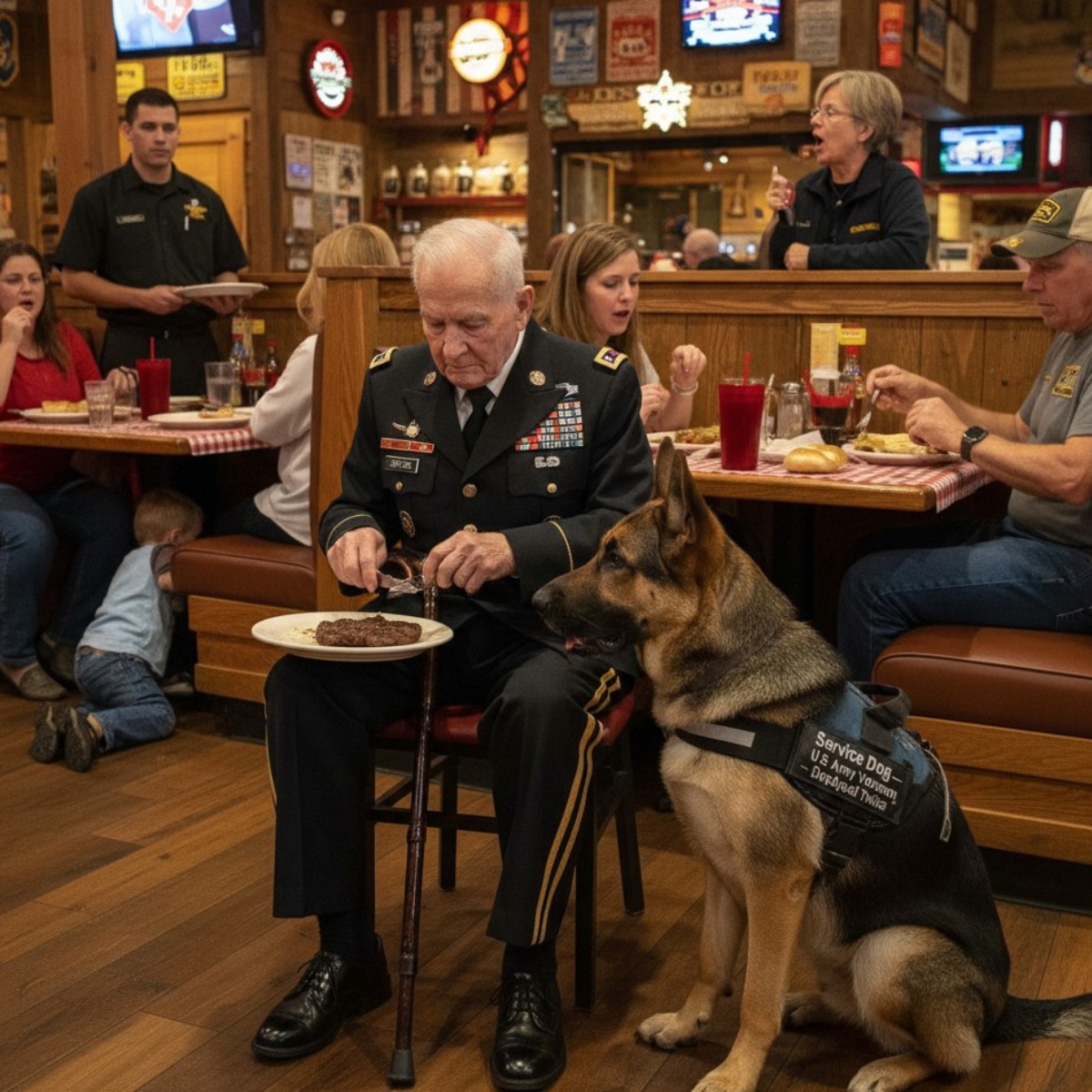
Then, a German Shepherd entered, moving with a calm, purposeful dignity. He wasn’t being led so much as he was partnering with the older, medal-bedecked soldier behind him. The dog’s vest identified him as a U.S. Army veteran who had been deployed twice. The quiet dignity of the pair was suddenly shattered by a woman at a nearby table, who loudly complained about a dog being in the restaurant. My dad’s reaction was a quiet, heartfelt murmur: “I’d sit next to that dog any day.” His tone held a weariness and a recognition I had never heard before.
The scene that unfolded was a powerful lesson in devotion. The old soldier received his free meal, a sizzling steak, and without hesitation, cut half of it into pieces for his companion. The dog waited, perfectly still, only eating when given a silent signal. The entire restaurant seemed to quiet down, bearing witness to this bond. When the complaining woman spoke again, my father finally responded, his voice firm yet gentle. He explained that the dog was a soldier who had seen combat, saved lives, and earned his place at that table just as much as any human.
In that moment, my understanding shifted. I saw that the dog wasn’t just a helper; he was a brother-in-arms, carrying his own invisible scars. As the pair left, my dad watched them go and said softly, “That dog is still keeping him safe.” When I asked how, he replied, “Because it’s difficult to come home.” The tightness in my throat told me he wasn’t just talking about the old soldier anymore. He was finally giving me a glimpse into the war he still carries inside, a language of silence and sacrifice I was only just beginning to understand.