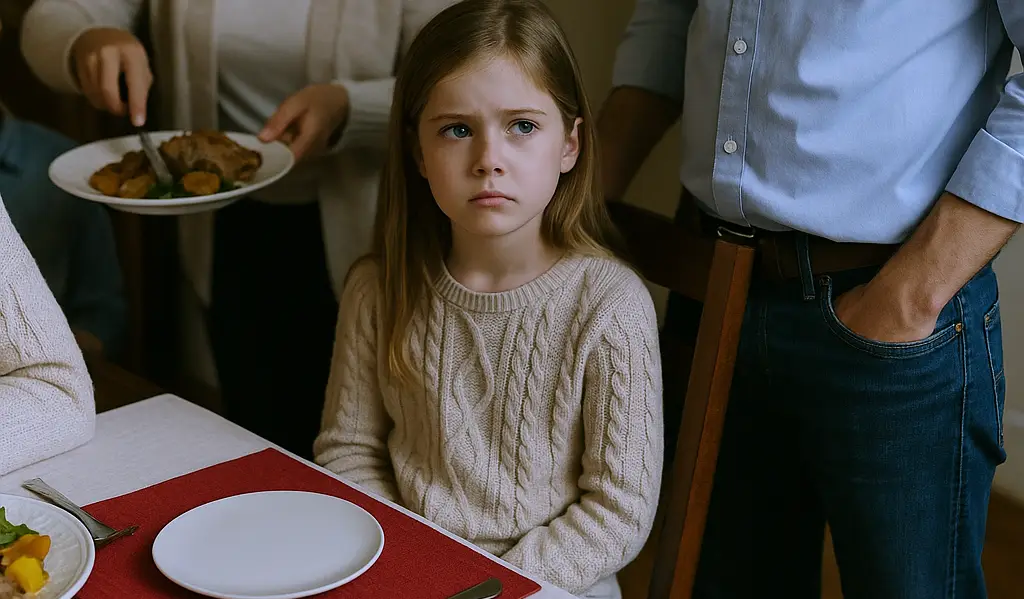
Fatherhood has a way of rewriting a man’s priorities, often in the most unexpected moments. For one dad, the rewrite happened at a Christmas dinner table, staring at an empty placemat where his daughter’s plate should have been. His mother’s excuse—that there “wasn’t enough” because the seven-year-old had upset her cousin—was a message as clear as it was cruel. In that instant, the man who fixed problems by being useful and quiet realized that some problems can’t be fixed, only left behind. His quiet strength was no longer in his silence, but in his decisive action to protect his child.
This father had built his identity on being reliable. He was the rock, the one who showed up with folding chairs and a fully-stocked battery drawer. But this reliability had been exploited, morphing into a expectation that he would always smooth things over, even when it meant overlooking the subtle ways his adopted daughter was marginalized. The family’s “golden child” was his nephew, and any perceived slight was treated as a major transgression. By punishing his daughter for a minor accident, the family was showing him where he and his child truly stood in the hierarchy.
Walking out of that house was an act of profound redefinition. He was no longer just a son; he was a father first. The subsequent text demanding rent was the old system trying to reassert control, to pull him back into his role as the family’s financial and emotional support pillar. But the spell was broken. He responded not with the anger they expected, but with a calm, factual accounting of the financial and emotional debts they had already incurred. He moved his phone plan, he compiled receipts, and he stated his terms with the clarity of a man who had found his true north.
The real work of fatherhood began in the days that followed. It was in the small, healing moments—making pancakes, going sledding, reassuring his daughter that she had done nothing wrong. It was in the difficult conversations with his own parents, where he held the line that their access to his family was contingent on their respect. He learned that a strong father doesn’t just provide financially; he provides a safe emotional space where his child knows, without a doubt, that they are the priority. He models what self-respect and healthy boundaries look like.
In the end, this story isn’t about a single dramatic Christmas. It’s about the ongoing, daily choice to be the father your child needs. It’s about understanding that sometimes the strongest thing a man can do is walk away from a toxic situation and calmly build a better one. This father didn’t make a scene; he made a stand. He traded the exhausting role of the family fixer for the vital role of his daughter’s protector, proving that the truest measure of a man is not in what he builds for others, but in what he safeguards for his children.