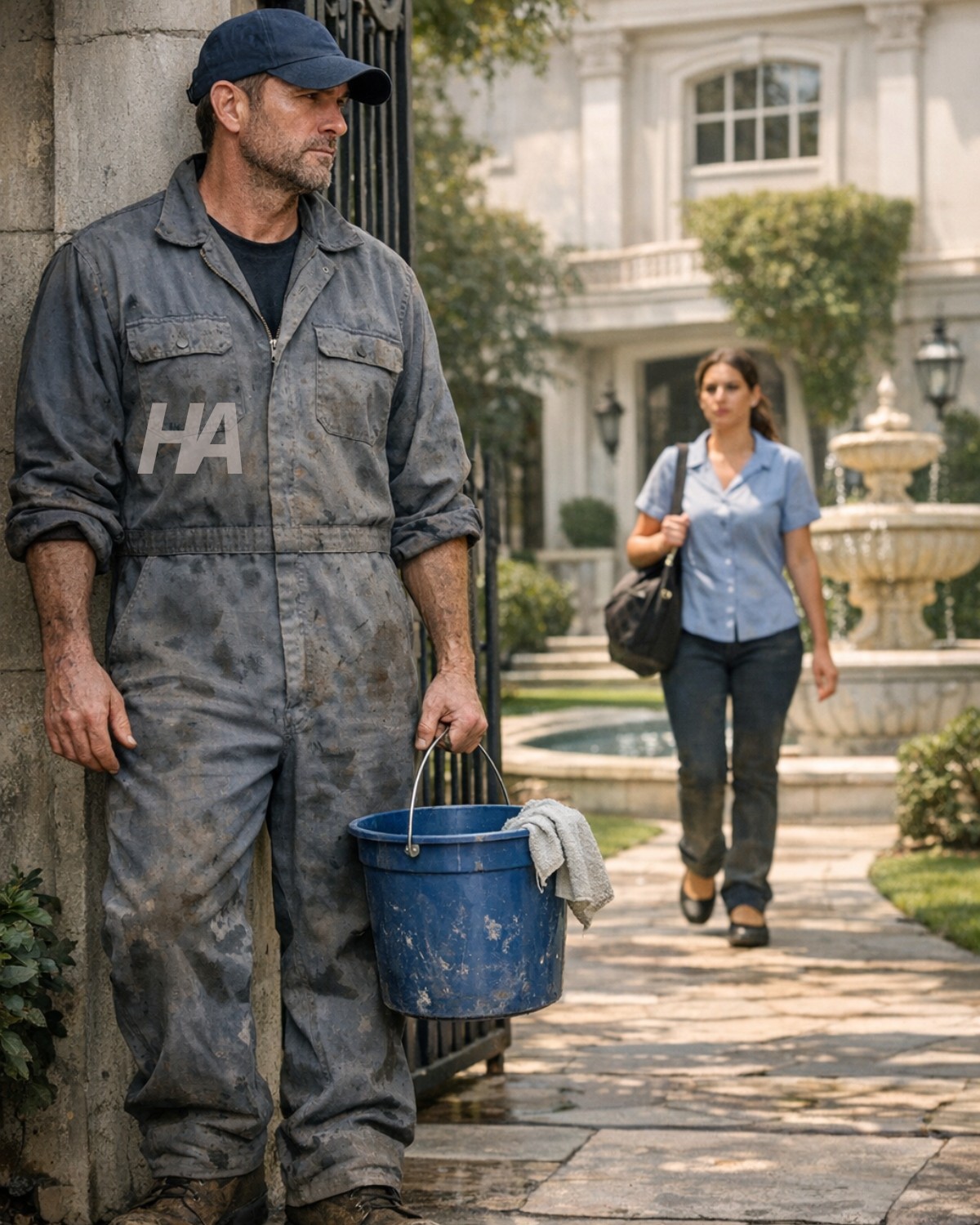
You see him before he sees you noticing him.
He stands near the back corridor with a dented metal bucket in one hand and a rag thrown over one shoulder, his gray coveralls stained at the knees and one sleeve rolled higher than the other as if he dressed in a hurry or simply stopped caring who noticed. If anyone else in the mansion pays attention to him, they hide it well. In houses this large, men carrying buckets become part of the wallpaper. They are useful, invisible, and rarely considered important enough to remember.
But you notice people for a living.
The cook with the pinched mouth. The footman who smirks when he thinks no one sees. The butler whose silence feels less cold than careful. The two little girls whose laughter floats down from the second-floor landing and then stops all at once, as though joy in this house must frequently ask permission before continuing. And now this handyman, standing slightly apart from the rhythm of the staff, watching the room with the alertness of someone pretending not to.
You set your old canvas bag beside the laundry room door and smooth the front of your worn uniform with both hands. The cloth is freshly pressed because that matters to you even when the seams have begun to thin. Poverty may take options first, but dignity only goes if you hand it over.
The housekeeper, a broad-shouldered woman named Teresa, appears in the hallway and motions impatiently. “Come on,” she says. “You can stare at the chandeliers later. The first floor must be done before lunch, and don’t touch the study. No one touches the study.”
You nod at once. “Yes, ma’am.”
She gives you the brisk once-over of a woman who has seen too many new hires arrive humble and leave dishonest. “Bathrooms after the formal salon. Silver room only if Marta tells you. Children’s playroom only when one of the nannies is present. And if Señor Santillán happens to be home, you keep your eyes down and your work fast. He dislikes idleness.”
“Is he home now?” you ask before you can stop yourself.
Teresa snorts. “If he were, you’d know. The whole house breathes differently when he’s here.”
At that, something flickers in the face of the handyman across the hall. So quickly that anyone else might miss it. Amusement, maybe. Or irritation. You cannot tell. But you tuck the reaction away the way poor women tuck away useful information: silently, for later.
You spend the first two hours cleaning rooms so large they feel more like hotel suites than places people actually live. Marble floors that reflect your movements back at you in polished ghost form. Shelves lined with books no one seems to read. Vases taller than your nephew had been at seven. Windows that frame the city in perfect expensive rectangles, making the world outside look curated instead of lived in.
Still, beneath all the wealth, the house feels tired.
Not dirty exactly. Houses with this many employees are rarely dirty in visible ways. But there are subtler things. Toys abandoned in corners as if children lost interest too quickly. A dining room set for too many guests and used too little. A piano in the music room with a layer of silence over it so thick you can practically dust it. Family portraits in gilded frames where everyone is dressed beautifully and smiling just a little too carefully, like people who know how to perform happiness better than inhabit it.
By midmorning, you hear the girls before you meet them.
One voice is high, bright, quick to challenge the world.
The other is softer, slower, carrying its thoughts more carefully.
You are straightening a stack of folded towels outside the upstairs hall bath when they come running around the corner in matching house slippers and mismatched moods. The older one, maybe nine, has black curls tied with a blue ribbon and the fierce eyes of someone accustomed to deciding things for other people. The younger, no more than six, clutches a stuffed rabbit by one ear and looks as if she is never entirely convinced a room will be kind to her until it proves it.
They stop when they see you.
Children in rich houses learn the hierarchy of workers young. Some treat you kindly. Some treat you like furniture with hands. These two simply stare.
You smile first. “Good morning.”
The older girl lifts her chin. “You’re the new maid.”
You hide your wince at the word. Not because it is inaccurate, but because accuracy can still bruise depending on how it is handled. “I’m Clara,” you say. “And you must be the young ladies of the house.”
The younger girl presses closer to her sister. The older one studies you with open suspicion. “How do you know?”
“Because only girls who live here would run through the hall like they own the place.”
That earns the smallest twitch at one corner of her mouth. Not quite a smile. More like a crack in a fortress wall.
“I’m Valentina,” she says. She jerks her chin toward the younger child. “That’s Sofía.”
You nod. “Nice to meet you, Valentina. Nice to meet you, Sofía.”
Sofía says nothing. She only peers at you from behind the stuffed rabbit’s limp body, eyes wide and dark.
“Are you going to leave too?” Valentina asks suddenly.
The question lands with enough force that you almost show it. Instead you ask gently, “Too?”
She shrugs, but there is anger in it. “Everyone leaves. Nannies leave. Tutors leave. One cook cried in the pantry and left after three days. The last lady who cleaned our rooms said she had to go because her back hurt. She took my purple hair ribbon.”
Sofía whispers, barely audible, “She said she’d come back.”
A silence opens in the hallway, tender and awkward. You know that silence. It lives wherever children have learned not to expect consistency and women have learned promises are expensive.
You crouch so you’re closer to their height. “I can’t promise forever,” you say. “But I came to work, not to disappear.”
Sofía’s fingers tighten on the rabbit. Valentina seems about to say something sharp, then decides against it. Instead she narrows her eyes. “If you’re lying, I’ll know.”
You almost laugh. “Then I guess I’d better be careful.”
That, somehow, is enough. They move on down the hall, the older one pretending not to glance back, the younger one doing it openly. When they vanish around the corner, you straighten slowly, feeling the ache in your knees and something heavier in your chest.
Children tell the truth more quickly than adults in houses like this.
That afternoon, while scrubbing the lower cupboards in the breakfast room, you hear the handyman again. He is somewhere beyond the open service door, working on a loose shutter or maybe pretending to. You catch fragments of his voice when he asks the gardener for a wrench. Deeper than you expected. Controlled. Not rough with fatigue the way laboring men’s voices often are by midday. He sounds like someone borrowing the shape of tiredness rather than truly wearing it.
Later, when you carry a basket of linen through the rear hall, you nearly collide with him.
He steps aside quickly, one hand lifting to steady the basket before it tips. His fingers are clean beneath the grease smudges. Strange thing to notice, but you do.
“Sorry,” he says.
“Was my fault,” you answer automatically.
His eyes meet yours then, properly, and the brief contact unsettles you more than it should. They are dark, almost black, but too observant to belong to a man no one notices. Most workers in homes like this learn invisibility as a survival art. This one seems to resist it simply by existing.
“You’re new,” he says.
You adjust the basket in your arms. “So are you.”
A hint of something moves through his expression. “Temporary repair job.”
“Temporary cleaning job,” you say.
He looks at the basket. Then at you. “Big house for one first day.”
You let out a breath that could almost become a laugh. “I’ve seen worse.”
That surprises him. You can tell. Men who study women for weakness rarely expect them to have histories broad enough to contain worse things than mansions.
Before he can ask more, Teresa’s voice snaps from the corridor. “Clara! Linen closet, now.”
You nod once to the handyman and continue on. But you feel his gaze on your back for several steps after.
His name, you learn later from one of the kitchen girls, is Daniel.
No last name. Just Daniel. Hired for repairs because the upstairs guest bath door sticks and one of the garden walls needs attention before a luncheon next week. The kitchen girls have already half decided he drinks, though they have no evidence for this beyond the fact that he keeps to himself and men who keep to themselves are always accused of some vice by women with too little time and too much imagination.
You reserve judgment.
By evening, your lower back hums with pain and your hands smell like lemon polish, bleach, and old wood. Teresa finally dismisses you from the first floor and points you toward the staff dining room where leftover soup waits in a dented tureen. The other employees eat in pockets of wary conversation. No one is openly hostile, but no one invites you in either. In rich houses, newcomers are treated like weather. You wait to see if they pass.
You take your bowl of soup to the far end of the table.
A minute later, Daniel sits across from you.
Several heads lift. Then duck again.
You spoon broth carefully, pretending not to notice the collective curiosity now buzzing just above the table like static. A woman can tell when she has become topic material in a room. You have spent enough years in kitchens, buses, clinics, and back corridors to recognize the shift.
Daniel tears a piece of bread and says, “They think I’m trying to flirt.”
You nearly choke on your soup. “That’s a strange opening line.”
He shrugs. “It’s true.”
A smile escapes you before you can prevent it. “Then maybe you should sit somewhere less interesting.”
He studies your face as if the smile itself is evidence of something. “Would that help?”
“No,” you admit. “Now they’ll only think it louder.”
For the first time, he laughs. It transforms him more than it should, taking some of the guardedness out of his features and replacing it with a warmth that does not fit his coveralls quite right. You notice that too. Another thing tucked away silently for later.
The meal passes with small practical talk. Where you’re from. How long the repair work should take. Whether the city’s buses have gotten worse or simply more crowded. You tell him you grew up outside Puebla, the oldest of four, and began working in other people’s homes at seventeen after your mother got sick. You do not tell him about your marriage because it still feels too close to a bruise when strangers touch it.
He does not tell you much at all.
Only that he has been around houses like this before. That he is good with his hands. That he prefers fixing things to talking about himself. All of which might be true and yet feel, somehow, like polished omissions.
The next days settle into rhythm.
You wake before dawn in the little room assigned to you above the garage, dress in the half-dark, braid your hair, and start downstairs before the mansion’s expensive quiet has fully lifted. You clean surfaces that already gleam, fold towels no one has used, wipe fingerprints from grand pianos and mirrored consoles and door handles shaped like vines. You learn which staircase creaks, which cook steals apricots from the pantry, which groundskeeper sings boleros badly under his breath when he thinks no one hears.
And you learn the girls.
Valentina tests you constantly. She asks impossible questions while you straighten her bookshelf, hides things to see if you’ll notice, watches for signs of impatience the way other children watch for storms. She is sharp, proud, and angry in ways too big for a child her age. Sofía is different. She trails after silence. She startles easily. She asks for stories when you help her put away dolls, then apologizes for asking as if requesting anything at all has become uncomfortable for her.
Slowly, cautiously, you become part of their daily edges.
Not a mother. They do not hand that title away.
Not a friend either, because children in houses like this know friendship with staff is always vulnerable to adult decisions.
But something.
A steady thing.
On your fifth day, you find Sofía crying under the back staircase with her rabbit clutched so tightly its button eye is coming loose. When you ask what happened, she shakes her head and cries harder. It takes ten full minutes before the truth emerges in hiccuped fragments: one of the tutors forgot to collect her from music practice, everyone thought someone else had her, and she waited alone in the sunroom for nearly an hour because she was afraid to move.
You sit with her on the stair step and feel something old and furious rise in you.
Not because the mistake was monstrous by adult standards. These houses are giant machines built on delegation. But because the smallness of the neglect is exactly what makes it dangerous. Children are not usually wounded by grand betrayals first. They are worn thin by being overlooked in tiny installments.
When Sofía finally calms, you say, “Next time, if no one comes, you find me or Marta or the cook. Understand?”
She nods solemnly.
“Better yet,” you say, softening your tone, “you yell loud enough to wake the chandeliers.”
That earns a watery laugh.
From the hallway, unseen by both of you, Daniel watches.
You only realize he was there when you stand to leave and catch the shadow of him stepping back around the corner. Again that prickling awareness moves through you. He sees more than a handyman ought to. More than most men bother to.
That evening, while you iron school uniforms in the service room, he appears in the doorway holding a broken latch. “You’re good with the girls.”
You keep your eyes on the iron. “I know what it’s like to be little in a place where people are busy.”
He says nothing for a moment. Then, quietly, “That’s not the same thing as being kind.”
You glance up.
His face is unreadable, but his voice is not. There is something in it now that wasn’t there before. Respect, maybe. Or surprise. As if whatever test he is secretly running in his own mind keeps producing results he did not plan for.
You return your attention to the uniforms. “Kindness is cheaper than therapy,” you say. “But rich people seem to forget that.”
He goes very still.
For a second you wonder if you have overstepped. Then he gives a short, almost reluctant smile. “That sounds like experience talking.”
“It usually is.”
The days continue.
By the second week, Valentina starts waiting for you near the upstairs landing with books in her arms and accusations disguised as questions. “This one is boring,” she announces about a fairy-tale collection. “The princess cries too much.”
You take the book, skim the page, and say, “Then perhaps the dragon had excellent reasons.”
That startles a laugh out of her so bright and sudden it seems to surprise her too.
Soon you are reading to both girls in the evenings when their official routines have fallen apart and the nannies are busy or rotating out again. You do voices for dragons and kings, make queens sarcastic on purpose, and always improve the endings when stories insult intelligent women. Sofía curls close beside you with her repaired rabbit. Valentina pretends she is only there for her sister, then interrupts every few pages to argue with the plot.
Once, at the edge of your vision, you notice Daniel standing in the half-dark of the hall listening.
He leaves before the story ends.
One afternoon everything shifts.
It begins with broken porcelain.
You are dusting the formal sitting room while one of the temporary caterers crosses behind you carrying a tray stacked too high with coffee cups for an investor lunch Señor Santillán is supposedly hosting off-site. At the exact moment you turn, one cup slides. You catch it, but the saucer drops, shattering near the Persian rug.
The caterer swears under his breath and hurries off without looking back. You kneel at once to gather the pieces, pulse quickening with that old servant panic every working-class woman knows. Breakage in a rich house is never just breakage. It is evidence. Ranking. Proof that carelessness has a class.
Before you can collect the last shard, a hard voice cuts across the room.
“What happened here?”
You look up.
A man stands in the doorway of the study. Not Daniel. Not a worker. Not any member of staff. He wears a dark tailored suit, silver watch, immaculate white shirt, and the expression of someone accustomed to walking into rooms and having all noise reorganize itself around his opinion. He is handsome, but not in the easy way. More like architecture. Expensive, controlled, and built to make people feel smaller by comparison.
Your stomach drops.
You know that face.
Not because you’ve seen him in person before. Because his photographs are framed in the downstairs corridor, in business magazines left in the sitting room, in the silver-plated article clipping Teresa once pointed out with a mix of pride and fear. Adrián Santillán. Owner of the house. Widower. Magnate. The man everyone warned you about.
And Daniel.
Daniel had his eyes.
The realization strikes like cold water.
You rise too fast, nearly cutting your fingers on a porcelain edge. “I’m sorry, sir. The tray—”
Adrián’s gaze falls to your hand. “You’re bleeding.”
Only then do you feel it. A thin red line along the side of your thumb where a shard kissed skin.
“It’s nothing,” you say automatically.
He crosses the room in three quick steps, crouches, and takes your wrist before you can react. His grip is firm, not painful, but the sheer shock of being touched by the master of the house in such a direct, practical way roots you in place.
“It’s not nothing if it gets infected,” he says.
You stare at him.
This is the man who was supposed to be away. The man everyone in the house adjusts their breathing around. The man who, until twenty seconds ago, had been walking these halls in stained coveralls testing your character like some rich king in a cruel folktale.
Heat rises into your face, but not from embarrassment.
From betrayal.
He notices the change immediately.
“You know,” he says quietly.
You pull your hand back. “Daniel.”
The single word cracks in the air between you.
Adrián straightens slowly. “Clara—”
“No.” You take one step away from him. “You don’t get to say my name like that after lying to me.”
He exhales once, controlled but not calm. “I was going to tell you.”
“When? After I passed?” The bitterness in your own voice surprises even you. “After you decided I wasn’t stealing silver or poisoning your children or dreaming of your bank account?”
His jaw tightens.
You finally understand now. The watchfulness. The careful omissions. The strange questions. The way he drifted near the girls, near the staff, near your interactions with the house as if evaluating a structure for hidden cracks. He hadn’t been curious. He had been inspecting.
“You were testing me,” you say.
He doesn’t deny it.
That hurts more than denial would have.
The silence stretches. Somewhere beyond the sitting room, a door opens and closes far away. The house continues breathing, unaware that one of its smallest private storms has just broken.
“Yes,” Adrián says at last. “I was.”
You laugh once. No humor in it. “How noble.”
His eyes darken. “You don’t know what has happened in this house.”
“Then tell me,” you fire back. “Tell me what gave you the right to disguise yourself as a laborer and treat a stranger like an experiment.”
For the first time, something cracks in his composure. Not enough to make him smaller. Enough to make him human. “Women I trusted stole from my daughters. Staff members sold schedules to reporters. A tutor blackmailed me with private family information. A nanny took jewelry and swore Valentina hid it as a game. Another employee fed gossip to my ex-brother-in-law during the custody dispute.” His voice lowers. “So yes. I tested you.”
You hold his gaze. “And if I had failed?”
He says nothing.
Because there is no answer that doesn’t make him monstrous.
You wrap your bleeding thumb in the corner of your apron. “I should quit.”
The words land heavily.
Not because you mean them theatrically. Because a part of you does.
You have walked away from houses before when the contempt became too creative or the pay too stained to accept. You know how to gather yourself and leave before people convince you that survival requires swallowing any humiliation they can invent. It is a skill, not a weakness.
But then Sofía’s rabbit peeks out from beneath the sofa where she must have dropped it earlier. And somewhere upstairs you hear Valentina arguing with a piano teacher again, voice bright with loneliness disguised as defiance. The house presses in around you with all its contradictions. The children. Marta’s tired kindness. Teresa’s bark without actual bite. And this man, standing before you with the face of a billionaire and the eyes of the disguised handyman who listened to bedtime stories from the hall.
Adrián follows your glance toward the rabbit. He understands enough.
“Don’t quit because of me,” he says.
You almost smile at the absurdity. “You are the reason.”
“Then stay because of them.”
The plea hides inside the command badly. That, perhaps, is the most honest thing he has said to you yet.
You breathe once, carefully. “You don’t get to ask that either.”
He flinches so subtly another person might miss it. But you don’t. You have spent your life watching the exact moment powerful people realize they are not fully in control of a room.
“Fair,” he says.
He reaches into his jacket pocket and withdraws a clean white handkerchief, offering it toward your injured thumb. You hesitate, then take it because blood on the carpet will somehow become your fault too if you’re not careful.
“Sit,” he says, gesturing toward the settee.
You remain standing.
Something almost like respect passes through his expression. Then he nods once, accepting the refusal. “The kitchen cabinet beneath the central island has a medical box. The better antiseptic is in there, not the upstairs hall closet. Marta uses the cheap one on staff.”
The information is so oddly specific, so unexpectedly practical, that despite everything you look at him differently for a second.
He notices that too.
“Keep the better one,” he says. “And Clara…”
You freeze.
“I was wrong to lie.”
The apology is not polished. It doesn’t sound like a man accustomed to giving them. That is the only reason it reaches you at all.
You nod once, not forgiveness, not yet. Just acknowledgment. Then you leave the sitting room with the handkerchief wrapped around your thumb and your thoughts breaking apart like porcelain on stone.
That night, sleep does not come easily.
You lie in the narrow staff bed above the garage and replay every conversation with Daniel, now Adrián, now both men at once. The way he listened. The way he asked about the girls. The way he held the basket the first day. The laugh that sat too elegantly in a workman’s throat. You feel foolish for not seeing it sooner and angry at yourself for feeling foolish at all. He built the disguise. The deceit belongs to him, not your trust.
Yet your anger keeps snagging on inconvenient details.
He never mocked you.
Never flirted cheaply.
Never baited you with money or pity.
He watched, yes, and tested, and lied by omission. But in the disguise he had somehow been more honest than most wealthy men ever are in their own clothes. That thought irritates you even more.
The next morning, Teresa finds you in the laundry room folding towels with enough force to flatten the earth.
“You know,” she says without preamble.
You pause. “Everyone knows?”
“Only those who need to.”
“In houses like this, that means everyone by noon.”
Teresa grunts. “Probably.”
She leans against the table, arms crossed. In daylight her severity softens into something drier, almost maternal. “He’s not easy,” she says.
“That’s one way to put it.”
“No,” she agrees. “Not the best one.”
You keep folding. “Did you know he was doing this?”
“Not until after he’d already started.” A beat. “Marta did. The butler did. I guessed when a ‘repairman’ began asking questions like a man who signs payroll.”
You cannot help it. A bitter half laugh escapes.
Teresa’s expression shifts. “You have a right to be angry.”
“That’s generous of you.”
She ignores the edge in your tone. “But for what it’s worth, he hasn’t looked at a new employee that closely since his wife died.”
The towel in your hands goes still.
You had heard bits and pieces, of course. Rich men’s tragedies become public property faster than poor women’s names. Adrián Santillán’s wife had died four years earlier in a car accident on the highway outside Querétaro. Since then he had become more private, more severe, more consumed by work. The daughters were raised in a mansion full of staff and still somehow always seemed half-abandoned. That much even the kitchen girls knew.
“What does that have to do with me?” you ask.
Teresa studies you. “Nothing. And too much.”
She leaves before you can demand a better answer.
For the next three days, Adrián gives you distance.
He moves through the house openly now as himself, the disguise discarded. Meetings in the study. Calls on the terrace. A cold, efficient orbit of money and authority. Yet he does not summon you, question you, or attempt some grand explanation. When your paths cross, he nods once and continues walking. The restraint should comfort you. Instead it makes you uneasy. It feels less like indifference than a man respecting a bruise he knows he caused.
The girls, meanwhile, become clingier.
Valentina starts asking whether you’ll still be here next week, phrasing it as if she only needs to know for practical reasons. Sofía begins leaving her rabbit on your folded uniforms as if staking a small claim. The need in them is almost unbearable once you let yourself fully see it.
On the fourth evening, rain locks the house under gray.
One of those long spring storms that turns the garden black and shiny and makes all large homes feel slightly haunted no matter how much money has been spent denying it. The piano teacher leaves early. The tutor cancels. Marta is in the city with Adrián’s attorney. Teresa has a migraine. The cook is busy with a dinner that may or may not happen depending on whether Adrián returns from his office.
Which leaves you, unexpectedly, with the girls.
At first it is manageable. Cocoa in the breakfast nook. A card game. A minor argument over whose turn it is to shuffle. Then thunder cracks so sharply above the house that Sofía screams and drops her mug. Chocolate splashes across the tile. Valentina goes white, though she immediately stands straighter and pretends she’s not frightened.
“It’s just weather,” she says too loudly.
Another boom follows, closer this time, and the lights flicker.
Sofía bursts into tears.
You crouch beside her at once. “Hey. Hey, look at me.” She is shaking hard, little body stiff with panic. “The storm is noisy, that’s all. Houses know how to hold.”
“I hate storms,” she sobs. “Mama died in rain.”
The words hit the room like broken glass.
Valentina turns away so fast it’s almost violent. “Sofía—”
But the younger girl is already crying harder, all the old fear stripped bare by thunder and darkness and memory too young to manage itself politely.
You gather her against you.
For a moment you do not know whether you are comforting her or yourself from some old echo of abandonment rising through the floorboards. Then instinct takes over. You speak low and steady. Count the seconds between thunder. Name five things in the room. Make the storm into numbers and cups and table legs instead of fate. Valentina stands rigid near the counter, arms wrapped around her middle so tightly her knuckles pale.
“Come here,” you tell her softly.
“I’m fine.”
“That wasn’t the request.”
She glares. Then lightning flashes, the lights go out entirely, and the whole kitchen drops into dark except for rain-whitened windows. Two heartbeats later she is beside you, trembling with more fury than fear because fury feels older, safer, more dignified.
You pull both girls close.
When Adrián returns twenty minutes later, wet from the storm and halfway through barking instructions into his phone, this is what he finds: the three of you seated on the pantry floor beneath emergency lantern light, Sofía wrapped in one of the kitchen blankets, Valentina pretending not to lean into your shoulder, and you telling a ridiculous made-up story about a rooster who sued the sky for emotional damages.
He stops in the doorway.
You do not notice him at first because Sofía has just hiccup-laughed through the tears and Valentina is arguing that no rooster would ever win against weather without legal representation. The sound of the girls laughing together in the dark is so rare that it changes the atmosphere of the entire kitchen. Even the storm seems to pause outside to listen.
Then Adrián says your name.
You look up.
He stands there dripping rain onto the tile, phone lowered, expression unreadable except for one thing: he had not expected this. Had not imagined walking into his darkened kitchen to find safety made out of blankets, absurd stories, and the new maid he disguised himself to test.
Sofía sees him and immediately starts crying again, though softer now. “Papa.”
He’s across the room in seconds. He kneels, takes her carefully, checks her face and hands as if injuries might have appeared in the last five minutes, then looks at Valentina. “You okay?”
She shrugs with all the dignity nine years can gather. “We were managing.”
You almost smile.
Adrián’s gaze shifts to you then, and something passes through it too fast to name. Gratitude, certainly. But also something more destabilizing. Recognition, perhaps. Not of your history. Of your value.
“Thank you,” he says.
The words land more heavily than they should.
Because this man is used to paying for competence, not bowing before it. He is practiced in transactions, not gratitude. Yet here it is, plain and unprotected.
You nod once. “They were scared.”
Another clap of thunder shakes the windows. Sofía buries her face in her father’s shoulder. Valentina rolls her eyes in a performance so exaggerated it almost circles back to tenderness.
Adrián rises with the younger girl in his arms. “Girls, upstairs. We’ll camp in the sitting room until the generator kicks in.”
Valentina starts to follow, then turns back. “Clara’s coming.”
It isn’t a question.
Adrián looks at you.
There are many reasonable ways out of this. Staff duties. Improper boundaries. Need to finish kitchen cleanup. Yet the storm still pounds the house and Sofía is clinging to his shirt like the world is breaking open again. You hear yourself say, “Only until they sleep.”
The sitting room becomes a temporary refuge. Blankets, lanterns, one tray of sandwiches no one really wants, and four people arranged by necessity closer than the house usually allows. You sit on the rug between the girls while Adrián takes the armchair near the dead fireplace, jacket removed, tie loosened, wet hair beginning to curl at the edges in a way that would probably ruin magazine covers and improve humanity. Sofía eventually dozes against your side. Valentina fights sleep like an insult, then loses.
For a long while, only rain speaks.
Then Adrián says quietly, “Their mother used to sing during storms.”
You keep your voice low. “So did mine.”
He looks at you across the lantern light. “What did she sing?”
You hesitate. Then softly, because the girls are almost asleep, you sing the lullaby your mother used to hum when the roof leaked and thunder made your youngest brother cry. It isn’t pretty, but it’s warm and steady and human. By the second verse Sofía’s breathing deepens completely. Valentina’s eyelids close at last.
When the song ends, the room feels altered.
Adrián’s face is half-shadowed. “You have children,” he says, not asking.
You go still.
There are silences you manage professionally, and there are silences built over bones. This one is the latter.
“I had a son,” you say.
Rain whispers against the windows.
Adrián does not move. “Had?”
You keep your eyes on Sofía’s sleeping face because that is easier than looking at the man who lied to you and somehow keeps catching truths you meant to keep shut. “He died at two. Fever. We were in a village clinic with no doctor, only a nurse waiting for medicine that never came.”
The sentence leaves your body as if it has been trapped there for years in exactly that shape.
Adrián says nothing. No useless I’m sorry, no rich-man instinct to fix what cannot be fixed. Just silence. A decent silence, heavy enough to hold pain without decorating it.
You continue because, once grief tastes air, it often wants more than you intended to give. “After that, my husband started drinking. Then blaming. Then disappearing for days. One morning he disappeared for good.”
Lightning moves behind the curtains, pale and brief.
“So yes,” you say, voice low and even now, “I know what scared children sound like.”
Adrián’s hand tightens once on the arm of the chair. “Clara…”
“Don’t,” you say, though not sharply. “I’m not telling you so you’ll pity me.”
“I know.”
The strange thing is, he does.
For the first time since you learned who he was, you see the outline of the man beneath the suits and tests and authority. A widower. A father trying to hold together something too large and too damaged to be managed entirely with money. A man who trusted so badly and so often in the wrong people that he decided deception was a form of prudence. Not an excuse. But a shape.
The generator kicks in half an hour later.
Warm lamplight floods the room. The spell breaks a little. Adrián carries Sofía upstairs. Valentina insists she is awake enough to walk but grabs your hand the whole way down the corridor. When the girls are finally in bed and the storm has softened into steady rain, you step back into the hall and find Adrián waiting there.
He has changed into a dark sweater and slacks, the kind of quiet expensive clothes that make even exhaustion look intentional.
“You should have told me,” he says.
You cross your arms. “About my son? Why?”
“Not your son.” He shakes his head slightly. “About why you came here. Why you work the way you do. Why…”
“Why I’m not after your money?” you finish for him.
The flinch is tiny. Real.
“I deserve that,” he says.
“Yes.”
Silence.
Then he surprises you again. “I need to make something right.”
You almost laugh. Wealthy men love that sentence because it makes damage sound like a scheduling issue. “Do you?”
“Yes.”
He doesn’t elaborate theatrically. He simply looks at you with a steadiness that makes evasion impossible. “I hired you under false pretenses,” he says. “You were judged before you entered the house. Watched without your consent. Measured against betrayals you did not commit. That was wrong.”
Hearing him name it so cleanly steals some of your anger’s footing. Not all. Enough.
“What do you want me to say?”
“Nothing.” He pauses. “I want to ask whether you’ll stay. But this time without a disguise between us.”
There it is. The real thing.
Not a command. Not a test. A request, though the man clearly dislikes the shape of needing one.
You think of the girls sleeping down the hall. Of Valentina’s defiant little face. Of Sofía’s panic on the pantry floor. Of Teresa’s tired pragmatism. Marta’s hidden kindness. The way the whole house, beneath its marble and rules, feels less cruel than profoundly underloved.
And then you think of yourself.
Of how easy it would be to become indispensable in a place that still doesn’t know how to handle tenderness.
“I’ll stay,” you say at last. “But not because I passed.”
Adrián nods slowly. “Understood.”
“I’ll stay because those girls need one adult in this house who doesn’t disappear when things get inconvenient.”
Something shifts in his expression, as if the sentence found a wound already there. He accepts it anyway.
“That’s fair,” he says.
“No,” you reply quietly. “It’s necessary.”
After that night, the house begins to change.
Not magically. Wealth does not dissolve into warmth because one storm reveals a family’s bruises. But the lines move. Adrián stops treating presence like surveillance. Instead of watching you from doorways in borrowed identities, he starts asking direct questions. What do the girls need? How often are the nannies rotating? Why does Valentina refuse math with one tutor and not another? Why is Sofía still waking from nightmares twice a week?
At first his questions are clumsy, almost managerial, as if he’s trying to parent through performance reviews. But he listens. That is the difference. When you tell him Valentina needs less correction and more choice, he actually tries it. When you suggest Sofía’s bedtime should belong to one consistent adult instead of a rotating staff schedule, he clears his evening calendar three nights that week himself.
The girls notice before he does.
Valentina stops calling him “Father” in that formal little dagger voice she uses when angry and returns, cautiously, to “Papa.” Sofía begins waiting by the study door some afternoons with a drawing in hand, trusting he might come out before bedtime this time. Small things. But children live or die emotionally by small things.
Adrián also changes with you, though he fights it.
He starts catching himself before issuing instructions as if you are an appliance. Starts saying please and thank you without sounding as though the words were dragged over gravel. Once, when the cook snaps at you over a scheduling mix-up she caused, he corrects her in front of the kitchen staff so sharply the room goes still. You don’t enjoy the embarrassment on her face. But you do enjoy that someone finally named the hierarchy out loud and put a limit on it.
Still, trust does not return in one grand wave. It comes like cautious weather.
You and Adrián learn each other in pieces.
He works too late, eats badly, and hides grief behind productivity.
You save string, wash out jars for reuse, and cannot sit through expensive charity luncheons without mentally calculating how many sacks of rice the floral arrangements would buy.
He loves his daughters violently and awkwardly, like a man trying to rebuild a house after the fire using only the tools that started it.
You love carefully, because loss taught you that affection often leaves fingerprints where it goes.
He notices when you limp after carrying linen baskets up too many stairs. The next day a second rolling cart appears in the service hall without comment.
You mention once that Sofía’s rabbit would survive longer with proper stitching thread than the cheap repair twine used in staff quarters. Three spools of quality thread appear in the laundry room before dinner.
Neither of you says thank you for these things. Not because gratitude is absent. Because some kindnesses are less fragile when left unnamed.
Then trouble arrives, as it always does when peace begins looking comfortable.
One Friday morning, a bracelet vanishes.
Not just any bracelet. A diamond and emerald piece belonging to Adrián’s late wife, kept in a velvet box inside the dressing room cabinet and only recently taken out because Valentina wanted to see “something Mama loved.” By lunch the entire house is vibrating with tension. Teresa has gone paper-white. Marta is checking inventory lists with hands that don’t usually shake. Two maids are already crying in corners. The driver has been questioned twice. The butler’s face looks carved from old salt.
You know before anyone says it who the suspicion will fall on.
New employee.
Poor background.
Close enough to the family quarters now to have opportunity.
You also know exactly how these stories end if no one interrupts them early. Women like you are rarely granted nuance once jewelry enters the room.
By afternoon, Adrián summons the staff to the small salon.
Everyone lines up against the wall with the frightened stiffness of people trying to look innocent by posture alone. The air smells faintly of lemon wax and panic. Valentina sits in the window seat, furious and pale. Sofía clutches her sister’s hand. On the central table lies the empty velvet bracelet box like an accusation with hinges.
Adrián stands by the fireplace, all warmth burned out of his face. He looks every inch the feared magnate again. For a second you remember Daniel with the bucket and almost think you imagined him.
“The bracelet was in the dressing room cabinet at eleven,” he says. “At noon it was gone. No one enters or leaves the east wing without being seen. So before this becomes uglier than it has to, I’m offering the simplest path first. If it was taken, return it now. No police. No public charges.”
No one moves.
No one breathes.
Then the head housemaid, Lorena, glances sideways. Tiny movement. Enough.
Toward you.
And there it is.
The whole room follows.
You feel the shift like a blade sliding between ribs. Not surprise. Not really. You have lived long enough to know how quickly a poor woman becomes plausible. New enough to distrust. Close enough to opportunity. Soft enough to imagine cornering. They do not even need motive. Class will invent one for them.
“Of course,” Lorena murmurs, just loud enough, “some people got very close very fast.”
Teresa whirls on her. “Watch your mouth.”
But the damage is done. Suspicion, once given shape, blooms like mold.
Adrián’s gaze cuts to Lorena, then to you.
You lift your chin. “I didn’t take it.”
“I know,” he says.
The room stills again.
He said it too quickly. Too certainly. Not the hedged defense of an employer favoring one servant. Knowing.
Lorena blinks. “Señor, with respect—”
“I said I know.”
This time the authority in his voice strikes like a door slamming. Even Valentina straightens.
Adrián looks at the empty bracelet box, then at his daughters. “Who opened the cabinet?”
Valentina’s eyes flash. “I did.”
“Did you close it?”
She hesitates. Small. Human. Fatal.
Sofía whispers, “We were playing funeral.”
All eyes turn.
Valentina flushes scarlet. “It wasn’t like that.”
Adrián crouches slowly in front of them. The entire room waits.
Sofía’s voice trembles. “We took out Mama’s things to make the memory table prettier. Then Lorena said we shouldn’t touch them, and Valentina put the bracelet in her coat pocket because she said you’d yell if you saw the box open.” She starts crying at once. “Then she forgot.”
Valentina explodes. “I did not forget, I hid it in the blue vase in the music room because Lorena was coming and I didn’t want anyone to know!”
A breath tears through the room.
Lorena goes white for a new reason.
Adrián closes his eyes briefly, perhaps from relief, perhaps from the sheer exhaustion of nearly watching the machinery crush the wrong person again. Then he rises, sends the footman for the bracelet, and dismisses half the staff.
You stand very still as everyone begins to disperse in a fog of embarrassment.
Lorena avoids your eyes.
The others do not.
Some look ashamed. Others defensive. A few, worst of all, relieved only because the target moved elsewhere. Class prejudice hates being caught in public. It always rearranges itself afterward as concern, misunderstanding, unfortunate optics.
You turn to go.
“Clara,” Adrián says.
You stop.
“Stay.”
The command should annoy you. Instead it simply tires you.
The room empties until only you, Adrián, the girls, and Marta remain. A footman returns moments later with the bracelet in a gloved hand, retrieved exactly where Valentina said. Adrián sends him away too. Then he looks at Lorena, who has remained frozen by the wall.
“You will apologize,” he says.
Lorena’s mouth opens. Closes. “Señor—”
“To Clara.”
The words hit her like cold water. She does not want to. That is obvious. Apology, in houses like this, is often more class-specific than theft. But she also knows refusal would cost her position.
Her face hardens, then loosens into a miserable approximation of contrition. “I’m sorry if it seemed I was accusing you.”
You almost laugh. If it seemed.
Adrián hears it too.
“No,” he says, his voice gone lethally quiet. “Try again.”
Lorena swallows. “I accused you. I was wrong.”
That is better. Barely.
You nod once, not to absolve her but to end the moment before it curdles further. She leaves. The girls are sent upstairs with Marta. Suddenly it is only you and Adrián in the little salon, the recovered bracelet between you like a bright reminder of how quickly ruin almost arrived.
“I know isn’t enough,” he says after a moment.
“No.”
He exhales. “Then tell me what is.”
The directness of it catches you off guard.
“You can’t stop people from thinking it,” you say. “You can stop them from being safe when they act on it.”
His eyes stay on yours. “Go on.”
So you do. Because perhaps this is the difference between being pitied and being useful. “New staff get searched when valuables go missing. Not informally. Not by gossip. By written policy, with witnesses, and no public accusations before facts. Your daughters don’t get access to heirloom cabinets without supervision and then leave the fallout to the servants. And if someone under you implies a poor woman is the obvious suspect because poverty makes a convenient story, you correct that immediately, not after the room has already tasted blood.”
When you finish, the salon is silent.
Adrián nods slowly. “Done.”
You almost smile at the speed of it. “That’s not a business memo.”
“No,” he agrees. “It’s overdue.”
The reforms begin that week.
Written procedures. Locked inventories. Access logs. Staff protections. Complaint channels routed through Marta and Teresa together instead of whichever supervisor shouts first. It does not transform the mansion into justice. Mansions are bad at justice. But it introduces friction into old cruelty, and sometimes friction is the first mercy people get.
Valentina apologizes too.
Not because Adrián tells her to. Because she comes to find you on the back terrace after dinner with her hands clasped so tightly in front of her that her knuckles have gone white.
“I should have said something sooner,” she mutters.
You set down the basket of folded napkins. “You were scared.”
She scowls. “That’s not an excuse.”
“No. But it’s an explanation.”
She looks away toward the dark garden. “I didn’t want Papa to know we were touching Mama’s things. And when Lorena looked at you…” Her voice thins. “I knew what everyone would think.”
You wait.
Valentina wipes at one eye furiously. “I hate that I knew.”
The honesty of it nearly undoes you.
You step closer and touch her shoulder once. “Then remember that feeling. It’ll make you dangerous in the right ways later.”
She stares at you. Then a real smile, small and broken and bright, appears. “You say weird things.”
“Only the useful ones.”
Months pass.
The house slowly becomes less sharp-edged. Not soft exactly. People with old damage rarely become soft all at once. But more honest. More breathable. Adrián begins eating dinner with the girls three nights a week. Sofía stops hiding food rolls in her cardigan pockets “for later.” Valentina starts piano again, but this time by choice and with the condition that no one may praise her phrasing unless they mean it. Marta laughs louder. Teresa takes one full Sunday off a month for the first time in years and returns shocked that the house did not collapse without her.
And you.
You stop packing your bag in your head every time a glass breaks.
That may be the greatest change of all.
One evening, after the girls are asleep and the staff corridors have quieted, Adrián finds you in the garden cutting roses gone heavy on the stem. The air smells of wet earth and the first edge of autumn. He stands beside the gravel path without speaking for a while, hands in the pockets of a dark coat.
“Valentina wants you at her school recital,” he says at last.
You snip a stem. “That’s kind.”
“It wasn’t phrased as a request.”
You smile. “That sounds like her.”
He watches you a moment longer. “Sofía drew you into the family picture this morning.”
Your hand stills.
You do not know what to say. So many wrong things hover near such moments. Presumption. Hope. Distance. Class. Grief. The dead wife whose place no one can or should try to fill. Your own dead child. The husband who left. The life you built from work and caution and knowing when not to ask for more.
Adrián seems to hear all of that in the silence.
“I’m not telling you to make you feel obligated,” he says quietly. “Only because I thought you should know.”
You nod.
The roses blur slightly until you blink hard and the garden returns to focus.
He steps closer, close enough now that you can smell rain and cedar and the faint clean starch of his shirt beneath the coat. “And because,” he adds, “what you’ve done here… for them… for me… deserves to be said plainly.”
You laugh once, softly. “You’re getting better at plain.”
“I have an excellent teacher.”
That almost feels like flirting, which should be impossible and ill-advised and yet somehow arrives not as a game but as a truth both of you noticed too late to pretend otherwise.
You set the shears down in the basket. “Adrián…”
He waits.
“I can care about your daughters. I can work in this house. I can even forgive you for Daniel, eventually.” You take a breath. “But I don’t know what to do with anything beyond that.”
Moonlight catches the side of his face. He looks tired suddenly. Not defeated. Just honest in a way rich men rarely allow themselves.
“You don’t have to do anything with it tonight,” he says.
“And tomorrow?”
His mouth curves without quite becoming a smile. “Tomorrow we make breakfast, sign school forms, and argue with Valentina about wearing shoes outside in wet grass.”
The future he offers is not grand. No jewels. No declarations. Just mornings. Practicality. Shared labor. You feel your guard shift a fraction, not falling, just repositioning.
“That sounds suspiciously domestic,” you say.
“I’m learning.”
The wind moves the roses between you.
When he reaches for your hand, he does it slowly enough that refusal remains fully yours. That matters. Perhaps more than either of you says aloud.
You let him take it.
His fingers are warm. Familiar now, though once they belonged to a man with a bucket and a lie. Funny how lives turn. Funny how truth sometimes arrives not by avoiding disguise, but by surviving it.
A year later, when Valentina performs a furious, brilliant piano piece at her recital and Sofía waves too hard from the front row and nearly falls off her seat, you sit beside Adrián in the school auditorium with your hands folded in your lap and realize the girls no longer glance over their shoulders to check who might vanish next. They have changed too. Children always do when steadiness becomes real.
After the applause, Valentina runs straight to you first and then, catching herself, drags her father into the hug with such violent affection that all three of you nearly topple into a potted fern. Sofía laughs so hard she hiccups. Nearby parents smile at the scene without knowing the full history behind it, only the visible ending: a family assembled not by perfection, but by repair.
Later that night, when the house is quiet and the girls asleep, Adrián stands with you in the upstairs hall outside their rooms. He looks down at the twin doors, then at you.
“You were the test,” he says.
You frown. “What?”
He takes a slow breath. “I thought I was testing you. What I was really testing was whether any part of me was still capable of trusting the right person.”
You are silent for a long moment.
Then you say, “And?”
His eyes hold yours. Dark. Steady. No disguise left anywhere in them now.
“You changed my life.”
The words are simple enough to be dangerous.
You could laugh them off. Deflect. Step away. Preserve the neatness of your role and the old safety of underestimating what you mean to one another. But some truths, once spoken plainly, deserve the dignity of being answered plainly too.
So you reach for his face, touch it lightly as though proving it is real, and say, “Then don’t waste the change.”
He leans into your hand like a man who has carried too much alone for too long.
And when he kisses you, finally, it is not the reward of a test passed or a poor woman elevated by a rich man’s notice. It is something rarer and harder earned. Two damaged adults meeting not at the level of power or pity, but at the level of recognition. One who had everything and trusted no one. One who had lost almost everything and still chose kindness anyway.
Down the hall, behind closed doors, two little girls sleep in a house that no longer feels quite so lonely.
And in the hush between one life and the next, you understand that the most important thing you changed was never Adrián’s heart alone.
It was the whole architecture of the home.
THE END