The paper in Caleb’s hand was an urgent care discharge sheet. At the top, under Nora’s name and that day’s date, were the words possible early pregnancy loss. Another line told us to go to the ER immediately for heavy bleeding, dizziness, or fainting.
Right below that was the part that made the room tilt. Estimated gestation: six weeks.
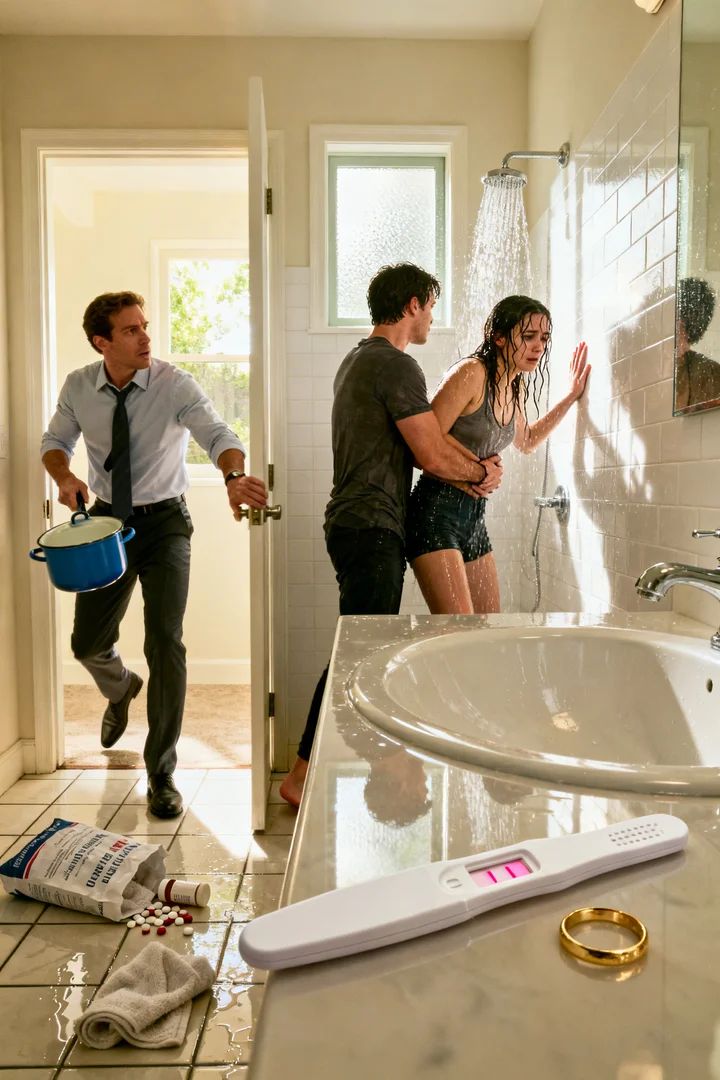
Caleb wasn’t having an affair with my wife. He was keeping her upright because she’d nearly collapsed in the shower.

Before I could even form an apology, Carla took the page from me, checked Nora’s pulse, and said, ‘We’re not standing here arguing. She needs a hospital now.’
Everything after that moved fast, but my shame kept pace with it.
Caleb wrapped Nora in a dry towel while Carla grabbed the spare blanket off our bed. I found myself kneeling on wet tile, trying to wipe up water with my hands because I didn’t know what else to do. Nora wouldn’t look at me.
‘Get the car,’ Carla snapped.
Caleb said, ‘No. She almost blacked out twice. I’m calling 911.’
He was right. I hated that he was right, but he was.
Nora sat on the closed toilet lid, pale and shivering, one hand clamped over her abdomen. The gold ring from the sink was still beside the faucet because her fingers had swollen so much she couldn’t wear it. The pregnancy test was from that morning. She had taken it after urgent care, alone, while I was building slides and telling myself I was being responsible.
The laughter I heard in the hallway hadn’t been flirting. Caleb had been telling the stupid story about the Thanksgiving turkey he dropped three years earlier because Nora kept drifting and he was trying to keep her awake.
That detail hurt almost as much as the rest. My brother had known the right thing to do in the moment. I had arrived full of suspicion.
When the paramedics came, Carla gave the report like she’d done it a hundred times. Fever since morning. Urgent care visit earlier. Positive home test. Heavy cramping. Bleeding. Near fainting in the shower. She handed them the discharge paper and pointed at the medication bottles lined up on the sink.
I stood there useless with my wet cuffs stuck to my wrists until one of the paramedics asked if I was the husband.
I said yes, and Nora finally looked at me.
There wasn’t rage in her face. That would’ve been easier. What I saw was disappointment. Deep, tired disappointment, like this moment had confirmed something she’d been afraid to say out loud.
I rode in the ambulance with her. Caleb followed in my car because Carla refused to let it stay in the loading zone. Even then she was carrying us.
Nora kept her eyes closed for most of the ride. Once, when the medic adjusted the blood pressure cuff, she reached for the rail and I touched her hand by reflex. She didn’t pull away, but she didn’t squeeze back either.
I said, ‘I’m sorry.’
Her answer was barely above a whisper. ‘You didn’t even ask why he was there.’
I had no defense for that. I just stared at the floor and listened to the siren punch holes through the afternoon.
At the hospital, they moved quickly because of the bleeding. Blood work. Ultrasound. More questions than I could process. A doctor with kind eyes and a clipped voice told us what the urgent care center had suspected. Nora had been pregnant, very early, and she was miscarrying.

I felt grief and guilt hit at the exact same time. I hadn’t known I was becoming a father, and I hadn’t been there when she found out we might lose it.
Caleb arrived with my wallet, Nora’s phone, and the prescription bag. He didn’t speak to me at first. He handed everything to Carla, who had somehow made it to the ER before the paperwork was finished. She bought Nora socks from the gift shop because the hospital floor was freezing. That’s the kind of person Carla is. Steady hands. Peppermint gum. No wasted words.
When the doctor left, the room got quiet in the worst way.
I asked Nora why she hadn’t told me she was pregnant.
She stared at the blanket over her knees for so long I thought she wouldn’t answer. Then she said, ‘Because I wanted one happy day first.’
That knocked the air out of me.
Two years earlier, before we moved to Tampa, Nora had a chemical pregnancy. It happened so early that most people wouldn’t have called it a loss. We did. We had picked names in whispers and then pretended not to. I threw myself back into work after that because work was clean and measurable. Nora carried it in her body. I carried it in a spreadsheet brain that wanted timelines and solutions.
She said she missed her period, bought a test before urgent care, and kept it in her purse unopened. She started spotting that morning and got scared. She told me about the fever and headache instead because it was easier. Less loaded. Less likely to crack her open before my presentation.
‘Why Caleb?’ I asked, and I hated how hurt I still sounded saying it.
That was when the real truth came out.
She said, ‘Because he lives downstairs, and because I knew he’d come the first time I called.’
I wanted to argue. I wanted to say of course I would’ve come. But memory got there before I did.
A month earlier, Nora had called me from a clinic parking lot because she’d gotten dizzy at work. I was in the middle of a client meeting and texted back, Can it wait an hour? It turned out to be dehydration. We laughed about it that night. Or I thought we did. Sitting in that hospital room, I understood it had stayed with her in a very different way.
She wasn’t punishing me by calling my brother.
She was choosing certainty.
Caleb finally spoke from the chair by the wall. ‘She didn’t even want me to tell you about urgent care. She said you had something important.’
I looked at him and saw how hard his own jaw was clenched. He was angry, but he was also scared for her. The scene in the bathroom replayed in my head again, only now every piece had changed shape. His arm at her waist. Her hand on the tile. The running water. The ring on the sink. None of it meant what I thought it meant, but it all meant something worse. It meant my wife had been in pain and had reached for someone else first.
There’s no clean way to sit with that.
The doctor came back and explained that Nora probably wouldn’t need surgery, but she would need monitoring, rest, and follow-up care. There was no fixing the outcome. There was only getting through the next few hours safely.

Caleb stood up and said he’d wait outside.
Before he left, he turned to me and said, ‘I almost hit you in that bathroom.’
I believed him.
I said, ‘You would’ve had a case.’
He nodded once and stepped into the hallway.
Carla stayed. She asked Nora if she wanted ice chips. She asked the nurse for an extra blanket. She made space without taking it over. At one point she touched my shoulder and said, very quietly, ‘Being sorry matters. Being different matters more.’
That sentence has lived in my head ever since.
Nora slept for a little while after the pain medication kicked in. I sat beside the bed and watched the monitor numbers jump and settle. The room smelled like antiseptic and warmed plastic. Every few minutes I looked at the chair where Caleb had been sitting and felt another layer of shame peel back.
When Nora woke up, I didn’t start with excuses. I didn’t bring up intent. I didn’t say I was stressed or worried or thrown off by what I saw.
I said, ‘I made that bathroom uglier than it already was.’
She looked at me for a long time and then nodded. ‘Yes,’ she said. ‘You did.’
It hurt. It was also true.
We talked more honestly in that room than we had in months. She told me she was tired of always being the one who absorbed the cost of my ambition. Not because I was cruel. I wasn’t. Because I was always one degree too late. One missed call. One delayed errand. One meeting that couldn’t possibly move until suddenly something in her learned not to ask.
I told her I thought providing meant showing love.
She said, ‘Sometimes it just means you’re gone with a good reason.’
Again, no defense.
That night Caleb drove home alone. Carla followed us back hours later because she said nobody should come home to a dark kitchen after a day like that. When we walked into the apartment, the blue enamel soup pot was still on the console table where I’d dropped it. Carla rinsed it, filled it with water, and set it on the stove before I even took my shoes off.
That pot hit me harder than the hospital bracelet on Nora’s wrist.
I’d brought it home thinking I was the caring husband, the man doing the right thing at lunch. I wanted credit for the gesture. Meanwhile, the real test had come later, in the bathroom, with wet tile under my shoes and fear in the room. I failed that test fast.

Caleb came up the next morning to bring Nora the charger she’d left in my car. He stayed near the doorway like he didn’t want to cross some invisible line.
I apologized before he could say anything.
I apologized for what I accused him of. I apologized for not asking one decent question before I went feral. I apologized for making him defend Nora from me when she was already half falling apart.
He listened, then shrugged once and said, ‘You were scared.’
‘I was,’ I said. ‘I was also wrong.’
That mattered to him more. I could see it.
He told me Nora had called him after she dropped a bottle of Tylenol in the bathroom and couldn’t bend down without cramping. By the time he got upstairs, she was trying to sit on the floor because she thought she might pass out. He turned on the shower because she said the steam helped the nausea. When I heard him laugh, he was in the middle of telling her the turkey story because she kept apologizing for bleeding on the bath mat.
That line gutted me. She had been apologizing while in pain, and I walked in ready to accuse.
For the next week, our apartment stayed quiet. Not hostile. Not healed either. Grief filled every room differently. Nora cried in short bursts and then went flat for hours. I cleaned because I didn’t know how else to love her. Caleb texted from downstairs instead of coming up unless she asked. Carla checked in with soup, blood pressure cuffs, and the kind of eye contact that makes lying impossible.
A few days later, Nora and I sat at the kitchen table after midnight. The dish rack was full. The AC kicked on and off. No hospital alarms. No running shower. Just us.
I asked her if calling Caleb first meant she had stopped trusting me entirely.
She said, ‘No. It meant I trusted him in an emergency more than I trusted your schedule.’
That sentence was brutal. It was also more useful than anything soft would have been.
We started counseling a month later. Not because of the miscarriage alone, and not because she thought I had one explosive jealousy problem. We started because the bathroom scene was built from smaller things that had piled up quietly. Work first. Assumptions second. Tenderness postponed until convenient.
I’m not proud of the man who opened that door.
But I am trying hard to be a different man than the one who walked out of that hospital.
Nora still keeps her ring on the sink sometimes when her hands ache. The first time I saw it there again, I froze. She noticed, slid it back on, and said, ‘You can ask me anything. Just ask.’
So I do.
Some losses don’t leave with the ambulance. They stay in the grout lines, in the silence after a missed call, in the distance between what we meant to be and what we proved under pressure. Ours did.
We are still married. Caleb still comes upstairs for football on Sundays. Carla still pretends she only has extra soup by accident. The grief has not turned neat, but it has turned honest.
And the next hard truth in our home won’t have to wait for someone to be bleeding on the bathroom floor.